Join WhatsApp Icon JEE WhatsApp Group

JEE Waves Questions

Waves is a high-weightage and conceptually demanding chapter in JEE Physics that describes how disturbances travel through media. It covers mechanical waves, sound, superposition, standing waves, and the Doppler effect topics that recur in JEE Main and feature prominently in JEE Advanced. Because waves blend equations with physical reasoning about interference and resonance, JEE Waves questions are an essential part of every aspirant's preparation. This chapter covers the wave equation, travelling and standing waves, superposition and interference, beats, vibrations in strings and air columns, and the Doppler effect for sound. JEE Main tests wave parameters, resonance, and Doppler problems, while JEE Advanced often combines these with deeper reasoning about phase and harmonics. Practising topic-wise JEE Questions help you handle standing-wave and Doppler problems with clarity and speed. A strong grasp of waves also supports wave optics, where the same superposition and interference principles reappear in the context of light.

Waves Topic Overview

Parameter

Details

Topic Name

Waves

Subject

Physics

JEE Main Weightage

~3–5% (1–2 questions on average)

JEE Advanced Weightage

~4–6% (often in combined problems)

Difficulty Level

Moderate to High

Important Concepts

Wave Equation, Standing Waves, Superposition, Beats, Resonance, Doppler Effect

Recommended Practice Level

High – attempt 60+ mixed problems

Why Practice JEE Waves Questions?

  • High weightage: Waves contributes 1–2 questions in JEE Main most years.
  • Foundation for wave optics: Superposition and interference carry directly into light.
  • Strong in Advanced: Standing-wave and Doppler problems appear in JEE Advanced.
  • Conceptual and numerical: Questions test both reasoning and calculation.
  • Resonance focus: String and air-column problems are frequently asked.
  • Builds phase intuition: Understanding phase difference sharpens problem-solving.
  • Rewards practice: Familiarity with question types greatly improves speed.

Important Concepts and Subtopics

Concept

Importance

Difficulty Level

Frequently Asked In

Wave Equation & Parameters

Very High

Moderate

JEE Main & Advanced

Superposition & Interference

Very High

Moderate–High

JEE Main & Advanced

Standing Waves in Strings

Very High

Moderate–High

JEE Main & Advanced

Standing Waves in Air Columns

High

Moderate

JEE Main & Advanced

Beats

High

Moderate

JEE Main

Doppler Effect (Sound)

Very High

Moderate–High

JEE Main & Advanced

Preparation Strategy for JEE Waves

Concept learning: Understand the wave equation and the meaning of amplitude, wavelength, frequency, and phase. Master superposition as the principle behind interference, beats, and standing waves.

Formula revision: Keep relations for wave speed, standing-wave harmonics in strings and pipes, beat frequency, and the Doppler effect handy. Organised JEE Study Material helps you keep these formulas and harmonic patterns in one place for quick revision.

Problem-solving techniques: For standing waves, identify open and closed boundaries to determine allowed harmonics. For Doppler problems, carefully assign signs to source and observer velocities based on direction.

Common mistakes: Sign errors in the Doppler formula, confusing harmonics in open versus closed pipes, mishandling phase difference in interference, and unit errors in wave speed.

Exam strategy: Solve direct wave-parameter and beat questions first, then attempt standing-wave and Doppler problems that require careful setup.

JEE Main & Advanced Weightage Analysis

Exam

Average Questions

Expected Marks

JEE Main

1–2

4–8

JEE Advanced

1–2

4–8

Waves is a steady contributor in JEE Main through resonance, beats, and Doppler questions. In JEE Advanced, it often appears in combined problems demanding careful phase and harmonic analysis.

Tips to Solve Waves Questions Faster

  • Identify boundary conditions (open or closed ends) to find allowed harmonics quickly.
  • For the Doppler effect, assign velocity signs based on approach or recession before substituting.
  • Use beat frequency as the difference between two close frequencies for quick answers.
  • Track phase difference carefully to determine constructive or destructive interference.
  • Remember that wave speed depends on the medium, not on frequency or amplitude.
  • Sketch the standing-wave pattern to count nodes and antinodes accurately.

Reinforcing these methods with a timed JEE Mock Test helps you handle standing-wave and Doppler questions efficiently under pressure.

JEE Waves Questions

Question 1

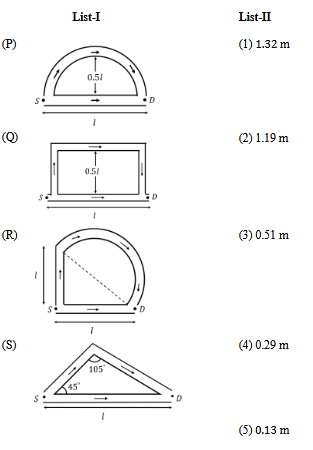
List-I shows four configurations made of straight and semi-circular narrow tubes containing air. A sound wave of wavelength $$\lambda=0.29\,\mathrm{m}$$ enters these structures at the point $$S$$ and a sound detector is placed at $$D$$. Between the points $$S$$ and $$D$$, the sound travels only through the tubes. List-II contains the possible smallest values of $$l$$ (refer to the figures) for which the detector $$D$$ records maximum amplitude. Ignore effects of sharp corners. [Given $$\cos(15^\circ)=0.97$$]

Choose the option that best describes the match between the entries in List-I to those in List-II.

image
Question 2

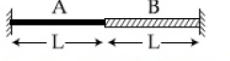
Two strings (A, B) having linear densities $$\mu_{A}=2\times10^{-4}kg/m\text{ and },\mu_{B}=4\times10^{-4}kg/m$$ and lengths $$L_{A}=2.5m$$ and $$L_{B}=1.5m$$ respectively are joined. Free ends of A and B are tied to two rigid supports C and D, respectively creating a tension of 500 N in the wire. Two identical pulses, sent from C and D ends, take time $$t_{1}\text{ and } t_{2}$$, respectively, to reach the joint. The ratio $$t_{1}/ t_{2}$$ is :

Question 3

In an open organ pipe $$v_{3}$$ and $$v_{6}$$ are $$3^{rd}$$ and $$6^{th}$$ harmonic frequencies, respectively. If $$v_{6} - v_{3}$$ = 2200 Hz then length of the pipe is ____ mm .
(Take velocity of sound in air is 330 m/s.)

Video Solution
Question 4

The speed of a longitudinal wave in a metallic bar is 400 m/s. If the density and Young's modulus of the bar material are increased by 0.5% and 1 %, respectively then the speed of the wave is changed approximately to m/ s.

Video Solution
Question 5

A point source is kept at the center of a spherically enclosed detector. If the volume of the detector increased by 8 times, the intensity will

Video Solution
Question 6

The fifth harmonic of a closed organ pipe is found to be in unison with the first harmonic of an open pipe. The ratio of lengths of closed pipe to that of the open pipe is 5/x. The value of x is ______.

Question 7

Two tuning forks A and Bare sounded together giving rise to 8 beats in 2 s. When fork A is loaded with wax, the beat frequency is reduced to 4 beats in 2 s. If the original frequency of tuning fork B is 380 Hz then original frequency of tuning fork A is ____ Hz.

Question 8

The velocity of sound in air is doubled when the temperature is raised from $$O^{o}$$C to $$\alpha ^{o}$$ C. The value of $$\alpha$$ is _______.

Question 9

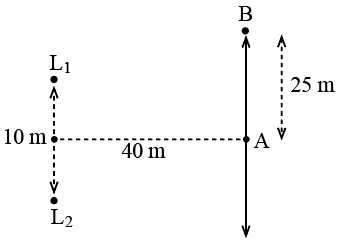
Two loudspeakers $$(L_{1} and L_{2})$$ are placed with a separation of 10 m , as shown in figure. Both speakers are fed with an audio input signal of same frequency with constant volume. A voice recorder, initially at point $$A$$ , at equidistance to both loud speakers, is moved by 25 m along the line $$AB$$ while monitoring the audio signal. The measured signal was found to undergo 10 cycles of minima and maxima during the movement. The frequency of the input signal is ________Hz
(Speed of sound in air is 324 m/s and $$ \sqrt{5}=2.23 $$)

Screenshot_44

Frequently Asked Questions