The largest $$n\epsilon N$$, for which $$7^{n}$$ divides 101!, is :
JEE Permutations & Combinations Questions
To calculate the largest power of 7 which divides 101!, we find the largest integer by dividing 101 by the increasing the power of the prime number (7) by one in subsequent step till we get 0. Then we will add all the largest integers to get the largest power of 7.
Largest power of 7 which divides 101! = $$\left[\dfrac{101}{7}\right]+\left[\dfrac{101}{7^2}\right]+\left[\dfrac{101}{7^3}\right]+\dots+\infty$$
$$\left[\dfrac{101}{7}\right]=14$$ as the largest integer which satisfies it is 14 (greatest integer function).
$$\left[\dfrac{101}{7^2}\right]=\left[\ \dfrac{101}{49}\right]=2$$
$$\left[\dfrac{101}{7^3}\right]=\left[\ \dfrac{101}{343}\right]=0$$
Now, the value of all the greatest integer funtion following this will be 0.
So, the largest power of 7 which divides 101! is $$(14+2+0)=16$$.
$$\therefore\ $$ The required answer is D.
Let $$A = \{(a, b, c) : a, b, c \text{ are non-negative integers and } a + b + 2c = 22\}$$. Then $$n(A)$$ is equal to :
We need to find the number of ordered triples $$(a,b,c)$$ of non-negative integers that satisfy $$a+b+2c = 22$$.
Step 1: Fix $$c$$ and count $$(a,b)$$.
Because $$2c \le 22$$, the integer $$c$$ can take every value from $$0$$ to $$11$$ inclusive.
For a fixed $$c$$, rewrite the equation as $$a+b = 22-2c.$$ Let $$S = 22-2c$$. Here $$S$$ is a non-negative integer.
Step 2: Count non-negative solutions of $$a+b=S$$.
For any non-negative integer $$S$$, the number of ordered pairs $$(a,b)$$ with $$a+b=S$$ is $$S+1$$ (by the “stars and bars” formula or by listing $$a=0,1,\dots,S$$).
Step 3: Sum over all possible values of $$c$$.
Hence the required count is $$n(A)=\sum_{c=0}^{11}\bigl[(22-2c)+1\bigr] =\sum_{c=0}^{11}(23-2c).$$
Step 4: Evaluate the arithmetic series.
The series $$23-2c$$ is an arithmetic progression with first term $$23$$ and last term $$23-2\cdot11=1$$. There are $$11-0+1 = 12$$ terms.
Sum of an AP = $$\dfrac{\text{number of terms}}{2}\times(\text{first term}+\text{last term})$$, so $$n(A)=\dfrac{12}{2}\times(23+1)=6\times24=144.$$
Step 5: State the answer.
Therefore, $$n(A)=144$$.
Option C which is: $$144$$
The largest value of n, for which $$40^{n}$$ divides 60! , is
The value $$40$$ upon factorisation gives, $$40\ =\ 2^3\times\ 5$$
So, we need to find the highest powers of $$2$$ and $$5$$ in $$60!$$ to find the highest power of $$40$$ in $$60!$$
The highest power of $$2$$ in $$60!$$ $$=\left[\dfrac{60}{2}\right]+\left[\dfrac{60}{2^2}\right]+\left[\dfrac{60}{2^3}\right]+...\ =\ 30+15+7+3+1=56$$
The highest power of $$5$$ in $$60!$$ $$=\left[\dfrac{60}{5}\right]+\left[\dfrac{60}{5^2}\right]+\left[\dfrac{60}{5^3}\right]+...\ =\ 12+2=14$$
We calculated the highest power of $$2$$ in $$60!$$ to be $$56$$, and the highest power of $$2^3$$ in $$60!$$ is $$\left[\dfrac{56}{3}\right]\ =\ 18$$
The highest power of $$40$$ is the minimum value among the highest power of $$5$$ and the highest power of $$2^3$$ in $$60!$$, which is $$\min(14,18)=14$$
So, the highest power $$40$$ in $$60!$$ is $$14$$.
Hence, the correct answer is option C.
The number of 4-letter words, with or without meaning, which can be formed using the letters PQRPQRSTUVP, is ___ .
The word given is PQRPQRSTUVP. Here, we have P 3 times, Q 2 times, R 3 times, and S,T,U,V one time each
Total distinct letters: 7
We form 4-letter words using these.
Case 1: All letters are distinct
Here, 4 distinct letters can be chosen from 7 letters in $$ {}^7C_4 = 7 \cdot 6 \cdot 5 \cdot 4 = 840 \text { ways} $$
Case 2: One pair + two distinct
To choose a pair, we need to pick one from the letters that occur 2 times or more in the word. Of the letters P,Q and R occure more than once, so the letter that will form the pair can be picked in 3 ways. For the remaining 2 distinct letters, they can be picked from the remaining 6 letters in $$ \binom{6}{2} = 15 $$ ways. These can be arranged amongst themselves in $$ \frac{4!}{2!} = 12$$ ways
Total number of ways words can be formed is= $$ 3 \cdot 15 \cdot 12 = 540 \text { ways} $$
Case 3: Two pairs
Here, we need to choose 2 letters (each must occur ≥2 times): from (P,Q,R), which can be done in 3 ways. The letters can be arranged amongst themselves in $$ \dfrac{4!}{2!2!} = 6 $$ ways
Total number of ways words can be formed is $$ 3 \cdot 6 = 18 \text{ ways} $$
Case 4: Three same + one different
Only P occurs three times, so here it can be picked in 1 way, and the 1 different letter from the remaining 6 can be picked in 6 ways. The letters can be arranged amongst themselves in $$ \dfrac{4!}{3!} = 4 $$
Total number of ways words can be formed is $$ 1 \cdot 6 \cdot 4 = 24 \text{ ways}$$
Hence, the total number of ways words can be formed considering all the cases is $$ 840 + 540 + 18 + 24 =1422 \text { ways} $$
Three persons enter in a lift at the ground floor. The lift will go upto $$10^{th}$$ floor. The number of ways, in which the three persons can exit the lift at three different floors, if the lift does not stop at first, second and third floors, is equal to________
Three persons exit a lift at three different floors. The lift does not stop at floors 1, 2, or 3. Find the number of ways.
The lift goes from ground floor to 10th floor. It does not stop at 1st, 2nd, and 3rd floors. So the available exit floors are: 4, 5, 6, 7, 8, 9, 10 — a total of 7 floors.
The three persons must exit at three different floors chosen from these 7. The first person can choose any of 7 floors, the second can choose any of the remaining 6, and the third can choose any of the remaining 5:
$$\text{Number of ways} = P(7, 3) = 7 \times 6 \times 5 = 210$$
Alternatively, this is $$\frac{7!}{(7-3)!} = \frac{7!}{4!} = \frac{5040}{24} = 210$$.
The correct answer is 210.
Two players $$A$$ and $$B$$ play a series of badminton games. The first player, who wins 5 games first, wins the series. Assuming that no game ends in a draw, the number of ways in which player $$A$$ wins the series is :_____.
To find the number of ways player $$A$$ can win the series, we need to consider all the different scenarios based on the total number of games played.
Since the first player to win 5 games wins the series, the series can last anywhere from 5 games to a maximum of 9 games (because if they played 10 games, one player would have already reached 5 wins).
Crucial Rule
For player $$A$$ to win in exactly $$n$$ games, player $$A$$ must win the very last game (the $$n^{th}$$ game). This means in the preceding $$n-1$$ games, player $$A$$ must have won exactly 4 games.
Step-by-Step Calculation
We sum the number of ways for $$A$$ to win for each possible series length:
Total Games (n) |
Wins for A in first n−1 games |
Calculation: (4n−1) |
Number of Ways |
5 Games |
4 wins in 4 games |
$$\binom{4}{4}$$ |
1 |
6 Games |
4 wins in 5 games |
$$\binom{5}{4}$$ |
5 |
7 Games |
4 wins in 6 games |
$$\binom{6}{4}$$ |
15 |
8 Games |
4 wins in 7 games |
$$\binom{7}{4}$$ |
35 |
9 Games |
4 wins in 8 games |
$$\binom{8}{4}$$ |
70 |
Total Number of Ways
Now, we add these individual scenarios together:
$$\text{Total} = 1 + 5 + 15 + 35 + 70$$
$$\text{Total} = 126$$
The number of ways in which player $$A$$ wins the series is 126.
Let $$ABC$$ be a triangle. Consider four points $$p_{1},p_{2},p_{3},p_{4}$$ on the side AB, five points $$p_{5},p_{6},p_{7},p_{8},p_{9}$$ on the side $$BC$$, and four points $$p_{10},p_{11},p_{12},p_{13}$$ on the side $$AC$$. None of these points is a vertex of the trinagle $$ABC$$. Then the total number of pentagons, that can be formed by taking all the vertices from the points $$p_{1},p_{2},... ,p_{13}$$, is_______
Total number of ways to choose any five points from the thirteen given points is $$\binom{13}{5}=1287\quad-(1)$$
These points lie on the three sides of triangle $$ABC$$: - Side $$AB$$ has 4 points, - Side $$BC$$ has 5 points, - Side $$AC$$ has 4 points. A pentagon cannot have three collinear vertices, so we must exclude all choices that pick three or more points from any one side.
Let $$A$$ = selections with at least 3 points on $$AB$$, $$B$$ = selections with at least 3 points on $$BC$$, $$C$$ = selections with at least 3 points on $$AC$$. We will use inclusion-exclusion to count the invalid selections.
Compute $$|A|$$: choose $$k$$ points from the 4 on $$AB$$ and the remaining $$5-k$$ from the other 9 points. $$|A|=\sum_{k=3}^{4}\binom{4}{k}\binom{9}{5-k} =\binom{4}{3}\binom{9}{2}+\binom{4}{4}\binom{9}{1} =4\times36+1\times9 =144+9=153\quad-(2)$$
Compute $$|B|$$ similarly, choosing $$\ell$$ points from the 5 on $$BC$$ and $$5-\ell$$ from the other 8 points: $$|B|=\sum_{\ell=3}^{5}\binom{5}{\ell}\binom{8}{5-\ell} =\binom{5}{3}\binom{8}{2}+\binom{5}{4}\binom{8}{1}+\binom{5}{5}\binom{8}{0} =10\times28+5\times8+1\times1 =280+40+1=321\quad-(3)$$
Compute $$|C|$$ the same way as $$|A|$$ (since $$AC$$ also has 4 points): $$|C|=\sum_{m=3}^{4}\binom{4}{m}\binom{9}{5-m} =\binom{4}{3}\binom{9}{2}+\binom{4}{4}\binom{9}{1} =144+9=153\quad-(4)$$
For any two of these events (say $$A$$ and $$B$$), requiring at least 3 points from $$AB$$ and at least 3 from $$BC$$ would select at least 6 points, which exceeds 5. Hence all intersections $$A\cap B$$, $$B\cap C$$, $$C\cap A$$ and the triple intersection are empty. By inclusion-exclusion, the total number of invalid selections is $$|A\cup B\cup C|=|A|+|B|+|C|=153+321+153=627\quad-(5)$$
Therefore, the number of valid pentagons is $$1287-627=660\quad-(6)$$
Answer: 660
Let S= {(m, n) :m, n $$\epsilon$$ {1, 2, 3, .... , 50}}. lf the number of elements (m, n) in S such that $$6^m+9^n$$ is a multiple of 5 is p and the number of elements (m, n) in S such that m + n is a square of a prime number is q, then p +q is equal to ________.
$$p$$ is the number of elements $$(m\ ,\ n)$$ such that $$6^m+9^n$$ is a multiple of 5.
$$6^m+9^n=0$$ (mod 5)
6 = 1 (mod 5)
$$6^m=1^m=1$$ (mod 5)
9 = 4 (mod 5)
$$9^n=4^n$$ (mod 5)
$$1+4^n=0$$ (mod 5)
Now, $$4^1=4$$ (mod 5)
$$4^2=1$$ (mod 5)
$$4^3=4$$ (mod 5)
$$4^4=1$$ (mod 5)
Now, we will get a remainder of 1 if we divide 1 by 5 (for any value of $$m$$) and a remainder of either 1 or 4 from $$4^n$$ if $$n$$ is even or odd, respectively.
It is given that $$6^m+9^n$$ is a multiple of 5.
It means that the remainder that we get from $$6^m+9^n$$ must be a multiple of 5.
So, we need the remainder of 4 from $$4^n$$.
Hence, $$n$$ will be odd.
$$m$$ can take any value from 1 to 50 and $$n$$ can only take odd numbers.
So, the number of elements of $$(m\ ,\ n)$$ for which $$6^m+9^n$$ must be a multiple of 5 is $$\left(50\times25\right)=1250$$
$$p$$ = 1250
Now, $$q$$ is the number of elements $$(m\ ,\ n)$$ such that $$(m+n)$$ is a square of a prime number.
$$1\le\left(m\ ,\ n\right)\le50$$
$$2\le\left(m\ +\ n\right)\le100$$
Square of prime numbers which is less than 100 = $$2^2,\ 3^2,\ 5^2,\ 7^2$$
So, $$(m+n)$$ = 4, 9, 25 and 49
For $$1\le\left(m\ ,\ n\right)\le50$$, if $$(m+n)\le51$$, there will be a total of $$(m+n-1)$$ elements.
For $$(m+n)$$ = 4, $$(m\ ,\ n)$$ = (1,3) , (2,2) , (3,1) i.e. 3 combinations.
For $$(m+n)$$ = 9, $$(m\ ,\ n)$$ will have 8 combinations.
For $$(m+n)$$ = 25, $$(m\ ,\ n)$$ will have 24 combinations.
For $$(m+n)$$ = 49, $$(m\ ,\ n)$$ will have 48 combinations.
Total combinations of $$(m+n)$$ = $$(3+8+24+48)$$ = 83
$$q$$ = 83
So, $$(p+q)$$ = $$1250+83$$ = 1333
Hence, the sum of the values of $$p$$ and $$q$$ is 1333.
The number of numbers greater than 5000, less than 9000 and divisible by 3, that can be formed using the digits 0, 1, 2, 5, 9, if the repetition of the digits is allowed, is______.
The digits given are $${0,1,2,5,9} $$.
We need to make 4-digit numbers that are $$>5000$$ and $$<9000$$, and are divisible by 3.
Thus, the number is of the form $$5abc$$. The first numbe rhas to be 5 otherwise the numbers formed will not be in the given range.
For divisibility by 3 $$ 5+a+b+c \equiv 0 \pmod{3} $$ , essentially sum of the digits should be either 0 or a multiple of 3.
We form the following cases:
Case 1: All digits different
Possible set of selection: $$ (5,0,1,9), \quad \text{sum } = 15 \equiv 0 $$
The place of 5 is fixed, the remaining three digits can be arranged in $$ 3! = 6 $$
Hence, 6 possible numbers can be obtained.
Case 2: Two alike, two different
If 5 is the number that is repeated, then the possible selections are: $$ (5,5,0,2),\ (5,5,2,9) $$
Since the 5 at the first place is fixed, in each of these, the numbers can be arranged in $$ 3! = 6 \text{ ways} $$
Otherwise, if 5 is not the number repeated then the valid selections are $$(5$$, $$0$$, $$0$$, $$1)$$, $$\ (5$$, $$1$$, $$1$$, $$2)$$, $$\ (5$$, $$2$$, $$2$$, $$0)$$, $$\ (5$$, $$2$$, $$2$$, $$9)$$, $$\ (5$$, $$1$$, $$9$$, $$9)$$
In these cases, the digits can be arranged in $$ \frac{3!}{2!} = 3 \text{ ways} $$
So, the total number of numbers obtained in this case is $$ 5 \cdot 3 + 2 \cdot 6 = 15 + 12 = 27 $$
Case 3: Three alike, one different
If 5 is the digit that is repeated 3 times, the valid selections are: $$ (5,5,5,0),\ (5,5,5,9) $$
The digits can be arranged in $$ \frac{3!}{2!} = 3 \text{ ways} $$
If any other digit other than 5 is repeated 3 times, then we can have numbers 5000, 5222 and 5999 none of which are divisible by 3. hence they are not valid choices.
So, the total number of numbers obtained in this case is $$3+3=6 \text{ ways}$$
Case 4: Two pairs
The only valid arrangement here is $$ (5,5,1,1) $$ , and the digits can be arranged in $$ \frac{3!}{2!} = 3 $$. So the total number of numbers obtained is 3.
Hence, the total number of such numbers is $$ 6 + 27 + 6 + 3 = 42 $$
Bag A contains 9 white and 8 black balls, while bag B contains 6 white and 4 black balls. One ball is randomly picked up from the bag B and mixed up with the balls in the bag A. Then a ball is randomly drawn from the bag A. If the probability, that the ball drawn is white, is $$\dfrac{p}{q},gcd(p,q)=1,$$ then $$p+q$$ is equal to
Bag A contains 9 white and 8 black balls and Bag B contains 6 white and 4 black balls.
It is given that one ball is picked from Bag B and mixed with the balls in Bag A. Then one ball is picked from Bag A and we have to find the probability that the ball picked is white.
Two cases will be formed.
Case 1: White ball is picked from Bag B and mixed with the other balls in Bag A.
Probability of picking a white ball from Bag B = $$\dfrac{6}{10}$$
Now, it is mixed with the balls in Bag A.
Bag A: 10 white and 8 black balls.
Probability of picking a white ball from Bag A = $$\dfrac{10}{18}$$
Probability of picking a white ball from Bag A given that a white ball is picked from Bag B = $$\dfrac{6}{10}\times\dfrac{10}{18}=\dfrac{1}{3}$$
Case 2: Black ball is picked from Bag B and mixed with the other balls in Bag A.
Probability of picking a black ball from Bag B = $$\dfrac{4}{10}$$
Now, it is mixed with the balls in Bag A.
Bag A: 9 white and 9 black balls.
Probability of picking a white ball from Bag A = $$\dfrac{9}{18}$$
Probability of picking a white ball from Bag A given that a black ball is picked from Bag B = $$\dfrac{4}{10}\times\dfrac{9}{18}=\dfrac{1}{5}$$
So, the probability of picking a white ball from Bag A after picking a ball from Bag B = $$\dfrac{1}{3}+\dfrac{1}{5}=\dfrac{8}{15}$$
It is in the form of $$\dfrac{p}{q}$$ where the greatest common divisor of $$(p\ ,\ q)=1$$
So, $$\dfrac{p}{q}=\dfrac{8}{15}$$
$$p+q=8+15=23$$
Hence, the sum of $$p$$ and $$q$$ is 23.
$$\therefore\ $$ The required answer is A.
A bag contains 1O balls out of which k are red and (10 - k) are black, where $$0\leq k\leq 10$$. If three balls are drawn at random without replacement and all of them are found to be black, then the probability that the bag contains 1 red and 9 black balls is:
Concept
Given
Approach
Solution
Step 2: Given k, number of black balls is $$(10-k)$$. Probability of drawing 3 black without replacement is
$$P(3\,black\mid k)=\frac{\displaystyle{\binom{10-k}{3}}}{\displaystyle{\binom{10}{3}}}.$$
Step 3: Compute numerator for k=1:
$$P(k=1,3\,black)=P(k=1)\times P(3\,black\mid k=1)=\frac{1}{11}\times\frac{\binom{9}{3}}{\binom{10}{3}}=\frac{1}{11}\times\frac{84}{120}=\frac{84}{1320}=\frac{7}{110}.$$
Step 4: Compute total probability of drawing 3 black:
$$P(3\,black)=\sum_{k=0}^{10}P(k)P(3\,black\mid k)=\frac{1}{11}\sum_{k=0}^{10}\frac{\binom{10-k}{3}}{\binom{10}{3}}. $$
Let $$i=10-k$$, then $$i$$ goes from 0 to 10. So
$$\sum_{k=0}^{10}\binom{10-k}{3}=\sum_{i=0}^{10}\binom{i}{3}=\binom{11}{4}=330.$$
Thus
$$P(3\,black)=\frac{1}{11}\times\frac{330}{120}=\frac{330}{1320}=\frac{1}{4}.$$
Step 5: Apply Bayes theorem:
$$P(k=1\mid3\,black)=\frac{P(k=1,3\,black)}{P(3\,black)}=\frac{7/110}{1/4}=\frac{7}{110}\times4=\frac{28}{110}=\frac{14}{55}.$$
Shortcut
Common Mistakes
- Miscomputing the sum of combinations in the denominator
Answer
The number of seven-digit numbers, that can be formed by using the digits 1, 2, 3, 5 and 7 such that each digit is used at least once, is :
We need to form seven-digit numbers using the digits 1, 2, 3, 5, and 7, with each digit used at least once. Since we have 5 distinct digits and 7 positions, exactly 2 extra positions need to be filled. This leads to two cases.
Case 1: One digit appears 3 times and the remaining four digits appear once each.
We choose which digit repeats 3 times: $${}^{5}C_{1} = 5$$ ways. The number of arrangements of 7 digits where one appears 3 times is $$\frac{7!}{3!} = 840$$.
Total for Case 1: $$5 \times 840 = 4200$$.
Case 2: Two digits each appear 2 times and the remaining three digits appear once each.
We choose which 2 digits repeat: $${}^{5}C_{2} = 10$$ ways. The number of arrangements is $$\frac{7!}{2! \times 2!} = 1260$$.
Total for Case 2: $$10 \times 1260 = 12600$$.
The total number of seven-digit numbers is $$4200 + 12600 = 16800$$.
Hence, the correct answer is Option 3.
The number of ways, in which 16 oranges can be distributed to four children such that each child gets at least one orange , is
Firstly, we can give one orange to each child. There are four children. So, the remaining oranges now are 16 - 4 = 12.
Now we distribute 12 oranges among 4 children with no restriction.
We can directly apply the formula here, i.e. n things can be distributed among r candidates in $$^{n+r-1}C_{r-1}$$ ways.
Here, n = 12 and r = 4
Applying the formula, we get: $$^{12+4-1}C_{4-1}=^{15}C_3=\frac{15\times14\times13}{3\times2\times1}$$ = 455
A building has ground floor and 10 more floors. Nine persons enter a lift at the ground floor. The lift goes up to the 10th floor. The number of ways, in which any 4 persons exit at a floor and the remaining 5 persons exit at a different floor, if the lift does not stop at the first and the second floors, is equal to :
Let $$p_n$$ denote the total number of triangles formed by joining the vertices of an $$n$$-side regular polygon. If $$p_{n+1} - p_n = 66$$, then the sum of all distinct prime divisors of $$n$$ is :
For a convex regular polygon, any choice of three distinct vertices forms a triangle. Hence, the total number of triangles that can be drawn is simply the combination
$$p_n = \binom{n}{3} = \frac{n(n-1)(n-2)}{6}$$
The condition given in the question is
$$p_{n+1} - p_n = 66$$
Compute each term:
$$p_{n+1}= \binom{n+1}{3}= \frac{(n+1)n(n-1)}{6}$$
$$p_n = \binom{n}{3}= \frac{n(n-1)(n-2)}{6}$$
Subtracting, we get
$$p_{n+1}-p_n = \frac{(n+1)n(n-1) - n(n-1)(n-2)}{6}$$
Factor out the common term $$n(n-1)$$:
$$p_{n+1}-p_n = \frac{n(n-1)\big[(n+1)-(n-2)\big]}{6} = \frac{n(n-1)\times 3}{6} = \frac{n(n-1)}{2}$$
Set this equal to the given value 66:
$$\frac{n(n-1)}{2}=66 \quad\Longrightarrow\quad n(n-1)=132$$
This is a quadratic equation:
$$n^2-n-132=0$$
Factoring (or using the quadratic formula) gives
$$(n-12)(n+11)=0\quad\Longrightarrow\quad n=12\;(\text{positive solution})$$
The distinct prime factors of $$12$$ are $$2$$ and $$3$$. Their sum is
$$2+3 = 5$$
Therefore, the required sum is $$5$$.
Option C which is: 5
Let S = {1, 2, 3, 4, 5, 6, 7, 8, 9}. Let x be the number of 9-digit numbers formed using the digits of the set S such that only one digit is repeated and it is repeated exactly twice. Let y be the number of 9-digit numbers formed using the digits of the set S such that only two digits are repeated and each of these is repeated exactly twice. Then,
Calculating x:
In this case, we have to form a 9-digit number where only one digit is repeated, and it is repeated exactly twice.
Selecting the repeated digit: $$^9C_1=9$$ ways
Now, one digit is used twice, we need 9 - 2 = 7 more distinct digits from the remaining 8 digits in S. This can be selected in $$^8C_7=8$$ ways.
Now, all these 9 digits can be arranged in $$\dfrac{9!}{2!}$$ ways.
Total possible arrangements: $$9\times8\times\dfrac{9!}{2!}=36\times9!$$ which is equal to x.
Calculating x:
In this case, we have to form a 9-digit number where two digits are repeated, and each is repeated exactly twice.
Selecting the repeated digits: $$^9C_2=36$$ ways
Now, two digits is used twice, we need 9 - 4 = 5 more distinct digits from the remaining 7 digits in S. This can be selected in $$^7C_5=21$$ ways.
Now, all these 9 digits can be arranged in $$\dfrac{9!}{2!2!}$$ ways.
Total possible arrangements: $$36\times21\times\dfrac{9!}{2!2!}=9\times21\times9!=189\times9!$$ which is equal to y.
To find the relationship, we can divide y by x.
$$\dfrac{y}{x}=\dfrac{189\times9!}{36\times9!}$$
$$\dfrac{y}{x}=\dfrac{21}{4}$$
Or, we can say, 4y = 21x
The number of 4-letter words, with or without meaning, each consisting of two vowels and two consonants that can be formed from the letters of the word INCONSEQUENTIAL, without repeating any letter, is:
The number of ways, of forming a queue of 4 boys and 3 girls such that all the girls are not together, is :
Total number of persons = 4 boys + 3 girls = 7.
Step 1 : Total possible queues without any restriction
Arranging 7 distinct persons in a line gives $$7! = 5040$$ ways.
Step 2 : Arrangements where all three girls stand together
Treat the 3 girls as one single block G.
Then we have: G (one block) + 4 individual boys ⇒ total units = 5.
These 5 units can be permuted in $$5!$$ ways.
Within the girls’ block, the 3 girls can be ordered among themselves in $$3!$$ ways.
Hence, arrangements with all girls together = $$5! \times 3! = 120 \times 6 = 720$$.
Step 3 : Required arrangements (girls not all together)
Required count = (all possible arrangements) − (arrangements with girls together)
$$\Rightarrow 7! - 5!\,3! = 5040 - 720 = 4320.$$
Hence, the number of ways to form the queue so that the three girls are not all together is $$4320$$.
Option D which is: $$4320$$
A box contains 5 blue, 6 yellow, and 4 red balls. The number of ways, of drawing 8 balls containing atleast two balls of each colour, is :
Let $$b,y,r$$ denote the numbers of blue, yellow and red balls drawn, respectively.
Required conditions:
• $$b+y+r = 8$$ (total balls drawn)
• $$b \ge 2,\; y \ge 2,\; r \ge 2$$ (at least two of each colour)
• Availability limits: $$b \le 5,\; y \le 6,\; r \le 4$$
We first list all integral triples $$(b,y,r)$$ satisfying these inequalities.
Case 1: $$b = 2 \;\Rightarrow\; y+r = 6$$ Possible pairs $$\Rightarrow (y,r) = (2,4),(3,3),(4,2)$$ — three triples.Thus $$\;(2,2,4),(2,3,3),(2,4,2)$$. Case 2: $$b = 3 \;\Rightarrow\; y+r = 5$$ Possible pairs $$\Rightarrow (y,r) = (2,3),(3,2)$$ — two triples.
Thus $$\;(3,2,3),(3,3,2)$$. Case 3: $$b = 4 \;\Rightarrow\; y+r = 4$$ Only pair satisfying $$y,r \ge 2$$ is $$(2,2)$$.
Thus $$\;(4,2,2)$$.
No solution exists for $$b = 5$$ because it would give $$y+r = 3 \lt 4$$, contradicting $$y,r \ge 2$$.
Hence the feasible colour distributions are:
$$(2,2,4),\;(2,3,3),\;(2,4,2),\;(3,2,3),\;(3,3,2),\;(4,2,2).$$
For each triple, the balls of a given colour are distinct, so the number of selections is the product of binomial coefficients:
$$ \begin{aligned} (2,2,4):\;&\binom{5}{2}\binom{6}{2}\binom{4}{4} &= 10 \times 15 \times 1 &= 150\\ (2,3,3):\;&\binom{5}{2}\binom{6}{3}\binom{4}{3} &= 10 \times 20 \times 4 &= 800\\ (2,4,2):\;&\binom{5}{2}\binom{6}{4}\binom{4}{2} &= 10 \times 15 \times 6 &= 900\\ (3,2,3):\;&\binom{5}{3}\binom{6}{2}\binom{4}{3} &= 10 \times 15 \times 4 &= 600\\ (3,3,2):\;&\binom{5}{3}\binom{6}{3}\binom{4}{2} &= 10 \times 20 \times 6 &= 1200\\ (4,2,2):\;&\binom{5}{4}\binom{6}{2}\binom{4}{2} &= 5 \times 15 \times 6 &= 450 \end{aligned} $$
Adding all these cases:
$$150 + 800 + 900 + 600 + 1200 + 450 = 4100.$$
Therefore, the number of ways to draw the 8 balls is $$4100$$.
Option A which is: $$4100$$
A person has three different bags and four different books. The number of ways, in which he can put these books in the bags so that no bag is empty, is :
The letters of the word "UDAYPUR" are written in all possible ways with or without meaning and these words are arranged as in a dictionary. The rank of the word "UDAYPUR" is
When the letters of the word "UDAYPUR" are arranged in alphabetical order, we get A, D, P, R, U, U, Y.
We need to find the rank of the word "UDAYPUR" out of all the words formed by arranging the above letters.
Number of words formed with first letter as A$$=\dfrac{6!}{2!}$$ (because all the 6 letters can be arranged in 6! ways and there are 2 U's, so dividing by 2!)
Number of words formed with first letter as D$$=\dfrac{6!}{2!}$$ (because all the 6 letters can be arranged in 6! ways and there are 2 U's, so dividing by 2!)
Number of words formed with first letter as P$$=\dfrac{6!}{2!}$$ (because all the 6 letters can be arranged in 6! ways and there are 2 U's, so dividing by 2!)
Number of words formed with first two letters as UA $$=5!$$ (because all the 5 letters left can be arranged in 5! ways)
Number of words formed with first four letters as UDAP $$=3!$$ (because all the 3 letters left can be arranged in 3! ways)
Number of words formed with first four letters as UDAR $$=3!$$ (because all the 3 letters left can be arranged in 3! ways)
Number of words formed with first four letters as UDAU $$=3!$$ (because all the 3 letters left can be arranged in 3! ways)
Number of words formed with the first six letters as UDAYPR $$=1$$ (which is UDAYPRU)
All the above words precede the word "UDAYPUR" when arranged in a dictionary, and to get the rank, we need to add all the above values and 1 to it, since it is the next word.
The next word formed is "UDAYPUR", and the rank of it can be calculated as,
Rank $$=\dfrac{6!}{2!}+\dfrac{6!}{2!}+\dfrac{6!}{2!}+\dfrac{6!}{2!}+5!+3!+3!+3!+1+1=360\times\ 4+120+6\times\ 3+2=1580$$
So, the rank of the word is 1580.
Hence, the correct answer is option A.
Group A consists of 7 boys and 3 girls, while group B consists of 6 boys and 5 girls. The number of ways, 4 boys and 4 girls can be invited for a picnic if 5 of them must be from group A and the remaining 3 from group B, is equal to :
We need to form a group of 8 people (4 boys, 4 girls) such that 5 are from Group A (7B, 3G) and 3 are from Group B (6B, 5G).
First, we will distribute boys and girls from Group A.
Let Boys from A = x and Girls from A = y
Then, x + y = 5
Now, from Group B:
Boys = 4 - x
Girls = 4 - y
Now, the possible cases are:
Case 1: x = 4, y = 1
From A: $$^7C_4\times^3C_1=35\times3=105$$
From B: $$^6C_0\times^5C_3=1\times10=10$$
Total = 105*10 = 1050
Case 2: x = 3, y = 2
From A: $$^7C_3\times^3C_2=35\times3=105$$
From B: $$^6C_1\times^5C_2=6\times10=60$$
Total = 105*60 = 6300
Case 3: x = 2, y = 3
From A: $$^7C_2\times^3C_3=21\times1=21$$
From B: $$^6C_2\times^5C_1=15\times5=75$$
Total = 21*75 = 1575
Sum = 1050 + 6300 + 1575 = 8925
The largest $$n \in \mathbb{N}$$ such that $$3^n$$ divides 50! is:
To find the highest power of a prime $$p$$ that divides $$m!$$, we use Legendre’s formula:
$$\nu_p(m!) = \left\lfloor\frac{m}{p}\right\rfloor + \left\lfloor\frac{m}{p^2}\right\rfloor + \left\lfloor\frac{m}{p^3}\right\rfloor + \cdots$$
where $$\nu_p(m!)$$ denotes the exponent of $$p$$ in the prime-factorisation of $$m!$$.
Here, $$p = 3$$ and $$m = 50$$. We compute each term until the quotient becomes zero:
First term: $$\left\lfloor\frac{50}{3}\right\rfloor = 16$$
Second term: $$\left\lfloor\frac{50}{9}\right\rfloor = 5$$
Third term: $$\left\lfloor\frac{50}{27}\right\rfloor = 1$$
Fourth term: $$\left\lfloor\frac{50}{81}\right\rfloor = 0$$ (and all further terms are also $$0$$)
Add the non-zero contributions:
$$\nu_3(50!) = 16 + 5 + 1 = 22$$
Therefore the greatest integer $$n$$ such that $$3^n$$ divides $$50!$$ is $$n = 22$$.
Hence, the correct option is Option B.
From all the English alphabets, five letters are chosen and are arranged in alphabetical order. The total number of ways, in which the middle letter is ' M ', is :
We have to select 5 alphabets and arrange them in alphabetical order such that the middle term is M.
M is the 13th term in the English alphabets.
It means that we have to select 2 alphabets out of 12, and place it on the left hand side of M and 2 alphabets out of the remaining 13, and place it on the right hand side of M.
For the left hand side of M:
Number of ways in which we select 2 alphabets out of 12 = $$12_{C_2}$$
Number of ways in which we arrange the selected alphabets in alphabetical order = 1 (only one case will be possible)
Total number of ways in which we select 2 alphabets out of 12 and arrange it in alphabetical order = $$12_{C_2}\times1=12_{C_2}=66$$
For the right hand side of M:
Number of ways in which we select 2 alphabets out of 13 = $$13_{C_2}$$
Number of ways in which we arrange the selected alphabets in alphabetical order = 1 (only one case will be possible)
Total number of ways in which we select 2 alphabets out of 13 and arrange it in alphabetical order = $$13_{C_2}\times1=13_{C_2}=78$$
Number of ways in which we can select M and place it in the middle of 5 alphabets = 1
Total number of ways in which we select 5 alphabets and arrange it in alphabetical order such that M is the middle term = $$66\times78\times1=5148$$
Hence, we can select 5 alphabets out of 26 and arrange it in alphabetical order in such a way that the middle term is M in 5148 ways.
$$\therefore\ $$ The required answer is A.
The number of words, which can be formed using all the letters of the word "DAUGHTER", so that all the vowels never come together, is
We need to find how many words can be formed using all letters of "DAUGHTER" such that all vowels never come together.
DAUGHTER has 8 letters: D, A, U, G, H, T, E, R
Vowels: A, U, E (3 vowels)
Consonants: D, G, H, T, R (5 consonants)
All letters are distinct.
Total = $$8! = 40320$$
Treat the 3 vowels as a single unit. We then have 6 units (5 consonants + 1 vowel group) to arrange:
Arrangements = $$6! \times 3! = 720 \times 6 = 4320$$
(The $$3!$$ accounts for internal arrangements of the vowels within the group.)
Required count = Total - Vowels together = $$40320 - 4320 = 36000$$
The correct answer is Option 1: 36000.
There are 12 points in a plane, no three of which are in the same straight line, except 5 points which are collinear. Then the total number of triangles that can be formed with the vertices at any three of these 12 points is
Any triangle is completely determined by choosing its three vertices.
Therefore, start by counting all possible selections of three points from the 12 points.
Total unordered triples of points $$= {}^{12}C_{3} = \frac{12 \times 11 \times 10}{3 \times 2 \times 1} = 220$$ $$-(1)$$
A triangle cannot be formed if all three chosen points lie on the same straight line. The only collinear points given are the 5 points on one common line; all other triples are non-collinear.
Number of degenerate (collinear) triples $$= {}^{5}C_{3} = \frac{5 \times 4 \times 3}{3 \times 2 \times 1} = 10$$ $$-(2)$$
Subtract these degenerate cases from the total in $$(1)$$ to obtain the required number of triangles:
Required triangles $$= 220 - 10 = 210$$
Hence, the total number of distinct triangles that can be formed is $$210$$. Option D is correct.
Let p be the number of all triangles that can be formed by joining the vertices of a regular polygon P of n sides and q be the number of all quadrilaterals that can be formed by joining the vertices of P. If $$p + q = 126$$, then the eccentricity of the ellipse $$\frac{x^2}{16} + \frac{y^2}{n} = 1$$ is :
The number of triangles that can be formed from the vertices of a regular $$n$$-gon is the number of ways of choosing any $$3$$ vertices:
$$p = {}^{n}C_{3} = \frac{n(n-1)(n-2)}{6}$$
The number of quadrilaterals is the number of ways of choosing any $$4$$ vertices:
$$q = {}^{n}C_{4} = \frac{n(n-1)(n-2)(n-3)}{24}$$
We are told that
$$p + q = 126$$
Substituting the expressions for $$p$$ and $$q$$:
$$\frac{n(n-1)(n-2)}{6} + \frac{n(n-1)(n-2)(n-3)}{24} = 126$$
Multiply every term by $$24$$ to clear denominators:
$$4n(n-1)(n-2) + n(n-1)(n-2)(n-3) = 3024$$
Factor out $$n(n-1)(n-2)$$:
$$n(n-1)(n-2)\,\bigl[\,4 + (n-3)\bigr] = 3024$$
Simplify the bracket:
$$n(n-1)(n-2)(n+1) = 3024$$
Try successive integer values of $$n \ge 4$$ until the product equals $$3024$$.
Case 6: $$6\cdot5\cdot4\cdot7 = 840 \lt 3024$$
Case 7: $$7\cdot6\cdot5\cdot8 = 1680 \lt 3024$$
Case 8: $$8\cdot7\cdot6\cdot9 = 3024$$ — match found.
Hence $$n = 8$$.
The ellipse given is
$$\frac{x^2}{16} + \frac{y^2}{n} = 1 \quad\Longrightarrow\quad
\frac{x^2}{16} + \frac{y^2}{8} = 1$$
because $$n = 8$$.
For an ellipse $$\frac{x^2}{a^2} + \frac{y^2}{b^2} = 1$$ with $$a^2 \gt b^2$$, the eccentricity is
$$e = \sqrt{1 - \frac{b^{2}}{a^{2}}}$$
Here $$a^2 = 16,\; b^2 = 8$$, so
$$e = \sqrt{1 - \frac{8}{16}} = \sqrt{\frac{1}{2}} = \frac{1}{\sqrt{2}}$$
Therefore the required eccentricity is $$\boxed{\dfrac{1}{\sqrt{2}}}$$, which corresponds to Option D.
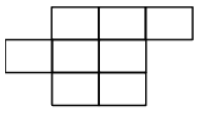
The number of ways, in which the letters A, B, C, D, E can be placed in the 8 boxes of the figure below so that no row remains empty and at most one letter can be placed in a box, is :
The number of different 5 digit numbers greater than 50000 that can be formed using the digits 0 ,1, 2, 3, 4, 5, 6, 7, such that the sum of their first and last digits should not be more than 8 , is
We need 5-digit numbers greater than 50000 using digits 0, 1, 2, 3, 4, 5, 6, 7 (repetition allowed), where the sum of the first and last digits is at most 8.
Since the number must be greater than 50000, the first digit $$a$$ must be 5, 6, or 7.
The middle three digits can each be any of the 8 digits (0 through 7), giving $$8^3 = 512$$ choices.
For the last digit $$e$$, we need $$a + e \leq 8$$ where $$e \in \{0, 1, 2, 3, 4, 5, 6, 7\}$$.
Case 1: $$a = 5$$: then $$e \leq 3$$, so $$e \in \{0, 1, 2, 3\}$$ — 4 choices.
Case 2: $$a = 6$$: then $$e \leq 2$$, so $$e \in \{0, 1, 2\}$$ — 3 choices.
Case 3: $$a = 7$$: then $$e \leq 1$$, so $$e \in \{0, 1\}$$ — 2 choices.
Total number of such 5-digit numbers = $$(4 + 3 + 2) \times 512 = 9 \times 512 = 4608$$
However, the question asks for numbers strictly greater than 50000. The number 50000 itself satisfies all conditions (first digit 5, last digit 0, sum = 5 ≤ 8), but 50000 is not greater than 50000. So we must exclude it.
Therefore, the required count = $$4608 - 1 = 4607$$
In a group of 3 girls and 4 boys, there are two boys $$B_{1}\text{ and }B_{2}$$. The number of ways, in which these girls and boys can stand in a queue such that all the girls stand together, all the boys stand together, but $$B_{1}\text{ and }B_{2}$$ are not adjacent to each other, is :
Let's assume all girls together as 1 block (G) and all boys together as another block (B).
So we have 2 blocks: G and B. They can be arranged in: 2! = 2 ways
Arrange the girls inside their block = 3! = 6 ways
Arrange boys inside their block = 4! = 24 ways
Now, we can subtract the cases where B1 and B2 are adjacent.
If we assume B1 and B2 as one unit, then we have 3 units of boys. They can be arranged in 3! ways, and B1 and B2 can also arrange themselves in two ways.
So, adjacent cases = 3! × 2 = 6 × 2 = 12
Valid arrangements: 24 - 12 = 12
Hence, the total number of ways: 2 × 6 × 12 = 144
The number of 6-letter words, with or without meaning, that can be formed using the letters of the word MATHS such that any letter that appears in the word must appear at least twice, is _______.
We form 6-letter words from letters of MATHS (5 distinct letters), with condition:
Any letter used must appear at least twice.
Possible repetition patterns for total 6 letters:
Case 1: (2+2+2)
Choose 3 letters from 5:
$$\binom{5}{3}=10$$
Arrange:
$$\frac{6!}{2!2!2!}=90$$
Total:
$$10\times90=900$$
Case 2: (4+2)
Choose letter repeated 4 times:
5
Choose letter repeated 2 times from remaining 4:
4
Arrange:
$$\frac{6!}{4!2!}=15$$
Total:
$$5\times4\times15=300$$
Case 3: (3+3)
Choose 2 letters from 5:
$$\binom{5}{2}=10$$
Arrange:
$$\frac{6!}{3!3!}=20$$
Total:
$$10\times20=200$$
Case 4: (2+2+1+1) ❌ not allowed
(two letters appear once)
Case 5: (6)
All same letter:
5
Total 900+300+200+5=1405
The number of ways, 5 boys and 4 girls can sit in a row so that either all the boys sit together or no two boys sit together, is
If all the boys sit together, then there will be 4 girls and 1 group of boys.
Number of ways in which the boys can be arranged = 5!
Number of ways in which 4 girls and 1 group of boys can be arranged = 5!
Total number of ways in which we can arrange 4 girls and 5 boys such that all the boys sit together = $$5!\times5!=14400$$
Now, we have to arrange the boys and girls such that no two boys sit together.
So, we will first fix the positions of girls in 1 way where girls are sitting at the alternate positions (not at the first or the last position) out of the total 9 positions.
Girls will sit at 2nd, 4th, 6th and 8th positions.
Number of ways in which the girls are arranged = 4!
Now, the boys will sit in the remaining places.
Number of ways in which the boys are arranged = 5!
Total number of ways in which we can arrange the boys and girls such that no two boys sit together = $$4!\times5!=2880$$
Total number of ways in which we can arrange 5 boys and 4 girls such that either all the boys sit together or no boys sit together at all = $$14400+2880=17280$$
$$\therefore\ $$ The required answer is 17280.
If the number of seven-digit numbers, such that the sum of their digits is even, is $$m \cdot n \cdot 10^n$$; $$m, n \in \{1, 2, 3, \ldots, 9\}$$, then $$m + n$$ is equal to __________.
Let $$S$$ be the set of all seven-digit natural numbers. A seven-digit number has its first (left-most) digit from $$1$$ to $$9$$ and each of the remaining six digits from $$0$$ to $$9$$, so
total elements in $$S = 9 \times 10^{6} = 90\,00\,00\,00 = 9{,}000{,}000$$
We must count those numbers in $$S$$ whose digit-sum is even. Denote this subset by $$E$$ and let $$O$$ be the subset with odd digit-sum.
Key idea (Parity-changing bijection): For every number in $$S$$ we will construct a unique partner in $$S$$ whose digit-sum parity is opposite.
Take a number with decimal representation $$a_1a_2a_3a_4a_5a_6a_7$$.
Define a mapping $$f:S \rightarrow S$$ by changing only the last digit:
• if $$a_7$$ is even, replace it by $$a_7+1$$ (this is odd);
• if $$a_7$$ is odd, replace it by $$a_7-1$$ (this is even).
This mapping leaves the first digit $$a_1$$ unchanged (so the image is still seven-digit) and clearly toggles the parity of the digit-sum. Moreover, the rule is reversible—applying it twice returns the original number—so $$f$$ is a bijection between $$E$$ and $$O$$.
Therefore $$|E| = |O| = \dfrac{|S|}{2} = \dfrac{9\,000\,000}{2} = 4\,500\,000$$.
Write the answer in the required form $$m \cdot n \cdot 10^{\,n}$$ with $$m,n \in \{1,2,\ldots ,9\}$$.
Observe $$4\,500\,000 = 45 \times 10^{5}$$.
Factor the coefficient $$45$$ as the product of two single-digit numbers: $$45 = 9 \times 5$$.
Thus $$m = 9,\; n = 5$$ and the requested sum is
$$m + n = 9 + 5 = 14.$$
Final answer: $$14$$.
The number of 3-digit numbers that are divisible by 2 and 3, but not divisible by 4 and 9, is_______
Divisible by 2 and 3 means the number should also be divisible by 6 and it should not be divisible by 4 and 9.
Smallest 3-digit multiple of 6 = 102
Largest = 996
Number of multiples: $$\dfrac{\left(996-102\right)}{6}+1=150$$
Now, we need to subtract the numbers divisible by both 4 and 9 (i.e., multiples of 36)
Smallest = 108, Largest = 972
$$\dfrac{\left(972-108\right)}{36}+1=25$$
Final answer: 150 - 25 = 125
The number of sequences of ten terms, whose terms are either 0 or 1 or 2, that contain exactly five 1s and exactly three 2s, is equal to:
We need to find the number of sequences of ten terms, where each term is 0, 1, or 2, containing exactly five 1s and exactly three 2s.
Since the sequence has 10 terms with exactly five 1s and exactly three 2s, the remaining $$10 - 5 - 3 = 2$$ terms must be 0s.
We need to choose positions for the 1s, 2s, and 0s among the 10 positions. This is a multinomial coefficient:
$$\frac{10!}{5! \cdot 3! \cdot 2!}$$
Computing this: $$\frac{10!}{5! \cdot 3! \cdot 2!} = \frac{3628800}{120 \cdot 6 \cdot 2} = \frac{3628800}{1440} = 2520$$.
Hence, the correct answer is Option C.
Let $$^{n}C_{r-1}=28,^{n}C_{r}=56$$ and $$^{n}C_{r+1}=70$$. Let $$A(4\cos t,4\sin t),B(2\sin t,-2\cos t)$$ and $$C(3r-n,r^{2}-n-1)$$ be the vertices of a triangle ABC, where $$t$$is a parameter. If $$(3x-1)^{2}+(3y)^{2}=\alpha$$, is the locus of the centroid of triangle ABC, then $$\alpha$$ equals
We are given the binomial coefficients $$\binom{n}{r-1}=28\,,\quad \binom{n}{r}=56\,,\quad \binom{n}{r+1}=70$$ and the points $$A(4\cos t,4\sin t)\,,\;B(2\sin t,-2\cos t)\,,\;C(3r-n,\;r^2-n-1)\,. $$ The locus of the centroid of triangle ABC is$$(3x-1)^2+(3y)^2=\alpha$$ and we must find $$\alpha$$.
First, from the ratio $$\frac{\binom{n}{r}}{\binom{n}{r-1}}=\frac{56}{28}=2=\frac{n-r+1}{r}$$ we get $$n-r+1=2r\quad\Rightarrow\quad n=3r-1\,. $$ Next, from $$\frac{\binom{n}{r+1}}{\binom{n}{r}}=\frac{70}{56}=\frac{5}{4}=\frac{n-r}{r+1}$$ we obtain $$4(n-r)=5(r+1)\quad\Rightarrow\quad 4n=9r+5\,. $$ Substituting $$n=3r-1$$ into $$4n=9r+5$$ gives $$4(3r-1)=9r+5\;\Rightarrow\;12r-4=9r+5\;\Rightarrow\;3r=9\;\Rightarrow\;r=3\,,\;n=8\,. $$ One checks indeed $$\binom{8}{2}=28\,,\;\binom{8}{3}=56\,,\;\binom{8}{4}=70\,. $$
With $$r=3$$ and $$n=8$$, point $$C$$ is $$C=(3r-n,\;r^2-n-1)=(9-8,\;9-8-1)=(1,0)\,. $$ The centroid $$G$$ of triangle $$ABC$$ has coordinates $$x_G=\frac{4\cos t+2\sin t+1}{3},\qquad y_G=\frac{4\sin t-2\cos t+0}{3}\,. $$ Hence $$3x_G-1=4\cos t+2\sin t,\qquad3y_G=4\sin t-2\cos t\,. $$
Therefore the locus satisfies $$(3x_G-1)^2+(3y_G)^2=(4\cos t+2\sin t)^2+(4\sin t-2\cos t)^2$$ $$=16\cos^2t+16\sin t\cos t+4\sin^2t+16\sin^2t-16\sin t\cos t+4\cos^2t$$ $$=16(\cos^2t+\sin^2t)+4(\sin^2t+\cos^2t)=16+4=20\,. $$
Hence $$\alpha=20$$, which corresponds to Option D.
Let P be the set of seven digit numbers with sum of their digits equal to 11 . If the numbers in P are formed by using the digits 1,2 and 3 only, then the number of elements in the set $$P$$ is :
We need to find the number of 7-digit numbers formed using only digits 1, 2, and 3 such that the sum of digits equals 11.
Let the seven digits be $$x_1, x_2, \ldots, x_7$$ where each $$x_i \in \{1, 2, 3\}$$ and $$x_1 + x_2 + \cdots + x_7 = 11$$.
Let $$y_i = x_i - 1$$, so $$y_i \in \{0, 1, 2\}$$. Then:
$$ \sum_{i=1}^{7} (y_i + 1) = 11 \implies \sum_{i=1}^{7} y_i = 4 $$
We need to count the number of solutions to $$y_1 + y_2 + \cdots + y_7 = 4$$ where $$0 \leq y_i \leq 2$$.
Without the upper bound constraint, the number of non-negative integer solutions is $$\binom{4 + 7 - 1}{7 - 1} = \binom{10}{6} = 210$$.
Now subtract cases where any $$y_i \geq 3$$. If $$y_i \geq 3$$, let $$z_i = y_i - 3 \geq 0$$. Then the sum becomes $$z_i + \sum_{j \neq i} y_j = 1$$. The number of non-negative solutions is $$\binom{1 + 6}{6} = \binom{7}{6} = 7$$.
There are $$\binom{7}{1} = 7$$ ways to choose which variable exceeds 2, giving $$7 \times 7 = 49$$ cases.
No two variables can simultaneously be $$\geq 3$$ since that would require a sum $$\geq 6 > 4$$. So higher-order inclusion-exclusion terms are zero.
$$ N = 210 - 49 = 161 $$
The correct answer is Option 4: 161.
If all the words with or without meaning made using all the letters of the word "KANPUR" are arranged as in a dictionary, then the word at $$440^{th}$$ position in this arrangement, is :
The word "KANPUR" has 6 distinct letters: A, K, N, P, R, U.
Arranging in alphabetical order: A, K, N, P, R, U.
Total permutations = 6! = 720.
Words starting with each letter = 5! = 120.
Words starting with A: positions 1-120
Words starting with K: positions 121-240
Words starting with N: positions 241-360
Words starting with P: positions 361-480
440th word starts with P. Position within P-words: 440 - 360 = 80.
After P, remaining letters: A, K, N, R, U (alphabetical order).
Words starting with PA: 4! = 24 (positions 1-24)
Words starting with PK: 4! = 24 (positions 25-48)
Words starting with PN: 4! = 24 (positions 49-72)
Words starting with PR: 4! = 24 (positions 73-96)
80th word starts with PR. Position within PR-words: 80 - 72 = 8.
After PR, remaining letters: A, K, N, U.
Words starting with PRA: 3! = 6 (positions 1-6)
Words starting with PRK: 3! = 6 (positions 7-12)
8th word starts with PRK. Position within PRK-words: 8 - 6 = 2.
After PRK, remaining letters: A, N, U.
Words starting with PRKA: 2! = 2 (positions 1-2)
2nd word starting with PRKA: remaining letters N, U arranged as UN.
PRKAUN (position 2 within PRKA-words)
Wait: 1st position is PRKANU, 2nd position is PRKAUN.
So the 440th word is PRKAUN.
The correct answer is Option 3: PRKAUN.
Line $$L_1$$ of slope 2 and line $$L_2$$ of slope $$\dfrac{1}{2}$$ intersect at the origin O. In the first quadrant, $$P_1, P_2, \ldots P_{12}$$ are 12 points on line $$L_1$$ and $$Q_1, Q_2, \ldots Q_9$$ are 9 points on line $$L_2$$. Then the total number of triangles, that can be formed having vertices at three of the 22 points O, $$P_1, P_2, \ldots P_{12}$$, $$Q_1, Q_2, \ldots Q_9$$, is:
We have a total of 22 points:
• the origin $$O$$,
• $$12$$ points $$P_1, P_2,\,\ldots,\,P_{12}$$ on the line $$L_1$$ (slope $$2$$),
• $$9$$ points $$Q_1, Q_2,\,\ldots,\,Q_{9}$$ on the line $$L_2$$ (slope $$\tfrac12$$).
A triangle can be formed by any three non-collinear points. Hence
Total number of triangles
$$=\;\bigl(\text{all possible triples of points}\bigr)\;-\;\bigl(\text{collinear triples}\bigr).$$
Step 1: Count all possible triples of points
There are $$22$$ points in all, so the number of ways to choose any three of them is
$$\binom{22}{3} \;=\; \frac{22 \times 21 \times 20}{6} \;=\; 1540.$$
Step 2: Subtract triples that are collinear
• Triples on line $$L_1$$:
Along $$L_1$$ we have the origin $$O$$ plus the 12 points $$P_i$$, altogether $$13$$ collinear points.
The number of triples drawn entirely from these $$13$$ points is
$$\binom{13}{3} \;=\; \frac{13 \times 12 \times 11}{6} \;=\; 286.$$
• Triples on line $$L_2$$:
Along $$L_2$$ we have the origin $$O$$ plus the 9 points $$Q_j$$, altogether $$10$$ collinear points.
The number of triples drawn entirely from these $$10$$ points is
$$\binom{10}{3} \;=\; \frac{10 \times 9 \times 8}{6} \;=\; 120.$$
Step 3: Adjust for any overlap
A triple can lie on both $$L_1$$ and $$L_2$$ only if all three of its points are common to the two lines.
The only common point of $$L_1$$ and $$L_2$$ is the origin $$O$$, so no triple is counted in both collinear groups.
Therefore, no further adjustment is required.
Step 4: Final count of triangles
$$\begin{aligned}
\text{Number of triangles}
&= 1540 \;-\; 286 \;-\; 120 \\
&= 1134.
\end{aligned}$$
Hence, the total number of distinct triangles that can be formed is $$1134$$, which corresponds to Option B.
A group of 9 students, $$s_1, s_2, \ldots, s_9$$, is to be divided to form three teams $$X$$, $$Y$$ and $$Z$$ of sizes 2, 3, and 4, respectively. Suppose that $$s_1$$ cannot be selected for the team $$X$$, and $$s_2$$ cannot be selected for the team $$Y$$. Then the number of ways to form such teams is ________.
First, treat the three teams $$X$$ (size $$2$$), $$Y$$ (size $$3$$) and $$Z$$ (size $$4$$) as labelled; changing a student from one team to another gives a different arrangement.
Total arrangements without any restriction
Choose the two members of $$X$$, then the three members of $$Y$$; the remaining four automatically form $$Z$$:
$$T = \binom{9}{2}\,\binom{7}{3} = 36 \times 35 = 1260.$$
Introduce two “bad” events:
$$A$$ : student $$s_1$$ is placed in team $$X$$ (not allowed).
$$B$$ : student $$s_2$$ is placed in team $$Y$$ (not allowed).
We need the count of arrangements that avoid both $$A$$ and $$B$$. Use the inclusion-exclusion principle:
Number of valid arrangements $$= T - |A| - |B| + |A\cap B|.$$
Count |A| (arrangements with $$s_1$$ in $$X$$)
Fix $$s_1$$ in $$X$$, pick one more member for $$X$$ from the remaining $$8$$ students, then form $$Y$$ from the remaining $$7$$ students:
$$|A| = \binom{8}{1}\,\binom{7}{3} = 8 \times 35 = 280.$$
Count |B| (arrangements with $$s_2$$ in $$Y$$)
Fix $$s_2$$ in $$Y$$, pick two more members for $$Y$$ from the remaining $$8$$ students, then form $$X$$ from the remaining $$6$$ students:
$$|B| = \binom{8}{2}\,\binom{6}{2} = 28 \times 15 = 420.$$
Count |A ∩ B| (both $$s_1$$ in $$X$$ and $$s_2$$ in $$Y$$)
Place $$s_1$$ in $$X$$ and choose one more member for $$X$$ from the $$7$$ students other than $$s_2$$: $$\binom{7}{1}=7$$.
Now $$s_2$$ is in $$Y$$; pick the remaining two members of $$Y$$ from the $$6$$ students still free: $$\binom{6}{2}=15$$.
$$|A\cap B| = 7 \times 15 = 105.$$
Apply inclusion-exclusion
$$\text{Valid arrangements}=1260 - 280 - 420 + 105 = 665.$$
Hence, the required number of ways to form the teams is 665.
60 words can be made using all the letters of the word BHBJO, with or without meaning. If these words are written as in a dictionary, then the $$50^{th}$$ word is :
We need to find the 50th word when all arrangements of the letters of BHBJO are written in dictionary order.
Letters of BHBJO: B, H, B, J, O — sorted in alphabetical order: B, B, H, J, O.
Total words = $$\frac{5!}{2!} = 60$$ (since B repeats twice).
Dictionary ordering — count words starting with each letter:
Words starting with B: Remaining letters are {B, H, J, O} (4 distinct). Number of arrangements = $$4! = 24$$. (Words 1-24)
Words starting with H: Remaining letters are {B, B, J, O}. Number of arrangements = $$\frac{4!}{2!} = 12$$. (Words 25-36)
Words starting with J: Remaining letters are {B, B, H, O}. Number of arrangements = $$\frac{4!}{2!} = 12$$. (Words 37-48)
Words starting with O: Remaining letters are {B, B, H, J}. Number of arrangements = $$\frac{4!}{2!} = 12$$. (Words 49-60)
The 50th word is the 2nd word among those starting with O.
Words starting with O, arranged in dictionary order:
Remaining letters: {B, B, H, J}, sorted: B, B, H, J.
Words starting with OB: Remaining {B, H, J} = $$3! = 6$$ words. (Words 49-54)
The 49th word is the first word starting with OB. Let's list:
- 49th: O B B H J
- 50th: O B B J H
So the 50th word is OBBJH.
The correct answer is Option (2): OBBJH.
Let $$0 \leq r \leq n$$. If $$^{n+1}C_{r+1} : ^{n}C_{r} : ^{n-1}C_{r-1} = 55 : 35 : 21$$, then $$2n + 5r$$ is equal to:
$$\frac{C(n+1,r+1)}{C(n,r)} = \frac{55}{35} = \frac{11}{7}$$. $$\frac{n+1}{r+1} = 11/7 \Rightarrow 7n+7 = 11r+11 \Rightarrow 7n = 11r+4$$.
$$\frac{C(n,r)}{C(n-1,r-1)} = \frac{35}{21} = \frac{5}{3}$$. $$\frac{n}{r} = 5/3 \Rightarrow n = 5r/3$$.
From second: $$r = 3n/5$$. Sub in first: $$7n = 11(3n/5)+4 = 33n/5+4$$. $$35n-33n = 20$$. $$2n = 20$$, $$n = 10$$. $$r = 6$$.
$$2n+5r = 20+30 = 50$$.
The correct answer is Option (1): 50.
Number of ways of arranging $$8$$ identical books into $$4$$ identical shelves where any number of shelves may remain empty is equal to
We need to find the number of ways of arranging 8 identical books into 4 identical shelves, where any number of shelves may remain empty.
Since both the books and the shelves are identical, this problem reduces to finding the number of partitions of 8 into at most 4 parts.
A partition of 8 into at most 4 parts means writing 8 as an unordered sum of at most 4 positive integers (where empty shelves correspond to parts of value 0).
Listing all partitions of 8 into at most 4 parts:
1 part:
8 = 8 → (8)
2 parts:
8 = 7+1, 6+2, 5+3, 4+4 → 4 partitions
3 parts:
8 = 6+1+1, 5+2+1, 4+3+1, 4+2+2, 3+3+2 → 5 partitions
4 parts:
8 = 5+1+1+1, 4+2+1+1, 3+3+1+1, 3+2+2+1, 2+2+2+2 → 5 partitions
Total = 1 + 4 + 5 + 5 = 15
Therefore, the correct answer is Option 4: 15.
The number of triangles whose vertices are at the vertices of a regular octagon but none of whose sides is a side of the octagon is
We need to count triangles whose vertices are vertices of a regular octagon, but none of whose sides is a side of the octagon.
A regular octagon has 8 vertices. The total number of triangles formed by choosing any 3 vertices is given by $$\binom{8}{3} = \frac{8!}{3! \times 5!} = \frac{8 \times 7 \times 6}{6} = 56$$.
Using complementary counting, the desired number equals the total number of triangles minus those with at least one side of the octagon.
To count triangles with exactly one side of the octagon, note that the octagon has 8 sides. For each side, the third vertex must not be adjacent to either endpoint of that side, which excludes the two endpoints themselves and their two other neighbors, leaving $$8 - 4 = 4$$ valid choices for the third vertex. Hence there are $$8 \times 4 = 32$$ such triangles.
Triangles with exactly two sides of the octagon occur when the two sides are consecutive, sharing a common vertex, and each such pair of consecutive sides determines exactly one triangle formed by three consecutive vertices. Since there are 8 vertices, there are 8 such pairs, giving $$8$$ triangles.
It is impossible for a triangle to have three sides of the octagon, so that count is $$0$$.
Therefore, the total number of triangles with at least one side of the octagon is $$32 + 8 + 0 = 40$$, and the number of triangles with no side of the octagon is $$56 - 40 = 16$$.
The correct answer is Option 4: 16.
The number of ways five alphabets can be chosen from the alphabets of the word MATHEMATICS, where the chosen alphabets are not necessarily distinct, is equal to :
We need to find the number of ways to choose 5 alphabets from the word MATHEMATICS (not necessarily distinct).
The distinct letters in MATHEMATICS with their frequencies are:
M: 2, A: 2, T: 2, H: 1, E: 1, I: 1, C: 1, S: 1
So we have 8 distinct letters, with 3 letters (M, A, T) appearing twice and 5 letters (H, E, I, C, S) appearing once.
We need to choose 5 letters where the chosen set respects the available multiplicities. We consider cases based on the pattern of repetitions.
Case 1: All 5 distinct.
Choose 5 from 8 distinct letters: $$\binom{8}{5} = 56$$.
Case 2: One pair + 3 distinct.
Choose which letter is repeated (from M, A, T): $$\binom{3}{1} = 3$$ ways.
Choose remaining 3 distinct letters from the other 7: $$\binom{7}{3} = 35$$ ways.
Total: $$3 \times 35 = 105$$.
Case 3: Two pairs + 1 distinct.
Choose 2 letters to be repeated (from M, A, T): $$\binom{3}{2} = 3$$ ways.
Choose 1 distinct letter from the remaining 6: $$\binom{6}{1} = 6$$ ways.
Total: $$3 \times 6 = 18$$.
Case 4: Three or more of the same letter.
Not possible since no letter appears more than twice.
Grand total = $$56 + 105 + 18 = 179$$.
The correct answer is Option 1: 179.
If all the words with or without meaning made using all the letters of the word "NAGPUR" are arranged as in a dictionary, then the word at $$315^{th}$$ position in this arrangement is :
NAGPUR has 6 distinct letters: A,G,N,P,R,U. Alphabetical: A,G,N,P,R,U.
Words starting with A: 5! = 120. Starting with G: 120. Total = 240.
Words starting with N: 241-360. First 2 letters NA: 4! = 24 (241-264). NG: 24 (265-288). NP: 24 (289-312).
Word 313-336 start with NR. 313: NRAGPU, 314: NRAGUP, 315: NRAPGU.
The correct answer is Option (3): NRAPGU.
If $$n$$ is the number of ways five different employees can sit into four indistinguishable offices where any office may have any number of persons including zero, then $$n$$ is equal to:
This is the problem of partitioning a set of 5 distinct elements into $$1, 2, 3,$$ or $$4$$ non-empty subsets (since offices are indistinguishable, we use Stirling numbers of the second kind, $$S(n, k)$$).
• 1 office used: $$S(5,1) = 1$$
• 2 offices used: $$S(5,2) = \frac{2^5 - 2}{2} = 15$$
• 3 offices used: $$S(5,3) = 25$$
• 4 offices used: $$S(5,4) = 10$$
Total ways $$n = 1 + 15 + 25 + 10 = \mathbf{51}$$.
The number of ways in which 21 identical apples can be distributed among three children such that each child gets at least 2 apples, is
21 apples, 3 children, each ≥ 2. Give 2 each first: remaining 15 among 3 with each ≥ 0. $$\binom{15+2}{2}=\binom{17}{2}=136$$.
The answer is Option (4): 136.
There are 5 points $$P_1, P_2, P_3, P_4, P_5$$ on the side AB, excluding A and B, of a triangle ABC. Similarly there are 6 points $$P_6, P_7,\ldots, P_{11}$$ on the side BC and 7 points $$P_{12}, P_{13},\ldots, P_{18}$$ on the side CA of the triangle. The number of triangles, that can be formed using the points $$P_1, P_2,\ldots, P_{18}$$ as vertices, is:
Total points: 5 on AB, 6 on BC, 7 on CA = 18 points total.
Total triangles from 18 points = C(18,3) = 816
Subtract collinear cases (3 points on same side don't form a triangle):
C(5,3) + C(6,3) + C(7,3) = 10 + 20 + 35 = 65
Number of valid triangles = 816 - 65 = 751
The correct answer is Option 3: 751.
$${}^{n-1}C_r = (k^2 - 8) \; {}^{n}C_{r+1}$$ if and only if :
The relation in the question is $$^{n-1}C_r = (k^{2}-8)\;{}^{n}C_{\,r+1}$$, where $$n$$ and $$r$$ are integers satisfying $$n \ge 1$$ and $$0 \le r \le n-1$$.
First write both binomial coefficients in factorial form.
$$^{n-1}C_r = \dfrac{(n-1)!}{r!\,(n-1-r)!}$$
$${}^{n}C_{\,r+1} = \dfrac{n!}{(r+1)!\,(n-r-1)!}$$
Compute their ratio.
$$\dfrac{^{\,n-1}C_r}{{}^{\,n}C_{\,r+1}}
= \dfrac{\dfrac{(n-1)!}{r!\,(n-1-r)!}}
{\dfrac{n!}{(r+1)!\,(n-r-1)!}}
= \dfrac{(n-1)!}{r!\,(n-1-r)!}\;
\dfrac{(r+1)!\,(n-r-1)!}{n!}$$
Simplify step by step.
• Because $$(r+1)! = (r+1)\,r!$$, the factor $$r!$$ cancels leaving $$r+1$$.
• Because $$(n-1-r)! = (n-r-1)!$$, these factors cancel completely.
• Use $$n! = n\,(n-1)!$$ to cancel $$(n-1)!$$.
After cancellations we obtain
$$\dfrac{^{\,n-1}C_r}{{}^{\,n}C_{\,r+1}} = \dfrac{r+1}{n}$$ $$-(1)$$
Return to the original equation and divide both sides by $${}^{\,n}C_{\,r+1}$$:
$$\dfrac{^{\,n-1}C_r}{{}^{\,n}C_{\,r+1}} = k^{2}-8$$
Using $$(1)$$ gives
$$k^{2}-8 = \dfrac{r+1}{n}$$ $$-(2)$$
Now analyse the fraction on the right side.
Because $$0 \le r \le n-1$$, we have $$1 \le r+1 \le n$$.
Hence
$$0 \lt \dfrac{r+1}{n} \le 1$$ $$-(3)$$
Combine $$(2)$$ and $$(3)$$ to bound $$k$$.
From $$(2)$$ and the lower bound in $$(3)$$:
$$k^{2}-8 \gt 0 \;\;\Longrightarrow\;\; k^{2} \gt 8 \;\;\Longrightarrow\;\; k \gt 2\sqrt{2}$$
From $$(2)$$ and the upper bound in $$(3)$$:
$$k^{2}-8 \le 1 \;\;\Longrightarrow\;\; k^{2} \le 9 \;\;\Longrightarrow\;\; k \le 3$$
Together,
$$2\sqrt{2} \lt k \le 3$$
This interval matches Option A.
Therefore, the given equation holds if and only if
Case Answer: Option A, $$2\sqrt{2} \lt k \le 3$$.
If for some n; $${}^{6}C_{m}+2^{6}C_{m+1}+{}^{6}C_{m+2}>{}^{8}C_{3}$$ and $$^{n-1}P_3 : ^nP_4 = 1:8$$, then $$^nP_{m+1} + ^{n+1}C_m$$ is equal to
First fix the symbol conventions.
Combinations : $${}^{n}C_{r} = \frac{n!}{r!(n-r)!}$$
Permutations : $$^{n}P_{r} = \frac{n!}{(n-r)!} = n(n-1)\dots (n-r+1)$$
Case 1 : Finding $$m$$ from the inequality
The given condition is
$${}^{6}C_{m} + 2\;{}^{6}C_{m+1} + {}^{6}C_{m+2} \gt {}^{8}C_{3}$$
Compute the right-hand side:
$${}^{8}C_{3} = \frac{8\cdot7\cdot6}{3\cdot2\cdot1}=56$$
The terms $${}^{6}C_{r}$$ are (for $$r=0$$ to $$6$$):
$$1,\;6,\;15,\;20,\;15,\;6,\;1$$
Because $$m+2 \le 6$$, the feasible values are $$m = 0,1,2,3,4$$. Evaluate the left-hand side for each:
$$\begin{aligned} m=0:&\;1 + 2(6) + 15 = 28\\ m=1:&\;6 + 2(15) + 20 = 56\\ m=2:&\;15 + 2(20) + 15 = 70\\ m=3:&\;20 + 2(15) + 6 = 56\\ m=4:&\;15 + 2(6) + 1 = 28 \end{aligned}$$
The inequality $$\gt56$$ is satisfied only for $$m = 2$$.
Case 2 : Finding $$n$$ from the permutation ratio
The second relation is
$$^{\,n-1}P_{3} : {}^{\,n}P_{4} = 1 : 8$$
Write both permutations explicitly:
$$^{\,n-1}P_{3} = (n-1)(n-2)(n-3)$$
$$^{\,n}P_{4} = n(n-1)(n-2)(n-3)$$
Therefore $$\frac{^{\,n-1}P_{3}}{^{\,n}P_{4}} = \frac{(n-1)(n-2)(n-3)}{n(n-1)(n-2)(n-3)} = \frac{1}{n}$$
Given that this ratio equals $$\frac{1}{8}$$, we get $$n = 8$$.
Case 3 : Evaluating $$^{\,n}P_{m+1} + {}^{\,n+1}C_{m}$$
With $$n = 8$$ and $$m = 2$$, we need $$^{\,8}P_{3} + {}^{\,9}C_{2}$$.
Compute each term:
$$^{\,8}P_{3} = 8\cdot7\cdot6 = 336$$
$${}^{\,9}C_{2} = \frac{9\cdot8}{2\cdot1} = 36$$
Add them:
$$336 + 36 = 372$$
Hence $$^{\,n}P_{m+1} + {}^{\,n+1}C_{m} = 372$$.
Option D is correct.
Let the set $$S = \{2, 4, 8, 16, \ldots, 512\}$$ be partitioned into 3 sets $$A, B, C$$ with equal number of elements such that $$A \cup B \cup C = S$$ and $$A \cap B = B \cap C = A \cap C = \phi$$. The maximum number of such possible partitions of $$S$$ is equal to:
The set $$S = \{2, 4, 8, 16, 32, 64, 128, 256, 512\}$$ has 9 elements ($$2^1$$ to $$2^9$$).
We need to partition $$S$$ into 3 sets $$A, B, C$$ with equal number of elements, so each set has 3 elements.
Count total ways to partition 9 elements into 3 groups of 3.
The number of ways to choose 3 elements for set A from 9: $$\binom{9}{3}$$
Then choose 3 from remaining 6 for set B: $$\binom{6}{3}$$
The remaining 3 go to set C: $$\binom{3}{3}$$
Since the sets A, B, C are distinguishable (they are labeled), we don't divide by $$3!$$.
$$ \text{Total partitions} = \binom{9}{3} \times \binom{6}{3} \times \binom{3}{3} = 84 \times 20 \times 1 = 1680 $$The correct answer is Option (1): 1680.
Let $$a = 1 + \frac{^2C_2}{3!} + \frac{^3C_2}{4!} + \frac{^4C_2}{5!} + \ldots$$, $$b = 1 + \frac{^1C_0 + ^1C_1}{1!} + \frac{^2C_0+^2C_1+^2C_2}{2!} + \frac{^3C_0+^3C_1+^3C_2+^3C_3}{3!} + \ldots$$. Then $$\frac{2b}{a^2}$$ is equal to ______.
First write the two series in compact sigma‐notation.
For $$a$$, every term after the first is of the form $$\frac{{}^{n}C_{2}}{(n+1)!}$$ with $$n \ge 2$$.
Hence $$a = 1 + \sum_{n = 2}^{\infty} \frac{{}^{n}C_{2}}{(n+1)!}\; -(1)$$
For $$b$$, the $$n^{\text{th}}$$ bracket gives $$\sum_{r = 0}^{n} {}^{n}C_{r}=2^{n}$$, so
$$b = 1 + \sum_{n = 1}^{\infty} \frac{2^{n}}{n!}\; -(2)$$
Case 1: Evaluation of $$a$$
Use $${}^{n}C_{2} = \frac{n(n-1)}{2}$$ in $$(1):$$
$$a = 1 + \sum_{n=2}^{\infty} \frac{n(n-1)}{2\,(n+1)!}$$
Simplify the general term:
$$\frac{n(n-1)}{(n+1)!} = \frac{n(n-1)}{(n+1)\,n\,(n-1)!} = \frac{1}{(n+1)(n-2)!}$$
Hence
$$a = 1 + \frac12 \sum_{n=2}^{\infty} \frac{1}{(n+1)(n-2)!}$$
Shift the index: put $$k = n-2 \;(k = 0,1,2,\dots)$$.
Then $$a = 1 + \frac12 \sum_{k=0}^{\infty} \frac{1}{(k+3)\,k!}\; -(3)$$
Use the identity $$\frac{1}{k+3} = \int_{0}^{1} x^{k+2}\,dx$$
Insert this into $$(3):$$
$$a = 1 + \frac12 \int_{0}^{1} \left[\sum_{k=0}^{\infty} \frac{x^{k}}{k!}\right] x^{2}\,dx = 1 + \frac12 \int_{0}^{1} x^{2} e^{x}\,dx$$
Integrate $$x^{2}e^{x}$$ once: $$\int x^{2} e^{x} dx = e^{x}(x^{2}-2x+2) + C$$
Therefore $$\int_{0}^{1} x^{2} e^{x} dx = e^{1}(1^{2}-2\cdot1+2) - e^{0}(0-0+2) = e(1) - 2 = e - 2$$
Put this back: $$a = 1 + \frac12 (e - 2) = \frac{e}{2}\; -(4)$$
Case 2: Evaluation of $$b$$
From $$(2)$$ and the Maclaurin series of $$e^{x}$$, $$b = 1 + \sum_{n=1}^{\infty} \frac{2^{n}}{n!} = \sum_{n=0}^{\infty} \frac{2^{n}}{n!} = e^{2}\; -(5)$$
Case 3: Required ratio
Using $$(4)$$ and $$(5):$$
$$\frac{2b}{a^{2}} = \frac{2\,e^{2}}{\left(\dfrac{e}{2}\right)^{2}} = \frac{2\,e^{2}}{e^{2}/4}=8$$
Hence $$\displaystyle \frac{2b}{a^{2}} = 8$$.
The lines $$L_1, L_2, \ldots, L_{20}$$ are distinct. For $$n = 1, 2, 3, \ldots, 10$$ all the lines $$L_{2n-1}$$ are parallel to each other and all the lines $$L_{2n}$$ pass through a given point P. The maximum number of points of intersection of pairs of lines from the set $$\{L_1, L_2, \ldots, L_{20}\}$$ is equal to:
We have 20 lines: $$L_1, L_2, \ldots, L_{20}$$.
Odd-indexed lines $$L_1, L_3, L_5, \ldots, L_{19}$$ (10 lines) are all parallel to each other.
Even-indexed lines $$L_2, L_4, L_6, \ldots, L_{20}$$ (10 lines) all pass through a point P.
For maximum intersections, we count using $$\binom{20}{2}$$ total pairs and subtract cases where pairs don't intersect.
Total pairs: $$\binom{20}{2} = 190$$.
Pairs that don't give distinct intersection points:
1) Parallel lines (odd-indexed) don't intersect each other: $$\binom{10}{2} = 45$$ pairs with 0 intersection points.
2) Concurrent lines (even-indexed) all meet at point P: $$\binom{10}{2} = 45$$ pairs, but they all intersect at the same point P. So they contribute 1 point instead of 45 distinct points. We lose $$45 - 1 = 44$$ points.
Maximum intersection points = $$190 - 45 - 44 = 101$$.
The answer is $$\boxed{101}$$.
The number of ways of getting a sum 16 on throwing a dice four times is ______
We need to find the number of ways of getting a sum of 16 when throwing a die four times.
We need the number of solutions to $$x_1 + x_2 + x_3 + x_4 = 16$$ where each $$x_i \in \{1, 2, 3, 4, 5, 6\}$$.
Let $$y_i = x_i - 1$$, so $$0 \leq y_i \leq 5$$. The equation becomes:
$$ y_1 + y_2 + y_3 + y_4 = 16 - 4 = 12 $$
Without upper bound constraint: The number of non-negative integer solutions to $$y_1 + y_2 + y_3 + y_4 = 12$$ is:
$$ \binom{12 + 3}{3} = \binom{15}{3} = \frac{15 \times 14 \times 13}{6} = 455 $$
Subtract: at least one $$y_i \geq 6$$. If $$y_1 \geq 6$$, let $$z_1 = y_1 - 6 \geq 0$$. Then $$z_1 + y_2 + y_3 + y_4 = 6$$, giving $$\binom{9}{3} = 84$$ solutions. By symmetry, there are 4 such cases:
$$ \binom{4}{1} \times \binom{9}{3} = 4 \times 84 = 336 $$
Add back: at least two $$y_i \geq 6$$. If $$y_1 \geq 6$$ and $$y_2 \geq 6$$, let $$z_1 = y_1 - 6, z_2 = y_2 - 6$$. Then $$z_1 + z_2 + y_3 + y_4 = 0$$, giving $$\binom{3}{3} = 1$$ solution. There are $$\binom{4}{2} = 6$$ such pairs:
$$ \binom{4}{2} \times \binom{3}{3} = 6 \times 1 = 6 $$
Three or more $$y_i \geq 6$$: This would require the sum to be at least 18, which exceeds 12. So this is impossible.
$$ N = 455 - 336 + 6 = 125 $$
The answer is $$\boxed{125}$$.
There are 4 men and 5 women in Group A, and 5 men and 4 women in Group B. If 4 persons are selected from each group, then the number of ways of selecting 4 men and 4 women is _____
Select 4 from Group A (4M, 5W) and 4 from Group B (5M, 4W) such that the total is 4 men and 4 women.
Let $$k$$ men be selected from Group A, which means $$4-k$$ women are chosen from Group A. Since the overall requirement is 4 men and 4 women, from Group B one must select $$4-k$$ men and $$k$$ women.
The parameter $$k$$ must satisfy $$0 \le k \le 4$$ for men in Group A, $$4-k \le 5$$ for women in Group A, $$4-k \le 5$$ for men in Group B, and $$k \le 4$$ for women in Group B. These conditions hold for $$k=0,1,2,3,4$$.
Therefore the total number of ways is given by
$$N = \sum_{k=0}^{4} \binom{4}{k}\binom{5}{4-k}\binom{5}{4-k}\binom{4}{k}$$
For $$k=0$$, the count is $$\binom{4}{0}\binom{5}{4}\binom{5}{4}\binom{4}{0} = 1 \times 5 \times 5 \times 1 = 25$$
For $$k=1$$, the count is $$\binom{4}{1}\binom{5}{3}\binom{5}{3}\binom{4}{1} = 4 \times 10 \times 10 \times 4 = 1600$$
For $$k=2$$, the count is $$\binom{4}{2}\binom{5}{2}\binom{5}{2}\binom{4}{2} = 6 \times 10 \times 10 \times 6 = 3600$$
For $$k=3$$, the count is $$\binom{4}{3}\binom{5}{1}\binom{5}{1}\binom{4}{3} = 4 \times 5 \times 5 \times 4 = 400$$
For $$k=4$$, the count is $$\binom{4}{4}\binom{5}{0}\binom{5}{0}\binom{4}{4} = 1 \times 1 \times 1 \times 1 = 1$$
Summing these gives $$N = 25 + 1600 + 3600 + 400 + 1 = 5626$$
The correct answer is 5626.
All the letters of the word $$GTWENTY$$ are written in all possible ways with or without meaning and these words are written as in a dictionary. The serial number of the word $$GTWENTY$$ is _______
Alphabetical order of letters: E, G, N, T, T, W, Y. (Note: T is repeated twice).
Words starting with E: $$\frac{6!}{2!} = \frac{720}{2} = 360$$
Words starting with G: We now look for the word GTWENTY.
o Next letter is E: $$G E \dots$$ remaining (N, T, T, W, Y) $$\rightarrow \frac{5!}{2!} = 60$$
o Next letter is N: $$G N \dots$$ remaining (E, T, T, W, Y) $$\rightarrow \frac{5!}{2!} = 60$$
o Next letter is T: $$G T \dots$$
$$G T E \dots$$ remaining (N, T, W, Y) $$\rightarrow 4! = 24$$
$$G T N \dots$$ remaining (E, T, W, Y) $$\rightarrow 4! = 24$$
$$G T T \dots$$ remaining (E, N, W, Y) $$\rightarrow 4! = 24$$
$$G T W \dots$$ (This matches our word)
$$G T W E \dots$$
$$G T W E N \dots$$
$$G T W E N T Y$$ (This is the first word in this sequence) $$\rightarrow 1$$
Total Rank: $$360 + 60 + 60 + 24 + 24 + 24 + 1 = \mathbf{553}$$
In an examination of Mathematics paper, there are 20 questions of equal marks and the question paper is divided into three sections: A, B and C. A student is required to attempt total 15 questions taking at least 4 questions from each section. If section A has 8 questions, section B has 6 questions and section C has 6 questions, then the total number of ways a student can select 15 questions is _________.
Let $$a,\,b,\,c$$ denote the numbers of questions chosen from Sections A, B and C respectively.
Total questions to be attempted: $$a+b+c = 15$$.
Minimum requirement: $$a \ge 4,\; b \ge 4,\; c \ge 4$$.
Upper limits (because of the number of questions present): $$a \le 8,\; b \le 6,\; c \le 6$$.
Introduce new variables to handle the “at least 4” condition:
$$a = a' + 4,\; b = b' + 4,\; c = c' + 4,\qquad a',b',c' \ge 0$$.
Substituting in $$a+b+c=15$$ gives
$$a' + b' + c' = 15 - 12 = 3 \qquad -(1)$$
Equation $$(1)$$ demands non-negative integer solutions of sum $$3$$. These are:
• $$\,(3,0,0)$$ and its permutations • $$\,(2,1,0)$$ and its permutations • $$\,(1,1,1)$$.
Now apply the upper bounds.
Case 1: $$(a',b',c') = (3,0,0)$$
Then $$(a,b,c)=(7,4,4)$$ which satisfies $$a\le 8,\;b\le 6,\;c\le 6$$.
The other two permutations give $$(a,b,c)=(4,7,4)$$ or $$(4,4,7)$$, both violating $$b\le6$$ or $$c\le6$$.
Hence only one admissible triple: $$(7,4,4)$$.
Case 2: $$(a',b',c') = (2,1,0)$$
All six permutations obey the limits, giving
$$(6,5,4),\;(6,4,5),\;(5,6,4),\;(4,6,5),\;(5,4,6),\;(4,5,6).$$
Case 3: $$(a',b',c') = (1,1,1)$$
This single solution yields $$(5,5,5)$$, within the limits.
Thus the admissible $$(a,b,c)$$ triples are
$$(7,4,4),\;(6,5,4),\;(6,4,5),\;(5,6,4),\;(4,6,5),\;(5,4,6),\;(4,5,6),\;(5,5,5).$$
For each triple, multiply the individual combinations:
Section A: choose $$a$$ out of $$8 \;\;(\binom{8}{a})$$
Section B: choose $$b$$ out of $$6 \;\;(\binom{6}{b})$$
Section C: choose $$c$$ out of $$6 \;\;(\binom{6}{c})$$.
Compute every case:
$$\begin{aligned} (7,4,4):&\;\binom{8}{7}\binom{6}{4}\binom{6}{4}=8\cdot15\cdot15=1800\\[2pt] (6,5,4):&\;\binom{8}{6}\binom{6}{5}\binom{6}{4}=28\cdot6\cdot15=2520\\[2pt] (6,4,5):&\;28\cdot15\cdot6=2520\\[2pt] (5,6,4):&\;\binom{8}{5}\binom{6}{6}\binom{6}{4}=56\cdot1\cdot15=840\\[2pt] (4,6,5):&\;\binom{8}{4}\cdot1\cdot6=70\cdot6=420\\[2pt] (5,4,6):&\;56\cdot15\cdot1=840\\[2pt] (4,5,6):&\;70\cdot6\cdot1=420\\[2pt] (5,5,5):&\;56\cdot6\cdot6=2016 \end{aligned}$$
Add the eight results:
$$1800+2520+2520+840+420+840+420+2016 = 11376.$$
Hence, a student can select the required 15 questions in $$\mathbf{11376}$$ different ways.
The total number of words (with or without meaning) that can be formed out of the letters of the word "DISTRIBUTION" taken four at a time, is equal to ______.
"DISTRIBUTION" has 12 letters: D(1), I(3), S(1), T(2), R(1), B(1), U(1), O(1), N(1) — 9 distinct letters.
We count 4-letter words by cases based on repetition.
Case 1: All different. Choose 4 from 9 distinct letters: $$\binom{9}{4} \times 4! = 126 \times 24 = 3024$$.
Case 2: One pair + 2 different. Pairs available: I or T (2 choices). Choose 2 more from remaining 8: $$2 \times \binom{8}{2} \times \frac{4!}{2!} = 2 \times 28 \times 12 = 672$$.
Case 3: Two pairs. Choose 2 from $$\{I,T\}$$: $$\binom{2}{2} = 1$$. Arrangements: $$\frac{4!}{2!2!} = 6$$.
Case 4: Three same. Only I has 3 copies. Choose 1 more from 8: $$8 \times \frac{4!}{3!} = 32$$.
Total = $$3024 + 672 + 6 + 32 = \boxed{3734}$$.
If $$\frac{^{11}C_1}{2} + \frac{^{11}C_2}{3} + \ldots + \frac{^{11}C_9}{10} = \frac{n}{m}$$ with $$\gcd(n, m) = 1$$, then $$n + m$$ is equal to _______
We need to evaluate $$\sum_{r=1}^{9}\frac{^{11}C_r}{r+1}$$ and express it as $$\frac{n}{m}$$ with $$\gcd(n,m) = 1$$, then find $$n + m$$.
Use the identity $$\frac{\binom{n}{r}}{r+1} = \frac{1}{n+1}\binom{n+1}{r+1}$$.
This identity comes from:
$$\frac{\binom{n}{r}}{r+1} = \frac{n!}{r!(n-r)!(r+1)} = \frac{1}{n+1} \cdot \frac{(n+1)!}{(r+1)!(n-r)!} = \frac{1}{n+1}\binom{n+1}{r+1}$$
With $$n = 11$$:
$$\frac{\binom{11}{r}}{r+1} = \frac{1}{12}\binom{12}{r+1}$$
Substitute and evaluate the sum.
$$\sum_{r=1}^{9}\frac{\binom{11}{r}}{r+1} = \frac{1}{12}\sum_{r=1}^{9}\binom{12}{r+1} = \frac{1}{12}\sum_{k=2}^{10}\binom{12}{k}$$
where $$k = r + 1$$.
Use the binomial sum.
We know: $$\sum_{k=0}^{12}\binom{12}{k} = 2^{12} = 4096$$
$$\sum_{k=2}^{10}\binom{12}{k} = 4096 - \binom{12}{0} - \binom{12}{1} - \binom{12}{11} - \binom{12}{12}$$
$$= 4096 - 1 - 12 - 12 - 1 = 4070$$
Final calculation.
$$\frac{n}{m} = \frac{4070}{12} = \frac{2035}{6}$$
Check: $$\gcd(2035, 6)$$. $$2035 = 5 \times 407 = 5 \times 11 \times 37$$. $$6 = 2 \times 3$$. No common factors, so $$\gcd = 1$$.
$$n + m = 2035 + 6 = 2041$$
The answer is 2041.
Let $$\alpha = \sum_{r=0}^{n}(4r^2 + 2r + 1)^nC_r$$ and $$\beta = \left(\sum_{r=0}^{n}\frac{^nC_r}{r+1}\right) + \frac{1}{n+1}$$. If $$140 < \frac{2\alpha}{\beta} < 281$$, then the value of $$n$$ is ________
A group of $$40$$ students appeared in an examination of $$3$$ subjects - Mathematics, Physics & Chemistry. It was found that all students passed in at least one of the subjects, $$20$$ students passed in Mathematics, $$25$$ students passed in Physics, $$16$$ students passed in Chemistry, at most $$11$$ students passed in both Mathematics and Physics, at most $$15$$ students passed in both Physics and Chemistry, at most $$15$$ students passed in both Mathematics and Chemistry. The maximum number of students passed in all the three subjects is _____.
We have 40 students who passed at least one of three subjects M, P, and C, with |M| = 20, |P| = 25, |C| = 16, |M ∩ P| ≤ 11, |P ∩ C| ≤ 15, and |M ∩ C| ≤ 15. We wish to determine the maximum number of students who passed all three subjects.
Since every student passed at least one subject, the Inclusion-Exclusion Principle gives
$$|M ∪ P ∪ C| = |M| + |P| + |C| - |M ∩ P| - |P ∩ C| - |M ∩ C| + |M ∩ P ∩ C| = 40$$
Substituting the known totals,
$$20 + 25 + 16 - |M ∩ P| - |P ∩ C| - |M ∩ C| + |M ∩ P ∩ C| = 40$$
which simplifies to
$$61 - \bigl(|M ∩ P| + |P ∩ C| + |M ∩ C|\bigr) + |M ∩ P ∩ C| = 40\,. $$
Letting $$S = |M ∩ P| + |P ∩ C| + |M ∩ C|$$ and $$t = |M ∩ P ∩ C|$$, this equation becomes
$$61 - S + t = 40\quad\Longrightarrow\quad S - t = 21\,,\quad\text{so}\quad S = 21 + t\,. $$
Each pairwise intersection is at most 11, 15, and 15 respectively, and must be at least $$t$$ since the triple intersection is contained in each pair. Hence the maximum possible sum is $$S=11+15+15=41$$, giving $$t ≤ 41 - 21 = 20$$, while also $$t ≤ |M ∩ P| ≤ 11$$. Thus $$t ≤ 11$$.
We must also ensure that every region in the Venn diagram has a non-negative number of students. For $$t = 10$$ we have $$S = 31$$ and may choose $$|M ∩ P| = 11\,,\; |P ∩ C| = 10\,,\; |M ∩ C| = 10\,. $$ Then
Only-M = $$20 - 11 - 10 + 10 = 9 \geq 0$$ $$\checkmark$$; Only-P = $$25 - 11 - 10 + 10 = 14 \geq 0$$ $$\checkmark$$; Only-C = $$16 - 10 - 10 + 10 = 6 \geq 0$$ $$\checkmark$$; (M ∩ P) only = $$11 - 10 = 1 \geq 0$$ $$\checkmark$$; (P ∩ C) only = $$10 - 10 = 0 \geq 0$$ $$\checkmark$$; (M ∩ C) only = $$10 - 10 = 0 \geq 0$$ $$\checkmark$$; and the total is $$9 + 14 + 6 + 1 + 0 + 0 + 10 = 40$$ $$\checkmark$$.
For $$t = 11$$ we would have $$S = 32$$. One might take $$|M ∩ P| = 11$$, $$|P ∩ C| = 11$$, $$|M ∩ C| = 10$$, giving Only-M = $$20 - 11 - 10 + 11 = 10 \geq 0$$, Only-P = $$25 - 11 - 11 + 11 = 14 \geq 0$$, Only-C = $$16 - 11 - 10 + 11 = 6 \geq 0$$, but then (M ∩ C) only = $$10 - 11 = -1 < 0$$ $$\times$$. Any other choice with $$|M ∩ P|=11$$ requires the other two intersections to sum to 21 while each is at least 11, forcing a sum of at least 22, which is impossible. Hence $$t = 11$$ cannot be realized.
These considerations show that the maximum feasible value of $$|M ∩ P ∩ C|$$ is 10.
The answer is 10.
Let $$A = \{1, 2, 3, \ldots, 7\}$$ and let $$P(A)$$ denote the power set of $$A$$. If the number of functions $$f : A \rightarrow P(A)$$ such that $$a \in f(a), \forall a \in A$$ is $$m^n$$, $$m$$ and $$n \in \mathbb{N}$$ and $$m$$ is least, then $$m + n$$ is equal to ______.
For each $$a \in A = \{1, 2, ..., 7\}$$, $$f(a)$$ must be a subset of $$A$$ that contains $$a$$.
For each element $$a$$, the number of subsets of $$A$$ containing $$a$$ is $$2^6 = 64$$ (the other 6 elements can each be in or out).
Since the choices for each element are independent, the total number of functions is $$64^7 = (2^6)^7 = 2^{42}$$.
We need $$m^n = 2^{42}$$ with $$m$$ being the least natural number base. The smallest such $$m$$ is $$m = 2$$, giving $$n = 42$$.
$$m + n = 2 + 42 = \boxed{44}$$.
Let $$S = \{1, 2, 3, 4, 5, 6\}$$ and $$X$$ be the set of all relations $$R$$ from $$S$$ to $$S$$ that satisfy both the following properties:
i. $$R$$ has exactly 6 elements.
ii. For each $$(a, b) \in R$$, we have $$|a - b| \geq 2$$.
Let $$Y = \{R \in X : \text{The range of } R \text{ has exactly one element}\}$$ and
$$Z = \{R \in X : R \text{ is a function from } S \text{ to } S\}$$.
Let $$n(A)$$ denote the number of elements in a set $$A$$.
If $$n(X) = {}^{m}C_6$$, then the value of $$m$$ is ______.
We first list all ordered pairs $$(a,b)$$ in $$S\times S$$ that satisfy the restriction $$|a-b|\ge 2$$.
Total ordered pairs in $$S\times S$$ are $$6\times 6 = 36$$.
Forbidden pairs:
• Diagonal pairs with $$a=b$$ → 6 pairs.
• Pairs with $$|a-b|=1$$.
When $$b=a+1$$: $$(1,2),(2,3),(3,4),(4,5),(5,6)$$ → 5 pairs.
When $$b=a-1$$: $$(2,1),(3,2),(4,3),(5,4),(6,5)$$ → 5 pairs.
So forbidden pairs = $$6+5+5 = 16$$.
Allowed pairs (with $$|a-b|\ge 2$$) = $$36-16 = 20$$.
Every relation $$R\in X$$ is a subset of these 20 allowed pairs containing exactly 6 elements. Choosing any 6 of the 20 allowed pairs gives such a relation, and every such choice is valid.
Hence $$n(X)=\binom{20}{6}= {}^{m}C_6$$ which implies $$m=20$$.
Final Answer: 20
Let $$S = \{1, 2, 3, 4, 5, 6\}$$ and $$X$$ be the set of all relations $$R$$ from $$S$$ to $$S$$ that satisfy both the following properties:
i. $$R$$ has exactly 6 elements.
ii. For each $$(a, b) \in R$$, we have $$|a - b| \geq 2$$.
Let $$Y = \{R \in X : \text{The range of } R \text{ has exactly one element}\}$$ and
$$Z = \{R \in X : R \text{ is a function from } S \text{ to } S\}$$.
Let $$n(A)$$ denote the number of elements in a set $$A$$.
If the value of $$n(Y) + n(Z)$$ is $$k^2$$, then $$|k|$$ is ______.
The set $$S = \{1,2,3,4,5,6\}$$ has six elements. Every relation under consideration must satisfy the two fixed conditions:
(i) it contains exactly $$6$$ ordered pairs, and
(ii) each ordered pair $$(a,b)$$ in it obeys $$|a-b|\ge 2$$.
We study the two subsets of relations, $$Y$$ and $$Z$$, separately.
Case 1: Counting $$n(Y)$$By definition, each relation $$R\in Y$$ has a range that is a single element, say $$\{b\}$$. Hence the only possible pairs in such an $$R$$ are of the form $$(a,b)$$ with $$a\in S$$. Because $$R$$ must contain exactly six distinct ordered pairs, every first component $$a=1,2,3,4,5,6$$ must occur once:
$$R=\{(1,b),(2,b),(3,b),(4,b),(5,b),(6,b)\}.$$
For this relation to be admissible, each pair must satisfy $$|a-b|\ge 2$$. In particular, $$|b-b|=0\lt 2$$ fails for the pair $$(b,b)$$. Therefore no value of $$b$$ can make all six pairs valid, and hence
$$n(Y)=0.$$
Case 2: Counting $$n(Z)$$A relation $$R\in Z$$ is a function from $$S$$ to $$S$$. Thus for every $$a\in S$$ there is exactly one ordered pair $$(a,f(a))$$ in $$R$$. The requirement $$|a-f(a)|\ge 2$$ must hold for each $$a$$.
We list the permissible images for every element of $$S$$:
For $$a=1$$: $$|1-b|\ge 2\Longrightarrow b=3,4,5,6$$ ⇒ 4 choices.
For $$a=2$$: $$|2-b|\ge 2\Longrightarrow b=4,5,6$$ ⇒ 3 choices.
For $$a=3$$: $$|3-b|\ge 2\Longrightarrow b=1,5,6$$ ⇒ 3 choices.
For $$a=4$$: $$|4-b|\ge 2\Longrightarrow b=1,2,6$$ ⇒ 3 choices.
For $$a=5$$: $$|5-b|\ge 2\Longrightarrow b=1,2,3$$ ⇒ 3 choices.
For $$a=6$$: $$|6-b|\ge 2\Longrightarrow b=1,2,3,4$$ ⇒ 4 choices.
Because the six choices are independent (the function need not be one-to-one), the total number of such functions equals the product of the individual counts:
$$n(Z)=4\cdot 3\cdot 3\cdot 3\cdot 3\cdot 4 =4^{2}\,3^{4}=16\cdot 81=1296.$$
Final computation$$n(Y)+n(Z)=0+1296=1296=k^{2}\; \Longrightarrow\; |k|=\sqrt{1296}=36.$$
Hence the required value is 36.
Let X be the set of all five digit numbers formed using 1, 2, 2, 2, 4, 4, 0. For example, 22240 is in X while 02244 and 44422 are not in X. Suppose that each element of X has an equal chance of being chosen. Let p be the conditional probability that an element chosen at random is a multiple of 20 given that it is a multiple of 5. Then the value of 38p is equal to
The multiset of available digits is $$\{0,1,2,2,2,4,4\}$$.
A member of $$X$$ is a 5-digit permutation of five of these digits, the left-most digit being non-zero.
Step 1 : Condition “multiple of 5’’
A number is a multiple of 5 only when its last digit is $$0$$ (the digit $$5$$ is not present).
Fix the units place as $$0$$. The remaining four positions must be filled with the digits of the multiset
$$\{1,2,2,2,4,4\}$$.
Step 2 : Count of all numbers ending in 0
Let $$a,b,c$$ be the numbers of $$1\,'\!s, 2\,'\!s, 4\,'\!s$$ used in the first four places.
They satisfy
$$a+b+c=4,\; 0\le a\le1,\;0\le b\le3,\;0\le c\le2.$$
For every triple $$(a,b,c)$$ the number of distinct arrangements is $$\dfrac{4!}{a!\,b!\,c!}.$$
Listing all admissible triples:
$$ \begin{array}{ccccl} a & b & c & \text{Digits used} & \text{Arrangements} \\ \hline 0 & 3 & 1 & 2,2,2,4 & \dfrac{4!}{3!\,1!}=4\\ 0 & 2 & 2 & 2,2,4,4 & \dfrac{4!}{2!\,2!}=6\\ 1 & 3 & 0 & 1,2,2,2 & \dfrac{4!}{1!\,3!}=4\\ 1 & 2 & 1 & 1,2,2,4 & \dfrac{4!}{1!\,2!\,1!}=12\\ 1 & 1 & 2 & 1,2,4,4 & \dfrac{4!}{1!\,1!\,2!}=12 \end{array} $$
Total 4-digit arrangements (hence total numbers ending with 0):
$$T = 4+6+4+12+12 = 38.$$
Step 3 : Extra condition for “multiple of 20’’
A number ending in $$0$$ is divisible by $$20$$ precisely when the tens digit (4th position) is even.
After fixing the unit digit as $$0$$ there is no second zero left, so the tens digit can only be $$2$$ or $$4$$.
Thus, the only disallowed case is when the tens digit equals $$1$$.
Case - Tens digit = 1
Choose $$1$$ for the 4th position. The remaining multiset for the first three places is $$\{2,2,2,4,4\}$$.
All 3-digit permutations from this multiset are:
• 2,2,2 (1 way)
• 2,2,4 (3!/2! = 3 ways)
• 2,4,4 (3!/2! = 3 ways)
Hence numbers whose tens digit is $$1$$:
$$N_1 = 1+3+3 = 7.$$
Step 4 : Count with even tens digit
Numbers satisfying the tens-digit condition (i.e. multiples of 20) are therefore
$$N_{\text{even}} = T - N_1 = 38 - 7 = 31.$$
Step 5 : Required conditional probability
Let $$p$$ denote the probability that a randomly chosen element of $$X$$ is a multiple of $$20$$
given that it is a multiple of $$5$$. By definition
$$p = \dfrac{N_{\text{even}}}{T} = \dfrac{31}{38}.$$
Step 6 : Final value
$$38p = 38 \times \dfrac{31}{38} = 31.$$
Hence the required value is 31.
The letters of the word OUGHT are written in all possible ways and these words are arranged as in a dictionary, in a series. Then the serial number of the word TOUGH is:
Find the serial number of the word TOUGH when all permutations of OUGHT are arranged in dictionary order.
Listing the letters in alphabetical order gives G, H, O, T, U (positions 1, 2, 3, 4, 5).
Words starting with G: $$4! = 24$$ (positions 1-24), words starting with H: $$4! = 24$$ (positions 25-48), words starting with O: $$4! = 24$$ (positions 49-72). Words starting with T come next (positions 73 onwards).
With remaining letters G, H, O, U, words starting with TG: $$3! = 6$$ (positions 73-78), words starting with TH: $$3! = 6$$ (positions 79-84). Words starting with TO come next (position 85 onwards).
With remaining letters G, H, U, words starting with TOG: $$2! = 2$$ (positions 85-86), words starting with TOH: $$2! = 2$$ (positions 87-88). Words starting with TOU come next (position 89).
Among words starting with TOU, the remaining letters are G and H. Since G comes before H, TOUGH is the first in this list, corresponding to position 89.
The correct answer is Option A: $$89$$.
All the letters of the word PUBLIC are written in all possible orders and these words are written as in a dictionary with serial numbers. Then the serial number of the word PUBLIC is
We need to find the position of the word PUBLIC when all permutations of its letters are arranged in dictionary (alphabetical) order.
The letters of PUBLIC in alphabetical order are: B, C, I, L, P, U.
All 6 letters are distinct, so total arrangements = $$6! = 720$$.
To find the rank of P-U-B-L-I-C:
Position 1: P
Letters before P in the sorted list: B, C, I, L (4 letters).
Words starting with each = $$5! = 120$$.
Count = $$4 \times 120 = 480$$.
Position 2: U (remaining: B, C, I, L, U)
Letters before U: B, C, I, L (4 letters).
Words for each = $$4! = 24$$.
Count = $$4 \times 24 = 96$$.
Position 3: B (remaining: B, C, I, L)
Letters before B: none. Count = $$0$$.
Position 4: L (remaining: C, I, L)
Letters before L: C, I (2 letters).
Count = $$2 \times 2! = 4$$.
Position 5: I (remaining: C, I)
Letters before I: C (1 letter). Count = $$1 \times 1! = 1$$.
Position 6: C
Count = $$0$$.
Rank = $$480 + 96 + 0 + 4 + 1 + 0 + 1 = 582$$.
The correct answer is Option D: 582.
Eight persons are to be transported from city A to city B in three cars of different makes. If each car can accommodate at most three persons, then the number of ways, in which they can be transported, is
We need to find the number of ways to transport 8 persons in 3 cars (of different makes), where each car can hold at most 3 persons.
Since each car holds at most 3 persons and the total is 8, the only valid partition is: 3 + 3 + 2 = 8. No other partition works (e.g., 4+3+1 would require a car with 4, exceeding the limit).
Since the three cars are distinguishable (different makes), we need to decide which car gets 2 persons and which two get 3 persons.
Method: First choose which car carries only 2 persons: there are $$\binom{3}{1} = 3$$ ways.
Then, choose 2 persons for that car: $$\binom{8}{2}$$ ways.
Then, choose 3 persons from the remaining 6 for the next car: $$\binom{6}{3}$$ ways.
The last 3 persons go to the remaining car: $$\binom{3}{3} = 1$$ way.
$$\text{Total} = 3 \times \binom{8}{2} \times \binom{6}{3} \times \binom{3}{3}$$ $$= 3 \times 28 \times 20 \times 1 = 1680$$Alternative calculation: We can also compute this as $$\frac{8!}{3!3!2!} \times \frac{3!}{2!}$$, where $$\frac{8!}{3!3!2!} = 560$$ counts the ways to partition 8 into groups of (3,3,2), and $$\frac{3!}{2!} = 3$$ assigns distinguishable cars to these groups (dividing by $$2!$$ because the two groups of 3 are interchangeable in the partition, but then multiplied by $$3!$$ for assigning to distinct cars).
$$560 \times 3 = 1680$$The correct answer is Option 3: 1680.
The number of 3 digit numbers, that are divisible by either 3 or 4 but not divisible by 48, is
We need to find 3-digit numbers divisible by either 3 or 4 but not divisible by 48.
Range: 100 to 999. First multiple: 102, last: 999.
$$\text{Count} = \frac{999 - 102}{3} + 1 = \frac{897}{3} + 1 = 299 + 1 = 300$$
First multiple: 100, last: 996.
$$\text{Count} = \frac{996 - 100}{4} + 1 = \frac{896}{4} + 1 = 224 + 1 = 225$$
First multiple: 108, last: 996.
$$\text{Count} = \frac{996 - 108}{12} + 1 = \frac{888}{12} + 1 = 74 + 1 = 75$$
$$|A \cup B| = 300 + 225 - 75 = 450$$
First multiple: 144, last: 960.
$$\text{Count} = \frac{960 - 144}{48} + 1 = \frac{816}{48} + 1 = 17 + 1 = 18$$
$$450 - 18 = 432$$
The answer is Option B: $$\mathbf{432}$$.
The number of numbers, strictly between 5000 and 10000 can be formed using the digits 1, 3, 5, 7, 9 without repetition, is
We need to count numbers strictly between 5000 and 10000 formed using the digits 1, 3, 5, 7, 9 without repetition.
The numbers must be 4-digit numbers from 5001 to 9999. Since all available digits are odd and nonzero, every such arrangement gives a valid number.
For the number to be between 5000 and 10000, the thousands digit must be 5, 6, 7, 8, or 9. From our available digits {1, 3, 5, 7, 9}, the valid first digits are 5, 7, and 9 — giving 3 choices.
After choosing the first digit, we have 4 remaining digits and 3 remaining positions.
Number of ways = $$4 \times 3 \times 2 = 24$$
Total = $$3 \times 24 = 72$$
The correct answer is Option D: 72.
If the letters of the word MATHS are permuted and all possible words so formed are arranged as in a dictionary with serial numbers, then the serial number of the word THAMS is
We need to find the serial number of the word THAMS when all permutations of the letters M, A, T, H, S are arranged in dictionary order.
The sorted order of letters is: A, H, M, S, T.
Words starting with letters before T:
Letters A, H, M, S come before T. Each gives $$4! = 24$$ words.
Count = $$4 \times 24 = 96$$
Words starting with T, then letters before H:
Remaining letters: {A, H, M, S}. Only A comes before H.
Count = $$1 \times 3! = 6$$
Words starting with TH, then letters before A:
Remaining letters: {A, M, S}. No letter comes before A.
Count = $$0$$
Words starting with THA, then letters before M:
Remaining letters: {M, S}. No letter comes before M.
Count = $$0$$
The word THAMS itself: Count = $$1$$
Serial number = $$96 + 6 + 0 + 0 + 1 = 103$$
The answer is Option A: $$103$$.
If the number of words, with or without meaning, which can be made using all the letters of the word MATHEMATICS in which C and S do not come together, is $$(6!)k$$ then $$k$$ is equal to
Given: The word MATHEMATICS has 11 letters: M, A, T, H, E, M, A, T, I, C, S.
The repeated letters are: M appears 2 times, A appears 2 times, T appears 2 times. The remaining letters H, E, I, C, S each appear once.
Total arrangements:
$$\text{Total} = \frac{11!}{2! \times 2! \times 2!} = \frac{39916800}{8} = 4989600$$
Arrangements where C and S are together:
Treat C and S as a single unit. This gives 10 items to arrange (with M appearing 2 times, A appearing 2 times, T appearing 2 times). The unit CS can be arranged internally in $$2! = 2$$ ways (CS or SC).
$$\text{Together} = \frac{10!}{2! \times 2! \times 2!} \times 2! = \frac{3628800}{8} \times 2 = 453600 \times 2 = 907200$$
Arrangements where C and S do NOT come together:
$$\text{Not together} = 4989600 - 907200 = 4082400$$
We are given that this equals $$(6!)k$$:
$$k = \frac{4082400}{6!} = \frac{4082400}{720} = 5670$$
The correct answer is Option B: 5670.
The number of arrangements of the letters of the word 'INDEPENDENCE' in which all the vowels always occur together is
The word INDEPENDENCE has 12 letters, of which the vowels are I, E, E, E, E (5 vowels with E repeated 4 times) and the consonants are N, D, P, N, D, N, C (7 consonants with N repeated 3 times and D repeated 2 times).
To count the arrangements in which all the vowels appear together, treat the group of vowels as a single unit. Along with the 7 consonants, this gives 8 units to arrange. Accounting for the repeated letters, the number of ways to arrange these units is $$\frac{8!}{3! \times 2!} = \frac{40320}{6 \times 2} = 3360$$.
Within the vowel group, the 5 letters can be arranged in $$\frac{5!}{4!} = 5$$ ways, since E is repeated 4 times.
Multiplying these yields the total number of arrangements: $$3360 \times 5 = 16800$$.
The correct answer is 16800.
The number of five-digit numbers, greater than 40000 and divisible by 5, which can be formed using the digits 0, 1, 3, 5, 7 and 9 without repetition, is equal to
Five-digit numbers > 40000, divisible by 5, using digits {0, 1, 3, 5, 7, 9} without repetition.
For divisibility by 5, the last digit must be 0 or 5.
Case 1: Last digit = 0
First digit ≥ 4: choices are {5, 7, 9} = 3 options
Remaining 3 positions: 4 × 3 × 2 = 24
Subtotal = 3 × 24 = 72
Case 2: Last digit = 5
First digit ≥ 4 and ≠ 5: choices are {7, 9} = 2 options
Remaining 3 positions from 4 remaining digits: 4 × 3 × 2 = 24
Subtotal = 2 × 24 = 48
Total = 72 + 48 = 120
The number of integers, greater than 7000 that can be formed, using the digits 3, 5, 6, 7, 8 without repetition is
We need integers greater than 7000 using digits 3, 5, 6, 7, 8 without repetition.
These can be 4-digit numbers (> 7000) or 5-digit numbers.
5-digit numbers: All 5-digit numbers formed using 3, 5, 6, 7, 8 without repetition are greater than 7000.
Count = $$5! = 120$$
4-digit numbers greater than 7000:
The first digit must be 7 or 8 (to make the number ≥ 7000).
First digit = 7: Remaining 3 digits chosen from {3, 5, 6, 8} in $$4 \times 3 \times 2 = 24$$ ways. But we need numbers > 7000, and any 4-digit number starting with 7 is ≥ 7000. Since 7000 itself can't be formed (no 0), all such numbers are > 7000.
Count = $$P(4,3) = 24$$
First digit = 8: Remaining 3 digits chosen from {3, 5, 6, 7} in $$4 \times 3 \times 2 = 24$$ ways.
Count = $$P(4,3) = 24$$
Total 4-digit numbers = $$24 + 24 = 48$$
Total = 120 + 48 = 168
The correct answer is Option 2: 168.
The number of triplets $$(x, y, z)$$ where $$x, y, z$$ are distinct non negative integers satisfying $$x + y + z = 15$$, is
We need to find the number of triplets $$(x, y, z)$$ of distinct non-negative integers satisfying $$x + y + z = 15$$.
Total solutions without distinctness constraint.
The number of non-negative integer solutions of $$x + y + z = 15$$ is:
$$\binom{15 + 2}{2} = \binom{17}{2} = 136$$
Subtract solutions where at least two variables are equal.
Let A = {x = y}, B = {y = z}, C = {x = z}.
$$|A|$$: If $$x = y$$, then $$2x + z = 15$$, so $$x$$ ranges from 0 to 7. That gives 8 solutions. Similarly $$|B| = |C| = 8$$.
$$|A \cap B|$$: If $$x = y = z$$, then $$3x = 15$$, so $$x = 5$$. That gives 1 solution. Similarly for all pairwise intersections and the triple intersection: $$|A \cap B| = |A \cap C| = |B \cap C| = |A \cap B \cap C| = 1$$.
By inclusion-exclusion:
$$|A \cup B \cup C| = 8 + 8 + 8 - 1 - 1 - 1 + 1 = 22$$
Distinct solutions.
$$136 - 22 = 114$$
The number of triplets is 114.
The total number of three-digit numbers, divisible by 3, which can be formed using the digits 1, 3, 5, 8, if repetition of digits is allowed, is
We need 3-digit numbers using {1, 3, 5, 8} with repetition, divisible by 3.
Digits mod 3: 1→1, 3→0, 5→2, 8→2. Residue counts: 0→1 choice, 1→1 choice, 2→2 choices.
Valid residue triplets summing to 0 mod 3:
(0,0,0): 1×1×1 = 1
(0,1,2): 6 arrangements × 1×1×2 = 12
(1,1,1): 1×1×1 = 1
(2,2,2): 2×2×2 = 8
Total = 1 + 12 + 1 + 8 = 22
The answer is $$\mathbf{22}$$.
The number of ways, in which 5 girls and 7 boys can be seated at a round table so that no two girls sit together is
We need to seat 5 girls and 7 boys at a round table such that no two girls sit together.
Seating the 7 boys around a circle can be done in $$(7-1)! = 6! = 720$$ ways. This arrangement creates 7 gaps between consecutive boys.
We select 5 of these gaps for the girls in $$\binom{7}{5} = 21$$ ways. Then the 5 girls can be arranged among themselves in $$5! = 120$$ ways.
Multiplying these numbers gives the total arrangements as $$720 \times 21 \times 120 = 1814400$$.
This equals $$126 \times (5!)^2 = 126 \times 14400 = 1814400$$. Noting that $$\binom{7}{5} \times 6! = 21 \times 720 = 15120 = 126 \times 120 = 126 \times 5!$$, the answer can be succinctly written as $$126(5!)^2$$.
If $$^{2n}C_3 : ^nC_3 = 10:1$$, then the ratio $$n^2+3n : n^2-3n+4$$ is
Just use basic PnC formula:-
$$^nC_r=\frac{n!}{r!\ \left(n-r\right)!}$$
$$\frac{\frac{2n!}{\left(2n-3\right)!3!}}{\frac{n!}{\left(n-3\right)!3!}}=\frac{10}{1}$$
$$\frac{2n\left(2n-1\right)\left(2n-2\right)\left(2n-3\right)!}{\left(2n-3\right)!\ 3!}=\frac{10\ n\left(n-1\right)\left(n-2\right)\left(n-3\right)!}{1\ \left(n-3\right)!\ 3!}$$
$$2n\left(2n-1\right)\left(2n-2\right)=10n\left(n-1\right)\left(n-2\right)$$
Solve it and get the value of n.
You will get n=1,8
1 will be rejected because n>=3 is allowed only.
Putting the n = 8 in the given equation you will get 2:1 as answer.
Let $$x$$ and $$y$$ be distinct integers where $$1 \leq x \leq 25$$ and $$1 \leq y \leq 25$$. Then, the number of ways of choosing $$x$$ and $$y$$, such that $$x + y$$ is divisible by 5, is _____.
We need to count the number of ways to choose distinct integers $$x$$ and $$y$$ with $$1 \leq x \leq 25$$ and $$1 \leq y \leq 25$$ such that $$x + y$$ is divisible by 5.
In $$\{1, 2, \ldots, 25\}$$, each residue class has exactly 5 elements:
- Residue 0: {5, 10, 15, 20, 25}
- Residue 1: {1, 6, 11, 16, 21}
- Residue 2: {2, 7, 12, 17, 22}
- Residue 3: {3, 8, 13, 18, 23}
- Residue 4: {4, 9, 14, 19, 24}
The valid residue pairs are: $$(0,0), (1,4), (2,3), (3,2), (4,1)$$.
- $$(0,0)$$: Choose $$x$$ and $$y$$ from the same 5 elements, $$x \neq y$$: $$5 \times 4 = 20$$
- $$(1,4)$$: $$5 \times 5 = 25$$
- $$(2,3)$$: $$5 \times 5 = 25$$
- $$(3,2)$$: $$5 \times 5 = 25$$
- $$(4,1)$$: $$5 \times 5 = 25$$
Total ordered pairs:
$$20 + 25 + 25 + 25 + 25 = 120$$The answer is $$120$$.
Number of integral solutions to the equation $$x + y + z = 21$$, where $$x \geq 1, y \geq 3, z \geq 4$$, is equal to ______.
Find the number of integral solutions to $$x + y + z = 21$$ where $$x \geq 1$$, $$y \geq 3$$, $$z \geq 4$$.
Substitute to remove lower bounds.
Let $$a = x - 1 \geq 0$$, $$b = y - 3 \geq 0$$, $$c = z - 4 \geq 0$$.
Then $$x = a + 1$$, $$y = b + 3$$, $$z = c + 4$$, and:
$$(a + 1) + (b + 3) + (c + 4) = 21$$
$$a + b + c = 13$$
Apply stars and bars.
The number of non-negative integer solutions to $$a + b + c = 13$$ is:
$$\binom{13 + 2}{2} = \binom{15}{2} = \frac{15 \times 14}{2} = 105$$
The correct answer is 105.
Let $$S = \{1, 2, 3, 5, 7, 10, 11\}$$. The number of non-empty subsets of $$S$$ that have the sum of all elements a multiple of 3, is _____.
We need to find the number of non-empty subsets of $$S = \{1, 2, 3, 5, 7, 10, 11\}$$ whose element sum is a multiple of 3.
- Residue 0: $$\{3\}$$ — 1 element
- Residue 1: $$\{1, 7, 10\}$$ — 3 elements
- Residue 2: $$\{2, 5, 11\}$$ — 3 elements
Residue 0 group $$\{3\}$$: Including or excluding 3 does not affect the sum mod 3. So this element provides a factor of 2 (include or exclude).
Residue 1 group $$\{1, 7, 10\}$$: Each subset of this group has a sum with some residue mod 3. There are $$2^3 = 8$$ subsets (including empty).
- Sum $$\equiv 0$$: $$\emptyset$$ (sum 0), $$\{1, 7, 10\}$$ (sum 18) — 2 subsets
- Sum $$\equiv 1$$: $$\{1\}$$ (1), $$\{7\}$$ (7), $$\{10\}$$ (10) — 3 subsets
- Sum $$\equiv 2$$: $$\{1,7\}$$ (8), $$\{1,10\}$$ (11), $$\{7,10\}$$ (17) — 3 subsets
Residue 2 group $$\{2, 5, 11\}$$: Similarly, $$2^3 = 8$$ subsets.
- Sum $$\equiv 0$$: $$\emptyset$$ (sum 0), $$\{2, 5, 11\}$$ (sum 18) — 2 subsets
- Sum $$\equiv 1$$: $$\{2, 5\}$$ (7), $$\{2, 11\}$$ (13), $$\{5, 11\}$$ (16) — 3 subsets
- Sum $$\equiv 2$$: $$\{2\}$$ (2), $$\{5\}$$ (5), $$\{11\}$$ (11) — 3 subsets
For the total sum to be $$\equiv 0 \pmod{3}$$, the contributions from residue-1 and residue-2 groups must satisfy:
$$r_1 + r_2 \equiv 0 \pmod{3}$$Valid combinations $$(r_1, r_2)$$:
- $$(0, 0)$$: $$2 \times 2 = 4$$ subsets
- $$(1, 2)$$: $$3 \times 3 = 9$$ subsets
- $$(2, 1)$$: $$3 \times 3 = 9$$ subsets
Total from residue 1 and 2 groups = $$4 + 9 + 9 = 22$$ subsets.
Element 3 can be included or excluded without affecting divisibility by 3:
$$22 \times 2 = 44 \text{ subsets (including empty set)}$$ $$44 - 1 = 43$$The answer is $$43$$.
The total number of six digit numbers, formed using the digits $$4, 5, 9$$ only and divisible by $$6$$, is ______.
We need to find the total number of six-digit numbers formed using the digits $$4, 5, 9$$ only, that are divisible by $$6$$.
A number is divisible by $$6$$ if it is divisible by both $$2$$ and $$3$$. First, for divisibility by $$2$$, the last digit must be even. Among $$\{4, 5, 9\}$$, only $$4$$ is even, so the last digit must be $$4$$. Since the last digit is fixed as $$4$$, divisibility by $$3$$ requires the sum of the first five digits plus $$4$$ to satisfy $$\text{Sum of first 5 digits} + 4 \equiv 0 \pmod{3}$$, which means $$\text{Sum of first 5 digits} \equiv 2 \pmod{3}$$.
Each of the five positions can be filled with $$4$$, $$5$$, or $$9$$, whose residues modulo $$3$$ are: $$4 \equiv 1 \pmod{3}$$, $$5 \equiv 2 \pmod{3}$$, and $$9 \equiv 0 \pmod{3}$$. Since the residues $$\{0, 1, 2\}$$ are equally likely and each position independently takes any residue, the number of 5-tuples with sum $$\equiv r \pmod{3}$$ is the same for each $$r \in \{0, 1, 2\}$$. The total number of 5-tuples is $$3^5 = 243$$, so there are $$\frac{243}{3} = 81$$ 5-tuples for each residue class.
We need the sum of the first five digits to be $$\equiv 2 \pmod{3}$$, which gives $$81$$ valid combinations for those digits. Therefore, the total number of six-digit numbers is 81.
Suppose Anil's mother wants to give 5 whole fruits to Anil from a basket of 7 red apples, 5 white apples and 8 oranges. If in the selected 5 fruits, at least 2 orange, at least one red apple and at least one white apple must be given, then the number of ways, Anil's mother can offer 5 fruits to Anil is _____.
We need to find the number of ways to select 5 fruits from 7 red apples, 5 white apples, and 8 oranges, with at least 2 oranges, at least 1 red apple, and at least 1 white apple.
Let $$r$$, $$w$$, and $$o$$ be the number of red apples, white apples, and oranges respectively. We need:
- $$r + w + o = 5$$
- $$o \geq 2$$, $$r \geq 1$$, $$w \geq 1$$
- $$r \leq 7$$, $$w \leq 5$$, $$o \leq 8$$
The possible cases are:
Case 1: $$o = 2$$, $$r + w = 3$$ with $$r \geq 1, w \geq 1$$.
Possible: $$(r, w) \in \{(1, 2), (2, 1)\}$$
- $$(1, 2, 2)$$: $$\binom{7}{1} \cdot \binom{5}{2} \cdot \binom{8}{2} = 7 \times 10 \times 28 = 1960$$
- $$(2, 1, 2)$$: $$\binom{7}{2} \cdot \binom{5}{1} \cdot \binom{8}{2} = 21 \times 5 \times 28 = 2940$$
Case 2: $$o = 3$$, $$r + w = 2$$ with $$r \geq 1, w \geq 1$$.
Only $$(r, w) = (1, 1)$$:
- $$(1, 1, 3)$$: $$\binom{7}{1} \cdot \binom{5}{1} \cdot \binom{8}{3} = 7 \times 5 \times 56 = 1960$$
$$1960 + 2940 + 1960 = 6860$$
The correct answer is $$6860$$.
A person forgets his 4-digit ATM pin code. But he remembers that in the code all the digits are different, the greatest digit is 7 and the sum of the first two digits is equal to the sum of the last two digits. Then the maximum number of trials necessary to obtain the correct code is _____.
If all the six digit numbers $$x_1x_2x_3x_4x_5x_6$$ with $$0 < x_1 < x_2 < x_3 < x_4 < x_5 < x_6$$ are arranged in the increasing order, then the sum of the digits in the $$72^{th}$$ number is ______.
We consider six-digit numbers $$x_1x_2x_3x_4x_5x_6$$ with $$0 < x_1 < x_2 < x_3 < x_4 < x_5 < x_6$$ arranged in increasing order, and we wish to find the sum of digits of the 72nd number.
Since $$x_1>0$$, the digits are chosen from $$\{1, 2, \ldots, 9\}$$ and all six must be strictly increasing, giving a total of $$\binom{9}{6} = 84$$ such numbers. Counting by the value of $$x_1$$ shows that there are $$\binom{8}{5}=56$$ numbers starting with $$x_1=1$$, $$\binom{7}{5}=21$$ starting with $$x_1=2$$, $$\binom{6}{5}=6$$ starting with $$x_1=3$$, and $$\binom{5}{5}=1$$ starting with $$x_1=4$$.
Therefore, the first 56 numbers have $$x_1=1$$, so the numbers in positions 57 through 77 have $$x_1=2$$. Hence the 72nd number is the $$72-56=16$$th number among those with $$x_1=2$$.
Within this group, if $$x_2=3$$ there are $$\binom{6}{4}=15$$ numbers obtained by choosing the remaining four from $$\{4,\ldots,9\}$$, and if $$x_2=4$$ there are $$\binom{5}{4}=5$$ numbers from $$\{5,\ldots,9\}$$. Since 16 exceeds 15, the 16th such number has $$x_2=4$$ and is the first in this subgroup, namely $$2,4,5,6,7,8$$.
Therefore, the 72nd number is $$245678$$, and the sum of its digits is $$2+4+5+6+7+8=32$$.
Let 5 digit numbers be constructed using the digits 0, 2, 3, 4, 7, 9 with repetition allowed, and are arranged in ascending order with serial numbers. Then the serial number of the number 42923 is ______.
5-digit numbers using digits {0, 2, 3, 4, 7, 9} with repetition, arranged in ascending order. Find the serial number of 42923.
The digits in order: 0, 2, 3, 4, 7, 9. (6 digits total)
Numbers starting with digits less than 4 (i.e., 2 or 3):
(Can't start with 0 for 5-digit number)
Starting with 2: remaining 4 digits each from {0,2,3,4,7,9} = $$6^4 = 1296$$
Starting with 3: $$6^4 = 1296$$
Total: $$2 \times 1296 = 2592$$
Numbers starting with 4, second digit less than 2:
Second digit = 0: $$6^3 = 216$$
Numbers starting with 42, third digit less than 9:
Third digit $$\in \{0, 2, 3, 4, 7\}$$: $$5 \times 6^2 = 5 \times 36 = 180$$
Numbers starting with 429, fourth digit less than 2:
Fourth digit = 0: $$6^1 = 6$$
Numbers starting with 4292, fifth digit less than 3:
Fifth digit $$\in \{0, 2\}$$: 2 numbers
Total numbers less than 42923:
$$2592 + 216 + 180 + 6 + 2 = 2996$$
Serial number of 42923 = $$2996 + 1 = 2997$$.
The answer is $$\boxed{2997}$$.
Let the digits $$a$$, $$b$$, $$c$$ be in A.P. Nine-digit numbers are to be formed using each of these three digits thrice such that three consecutive digits are in A.P. at least once. How many such numbers can be formed?
The largest natural number $$n$$ such that $$3n$$ divides 66! is ______.
To find the largest exponent $$n$$ such that $$3^n$$ (reading $$3n$$ as $$3^n$$ based on the context of such factorial problems) divides $$66!$$, we use Legendre's Formula.
Legendre's Formula
The exponent of a prime $$p$$ in $$m!$$ is given by:
$$E_p(m!) = \left\lfloor \frac{m}{p} \right\rfloor + \left\lfloor \frac{m}{p^2} \right\rfloor + \left\lfloor \frac{m}{p^3} \right\rfloor + \dots$$
Calculation for $$p=3$$ and $$m=66$$
- $$\lfloor 66/3 \rfloor = 22$$
- $$\lfloor 66/9 \rfloor = 7$$
- $$\lfloor 66/27 \rfloor = 2$$
- $$\lfloor 66/81 \rfloor = 0$$ (Stop here)
Sum: $$22 + 7 + 2 = 31$$
The number of ways of giving 20 distinct oranges to 3 children such that each child gets at least one orange is ______.
We will use this formula and it is used whenever we are solving these types of questions.
$$^{n-1}C_{r-1}=\frac{\left(n-1\right)!}{\left(n-r\right)!\left(r-1\right)!}=\frac{\left(20-1\right)!}{\left(17\right)!\left(3-1\right)!}=\frac{19\times\ 18}{2\times\ 1}=171$$
The number of words, with or without meaning, that can be formed using all the letters of the word ASSASSINATION so that the vowels occur together, is _____.
The word ASSASSINATION has 13 letters: A(3), S(4), I(2), N(2), T(1), O(1). The vowels are A, A, A, I, I, O (6 vowels), and the consonants are S, S, S, S, N, N, T (7 consonants). Since the vowels must occur together, we treat all 6 vowels as a single block.
We then arrange this block along with the 7 consonants, giving 8 items in total with repetitions S(4), N(2), and T(1). The number of arrangements is $$ \text{Arrangements} = \frac{8!}{4! \times 2! \times 1!} = \frac{40320}{48} = 840 $$. Next, arranging the vowels within their block, where there are A(3), I(2), and O(1), yields $$ \text{Arrangements} = \frac{6!}{3! \times 2! \times 1!} = \frac{720}{12} = 60 $$. Therefore, the total number of arrangements is $$840 \times 60 = 50400$$.
The sum of all the four-digit numbers that can be formed using all the digits 2, 1, 2, 3 is equal to _______.
We have to form four-digit numbers with the multiset of digits {2, 2, 1, 3}.
Because two 2’s are identical, the number of distinct arrangements is $$\frac{4!}{2!}=12$$.
Let us compute the required sum by analysing the contribution of each digit in each place (thousands, hundreds, tens, ones).
Step 1: How many numbers have a given digit in a fixed place?
Fix one position, say the thousands place.
• If the digit there is 1, the remaining digits are {2, 2, 3}.
Distinct permutations of these three digits $$=\frac{3!}{2!}=3$$.
• If the digit there is 3, the remaining digits are {2, 2, 1}.
Again $$3$$ permutations.
• If the digit there is 2, after placing one 2 we are left with {2, 1, 3} (all distinct).
Permutations of three distinct digits $$=3!=6$$.
So, in one fixed place, 1 appears 3 times, 3 appears 3 times and 2 appears 6 times.
Step 2: Contribution to the sum from each place
Thousands place (weight $$1000$$):
$$1\cdot3\cdot1000 + 3\cdot3\cdot1000 + 2\cdot6\cdot1000
= 3000 + 9000 + 12000 = 24000$$.
Because every place is symmetrical, the same frequency counts apply to the hundreds, tens and ones places.
• Hundreds place (weight $$100$$):
$$1\cdot3\cdot100 + 3\cdot3\cdot100 + 2\cdot6\cdot100
= 300 + 900 + 1200 = 2400$$.
• Tens place (weight $$10$$):
$$1\cdot3\cdot10 + 3\cdot3\cdot10 + 2\cdot6\cdot10
= 30 + 90 + 120 = 240$$.
• Ones place (weight $$1$$):
$$1\cdot3\cdot1 + 3\cdot3\cdot1 + 2\cdot6\cdot1
= 3 + 9 + 12 = 24$$.
Step 3: Total sum
Add the contributions from all four places:
$$24000 + 2400 + 240 + 24 = 26664$$.
Hence, the sum of all distinct four-digit numbers that can be formed with the digits 2, 1, 2, 3 is $$\mathbf{26664}$$.
A boy needs to select five courses from 12 available courses, out of which 5 courses are language courses. If he can choose at most two language courses, then the number of ways he can choose five courses is
A boy needs to select 5 courses from 12, of which 5 are language courses. He can choose at most 2 language courses.
The remaining 12 - 5 = 7 courses are non-language courses.
Case 1: 0 language courses.
$$\binom{7}{5} = 21$$
Case 2: 1 language course.
$$\binom{5}{1} \times \binom{7}{4} = 5 \times 35 = 175$$
Case 3: 2 language courses.
$$\binom{5}{2} \times \binom{7}{3} = 10 \times 35 = 350$$
Total = 21 + 175 + 350 = 546
The answer is 546.
Five digit numbers are formed using the digits 1, 2, 3, 5, 7 with repetitions and are written in descending order with serial numbers. For example, the number 77777 has serial number 1. Then the serial number of 35337 is
Five-digit numbers formed using digits $$\{1, 2, 3, 5, 7\}$$ with repetitions are arranged in descending order, and we wish to find the position of 35337 in this list. Since the available digits in decreasing order are $$7, 5, 3, 2, 1$$, we first count how many numbers exceed 35337.
Numbers starting with 7 or 5 (first digit $$> 3$$): since there are 2 choices for the first digit and each of the remaining four digits can be any of the five available, we have $$2 \times 5^4 = 2 \times 625 = 1250$$ such numbers.
Next, numbers with first digit 3 and second digit $$> 5$$ (i.e., 7) give $$1 \times 5^3 = 125$$.
Then, numbers with first two digits 35 and third digit $$> 3$$ (i.e., 5 or 7) yield $$2 \times 5^2 = 50$$.
Subsequently, numbers with first three digits 353 and fourth digit $$> 3$$ (i.e., 5 or 7) yield $$2 \times 5 = 10$$.
Furthermore, numbers with first four digits 3533 and fifth digit $$> 7$$ contribute 0 since no digit exceeds 7.
From the above, therefore the serial number of 35337 is given by adding these counts plus 1 for the number itself:
$$1250 + 125 + 50 + 10 + 0 + 1 = 1436$$.
Hence, the serial number of 35337 is 1436.
In an examination, 5 students have been allotted their seats as per their roll numbers. The number of ways, in which none of the students sits on the allotted seat, is _______
We need to find the number of derangements of 5 elements -- the number of permutations where no student sits in their allotted seat.
Define the problem formally.
A derangement of $$n$$ elements is a permutation $$\sigma$$ such that $$\sigma(i) \neq i$$ for all $$i$$. In this problem, $$n = 5$$ students, and we need no student in their correct seat.
State the derangement formula.
The number of derangements of $$n$$ elements is given by:
$$ D_n = n! \sum_{k=0}^{n} \frac{(-1)^k}{k!} $$
This formula comes from the inclusion-exclusion principle. If $$A_i$$ is the set of permutations where element $$i$$ is fixed, then:
$$ D_n = |S| - |A_1 \cup A_2 \cup \cdots \cup A_n| $$
By inclusion-exclusion, $$|A_{i_1} \cap \cdots \cap A_{i_k}| = (n-k)!$$ (fix $$k$$ elements, permute the rest), and there are $$\binom{n}{k}$$ ways to choose the $$k$$ elements, giving the formula above.
Calculate $$D_5$$.
$$ D_5 = 5! \left(\frac{1}{0!} - \frac{1}{1!} + \frac{1}{2!} - \frac{1}{3!} + \frac{1}{4!} - \frac{1}{5!}\right) $$
$$ = 120 \left(1 - 1 + \frac{1}{2} - \frac{1}{6} + \frac{1}{24} - \frac{1}{120}\right) $$
Computing the sum inside the parentheses with a common denominator of 120:
$$ = 120 \left(\frac{120 - 120 + 60 - 20 + 5 - 1}{120}\right) $$
$$ = 120 \times \frac{44}{120} = 44 $$
The number of ways is 44.
Number of 4-digit numbers (the repetition of digits is allowed) which are made using the digits 1, 2, 3 and 5, and are divisible by 15, is equal to
For a 4-digit number to be divisible by 15, it must satisfy both of the following conditions simultaneously:
1. Divisibility by 5:
The number must end in 5 (since 0 is not available).
2. Divisibility by 3:
The sum of all four digits must be divisible by 3.
Hence, fix the last digit as 5 and choose the remaining three digits such that the total sum is divisible by 3.
Possible valid selections are:
Group 1: Sets with repeated 1s
$$\{1,1,2\}$$
Sum of digits:
$$1+1+2+5 = 9$$
Since 9 is divisible by 3, the number is divisible by 15.
Number of arrangements of $$1,1,2$$:
$$\frac{3!}{2!} = 3$$
Possible arrangements:
$$(1,1,2), (1,2,1), (2,1,1)$$
Total numbers: $$3$$
--------------------------------------------------
$$\{1,1,5\}$$
Sum of digits:
$$1+1+5+5 = 12$$
Since 12 is divisible by 3, the number is divisible by 15.
Number of arrangements:
$$\frac{3!}{2!} = 3$$
Possible arrangements:
$$(1,1,5), (1,5,1), (5,1,1)$$
Total numbers: $$3$$
--------------------------------------------------
Group 2: Sets with repeated 2s or 5s
$$\{2,2,3\}$$
Sum of digits:
$$2+2+3+5 = 12$$
Valid since 12 is divisible by 3.
Number of arrangements:
$$\frac{3!}{2!} = 3$$
Possible arrangements:
$$(2,2,3), (2,3,2), (3,2,2)$$
Total numbers: $$3$$
--------------------------------------------------
$$\{5,5,3\}$$
Sum of digits:
$$5+5+3+5 = 18$$
Valid since 18 is divisible by 3.
Number of arrangements:
$$\frac{3!}{2!} = 3$$
Possible arrangements:
$$(5,5,3), (5,3,5), (3,5,5)$$
Total numbers: $$3$$
--------------------------------------------------
Group 3: Sets with repeated 3s
$$\{3,3,1\}$$
Sum of digits:
$$3+3+1+5 = 12$$
Valid since 12 is divisible by 3.
Number of arrangements:
$$\frac{3!}{2!} = 3$$
Possible arrangements:
$$(3,3,1), (3,1,3), (1,3,3)$$
Total numbers: $$3$$
--------------------------------------------------
Group 4: Sets with distinct digits
$$\{2,3,5\}$$
Sum of digits:
$$2+3+5+5 = 15$$
Valid since 15 is divisible by 3.
Since all digits are distinct, the number of arrangements is:
$$3! = 6$$
Possible arrangements:
$$(2,3,5), (2,5,3), (3,2,5), (3,5,2), (5,2,3), (5,3,2)$$
Total numbers: $$6$$
--------------------------------------------------
Total number of 4-digit numbers divisible by 15:
$$3+3+3+3+3+6 = 21$$
Hence, the required number of 4-digit numbers is
$$\boxed{21}$$
The number of 4-letter words, with or without meaning, each consisting of 2 vowels and 2 consonants, which can be formed from the letters of the word UNIVERSE without repetition is ______.
We need to form 4-letter words from the letters of UNIVERSE with exactly 2 vowels and 2 consonants, without repetition.
First, note that the vowels are U, I, E, E (with E appearing twice), while the consonants are N, V, R, S and are all distinct.
When selecting 2 vowels, there are two possibilities. Both vowels could be distinct, which gives $$\binom{3}{2} = 3$$ ways to choose from {U, I, E}, or they could both be E (using both E’s), which gives 1 way.
Choosing 2 consonants from the set {N, V, R, S} can be done in $$\binom{4}{2} = 6$$ ways.
After selecting the letters, we arrange the 4 chosen letters. If all four letters are distinct, there are $$4! = 24$$ arrangements. If the multiset contains two E’s and two distinct consonants, there are $$\dfrac{4!}{2!} = 12$$ arrangements.
Combining these cases leads to the total count:
$$\text{Total} = 3 \times 6 \times 24 + 1 \times 6 \times 12 = 432 + 72 = 504$$The answer is $$504$$.
The number of permutations, of the digits 1, 2, 3, ..., 7 without repetition, which neither contain the string 153 nor the string 2467, is _______.
We need the number of permutations of 1-7 that contain neither "153" nor "2467" as substrings. The total number of permutations is $$7! = 5040$$.
Counting those containing "153", we treat "153" as a single block, giving 5 objects to arrange: [153], 2, 4, 6, 7, so $$|A| = 5! = 120$$. Counting those containing "2467", we treat "2467" as a single block, giving 4 objects: 1, [2467], 3, 5, so $$|B| = 4! = 24$$.
When both "153" and "2467" are present, the two blocks use all 7 digits, and arranging the blocks [153] and [2467] gives $$|A \cap B| = 2! = 2$$. By inclusion-exclusion, $$|A \cup B| = 120 + 24 - 2 = 142$$, so the number of permutations without these substrings is $$5040 - 142 = 4898$$.
The answer is 4898.
The number of 9 digit numbers, that can be formed using all the digits of the number 123412341 so that the even digits occupy only even places, is ______
We need to find the number of 9-digit numbers formed using all digits of 123412341, where even digits occupy only even places.
We start by identifying the digits in the number 123412341. The digits are: 1, 2, 3, 4, 1, 2, 3, 4, 1.
Here, 1 appears 3 times, 2 appears 2 times, 3 appears 2 times, and 4 appears 2 times. Thus, the even digits are 2, 2, 4, 4 (4 even digits) and the odd digits are 1, 1, 1, 3, 3 (5 odd digits).
Next, we note that in a 9-digit number, the even places are positions 2, 4, 6, and 8. Since there are exactly 4 even digits and 4 even places, all even digits must occupy the even positions, and the odd digits occupy the odd positions.
We then arrange the even digits 2, 2, 4, 4 in the 4 even places. The number of arrangements is $$\frac{4!}{2! \times 2!} = 6$$.
Next, we arrange the odd digits 1, 1, 1, 3, 3 in the 5 odd places (positions 1, 3, 5, 7, 9). The number of arrangements is $$\frac{5!}{3! \times 2!} = 10$$.
Multiplying these results gives the total number of such 9-digit numbers as $$6 \times 10 = 60$$.
Therefore, the total number of 9-digit numbers that can be formed under the given conditions is 60.
Let $$S = \{1, 2, 3, 4, 5, 6\}$$. Then the number of one-one functions $$f: S \to P(S)$$, where $$P(S)$$ denote the power set of $$S$$, such that $$f(n) \subset f(m)$$ where $$n < m$$ is
Consider the $$6 \times 6$$ square in the figure. Let $$A_1, A_2, \ldots, A_{49}$$ be the points of intersections (dots in the picture) in some order. We say that $$A_i$$ and $$A_j$$ are friends if they are adjacent along a row or along a column. Assume that each point $$A_i$$ has an equal chance of being chosen.
Two distinct points are chosen randomly out of the points $$A_1, A_2, \ldots, A_{49}$$. Let $$p$$ be the probability that they are friends. Then the value of $$7p$$ is
The figure shows a square divided by 6 equally-spaced horizontal and 6 equally-spaced vertical lines.
Hence each side has 7 grid points, giving an overall lattice of $$7 \times 7$$ points.
Total number of intersection points
$$= 7 \times 7 = 49.$$
Label these points $$A_1, A_2, \ldots, A_{49}$$.
A pair of points is called “friends” if the two points are directly adjacent either in the same row or in the same column (vertical or horizontal neighbours only).
Step 1 - Count all possible pairs of points
For 49 distinct points, the total number of unordered pairs is
$$\binom{49}{2} \;=\; \frac{49 \times 48}{2} = 1176.$$
Step 2 - Count horizontal friend pairs
• Each row contains 7 points.
• Adjacent pairs within one row: $$7-1 = 6$$ pairs.
• There are 7 such rows.
So the number of horizontal friend pairs is
$$7 \times 6 = 42.$$
Step 3 - Count vertical friend pairs
By symmetry, each of the 7 columns also has 7 points and therefore 6 adjacent vertical pairs. Thus
$$7 \times 6 = 42$$ vertical friend pairs.
Step 4 - Total friend pairs
$$42 + 42 = 84.$$
Step 5 - Probability that a randomly selected pair is a friend pair
$$p = \frac{\text{number of friend pairs}}{\text{total pairs}} = \frac{84}{1176} = \frac{1}{14}.$$
Step 6 - Compute $$7p$$
$$7p = 7 \times \frac{1}{14} = \frac{1}{2} = 0.50.$$
Therefore, the required value of $$7p$$ is 0.50.
Consider 4 boxes, where each box contains 3 red balls and 2 blue balls. Assume that all 20 balls are distinct. In how many different ways can 10 balls be chosen from these 4 boxes so that from each box at least one red ball and one blue ball are chosen?
Let $$x_i$$ be the number of balls selected from the $$i^{\text{th}}$$ box, $$i = 1,2,3,4$$.
Each box must contribute at least one red and one blue, so $$x_i \ge 2$$ and $$x_i \le 5$$ (since a box contains only 5 balls).
The total number of balls to be chosen is
$$x_1 + x_2 + x_3 + x_4 = 10 \quad -(1)$$
Write $$x_i = 2 + y_i$$, where $$y_i \ge 0$$ and $$y_i \le 3$$. Substituting in $$(1)$$ gives
$$2+ y_1 + 2+ y_2 + 2+ y_3 + 2+ y_4 = 10$$ $$\Longrightarrow y_1 + y_2 + y_3 + y_4 = 2 \quad -(2)$$
Equation $$(2)$$ distributes 2 identical “extra” units among 4 boxes, each box receiving at most 3. Only two types of distributions are possible:
Case 1: One box gets both extras ($$2,0,0,0$$ and its permutations).Case 2: Two boxes get one extra each ($$1,1,0,0$$ and its permutations).
Translate back to $$x_i$$ values.
Case 1: Pattern $$\{4,2,2,2\}$$ (one box contributes 4 balls, the other three contribute 2 each).Number of ways to choose which box is the “4” box: $$4$$. Case 2: Pattern $$\{3,3,2,2\}$$ (two boxes contribute 3 balls each).
Number of ways to choose the two “3” boxes: $${}^{4}C_{2}=6$$.
Next, count the colour-wise selections inside a single box. Let $$(r,b)$$ denote “$$r$$ red and $$b$$ blue” chosen from that box (all balls are distinct).
Possible $$(r,b)$$ pairs and their counts:
- $$(1,1)\;(\text{for }x=2):\;{}^{3}C_{1}\,{}^{2}C_{1}=3\cdot2=6$$ ways ⇒ $$f(2)=6$$.
- $$(1,2)\text{ or }(2,1)\;(\text{for }x=3):\;3\cdot1=3,\;3\cdot2=6$$ ⇒ $$f(3)=3+6=9$$.
- $$(2,2)\text{ or }(3,1)\;(\text{for }x=4):\;3\cdot1=3,\;1\cdot2=2$$ ⇒ $$f(4)=3+2=5$$.
- $$(3,2)\;(\text{for }x=5):\;1\cdot1=1$$ ⇒ $$f(5)=1$$.
The function $$f(x)$$ gives the number of ways to choose balls from one box when that box contributes $$x$$ balls.
Case 1 (\{4,2,2,2\}):Product of ways for a fixed box pattern: $$f(4)\,f(2)^3 = 5\cdot6^3 = 5\cdot216 = 1080$$.
Including the 4 possible positions of the “4” box: Total ways $$= 4 \times 1080 = 4320$$. Case 2 (\{3,3,2,2\}):
Product of ways for a fixed pattern: $$f(3)^2\,f(2)^2 = 9^2 \cdot 6^2 = 81\cdot36 = 2916$$.
Including the $${}^{4}C_{2}=6$$ choices of the two “3” boxes: Total ways $$= 6 \times 2916 = 17496$$.
Add the two cases:
$$4320 + 17496 = 21816$$
Hence the required number of ways equals $$21816$$.
Option A which is: 21816
The total number of 5-digit numbers, formed by using the digits $$1, 2, 3, 5, 6, 7$$ without repetition, which are multiple of $$6$$, is
We need to find the total number of 5-digit numbers formed using digits $$\{1, 2, 3, 5, 6, 7\}$$ without repetition that are multiples of 6.
A number is divisible by 6 if and only if it is divisible by both 2 and 3. For divisibility by 2 the last digit must be even (2 or 6), and for divisibility by 3 the sum of the digits must be divisible by 3.
We must choose 5 digits out of the 6. The sum of all 6 digits is $$1 + 2 + 3 + 5 + 6 + 7 = 24.$$ If we omit a digit $$d$$, the sum of the remaining digits is $$24 - d$$, and for divisibility by 3 we require $$24 - d \equiv 0 \pmod{3},$$ i.e., $$d \equiv 0 \pmod{3}.$$ From the available digits, this means $$d = 3$$ or $$d = 6.$$
Omitting 3 leaves the digits $$\{1, 2, 5, 6, 7\}$$ with sum $$21$$, which is divisible by 3. For divisibility by 2 the last digit can be 2 or 6 (2 choices), and the remaining 4 positions can be filled by the other 4 digits in $$4! = 24$$ ways, giving a count of $$2 \times 24 = 48.$$
Omitting 6 leaves the digits $$\{1, 2, 3, 5, 7\}$$ with sum $$18$$, which is divisible by 3. The only available even digit is 2 (1 choice for the last digit), and the remaining 4 positions can be filled by the other 4 digits in $$4! = 24$$ ways, giving a count of $$1 \times 24 = 24.$$
Combining these cases yields a total of $$48 + 24 = 72,$$ so the correct answer is Option A: $$72$$.
The number of ways to distribute 30 identical candies among four children $$C_1, C_2, C_3$$ and $$C_4$$ so that $$C_2$$ receives atleast 4 and atmost 7 candies, $$C_3$$ receives atleast 2 and atmost 6 candies, is equal to
We need to distribute 30 identical candies among four children $$C_1, C_2, C_3, C_4$$ with constraints:
- $$C_1 \geq 0$$, $$C_4 \geq 0$$
- $$4 \leq C_2 \leq 7$$
- $$2 \leq C_3 \leq 6$$
Substitute to remove lower bounds:
Let $$C_2 = 4 + a$$ where $$0 \leq a \leq 3$$, and $$C_3 = 2 + b$$ where $$0 \leq b \leq 4$$.
Then: $$C_1 + C_4 = 30 - (4 + a) - (2 + b) = 24 - a - b$$
Count the number of non-negative integer solutions for $$C_1 + C_4 = 24 - a - b$$:
The number of solutions is $$24 - a - b + 1 = 25 - a - b$$.
Sum over all valid values of $$a$$ and $$b$$:
$$\text{Total} = \sum_{a=0}^{3} \sum_{b=0}^{4} (25 - a - b)$$
For $$a = 0$$: $$(25 + 24 + 23 + 22 + 21) = 115$$
For $$a = 1$$: $$(24 + 23 + 22 + 21 + 20) = 110$$
For $$a = 2$$: $$(23 + 22 + 21 + 20 + 19) = 105$$
For $$a = 3$$: $$(22 + 21 + 20 + 19 + 18) = 100$$
$$\text{Total} = 115 + 110 + 105 + 100 = 430$$
The correct answer is Option D: $$430$$.
The remainder when $$(2021)^{2022} + (2022)^{2021}$$ is divided by $$7$$ is
We need to distribute 30 identical candies among $$C_1, C_2, C_3, C_4$$ with $$4 \leq C_2 \leq 7$$ and $$2 \leq C_3 \leq 6$$, where $$C_1 \geq 0$$ and $$C_4 \geq 0$$.
For each valid pair $$(C_2, C_3)$$, the remaining $$30 - C_2 - C_3$$ candies are split between $$C_1$$ and $$C_4$$ (both $$\geq 0$$), giving $$30 - C_2 - C_3 + 1 = 31 - C_2 - C_3$$ ways.
We sum over all valid $$(C_2, C_3)$$ pairs:
For $$C_2 = 4$$: $$\displaystyle\sum_{C_3=2}^{6}(27 - C_3) = 25 + 24 + 23 + 22 + 21 = 115$$
For $$C_2 = 5$$: $$\displaystyle\sum_{C_3=2}^{6}(26 - C_3) = 24 + 23 + 22 + 21 + 20 = 110$$
For $$C_2 = 6$$: $$\displaystyle\sum_{C_3=2}^{6}(25 - C_3) = 23 + 22 + 21 + 20 + 19 = 105$$
For $$C_2 = 7$$: $$\displaystyle\sum_{C_3=2}^{6}(24 - C_3) = 22 + 21 + 20 + 19 + 18 = 100$$
Total $$= 115 + 110 + 105 + 100 = 430$$.
The answer is Option D: $$430$$.
$$\sum_{r=1}^{20}(r^2+1)(r!)$$ is equal to
The number of bijective functions $$f(\{1, 3, 5, 7, \ldots, 99\}) \to \{2, 4, 6, 8, \ldots, 100\}$$ if $$f(3) > f(5) > f(7) \ldots > f(99)$$ is
We wish to count bijective functions $$f:\{1,3,5,7,\ldots,99\}\to\{2,4,6,8,\ldots,100\}$$ satisfying the strict inequality $$f(3)>f(5)>f(7)>\cdots>f(99)\,.$$
Both the domain and the codomain consist of 50 elements, namely $$\{1,3,5,\ldots,99\}$$ and $$\{2,4,6,\ldots,100\}$$ respectively. Since $$f$$ is bijective, every one of the 50 codomain values must be used exactly once.
The requirement that the values assigned to the 49 inputs $$\{3,5,7,\ldots,99\}$$ form a strictly decreasing sequence implies that once we choose which 49 codomain values fill those inputs, there is exactly one way to order them so that $$f(3)>f(5)>\cdots>f(99)\,. $$ The remaining input, 1, can be mapped to any of the 50 codomain values; choosing its image then determines exactly which 49 values remain for the decreasing chain.
Therefore, the total number of such bijections is simply the number of choices for $$f(1)$$, namely:
$$ \binom{50}{1} = {^{50}C_1} $$The answer is Option A.
In an examination, there are $$5$$ multiple choice questions with $$3$$ choices, out of which exactly one is correct. There are $$3$$ marks for each correct answer, $$-2$$ marks for each wrong answer and $$0$$ mark if the question is not attempted. Then, the number of ways a student appearing in the examination gets $$5$$ marks is ______
There are 5 MCQ questions with 3 choices each. Scoring: +3 correct, -2 wrong, 0 unattempted. We need the number of ways to score exactly 5 marks.
Set up equations.
Let $$c$$ = correct, $$w$$ = wrong, $$s$$ = skipped. Then:
$$c + w + s = 5$$
$$3c - 2w = 5$$
Find valid combinations.
From $$3c - 2w = 5$$: testing values of $$c$$:
$$c = 1$$: $$w = -1$$ (invalid)
$$c = 3$$: $$w = 2$$, $$s = 0$$ ✓
$$c = 5$$: $$w = 5$$ (but $$c + w = 10 > 5$$, invalid)
The only valid case is $$c = 3, w = 2, s = 0$$.
Count the number of ways.
Choose which 3 questions are answered correctly: $$\binom{5}{3} = 10$$ ways.
For the remaining 2 wrong answers, each has 2 incorrect choices: $$2^2 = 4$$ ways.
Total = $$10 \times 4 = 40$$
Answer: 40
Numbers are to be formed between 1000 and 3000, which are divisible by 4, using the digits 1, 2, 3, 4, 5 and 6 without repetition of digits. Then the total number of such numbers is ______.
We need to find how many 4-digit numbers between 1000 and 3000, divisible by 4, can be formed using digits 1, 2, 3, 4, 5, 6 without repetition.
Since the number is between 1000 and 3000, the first digit is either 1 or 2.
A number is divisible by 4 if its last two digits form a number divisible by 4. The possible two-digit endings from {1, 2, 3, 4, 5, 6} (without repetition between the two digits) that are divisible by 4 are:
12, 16, 24, 32, 36, 52, 56, 64
Remaining digits available: {2, 3, 4, 5, 6} (digit 1 is used).
Valid endings not using digit 1: 24, 32, 36, 52, 56, 64 — that gives 6 endings.
For each ending, the second digit can be any of the remaining 3 digits (from the 5 available, minus the 2 used in the ending).
Count: $$6 \times 3 = 18$$
Remaining digits available: {1, 3, 4, 5, 6} (digit 2 is used).
Valid endings not using digit 2: 16, 36, 56, 64 — that gives 4 endings.
(Endings 12, 24, 32, 52 all use digit 2, so they are excluded.)
For each ending, the second digit can be any of the remaining 3 digits.
Count: $$4 \times 3 = 12$$
$$18 + 12 = 30$$
The correct answer is $$\boxed{30}$$.
The number of ways, 16 identical cubes, of which 11 are blue and rest are red, can be placed in a row so that between any two red cubes there should be at least 2 blue cubes, is ______
We need to arrange 16 cubes (11 blue, 5 red) in a row such that between any two red cubes there are at least 2 blue cubes.
First, we place all 11 blue cubes in a row. This creates 12 gaps (including ends): $$\_B\_B\_B\_B\_B\_B\_B\_B\_B\_B\_B\_$$
Since the condition requires at least 2 blue cubes between consecutive red cubes, we can model this using a change of variable.
Let us place the 5 red cubes among the 11 blue cubes. Let $$b_0, b_1, b_2, b_3, b_4, b_5$$ be the number of blue cubes before the first red, between consecutive red cubes, and after the last red respectively.
We need: $$b_0 + b_1 + b_2 + b_3 + b_4 + b_5 = 11$$ with $$b_1, b_2, b_3, b_4 \geq 2$$ and $$b_0, b_5 \geq 0$$.
Substituting to remove these constraints, let $$b_i' = b_i - 2$$ for $$i = 1, 2, 3, 4$$. Then $$b_i' \geq 0$$ and:
$$b_0 + (b_1' + 2) + (b_2' + 2) + (b_3' + 2) + (b_4' + 2) + b_5 = 11$$
$$b_0 + b_1' + b_2' + b_3' + b_4' + b_5 = 11 - 8 = 3$$
Now, the number of non-negative integer solutions to $$b_0 + b_1' + b_2' + b_3' + b_4' + b_5 = 3$$ (6 variables) is:
$$\binom{3 + 6 - 1}{6 - 1} = \binom{8}{5} = 56$$
The answer is $$\boxed{56}$$.
The total number of four digit numbers such that each of the first three digits is divisible by the last digit, is equal to ______.
We need to find the total number of four-digit numbers such that each of the first three digits is divisible by the last digit.
Let the four-digit number be $$\overline{abcd}$$ where $$a$$ is the thousands digit, $$b$$ the hundreds, $$c$$ the tens, and $$d$$ the units digit. The conditions are $$d | a$$, $$d | b$$, $$d | c$$, $$a \geq 1$$, and $$d \geq 1$$.
d = 1: Any digit is divisible by 1, so $$a \in \{1,...,9\}$$ (9 choices), $$b, c \in \{0,...,9\}$$ (10 choices each), giving $$9 \times 10 \times 10 = 900$$.
d = 2: $$a \in \{2,4,6,8\}$$ (4 choices), $$b, c \in \{0,2,4,6,8\}$$ (5 choices each), giving $$4 \times 5 \times 5 = 100$$.
d = 3: $$a \in \{3,6,9\}$$ (3 choices), $$b, c \in \{0,3,6,9\}$$ (4 choices each), giving $$3 \times 4 \times 4 = 48$$.
d = 4: $$a \in \{4,8\}$$ (2 choices), $$b, c \in \{0,4,8\}$$ (3 choices each), giving $$2 \times 3 \times 3 = 18$$.
d = 5: $$a \in \{5\}$$ (1 choice), $$b, c \in \{0,5\}$$ (2 choices each), giving $$1 \times 2 \times 2 = 4$$.
d = 6: $$a \in \{6\}$$ (1 choice), $$b, c \in \{0,6\}$$ (2 choices each), giving $$1 \times 2 \times 2 = 4$$.
d = 7: $$a \in \{7\}$$ (1 choice), $$b, c \in \{0,7\}$$ (2 choices each), giving $$1 \times 2 \times 2 = 4$$.
d = 8: $$a \in \{8\}$$ (1 choice), $$b, c \in \{0,8\}$$ (2 choices each), giving $$1 \times 2 \times 2 = 4$$.
d = 9: $$a \in \{9\}$$ (1 choice), $$b, c \in \{0,9\}$$ (2 choices each), giving $$1 \times 2 \times 2 = 4$$.
$$900 + 100 + 48 + 18 + 4 + 4 + 4 + 4 + 4 = 1086$$ Therefore, the answer is $$\textbf{1086}$$.
The total number of three-digit numbers, with one digit repeated exactly two times, is ______.
We need to count three-digit numbers where exactly one digit is repeated exactly two times (i.e., the number has exactly two identical digits and one different digit).
Case 1: Repeated digit $$\neq 0$$ and different digit $$\neq 0$$
Choose the repeated digit: 9 choices (1-9)
Choose the different digit: 8 choices (1-9, excluding the repeated digit)
Choose which position gets the different digit: 3 positions
Count: $$9 \times 8 \times 3 = 216$$
Case 2: Repeated digit $$\neq 0$$ and different digit $$= 0$$
Choose the repeated digit: 9 choices (1-9)
The different digit is 0, which cannot be in the hundreds place
Position for 0: 2 choices (tens or units place)
Count: $$9 \times 1 \times 2 = 18$$
Case 3: Repeated digit $$= 0$$ and different digit $$\neq 0$$
Two positions have digit 0 and one has a non-zero digit
The non-zero digit must be in the hundreds place (since a three-digit number cannot start with 0)
Choose the non-zero digit: 9 choices (1-9)
The non-zero digit must go in the hundreds position: 1 way
Count: $$9 \times 1 = 9$$
Total:
$$216 + 18 + 9 = 243$$
The answer is $$\boxed{243}$$.
A class contains b boys and g girls. If the number of ways of selecting 3 boys and 2 girls from the class is 168, then $$b + 3g$$ is equal to
We need $$\binom{b}{3} \cdot \binom{g}{2} = 168$$.
We factorize: $$168 = 8 \times 21 = 2^3 \times 3 \times 7$$.
Let us try small values. We need $$\binom{b}{3}$$ and $$\binom{g}{2}$$ to be factors of 168.
$$\binom{b}{3}$$: for $$b = 3$$: 1; $$b = 4$$: 4; $$b = 5$$: 10; $$b = 6$$: 20; $$b = 7$$: 35; $$b = 8$$: 56.
$$\binom{g}{2}$$: for $$g = 2$$: 1; $$g = 3$$: 3; $$g = 4$$: 6; $$g = 5$$: 10; $$g = 6$$: 15; $$g = 7$$: 21.
We need the product to be 168:
If $$\binom{b}{3} = 56$$ ($$b = 8$$), then $$\binom{g}{2} = 3$$ ($$g = 3$$). Check: $$56 \times 3 = 168$$. Yes!
If $$\binom{b}{3} = 4$$ ($$b = 4$$), then $$\binom{g}{2} = 42$$, and $$\binom{g}{2} = 42$$ gives $$g(g-1) = 84$$. Since $$9 \times 8 = 72$$ and $$10 \times 9 = 90$$, no integer solution.
If $$\binom{b}{3} = 35$$ ($$b = 7$$), then $$\binom{g}{2} = 168/35 = 4.8$$. Not integer.
If $$\binom{b}{3} = 20$$ ($$b = 6$$), then $$\binom{g}{2} = 168/20 = 8.4$$. Not integer.
If $$\binom{b}{3} = 10$$ ($$b = 5$$), then $$\binom{g}{2} = 168/10 = 16.8$$. Not integer.
So the only valid solution is $$b = 8, g = 3$$.
Therefore $$b + 3g = 8 + 9 = 17$$.
Hence, the correct answer is 17.
Let S be the set of all passwords which are six to eight characters long, where each character is either an alphabet from {A, B, C, D, E} or a number from {1, 2, 3, 4, 5} with the repetition of characters allowed. If the number of passwords in S whose at least one character is a number from {1, 2, 3, 4, 5} is $$\alpha \times 5^6$$, then $$\alpha$$ is equal to
Passwords are 6 to 8 characters long. Each character is from {A, B, C, D, E, 1, 2, 3, 4, 5} (10 characters total), and we require at least one number. Therefore, the total number of passwords is $$10^6 + 10^7 + 10^8.$$
To exclude those with no numbers, we consider passwords using only the five letters {A, B, C, D, E}, which gives $$5^6 + 5^7 + 5^8. $$
Subtracting these all-letter passwords from the total yields $$= (10^6 + 10^7 + 10^8) - (5^6 + 5^7 + 5^8). $$
Rewriting the difference term by term, we have $$= (10^6 - 5^6) + (10^7 - 5^7) + (10^8 - 5^8). $$
Since $$10^n = (2 \cdot 5)^n = 2^n \cdot 5^n$$, we can factor each term as follows: $$= 5^6(2^6 - 1) + 5^7(2^7 - 1) + 5^8(2^8 - 1). $$
Grouping the factors, this becomes $$= 5^6[63 + 5 \times 127 + 25 \times 255], $$ so that $$= 5^6[63 + 635 + 6375]. $$
Therefore, we obtain $$= 5^6 \times 7073, $$ and hence $$\alpha = 7073. $$
The answer is 7073.
The letters of the word 'MANKIND' are written in all possible orders and arranged in serial order as in an English dictionary. Then the serial number of the word 'MANKIND' is ______.
We need to find the serial number of the word "MANKIND" when all permutations of its letters are arranged in dictionary order.
First, we list the letters in alphabetical order. MANKIND has letters: M, A, N, K, I, N, D. Sorted alphabetically, they become A, D, I, K, M, N, N; note that N appears twice.
Since each word starting with a letter before M (namely A, D, I, K) leaves six letters with two Ns, each such prefix yields $$\dfrac{6!}{2!} = 360$$ arrangements, giving a subtotal of $$4\times 360 = 1440$$ words before those beginning with M.
When the first letter is M, no letter precedes A, so no words begin with MA that come before "MANKIND".
Once MA is fixed, the remaining letters are D, I, K, N, N. Because D, I, and K all come before N, each choice leads to $$\dfrac{4!}{2!} = 12$$ permutations, totaling $$3\times 12 = 36$$ words before MAN.
Fixing MAN leaves D, I, K, N; among these, D and I precede K, and each gives $$3! = 6$$ permutations, so there are $$2\times 6 = 12$$ words before MANK.
With MANK as prefix, the remaining letters are D, I, N, and only D comes before I, giving $$2! = 2$$ words before MANKI.
When the prefix is MANKI, the leftover letters are D and N, and D precedes N, yielding $$1! = 1$$ word before MANKIN.
Finally, for words starting with MANKIN, the only remaining letter is D, so there are no further words before MANKIND.
$$\text{Rank} = 1440 + 36 + 12 + 2 + 1 + 0 + 1 = 1492$$The +1 in the sum accounts for the word "MANKIND" itself, so it occupies the position $$1492$$ in the dictionary order.
The number of 3-digit odd numbers, whose sum of digits is a multiple of $$7$$, is ______.
The number of 5-digit natural numbers, such that the product of their digits is 36, is ______.
The number of 7-digit numbers which are multiples of 11 and are formed using all the digits $$1, 2, 3, 4, 5, 7$$ and $$9$$ is ______.
We need to find the number of 7-digit numbers formed using all the digits $$1, 2, 3, 4, 5, 7, 9$$ (each used exactly once) that are multiples of 11.
Divisibility rule for 11: A number is divisible by 11 if the alternating sum (sum of digits at odd positions minus sum of digits at even positions) is divisible by 11.
The total sum of all seven digits: $$1 + 2 + 3 + 4 + 5 + 7 + 9 = 31$$
For a 7-digit number $$d_1 d_2 d_3 d_4 d_5 d_6 d_7$$:
Positions 1, 3, 5, 7 (odd positions): 4 digits with sum $$S_o$$
Positions 2, 4, 6 (even positions): 3 digits with sum $$S_e$$
We need: $$S_o + S_e = 31$$ and $$S_o - S_e \equiv 0 \pmod{11}$$
Adding these: $$2S_o = 31 + 11k$$ for some integer $$k$$. Since $$S_o$$ must be an integer, $$31 + 11k$$ must be even, so $$k$$ must be odd.
Case $$k = 1$$: $$S_o = \frac{31+11}{2} = 21$$, $$S_e = 10$$
Case $$k = -1$$: $$S_o = \frac{31-11}{2} = 10$$, $$S_e = 21$$
Case $$k = 3$$: $$S_o = \frac{31+33}{2} = 32$$. The maximum possible $$S_o$$ with 4 digits from our set is $$4 + 5 + 7 + 9 = 25 < 32$$. Not possible.
Case $$k = -3$$: $$S_o = \frac{31-33}{2} = -1 < 0$$. Not possible.
So only $$k = \pm 1$$ are valid.
Finding 4-element subsets of $$\{1,2,3,4,5,7,9\}$$ with sum 21:
We systematically check all combinations including 9:
$$\{9, 7, 3, 2\}$$: $$9+7+3+2 = 21$$ $$\checkmark$$
$$\{9, 7, 4, 1\}$$: $$9+7+4+1 = 21$$ $$\checkmark$$
$$\{9, 5, 4, 3\}$$: $$9+5+4+3 = 21$$ $$\checkmark$$
$$\{9, 7, 5, ??\}$$: Need sum 0 from remaining - not possible.
$$\{9, 5, 3, 4\}$$: Already counted above.
Combinations without 9:
$$\{7, 5, 4, 3\}$$: $$7+5+4+3 = 19 \neq 21$$
$$\{7, 5, 4, 2\}$$: $$= 18$$. No.
Maximum without 9: $$\{7, 5, 4, 3\} = 19 < 21$$. None work.
So there are exactly 3 subsets with $$S_o = 21$$.
Finding 3-element subsets of $$\{1,2,3,4,5,7,9\}$$ with sum 21:
$$\{9, 7, 5\}$$: $$9+7+5 = 21$$ $$\checkmark$$
$$\{9, 7, 4\}$$: $$= 20$$. No.
$$\{9, 7, 3\}$$: $$= 19$$. No.
Maximum of any other triple: $$9+7+4 = 20 < 21$$, and $$9+7+5 = 21$$ is the only one.
So there is exactly 1 subset with $$S_e = 21$$.
Counting arrangements:
For each valid partition of digits into odd and even positions:
The 4 digits at odd positions can be arranged in $$4! = 24$$ ways.
The 3 digits at even positions can be arranged in $$3! = 6$$ ways.
Each subset contributes $$4! \times 3! = 24 \times 6 = 144$$ numbers.
Case 1 ($$S_o = 21$$): 3 subsets $$\times$$ 144 = 432
Case 2 ($$S_o = 10, S_e = 21$$): The 3-element subset $$\{5, 7, 9\}$$ goes to even positions, and the remaining 4 digits $$\{1, 2, 3, 4\}$$ (sum = 10) go to odd positions. This gives 1 subset $$\times$$ 144 = 144.
Total: $$432 + 144 = 576$$
The correct answer is $$576$$.
The number of natural numbers lying between 1012 and 23421 that can be formed using the digits 2, 3, 4, 5, 6 (repetition of digits is not allowed) and divisible by 55 is _____
We need to count natural numbers between 1012 and 23421, formed using the digits $$\{2, 3, 4, 5, 6\}$$ without repetition, that are divisible by 55. Since $$55 = 5 \times 11$$, the number must be divisible by both 5 and 11. The only available digit that is a multiple of 5 is 5 itself (and 0 is not available), so the last digit must be 5.
The range 1012 to 23421 includes 4-digit numbers and 5-digit numbers. Since we use distinct digits from $$\{2,3,4,5,6\}$$, a 4-digit number uses exactly four of these five digits, and a 5-digit number uses all five.
Case 1: 4-digit numbers $$\overline{abc5}$$ where $$a, b, c$$ are three distinct digits from $$\{2, 3, 4, 6\}$$. For divisibility by 11, the alternating sum of a 4-digit number $$\overline{d_1 d_2 d_3 d_4}$$ must satisfy $$(d_1 - d_2 + d_3 - d_4) \equiv 0 \pmod{11}$$. Here this gives $$(a - b + c - 5) \equiv 0 \pmod{11}$$, i.e., $$(a + c) - b = 5 + 11k$$ for integer $$k$$.
Since $$a, b, c \in \{2,3,4,6\}$$ are distinct, $$(a+c) - b$$ ranges from $$(2+3) - 6 = -1$$ to $$(6+4) - 2 = 8$$. The only multiple-of-11 shift that fits is $$k = 0$$, so $$(a+c) - b = 5$$.
Writing $$a + b + c = S$$ and using $$a + c = b + 5$$, we get $$S = 2b + 5$$, so $$b = \frac{S-5}{2}$$.
For the triplet $$\{2,3,4\}$$ with $$S = 9$$: $$b = 2$$, and $$a, c \in \{3,4\}$$. This gives numbers 3245 (since $$3245 = 55 \times 59$$) and 4235 (since $$4235 = 55 \times 77$$). Both are in range.
For $$\{2,3,6\}$$ with $$S = 11$$: $$b = 3$$, and $$a, c \in \{2,6\}$$. This gives numbers 2365 (since $$2365 = 55 \times 43$$) and 6325 (since $$6325 = 55 \times 115$$). Both are in range.
For $$\{2,4,6\}$$ with $$S = 12$$: $$b = 3.5$$, which is not a valid digit. No solutions here.
For $$\{3,4,6\}$$ with $$S = 13$$: $$b = 4$$, and $$a, c \in \{3,6\}$$. This gives numbers 3465 (since $$3465 = 55 \times 63$$) and 6435 (since $$6435 = 55 \times 117$$). Both are in range.
This yields $$2 + 2 + 0 + 2 = 6$$ valid 4-digit numbers.
Case 2: 5-digit numbers using all five digits $$\{2,3,4,5,6\}$$ with last digit 5, lying between 10000 and 23421. The first digit must be 2 (since digits 3, 4, or 6 as the leading digit would produce numbers exceeding 30000). With first digit 2, the number is $$\overline{2\,b\,c\,d\,5}$$ where $$b, c, d$$ is a permutation of $$\{3,4,6\}$$.
The alternating sum is $$2 - b + c - d + 5 = (7 + c) - (b + d)$$. Since $$b + c + d = 13$$, we have $$b + d = 13 - c$$, so the alternating sum equals $$7 + c - 13 + c = 2c - 6$$. For divisibility by 11, we need $$2c - 6 \equiv 0 \pmod{11}$$, giving $$c = 3$$. With $$c = 3$$, $$\{b,d\} = \{4,6\}$$, producing numbers 24365 and 26345. Since both exceed 23421, neither is valid.
The total count is $$6 + 0 = 6$$.
Hence, the correct answer is $$\boxed{6}$$.
The number of one-one functions $$f : \{a, b, c, d\} \to \{0, 1, 2, \ldots, 10\}$$ such that $$2f(a) - f(b) + 3f(c) + f(d) = 0$$ is ______
Let $$A$$ be a matrix of order $$2 \times 2$$, whose entries are from the set $$\{0, 1, 2, 3, 4, 5\}$$. If the sum of all the entries of $$A$$ is a prime number $$p, 2 < p < 8$$, then the number of such matrices $$A$$ is ______
We need to count $$2 \times 2$$ matrices with entries from $$\{0, 1, 2, 3, 4, 5\}$$ whose entry sum is a prime $$p$$ with $$2 < p < 8$$.
The primes in the range $$(2, 8)$$ are $$p = 3, 5, 7$$.
We need the number of solutions to $$a + b + c + d = p$$ where $$0 \leq a, b, c, d \leq 5$$.
Case 1: $$p = 3$$
Without the upper bound constraint, the number of non-negative integer solutions is $$\binom{3+3}{3} = \binom{6}{3} = 20$$.
Since no variable can exceed 3 when the sum is 3, all solutions satisfy the upper bound. Count = 20.
Case 2: $$p = 5$$
Unrestricted: $$\binom{8}{3} = 56$$.
Since the sum is 5, no single variable can exceed 5, so the upper bound constraint is automatically satisfied. Count = 56.
Case 3: $$p = 7$$
Unrestricted: $$\binom{10}{3} = 120$$.
Subtract cases where any variable $$\geq 6$$: if $$a \geq 6$$, let $$a' = a - 6$$, then $$a' + b + c + d = 1$$, giving $$\binom{4}{3} = 4$$ solutions.
By symmetry across all 4 variables: subtract $$4 \times 4 = 16$$.
Count = $$120 - 16 = 104$$.
Total:
$$20 + 56 + 104 = 180$$
The correct answer is $$\boxed{180}$$.
Let $$A$$ be a $$3 \times 3$$ matrix having entries from the set $$\{-1, 0, 1\}$$. The number of all such matrices $$A$$ having sum of all the entries equal to $$5$$, is ______.
We need to count $$3 \times 3$$ matrices with entries from $$\{-1, 0, 1\}$$ whose entries sum to $$5$$.
Let $$k$$ be the number of entries equal to 1, $$m$$ be the number equal to $$-1$$, and $$9 - k - m$$ the number equal to 0. We require $$k - m = 5$$ and $$k + m \le 9$$ with $$k, m \ge 0$$. Since $$k = m + 5$$, substituting yields $$2m + 5 \le 9$$, hence $$m \le 2$$.
When $$m = 0$$, it follows that $$k = 5$$ and there are 4 zeros. Choosing 5 positions for 1’s among 9 gives $$\binom{9}{5} = 126$$.
For $$m = 1$$, we have $$k = 6$$ and 2 zeros; thus we choose 6 positions for 1’s and 1 of the remaining 3 positions for a $$-1$$, giving $$\binom{9}{6} \times \binom{3}{1} = 84 \times 3 = 252$$.
When $$m = 2$$, then $$k = 7$$ and there are no zeros, so we select 7 positions for 1’s (the remaining 2 are $$-1$$’s), yielding $$\binom{9}{7} = 36$$.
Adding these counts gives $$126 + 252 + 36 = 414$$, and therefore the total number of such matrices is $$414$$.
The number of matrices of order $$3 \times 3$$, whose entries are either 0 or 1 and the sum of all the entries is a prime number, is _______
We need to count $$3 \times 3$$ matrices with entries 0 or 1 such that the sum of all 9 entries is a prime number. Each entry is independently 0 or 1, so the sum of entries ranges from 0 to 9.
The prime values in $$\{0, 1, 2, \ldots, 9\}$$ are $$\{2, 3, 5, 7\}$$.
The number of matrices with entry sum equal to $$k$$ is $$\binom{9}{k}$$ (choosing which $$k$$ of the 9 entries are 1). So the total count is:
$$\binom{9}{2} + \binom{9}{3} + \binom{9}{5} + \binom{9}{7}$$
We compute each: $$\binom{9}{2} = 36$$, $$\binom{9}{3} = 84$$, $$\binom{9}{5} = 126$$, $$\binom{9}{7} = 36$$.
The total is $$36 + 84 + 126 + 36 = 282$$.
Hence, the correct answer is 282.
A scientific committee is to be formed from 6 Indians and 8 foreigners, which includes at least 2 Indians and double the number of foreigners as Indians. Then the number of ways, the committee can be formed, is:
We need to form a scientific committee from 6 Indians and 8 foreigners, with at least 2 Indians, and the number of foreigners must be double the number of Indians.
If we select $$k$$ Indians, then we must select $$2k$$ foreigners. We need $$k \geq 2$$, $$k \leq 6$$, and $$2k \leq 8$$, so $$k$$ can be 2, 3, or 4.
For $$k = 2$$: we choose 2 Indians from 6 and 4 foreigners from 8. This gives $$\binom{6}{2} \times \binom{8}{4} = 15 \times 70 = 1050$$.
For $$k = 3$$: we choose 3 Indians from 6 and 6 foreigners from 8. This gives $$\binom{6}{3} \times \binom{8}{6} = 20 \times 28 = 560$$.
For $$k = 4$$: we choose 4 Indians from 6 and 8 foreigners from 8. This gives $$\binom{6}{4} \times \binom{8}{8} = 15 \times 1 = 15$$.
The total number of ways is $$1050 + 560 + 15 = 1625$$.
Hence, the correct answer is Option B.
Consider a rectangle $$ABCD$$ having 5, 6, 7, 9 points in the interior of the line segments $$AB$$, $$BC$$, $$CD$$, $$DA$$ respectively. Let $$\alpha$$ be the number of triangles having these points from different sides as vertices and $$\beta$$ be the number of quadrilaterals having these points from different sides as vertices. Then $$(\beta - \alpha)$$ is equal to:
We have a rectangle $$ABCD$$ with 5, 6, 7, 9 points in the interior of sides $$AB$$, $$BC$$, $$CD$$, $$DA$$ respectively. We need to find $$\beta - \alpha$$, where $$\alpha$$ is the number of triangles and $$\beta$$ is the number of quadrilaterals formed by choosing vertices from different sides.
For a triangle, we choose 3 sides out of 4 and then one point from each chosen side. The number of such triangles is:
$$\alpha = 5 \cdot 6 \cdot 7 + 5 \cdot 6 \cdot 9 + 5 \cdot 7 \cdot 9 + 6 \cdot 7 \cdot 9 = 210 + 270 + 315 + 378 = 1173$$
For a quadrilateral, we choose one point from each of the 4 sides:
$$\beta = 5 \cdot 6 \cdot 7 \cdot 9 = 1890$$
Therefore, $$\beta - \alpha = 1890 - 1173 = 717$$.
If $$n \geq 2$$ is a positive integer, then the sum of the series $${}^{n+1}C_2 + 2({}^2C_2 + {}^3C_2 + {}^4C_2 + \ldots + {}^nC_2)$$ is
We need to find the sum $${}^{n+1}C_2 + 2\left({}^2C_2 + {}^3C_2 + {}^4C_2 + \ldots + {}^nC_2\right)$$.
First, we compute $${}^{n+1}C_2 = \frac{n(n+1)}{2}$$.
For the inner sum, we apply the hockey stick identity: $${}^2C_2 + {}^3C_2 + \ldots + {}^nC_2 = {}^{n+1}C_3 = \frac{(n+1)n(n-1)}{6}$$.
Substituting into the original expression, we get $$\frac{n(n+1)}{2} + 2 \cdot \frac{(n+1)n(n-1)}{6} = \frac{n(n+1)}{2} + \frac{n(n+1)(n-1)}{3}$$.
Taking $$n(n+1)$$ as a common factor, this becomes $$n(n+1)\left(\frac{1}{2} + \frac{n-1}{3}\right) = n(n+1) \cdot \frac{3 + 2(n-1)}{6} = \frac{n(n+1)(2n+1)}{6}$$.
Therefore, the sum equals $$\frac{n(n+1)(2n+1)}{6}$$.
If the sides $$AB$$, $$BC$$ and $$CA$$ of a triangle $$ABC$$ have 3, 5 and 6 interior points respectively, then the total number of triangles that can be constructed using these points as vertices, is equal to:
The triangle $$ABC$$ has 3 interior points on side $$AB$$, 5 interior points on side $$BC$$, and 6 interior points on side $$CA$$. The question asks for triangles formed using these interior points as vertices, so there are $$3 + 5 + 6 = 14$$ points in total.
The total number of ways to choose 3 points from 14 is $$\binom{14}{3} = \frac{14 \times 13 \times 12}{6} = 364$$.
However, we must subtract the cases where all three chosen points are collinear, since collinear points do not form a triangle. Collinear points occur when all three points lie on the same side of the original triangle.
On side $$AB$$, there are 3 collinear points, giving $$\binom{3}{3} = 1$$ degenerate triple.
On side $$BC$$, there are 5 collinear points, giving $$\binom{5}{3} = 10$$ degenerate triples.
On side $$CA$$, there are 6 collinear points, giving $$\binom{6}{3} = 20$$ degenerate triples.
Therefore, the total number of valid triangles is $$364 - 1 - 10 - 20 = 333$$.
The correct answer is Option C: 333.
Let $$P_1, P_2, \ldots, P_{15}$$ be 15 points on a circle. The number of distinct triangles formed by points $$P_i, P_j, P_k$$ such that $$i + j + k \neq 15$$, is:
We have 15 distinct points $$P_1 , P_2 , \ldots , P_{15}$$ lying on a circle. Because no three points on a circle are collinear, every choice of three different points gives a triangle.
The total number of ways to choose any three points from 15 is obtained from the combination formula $$^{n}C_{r} = \dfrac{n!}{r!\,(n-r)!}.$$ Substituting $$n = 15$$ and $$r = 3$$ gives
$$$^{15}C_{3} = \dfrac{15!}{3!\,12!} = \dfrac{15 \times 14 \times 13}{3 \times 2 \times 1} = 455.$$$
So, without any restriction, $$455$$ triangles can be drawn.
Now we must remove those triangles whose indices satisfy the extra condition $$i + j + k = 15$$ (because such triples are not allowed; the question says $$i + j + k \neq 15$$).
To avoid double-counting we consider unordered triples with $$i < j < k$$. We list all sets of three distinct positive integers between 1 and 15 whose sum is exactly 15.
Start with the smallest possible first index.
When $$i = 1$$ we need $$j + k = 14$$ with $$1 < j < k$$.
Possible pairs are $$\{2,12\}, \{3,11\}, \{4,10\}, \{5,9\}, \{6,8\}.$$
That gives 5 triples: $$$(1,2,12),\,(1,3,11),\,(1,4,10),\,(1,5,9),\,(1,6,8).$$$
When $$i = 2$$ we need $$j + k = 13$$ with $$2 < j < k.$$ Pairs are $$\{3,10\}, \{4,9\}, \{5,8\}, \{6,7\},$$ giving 4 triples: $$$(2,3,10),\,(2,4,9),\,(2,5,8),\,(2,6,7).$$$
When $$i = 3$$ we need $$j + k = 12$$ with $$3 < j < k.$$ Pairs are $$\{4,8\}, \{5,7\},$$ giving 2 triples: $$(3,4,8),\,(3,5,7).$$
When $$i = 4$$ we need $$j + k = 11$$ with $$4 < j < k.$$ The only possible pair is $$\{5,6\},$$ giving 1 triple: $$(4,5,6).$$
When $$i \ge 5$$ the smallest possible sum is $$5 + 6 + 7 = 18 > 15,$$ so no further solutions occur.
Thus the total number of disallowed triples is $$5 + 4 + 2 + 1 = 12.$$
Finally, subtract these 12 forbidden triangles from the 455 total triangles:
$$455 - 12 = 443.$$
Hence, the correct answer is Option D.
Team 'A' consists of 7 boys and $$n$$ girls and Team 'B' has 4 boys and 6 girls. If a total of 52 single matches can be arranged between these two teams when a boy plays against a boy and a girl plays against a girl, then $$n$$ is equal to:
Team A has 7 boys and $$n$$ girls. Team B has 4 boys and 6 girls. A single match is played between one player from Team A and one from Team B, with boys playing against boys and girls playing against girls.
The number of boy-vs-boy matches is $$7 \times 4 = 28$$.
The number of girl-vs-girl matches is $$n \times 6 = 6n$$.
Total matches = $$28 + 6n = 52$$.
Solving: $$6n = 52 - 28 = 24$$, so $$n = 4$$.
This matches Option C: $$n = 4$$.
If $$^nP_r = ^nP_{r+1}$$ and $$^nC_r = ^nC_{r-1}$$, then the value of $$r$$ is equal to:
We have the two relations
$$^nP_r \;=\; ^nP_{\,r+1}\qquad\text{and}\qquad ^nC_r \;=\; ^nC_{\,r-1}.$$First we use the permutation formula
$$^nP_k \;=\; \frac{n!}{(n-k)!}.$$Substituting $$k=r$$ and $$k=r+1$$ we obtain
$$^nP_r \;=\; \frac{n!}{(n-r)!},\qquad ^nP_{\,r+1} \;=\; \frac{n!}{(n-r-1)!}.$$Since these two are equal, their quotient is $$1$$:
$$\frac{^nP_r}{^nP_{\,r+1}} \;=\; \frac{\dfrac{n!}{(n-r)!}}{\dfrac{n!}{(n-r-1)!}} \;=\; \frac{(n-r-1)!}{(n-r)!} \;=\; \frac{1}{n-r} \;=\; 1.$$Thus
$$n-r \;=\; 1\;\;\Longrightarrow\;\; r \;=\; n-1. \quad -(1)$$Next we use the combination formula
$$^nC_k \;=\; \frac{n!}{k!\,(n-k)!}.$$Putting $$k=r$$ and $$k=r-1$$ we get
$$^nC_r \;=\; \frac{n!}{r!\,(n-r)!},\qquad ^nC_{\,r-1} \;=\; \frac{n!}{(r-1)!\,(n-r+1)!}.$$Because these two are equal, their quotient is also $$1$$:
$$\frac{^nC_r}{^nC_{\,r-1}} \;=\; \frac{\dfrac{n!}{r!\,(n-r)!}} {\dfrac{n!}{(r-1)!\,(n-r+1)!}} \;=\; \frac{(r-1)!\,(n-r+1)!}{r!\,(n-r)!} \;=\; \frac{n-r+1}{r} \;=\; 1.$$Hence
$$n-r+1 \;=\; r \;\;\Longrightarrow\;\; n+1 \;=\; 2r \;\;\Longrightarrow\;\; r \;=\; \frac{n+1}{2}. \quad -(2)$$Now both (1) and (2) must hold simultaneously. Equating the two expressions for $$r$$ we write
$$n-1 \;=\; \frac{n+1}{2}.$$Multiplying by $$2$$ and simplifying, we have
$$2n-2 \;=\; n+1 \;\;\Longrightarrow\;\; n-3 \;=\; 0 \;\;\Longrightarrow\;\; n \;=\; 3.$$Finally, substituting $$n=3$$ into $$r=n-1$$ gives
$$r \;=\; 3-1 \;=\; 2.$$Therefore
$$r = 2.$$Hence, the correct answer is Option C.
Let $$x$$ denote the total number of one-one functions from a set $$A$$ with 3 elements to a set $$B$$ with 5 elements and $$y$$ denote the total number of one-one functions from the set $$A$$ to the set $$A \times B$$. Then:
Set $$A$$ has 3 elements and set $$B$$ has 5 elements. The number of one-one functions from $$A$$ to $$B$$ is $$x = P(5, 3) = 5 \times 4 \times 3 = 60$$.
The set $$A \times B$$ has $$3 \times 5 = 15$$ elements. The number of one-one functions from $$A$$ (3 elements) to $$A \times B$$ (15 elements) is $$y = P(15, 3) = 15 \times 14 \times 13 = 2730$$.
Now we check the ratio: $$\frac{2y}{x} = \frac{2 \times 2730}{60} = \frac{5460}{60} = 91$$.
Therefore, $$2y = 91x$$.
If the digits are not allowed to repeat in any number formed by using the digits 0, 2, 4, 6, 8, then the number of all numbers greater than 10,000 is equal to ___.
We must form numbers greater than 10,000 using the digits $$\{0, 2, 4, 6, 8\}$$ without repeating any digit. Since we have exactly 5 digits and the smallest 5-digit number formed from these digits (with a non-zero leading digit) is 20,468 which exceeds 10,000, every valid 5-digit number qualifies.
A 5-digit number uses all 5 available digits exactly once. The first digit cannot be 0 (otherwise it would not be a 5-digit number), so the first digit can be any of $$\{2, 4, 6, 8\}$$, giving 4 choices. The remaining 4 digits fill the other 4 positions in $$4! = 24$$ ways.
The total count is $$4 \times 24 = 96$$.
The number of 4-digit numbers which are neither multiple of 7 nor multiple of 3 is _________.
We begin by recalling that every 4-digit natural number lies between $$1000$$ and $$9999$$, inclusive. Hence the total count of 4-digit numbers is obtained from
$$9999-1000+1 = 9000.$$
Let us denote by
$$A = \{\text{4-digit numbers divisible by }7\},$$
$$B = \{\text{4-digit numbers divisible by }3\}.$$
Our aim is to count the 4-digit numbers which are in neither set, that is, numbers which belong to the complement of $$A\cup B$$ within the universe of 4-digit numbers.
Using the principle of inclusion-exclusion, we have
$$|A\cup B| = |A| + |B| - |A\cap B|,$$
and therefore
$$\text{Required count} = 9000 - |A\cup B|.$$
We now compute the three quantities $$|A|,\;|B|$$ and $$|A\cap B|$$ one by one.
Counting the multiples of 7
The smallest multiple of $$7$$ not less than $$1000$$ is found by dividing and taking the ceiling:
$$\left\lceil\frac{1000}{7}\right\rceil = 143,\qquad 7\times143 = 1001.$$
The largest multiple of $$7$$ not exceeding $$9999$$ is obtained via the floor:
$$\left\lfloor\frac{9999}{7}\right\rfloor = 1428,\qquad 7\times1428 = 9996.$$
Thus the integers $$143,144,\dots,1428$$ give all required multiples, so
$$|A| = 1428 - 143 + 1 = 1286.$$
Counting the multiples of 3
Proceeding likewise, the smallest multiple of $$3$$ not less than $$1000$$ is
$$\left\lceil\frac{1000}{3}\right\rceil = 334,\qquad 3\times334 = 1002,$$
and the largest such multiple is
$$\left\lfloor\frac{9999}{3}\right\rfloor = 3333,\qquad 3\times3333 = 9999.$$
Hence the numbers $$334,335,\dots,3333$$ supply every 4-digit multiple of $$3$$, giving
$$|B| = 3333 - 334 + 1 = 3000.$$
Counting the common multiples of 7 and 3
A number divisible by both $$7$$ and $$3$$ must be divisible by their least common multiple, $$\operatorname{lcm}(7,3)=21.$$
The smallest multiple of $$21$$ not less than $$1000$$ is
$$\left\lceil\frac{1000}{21}\right\rceil = 48,\qquad 21\times48 = 1008,$$
while the largest is
$$\left\lfloor\frac{9999}{21}\right\rfloor = 476,\qquad 21\times476 = 9996.$$
This yields the integers $$48,49,\dots,476$$, so
$$|A\cap B| = 476 - 48 + 1 = 429.$$
Applying inclusion-exclusion
Substituting the obtained values, we have
$$|A\cup B| \;=\; 1286 + 3000 - 429 = 3857.$$
Finishing the calculation
Finally, the count of 4-digit numbers which are neither multiples of $$7$$ nor multiples of $$3$$ is
$$9000 - 3857 = 5143.$$
So, the answer is $$5143$$.
The total number of numbers, lying between 100 and 1000 that can be formed with the digits 1, 2, 3, 4, 5, if the repetition of digits is not allowed and numbers are divisible by either 3 or 5, is ______
We need to form three-digit numbers (between 100 and 1000) using the digits $$\{1, 2, 3, 4, 5\}$$ without repetition, such that the number is divisible by either 3 or 5.
Using the inclusion-exclusion principle: the count of numbers divisible by 3 or 5 equals (divisible by 3) + (divisible by 5) - (divisible by 15).
A number is divisible by 3 if and only if the sum of its digits is divisible by 3. We list all 3-element subsets of $$\{1, 2, 3, 4, 5\}$$ whose digit sum is divisible by 3: $$\{1, 2, 3\}$$ with sum 6, $$\{1, 3, 5\}$$ with sum 9, $$\{2, 3, 4\}$$ with sum 9, and $$\{3, 4, 5\}$$ with sum 12. Each set of 3 digits can be arranged in $$3! = 6$$ ways, giving $$4 \times 6 = 24$$ numbers divisible by 3.
A number is divisible by 5 if and only if its units digit is 5. The remaining two positions are filled by choosing 2 digits from $$\{1, 2, 3, 4\}$$ and arranging them, giving $$4 \times 3 = 12$$ numbers divisible by 5.
A number is divisible by 15 if it is divisible by both 3 and 5. The units digit must be 5, and the digit sum must be divisible by 3. We need two digits from $$\{1, 2, 3, 4\}$$ such that their sum plus 5 is divisible by 3. Checking all pairs: $$\{1, 3\}$$ gives sum 9 (yes), and $$\{3, 4\}$$ gives sum 12 (yes). The remaining pairs $$\{1, 2\}, \{1, 4\}, \{2, 3\}, \{2, 4\}$$ give sums 8, 10, 10, 11 respectively (none divisible by 3). Each valid pair can be arranged in $$2! = 2$$ ways in the hundreds and tens places, giving $$2 \times 2 = 4$$ numbers divisible by 15.
By inclusion-exclusion, the total count is $$24 + 12 - 4 = 32$$.
There are 15 players in a cricket team, out of which 6 are bowlers, 7 are batsmen and 2 are wicketkeepers. The number of ways, a team of 11 players be selected from them so as to include at least 4 bowlers, 5 batsmen and 1 wicketkeeper, is ___.
We have 6 bowlers (B), 7 batsmen (bat), and 2 wicketkeepers (wk), and we need to select 11 players with at least 4 bowlers, at least 5 batsmen, and at least 1 wicketkeeper.
The valid combinations $$(B, \text{bat}, \text{wk})$$ that satisfy all constraints and sum to 11 are:
Case 1: $$(4, 5, 2)$$: $$\binom{6}{4}\binom{7}{5}\binom{2}{2} = 15 \times 21 \times 1 = 315$$
Case 2: $$(4, 6, 1)$$: $$\binom{6}{4}\binom{7}{6}\binom{2}{1} = 15 \times 7 \times 2 = 210$$
Case 3: $$(5, 5, 1)$$: $$\binom{6}{5}\binom{7}{5}\binom{2}{1} = 6 \times 21 \times 2 = 252$$
Cases with 0 wicketkeepers or fewer than 5 batsmen are excluded by the constraints. The total number of ways is $$315 + 210 + 252 = 777$$.
A number is called a palindrome if it reads the same backward as well as forward. For example 285582 is a six digit palindrome. The number of six digit palindromes, which are divisible by 55, is _________.
First, recall that a six-digit palindrome has the form $$\overline{ABC CBA},$$ where the first three digits $$A,B,C$$ are repeated in reverse order to give the last three digits. Writing this number in expanded form, we have
$$\overline{ABC CBA}=100000A+10000B+1000C+100C+10B+A.$$
Simplifying the powers of ten,
$$100000A+10000B+1000C+100C+10B+A=100001A+10010B+1100C.$$
We need those six-digit palindromes that are divisible by $$55.$$ Because $$55=5\times 11,$$ a number is divisible by $$55$$ if and only if it is simultaneously divisible by $$5$$ and by $$11.$$ We shall impose these two conditions one by one.
Condition for divisibility by 5. A decimal number is divisible by $$5$$ exactly when its last digit is either $$0$$ or $$5.$$ In our palindrome, the last digit is $$A,$$ and the first digit is the same $$A.$$ Since we require a six-digit number, the leading digit cannot be zero. Therefore
$$A=5.$$
So every six-digit palindrome divisible by $$5$$ must begin and end with the digit $$5.$$ No other choice of $$A$$ is possible.
Condition for divisibility by 11. The well-known test for divisibility by $$11$$ states: “A number is divisible by $$11$$ if and only if the absolute difference between the sum of the digits in odd positions and the sum of the digits in even positions is a multiple of $$11.$$”
Label the positions of the digits from the left as 1 through 6. Our palindrome with digits $$A,B,C,C,B,A$$ then has
Odd positions (1, 3, 5): $$A,\;C,\;B,$$ so $$\text{Sum}_{\text{odd}} = A+C+B.$$ Even positions (2, 4, 6): $$B,\;C,\;A,$$ so $$\text{Sum}_{\text{even}} = B+C+A.$$ Clearly
$$\text{Sum}_{\text{odd}}-\text{Sum}_{\text{even}}=(A+C+B)-(B+C+A)=0,$$
and $$0$$ is a multiple of $$11.$$ Hence every six-digit palindrome automatically satisfies the divisibility-by-11 condition, no matter what the values of $$B$$ and $$C$$ might be.
Counting the possibilities. • We have already fixed $$A=5$$ to meet the divisibility-by-5 requirement. • The digit $$B$$ can be any digit from $$0$$ to $$9,$$ giving $$10$$ possible values. • The digit $$C$$ can also be any digit from $$0$$ to $$9,$$ giving another $$10$$ possible values.
Because the choices of $$B$$ and $$C$$ are independent, the total number of distinct six-digit palindromes satisfying both conditions is
$$1 \text{ (choice for }A)\times 10 \text{ (choices for }B)\times 10 \text{ (choices for }C)=100.$$
So, the answer is $$100$$.
All the arrangements, with or without meaning, of the word FARMER are written excluding any word that has two R appearing together. The arrangements are listed serially in the alphabetic order as in the English dictionary. Then the serial number of the word FARMER in this list is _________.
We begin by writing the six letters of the word FARMER in strict alphabetical order. In English dictionary order we have $$A \lt E \lt F \lt M \lt R.$$ Remember that the letter $$R$$ occurs twice while every other letter occurs once.
In the required list we include all six-letter arrangements of these letters except those in which the two $$R$$’s stand next to each other. Our task is to find how many valid words appear before the given word FARMER, and then add one for FARMER itself.
Step 1 : fixing the first letter. The first letter of FARMER is $$F$$. All words that start with letters alphabetically smaller than $$F$$ will certainly come before FARMER. The letters smaller than $$F$$ are $$A$$ and $$E$$ (two letters).
Suppose we fix such a smaller letter (say $$A$$) in the first place. We must then arrange the remaining five letters $$E,\,F,\,M,\,R,\,R$$ without letting the two $$R$$’s touch.
We first arrange the three non-$$R$$ letters $$E,\,F,\,M$$ in every possible order. Because they are all distinct, the number of such orders is $$3! = 6.$$
Whenever these three letters are written, they create $$4$$ “gaps’’ (one before the first letter, two between consecutive letters, and one after the last letter). To keep the two $$R$$’s apart, we simply choose any two of these four gaps and drop one $$R$$ into each chosen gap. Because the $$R$$’s are identical, the only decision is the choice of gaps, which can be done in $$\binom{4}{2} = 6$$ ways.
Hence the total number of valid words that start with a fixed smaller letter such as $$A$$ is $$3! \times \binom{4}{2} \;=\; 6 \times 6 \;=\; 36.$$
The same calculation holds if the first letter is $$E$$, so we obtain
$$36 + 36 = 72$$
valid words whose first letter precedes $$F$$. All those 72 words will appear before FARMER.
Step 2 : fixing the first two letters as $$F A$$. With the first letter now forced to be $$F$$, we turn to the second position. The second letter in FARMER is $$A$$. Among the unused letters $$A,\,E,\,M,\,R,\,R$$ none is alphabetically smaller than $$A$$, so no additional words are formed here. Our running count stays at $$72$$ words.
Step 3 : fixing the first three letters as $$F A$$ and choosing the third. The third letter in FARMER is $$R$$. The unused letters are $$E,\,M,\,R,\,R$$. Letters alphabetically smaller than $$R$$ are $$E$$ and $$M$$. We look at each choice in turn.
(i) Take $$E$$ as the third letter, giving the prefix $$F A E$$. The remaining letters are $$M,\,R,\,R$$. Among the $$3!/2! = 3$$ ordinary permutations of these three letters, only $$R M R$$ keeps the two $$R$$’s apart, so exactly one valid word is produced.
(ii) Take $$M$$ as the third letter, yielding the prefix $$F A M$$. The remaining letters are $$E,\,R,\,R$$, and again only $$R E R$$ is acceptable. Thus a second valid word is obtained.
Hence
$$1 + 1 = 2$$
additional words appear before any word that actually has $$F A R$$ as its first three letters. Adding these two words raises the count to
$$72 + 2 = 74.$$
Step 4 : fixing the prefix $$F A R$$ and choosing the fourth letter. The fourth letter in FARMER is $$M$$. After the prefix $$F A R$$ the unused letters are $$E,\,M,\,R$$. Among these, the letter alphabetically smaller than $$M$$ is only $$E$$.
If we select $$E$$ for the fourth place, the prefix becomes $$F A R E$$ and the leftover letters are $$M$$ and $$R$$. Because there is now only one $$R$$ remaining, there is no danger of placing two $$R$$’s together. The two distinct letters $$M$$ and $$R$$ can be arranged in
$$2! = 2$$
ways. Thus two more valid words precede FARMER, bringing the running total to
$$74 + 2 = 76.$$
Step 5 : fixing the prefix $$F A R M$$. With the fourth letter matching FARMER, the remaining letters are $$E$$ and $$R$$. The fifth letter in FARMER is $$E$$. Since no unused letter is alphabetically smaller than $$E$$, no new words are gained here.
The prefix now exactly matches $$F A R M E$$, leaving one final $$R$$ to be placed, which is allowed because it sits after an $$E$$ and is therefore not adjacent to another $$R$$.
Step 6 : counting FARMER itself. All the words counted so far (76 of them) precede FARMER. Consequently, the word FARMER occupies position
$$76 + 1 = 77.$$
So, the answer is $$77$$.
If $$\sum_{r=1}^{10} r!(r^3 + 6r^2 + 2r + 5) = \alpha(11!)$$, then the value of $$\alpha$$ is equal to ___.
We decompose the expression $$r^3 + 6r^2 + 2r + 5$$. Since $$(r+1)(r+2)(r+3) = r^3 + 6r^2 + 11r + 6$$, we have $$r^3 + 6r^2 + 2r + 5 = (r+1)(r+2)(r+3) - 9r - 1$$.
Multiplying by $$r!$$ gives $$r!(r^3 + 6r^2 + 2r + 5) = r!(r+1)(r+2)(r+3) - 9r \cdot r! - r!$$. Now $$r!(r+1)(r+2)(r+3) = (r+3)!$$, and using the identity $$r \cdot r! = (r+1)! - r!$$, we get $$(r+3)! - 9[(r+1)! - r!] - r! = (r+3)! - 9(r+1)! + 8 \cdot r!$$.
Each of the three sums telescopes when summed from $$r = 1$$ to $$10$$. For the first: $$\sum_{r=1}^{10}(r+3)! = 4! + 5! + \cdots + 13!$$. For the second: $$9\sum_{r=1}^{10}(r+1)! = 9(2! + 3! + \cdots + 11!)$$. For the third: $$8\sum_{r=1}^{10}r! = 8(1! + 2! + \cdots + 10!)$$.
We compute each sum step by step. Writing $$A_n = 1! + 2! + \cdots + n!$$, we have $$A_{10} = 4{,}037{,}913$$. Then: $$\sum_{r=1}^{10}(r+3)! = A_{13} - A_3 = (A_{10} + 11! + 12! + 13!) - (1! + 2! + 3!) = 4{,}037{,}913 + 39{,}916{,}800 + 479{,}001{,}600 + 6{,}227{,}020{,}800 - 9 = 6{,}749{,}977{,}104$$. Similarly, $$9 \cdot (A_{11} - A_1) = 9(4{,}037{,}913 + 39{,}916{,}800 - 1) = 9 \times 43{,}954{,}712 = 395{,}592{,}408$$. And $$8 \cdot A_{10} = 8 \times 4{,}037{,}913 = 32{,}303{,}304$$.
Therefore the total sum is $$6{,}749{,}977{,}104 - 395{,}592{,}408 + 32{,}303{,}304 = 6{,}386{,}688{,}000$$. Since $$11! = 39{,}916{,}800$$, we get $$\alpha = \dfrac{6{,}386{,}688{,}000}{39{,}916{,}800} = 160$$.
Let $$S = \{1, 2, 3, 4, 5, 6, 9\}$$. Then the number of elements in the set $$T = \{A \subseteq S : A \neq \phi$$ and the sum of all the elements of $$A$$ is not a multiple of 3$$\}$$ is _________.
We have the set $$S=\{1,2,3,4,5,6,9\}$$ containing seven elements. For every subset $$A\subseteq S$$ we are interested in the remainder obtained when the sum of its elements is divided by 3. Because divisibility by 3 depends only on the remainder, it is natural to classify each element of $$S$$ according to its remainder (or “residue”) modulo 3.
Computing the residues, we obtain
$$\begin{aligned} 1&\equiv1\pmod3,\\ 2&\equiv2\pmod3,\\ 3&\equiv0\pmod3,\\ 4&\equiv1\pmod3,\\ 5&\equiv2\pmod3,\\ 6&\equiv0\pmod3,\\ 9&\equiv0\pmod3. \end{aligned}$$
So the seven elements fall into three residue classes:
$$ \begin{array}{lcl} \text{Class }0:&\; \{3,6,9\} &\Longrightarrow n_0=3,\\[2pt] \text{Class }1:&\; \{1,4\} &\Longrightarrow n_1=2,\\[2pt] \text{Class }2:&\; \{2,5\} &\Longrightarrow n_2=2. \end{array} $$
Choosing elements from the “0‐class” never alters the remainder, because each of those numbers is itself a multiple of 3. Hence any subset chosen from $$\{3,6,9\}$$ contributes $$0$$ (mod 3) to the total sum. There are $$2^{n_0}=2^{3}=8$$ possible selections from this class, including the empty selection.
If we pick $$k_1$$ elements from the “1‐class”, each contributes a remainder $$1$$, so their combined remainder is
$$k_1\pmod3.$$
Because $$n_1=2$$, the value $$k_1$$ may be $$0,1,$$ or $$2$$, and the corresponding numbers of ways are
$$\binom{2}{0}=1,\quad\binom{2}{1}=2,\quad\binom{2}{2}=1.$$
Similarly, choosing $$k_2$$ elements from the “2‐class” gives a combined remainder
$$2k_2\pmod3,$$
and with $$n_2=2$$ the admissible values and counts are also
$$\binom{2}{0}=1,\quad\binom{2}{1}=2,\quad\binom{2}{2}=1.$$
For the total sum of a subset to be a multiple of 3 we require
$$k_1+2k_2\equiv0\pmod3.$$
We now list every pair $$(k_1,k_2)$$ satisfying this condition together with the number of ways it can occur.
1. $$k_1=0$$ gives residue $$0$$. We need $$2k_2\equiv0\pmod3$$, which is true only for $$k_2=0$$. Number of ways:
$$\binom{2}{0}\times\binom{2}{0}=1\times1=1.$$
2. $$k_1=1$$ gives residue $$1$$. We need $$1+2k_2\equiv0\pmod3\;\Longrightarrow\;2k_2\equiv2\pmod3\;\Longrightarrow\;k_2=1.$$ Number of ways:
$$\binom{2}{1}\times\binom{2}{1}=2\times2=4.$$
3. $$k_1=2$$ gives residue $$2$$. We need $$2+2k_2\equiv0\pmod3\;\Longrightarrow\;2k_2\equiv1\pmod3\;\Longrightarrow\;k_2=2.$$ Number of ways:
$$\binom{2}{2}\times\binom{2}{2}=1\times1=1.$$
Adding these counts, the total number of ways to choose elements from the “1‐class” and “2‐class” so that the running sum is divisible by 3 is
$$1+4+1=6.$$
For every such choice we may freely choose any subset of the three “0‐class” elements, and there are $$8$$ possibilities for that. Multiplying, the number of all subsets (including the empty one) whose element-sum is a multiple of 3 equals
$$6\times8=48.$$
Among these $$48$$ subsets, one is the empty set itself. Because the problem specifically excludes the empty set (it demands $$A\neq\varnothing$$), the count of non-empty subsets with sum divisible by 3 is
$$48-1=47.$$
The total number of non-empty subsets of a 7-element set is
$$2^{7}-1=128-1=127.$$
Therefore the number of non-empty subsets whose element-sum is not a multiple of 3 is obtained by simple subtraction:
$$127-47=80.$$
Hence, the correct answer is Option C ($$80$$).
The number of six letter words (with or without meaning), formed using all the letters of the word 'VOWELS', so that all the consonants never come together, is _________.
We first look at the word ‘VOWELS’. It has $$6$$ distinct letters: $$V,\,O,\,W,\,E,\,L,\,S$$. Out of these, $$O$$ and $$E$$ are vowels, while $$V,\,W,\,L,\,S$$ are consonants.
We wish to count all possible six-letter arrangements that can be made with these letters, but in such a way that the four consonants never come together in one single block.
To obtain this count, it is convenient to use the basic counting principle
Total required number $$=\ ($$ Total permutations of all six letters $$)\;-\;($$ Permutations in which all consonants are together $$).$$
We now evaluate each term separately.
1. The formula for the number of permutations of $$n$$ distinct objects is $$n!$$ (“$$n$$ factorial”). Here $$n=6$$, so
Total permutations of all six letters $$=6!$$ $$=6\times5\times4\times3\times2\times1$$ $$=720.$$
2. Next, we count the unwanted arrangements in which all four consonants $$V,\,W,\,L,\,S$$ stand side by side. Treat these four consonants as a single super-letter or block. Together with the remaining two vowels $$O$$ and $$E$$, we now have only $$3$$ “letters” to arrange:
[VWLS] , O , E.
The number of ways to arrange $$3$$ distinct objects is $$3!$$. Inside the block [VWLS] the four consonants themselves can be permuted in $$4!$$ ways. By the multiplication principle, the total number of such “all-consonants-together” words is
$$3!\times4!$$ $$=(3\times2\times1)\times(4\times3\times2\times1)$$ $$=6\times24$$ $$=144.$$
3. Finally, we subtract these unwanted cases from the total:
Required number $$=720-144$$ $$=576.$$
So, the answer is $$576$$.
There are 5 students in class 10, 6 students in class 11 and 8 students in class 12. If the number of ways, in which 10 students can be selected from them so as to include at least 2 students from each class and at most 5 students from the total 11 students of classes 10 and 11 is 100k, then k is equal to ___.
We have three classes. Class 10 contains 5 students, Class 11 contains 6 students and Class 12 contains 8 students. We wish to form a group of 10 students that satisfies two simultaneous conditions: (i) at least 2 students must come from each individual class and (ii) from the combined 11 students of Classes 10 and 11, at most 5 may be chosen.
Let us introduce variables to count how many students are selected from each class:
$$x=\text{number chosen from Class 10},\qquad y=\text{number chosen from Class 11},\qquad z=\text{number chosen from Class 12}.$$
Because exactly 10 students are to be selected, we immediately have
$$x+y+z=10.$$
The phrase “at least 2 from each class” translates algebraically to
$$x\ge 2,\qquad y\ge 2,\qquad z\ge 2.$$
The second condition “at most 5 students from the total 11 students of Classes 10 and 11” means the combined number drawn from these two classes cannot exceed 5, that is
$$x+y\le 5.$$
Together, the three inequalities and the single equation determine the admissible ordered triples $$(x,y,z)$$. Because $$x\ge 2$$ and $$y\ge 2$$, their minimum sum is $$2+2=4$$. Since that sum must not exceed 5, we check the small integer possibilities one by one:
• If $$x=2$$ and $$y=2$$, then $$x+y=4\le 5$$. Using $$x+y+z=10$$ gives $$z=10-4=6$$, which also satisfies $$z\ge 2$$.
• If $$x=2$$ and $$y=3$$, then $$x+y=5\le 5$$. Thus $$z=10-5=5$$, still $$\ge 2$$.
• If $$x=3$$ and $$y=2$$, again $$x+y=5\le 5$$ and $$z=10-5=5$$.
• Any larger combination such as $$(2,4)$$, $$(3,3)$$ or $$(4,2)$$ would give $$x+y\ge 6$$, violating $$x+y\le 5$$, so they are excluded.
Hence only three distributions are possible:
$$$(x,y,z)=(2,2,6),\quad(2,3,5),\quad(3,2,5).$$$
For each permitted triple we now count how many ways the actual students can be chosen. We use the combination formula, which is
$$^nC_r=\frac{n!}{r!\,(n-r)!},$$
meaning “the number of ways of choosing $$r$$ objects from $$n$$ distinct objects.”
Case 1: $$(x,y,z)=(2,2,6)$$.
From Class 10 choose 2 out of 5: $$^5C_2=10.$$
From Class 11 choose 2 out of 6: $$^6C_2=15.$$
From Class 12 choose 6 out of 8: $$^8C_6=\;^8C_2=28.$$
Multiplying, total ways for this case are $$10\times15\times28=4200.$$
Case 2: $$(x,y,z)=(2,3,5)$$.
Class 10: $$^5C_2=10.$$
Class 11: $$^6C_3=20.$$
Class 12: $$^8C_5=\;^8C_3=56.$$
Thus $$10\times20\times56=11200.$$
Case 3: $$(x,y,z)=(3,2,5)$$.
Class 10: $$^5C_3=10.$$
Class 11: $$^6C_2=15.$$
Class 12: $$^8C_5=56.$$
Hence $$10\times15\times56=8400.$$
Adding the three mutually exclusive counts gives the grand total number of admissible selections:
$$4200+11200+8400=23800.$$
The question states that this total equals $$100k$$, that is
$$23800=100k\;\Longrightarrow\;k=\frac{23800}{100}=238.$$
So, the answer is $$238$$.
The number of three-digit even numbers, formed by the digits 0, 1, 3, 4, 6, 7 if the repetition of digits is not allowed, is _________
We wish to count all three-digit even numbers that can be made with the six distinct digits $$\{0,1,3,4,6,7\}$$ when no digit is repeated.
A whole number is even exactly when its units (ones) digit is even. Inside our set the even digits are $$0,4,6.$$ Therefore the units place can be filled in three different ways, and we shall examine every one of those ways separately.
First let the units digit be $$0.$$
With $$0$$ fixed in the units place, the hundreds and tens places must be filled from the five remaining digits $$\{1,3,4,6,7\}.$$ For the hundreds place we may not use $$0$$ (because then the numeral would not be three-digit) and we may not repeat any digit. Hence there are
$$5$$ choices for the hundreds place.
After the hundreds position is chosen, one digit has been used up, so exactly $$4$$ digits are still free for the tens place.
Thus the number of numerals obtained in this sub-case is
$$1\;(\text{choice for units})\times5\times4=20.$$
Next let the units digit be $$4.$$
With $$4$$ already employed, the available digits for the hundreds place are $$\{0,1,3,6,7\}.$$ But $$0$$ cannot sit in the hundreds place, so we really have only $$4$$ admissible choices (namely $$1,3,6,7$$) for that position.
After deciding the hundreds digit, four digits are left, and all of them are now legal for the tens place (because the tens place may even be $$0$$). Therefore there are $$4$$ ways to choose the tens digit.
The count for this sub-case equals
$$1\;(\text{choice for units})\times4\times4=16.$$
Finally let the units digit be $$6.$$
The reasoning is identical to the previous case. The unused digits are $$\{0,1,3,4,7\},$$ of which $$0$$ cannot serve as the hundreds digit. Hence the hundreds place again admits $$4$$ choices, while the tens place can be filled in $$4$$ ways.
This yields
$$1\;(\text{choice for units})\times4\times4=16$$ different numerals.
We now add the results of the three mutually exclusive cases to obtain the total number of three-digit even numbers:
$$20+16+16=52.$$
So, the answer is $$52$$.
The students $$S_1, S_2, \ldots, S_{10}$$ are to be divided into 3 groups $$A$$, $$B$$ and $$C$$ such that each group has at least one student and the group $$C$$ has at most 3 students. Then the total number of possibilities of forming such groups is ______.
We need to divide 10 students $$S_1, S_2, \ldots, S_{10}$$ into three groups $$A$$, $$B$$, and $$C$$ such that each group has at least one student and $$|C| \leq 3$$. We count by the size of group $$C$$.
When $$|C| = 1$$: We choose 1 student for $$C$$ in $$\binom{10}{1} = 10$$ ways. The remaining 9 students must be divided into non-empty groups $$A$$ and $$B$$, which can be done in $$2^9 - 2 = 510$$ ways (each student goes to $$A$$ or $$B$$, excluding the cases where all go to $$A$$ or all go to $$B$$). This gives $$10 \times 510 = 5100$$.
When $$|C| = 2$$: We choose 2 students for $$C$$ in $$\binom{10}{2} = 45$$ ways. The remaining 8 students are divided into non-empty $$A$$ and $$B$$ in $$2^8 - 2 = 254$$ ways. This gives $$45 \times 254 = 11430$$.
When $$|C| = 3$$: We choose 3 students for $$C$$ in $$\binom{10}{3} = 120$$ ways. The remaining 7 students are divided into non-empty $$A$$ and $$B$$ in $$2^7 - 2 = 126$$ ways. This gives $$120 \times 126 = 15120$$.
The total number of possibilities is $$5100 + 11430 + 15120 = 31650$$.
The correct answer is $$31650$$.
If $$^1P_1 + 2 \cdot ^2P_2 + 3 \cdot ^3P_3 + \ldots + 15 \cdot ^{15}P_{15} = ^qP_r - s$$, $$0 \leq s \leq 1$$, then $$^{q+s}C_{r-s}$$ is equal to _________
We have to evaluate the expression
$$1\cdot{}^1P_1+2\cdot{}^2P_2+3\cdot{}^3P_3+\ldots+15\cdot{}^{15}P_{15}$$
and compare it with $$^qP_r-s$$ where $$0\le s\le1$$. After finding $$q,\;r,\;s$$ we shall compute $$^{\,q+s}C_{\,r-s}$$.
First recall the definition of permutations:
$$^nP_r=\frac{n!}{(n-r)!}.$$
In every term of our sum the two numbers are the same, i.e. $$r=n$$, so we get
$$^kP_k=\frac{k!}{(k-k)!}=\frac{k!}{0!}=k!.$$
Hence every term simplifies to $$k\cdot k!$$ and the entire left‐hand side becomes
$$\sum_{k=1}^{15}k\cdot k!.$$
There is a standard identity:
$$\sum_{k=1}^{n}k\cdot k!=(n+1)!-1.$$ This can be proved quickly by mathematical induction, but we shall accept it as known.
Putting $$n=15$$ we obtain
$$\sum_{k=1}^{15}k\cdot k!=(15+1)!-1=16!-1.$$
So the given equality becomes
$$^qP_r-s=16!-1.$$
Now $$s$$ can be only $$0$$ or $$1$$. If $$s=0$$ we would need $$^qP_r=16!-0=16!-1,$$ which is not a factorial and very unlikely to be a permutation value. Choosing $$s=1$$ gives
$$^qP_r=16!.$$
To realise a value of exactly $$16!$$ with a permutation, the simplest way is to take $$r=q$$. Then
$$^qP_q=q!,$$
and the equation $$q!=16!$$ forces
$$q=16,\qquad r=16.$$
Therefore we have found
$$q=16,\qquad r=16,\qquad s=1.$$
We are asked to compute
$$^{\,q+s}C_{\,r-s}.$$
Substituting the values just obtained, we get
$$^{\,q+s}C_{\,r-s}=^{\,16+1}C_{\,16-1}=^{17}C_{15}.$$
The binomial coefficient satisfies $$^nC_r=^nC_{n-r},$$ so
$$^{17}C_{15}=^{17}C_{2}.$$
Using the combination formula
$$^nC_r=\frac{n!}{r!\,(n-r)!},$$
we calculate
$$^{17}C_2=\frac{17!}{2!\,15!}=\frac{17\cdot16\cdot15!}{2\cdot15!}=\frac{17\cdot16}{2}=136.$$
Hence, the correct answer is Option 136.
Let $$A = \{0, 1, 2, 3, 4, 5, 6, 7\}$$. Then the number of bijective functions $$f : A \to A$$ such that $$f(1) + f(2) = 3 - f(3)$$ is equal to ___.
We need bijective functions $$f : A \to A$$ where $$A = \{0, 1, 2, 3, 4, 5, 6, 7\}$$ satisfying $$f(1) + f(2) = 3 - f(3)$$, i.e., $$f(1) + f(2) + f(3) = 3$$.
Since $$f$$ is a bijection (permutation of $$A$$), the values $$f(1), f(2), f(3)$$ must be three distinct elements of $$A$$ that sum to 3.
We need to find all sets of three distinct non-negative integers from $$\{0, 1, 2, 3, 4, 5, 6, 7\}$$ that sum to 3. The possible unordered sets are:
$$\{0, 1, 2\}$$: sum $$= 0 + 1 + 2 = 3$$. This works.
No other triple of distinct non-negative integers from $$A$$ sums to 3, since the next smallest sum of three distinct elements would be $$0 + 1 + 3 = 4$$.
So $$\{f(1), f(2), f(3)\} = \{0, 1, 2\}$$. The three values can be assigned to $$f(1), f(2), f(3)$$ in $$3! = 6$$ ways.
The remaining 5 inputs $$\{0, 4, 5, 6, 7\}$$ must map to the remaining 5 outputs $$\{3, 4, 5, 6, 7\}$$, and these can be assigned in $$5! = 120$$ ways.
The total number of bijective functions is $$6 \times 120 = 720$$.
If the number of five digit numbers with distinct digits and 2 at the $$10^{th}$$ place is $$336k$$, then $$k$$ is equal to:
We have to count the five-digit natural numbers in which every digit is different and the digit at the tens place (that is, the $$10^{1}$$ place) is a fixed 2.
Let us write a general five-digit number as
$$\overline{d_5\,d_4\,d_3\,d_2\,d_1},$$
where $$d_5$$ is the ten-thousands digit, $$d_4$$ the thousands digit, $$d_3$$ the hundreds digit, $$d_2$$ the tens digit and $$d_1$$ the units digit. According to the statement $$d_2=2$$. All the remaining digits have to be chosen from the other ten numerals $$0,1,3,4,5,6,7,8,9$$ with the restriction that no digit repeats.
Step 1. Choosing $$d_5$$. For a five-digit number the leading digit cannot be $$0$$, and it also cannot be $$2$$ (because $$2$$ is already sitting at the tens place). Hence $$d_5$$ can be chosen from the set $$\{1,3,4,5,6,7,8,9\}$$, which gives
$$8\text{ ways.}$$
Step 2. Choosing $$d_4$$. After we have fixed $$d_5$$ and $$d_2$$, two different digits are already used. Eight digits are still unused: $$0$$ together with the seven digits that are not $$2$$ and not equal to the chosen $$d_5$$. Therefore
$$d_4$$ can be filled in $$8\text{ ways.}$$
Step 3. Choosing $$d_3$$. Now three different digits have been occupied, so
$$d_3$$ can be selected in $$7\text{ ways.}$$
Step 4. Choosing $$d_1$$. With four distinct digits already fixed, six digits remain unused, and any of them may be taken for the units place. Hence
$$d_1$$ can be assigned in $$6\text{ ways.}$$
Total count. By the multiplication principle, the total number of admissible five-digit numbers is
$$8 \times 8 \times 7 \times 6 \;=\;2688.$$
This number is expressed in the statement as $$336k$$, so
$$336k \;=\;2688 \;\;\Longrightarrow\;\; k \;=\;\dfrac{2688}{336} \;=\;8.$$
Hence, the correct answer is Option D.
Let $$n > 2$$ be an integer. Suppose that there are $$n$$ Metro stations in a city located around a circular path. Each pair of the nearest stations is connected by a straight track only. Further, each pair of the nearest station is connected by blue line, whereas all remaining pairs of stations are connected by red line. If number of red lines is 99 times the number of blue lines, then the value of $$n$$ is:
We have $$n$$ Metro stations placed on a circle, with $$n > 2$$. For any two stations we draw exactly one straight track, so overall the network is the complete graph on $$n$$ vertices.
Among these tracks, those joining the two stations that are next to each other on the circle are declared blue. Because the stations form a single closed polygon, every station is adjacent to exactly two neighbours, but every such edge is counted only once. Hence the number of blue tracks equals the number of sides of the polygon, namely
$$\text{Blue lines}=n.$$
All the other tracks, i.e. those whose ends are not nearest neighbours on the circle, are coloured red. Let us count how many tracks there are altogether. In a complete graph on $$n$$ vertices, the number of unordered pairs of vertices (and hence the number of tracks) is given by the combination formula
$$\binom{n}{2}= \frac{n(n-1)}{2}.$$
Therefore
$$\text{Total tracks}= \frac{n(n-1)}{2}.$$ $$\text{Red lines}= \text{Total tracks}-\text{Blue lines}= \frac{n(n-1)}{2}-n.$$
The condition given in the question says that the number of red lines is 99 times the number of blue lines, that is,
$$\frac{n(n-1)}{2}-n = 99\,n.$$
Now we solve this equation step by step. First clear the fraction by multiplying both sides by 2:
$$n(n-1) - 2n = 198\,n.$$
Expand the left side:
$$n^2 - n - 2n = 198\,n.$$
Combine like terms on the left:
$$n^2 - 3n = 198\,n.$$
Bring the right‐hand side to the left:
$$n^2 - 3n - 198\,n = 0,$$ $$n^2 - 201\,n = 0.$$
Factor out $$n$$:
$$n\,(n-201)=0.$$
Since we are told $$n>2$$, the factor $$n=0$$ is impossible. Hence we must have
$$n-201 = 0 \quad\Longrightarrow\quad n = 201.$$
Hence, the correct answer is Option A.
There are 3 sections in a question paper and each section contains 5 questions. A candidate has to answer a total of 5 questions, choosing at least one question from each section. Then the number of ways, in which the candidate can choose the questions, is:
Let the three sections be labelled Section I, Section II and Section III. If we denote by $$x_1,\,x_2,\,x_3$$ the number of questions chosen from Section I, Section II and Section III respectively, then
$$x_1+x_2+x_3 = 5,$$
because a total of five questions have to be answered, and
$$x_1 \ge 1,\; x_2 \ge 1,\; x_3 \ge 1,$$
because the candidate must attempt at least one question from each section. We now list all integer triples $$\,(x_1,x_2,x_3)\,$$ that satisfy these two conditions.
First we rewrite the condition $$x_1+x_2+x_3 = 5$$ under the restriction $$x_i \ge 1$$. If we set $$y_i = x_i-1$$ for $$i=1,2,3$$, then $$y_i \ge 0$$ and
$$y_1 + y_2 + y_3 = 5 - 3 = 2.$$
Hence we need the non-negative solutions of $$y_1 + y_2 + y_3 = 2$$. Using the stars-and-bars formula, the total number of such solutions is
$$\binom{2+3-1}{3-1} = \binom{4}{2} = 6,$$
and they are explicitly
$$$(2,0,0),\, (0,2,0),\, (0,0,2),\, (1,1,0)$$$, $$(1,0,1),\, (0,1,1).$$
Translating back by adding 1 to every component, the admissible triples $$\,(x_1,x_2,x_3)\,$$ are
$$$(3,1,1),\, (1,3,1),\, (1,1,3),\, (2,2,1)$$$, $$(2,1,2),\, (1,2,2).$$
So there are exactly two distinct types of distributions:
Type A. One section contributes 3 questions and each of the other two contributes 1 question → patterns $$\;(3,1,1)\,$$, $$\,(1,3,1)\,$$, $$\,(1,1,3).$$
Type B. Two sections contribute 2 questions each and the remaining one contributes 1 question → patterns $$\;(2,2,1)\,$$, $$\,(2,1,2)\,$$, $$\,(1,2,2).$$
We now count the actual choices of questions for every pattern.
Type A: pattern (3,1,1). From the section where 3 questions are to be chosen, the number of ways is $$\binom{5}{3}.$$ From each section where 1 question is to be chosen, the number of ways is $$\binom{5}{1}.$$ Hence, for this pattern, the number of ways is
$$$\binom{5}{3}\,\binom{5}{1}\,\binom{5}{1} = 10 \times 5 \times 5 = 250.$$$
The same count applies to each of the 3 permutations of (3,1,1), so the total for Type A is
$$3 \times 250 = 750.$$
Type B: pattern (2,2,1). Here the number of ways is
$$$\binom{5}{2}\,\binom{5}{2}\,\binom{5}{1} = 10 \times 10 \times 5 = 500.$$$
Again there are 3 permutations of (2,2,1), so the total for Type B is
$$3 \times 500 = 1500.$$
Adding the two types together, the grand total number of permissible question selections is
$$750 + 1500 = 2250.$$
Hence, the correct answer is Option D.
Total number of 6-digit numbers in which only and all the five digits 1, 3, 5, 7 and 9 appears, is
We have to count all possible six-digit numbers that are formed with the digits $$1,3,5,7,9$$ under the two simultaneous conditions:
(i) no digit outside this set can occur, and
(ii) each of these five digits must appear at least once in the six positions.
Because we need six places but only five distinct digits, exactly one of the five digits will appear twice and every other digit will appear once.
First we decide which digit is to be repeated. There are $$5$$ choices for this.
After choosing the repeated digit, we decide in which two of the six positions this repeated digit will sit. The number of ways to choose these two positions is given by the combination formula $$ {}^{6}C_{2}=\frac{6!}{2!\,4!}. $$
Once those two places are fixed, the remaining four different digits must fill the remaining four places. Because all four digits are distinct, they can be arranged in $$ 4! $$ ways.
Multiplying the independent choices we get the total required count:
$$ \text{Total} \;=\; 5 \times {}^{6}C_{2} \times 4!. $$
Substituting the values of the factorials, we calculate step by step:
$$ {}^{6}C_{2}=\frac{6!}{2!\,4!}= \frac{720}{2\times24}=15, $$
and
$$ 4!=24. $$
So
$$ \text{Total}=5 \times 15 \times 24. $$
Now multiply sequentially:
$$ 15 \times 24 = 360, $$
and
$$ 5 \times 360 = 1800. $$
For comparison with the given options we rewrite the result using $$6! = 720$$:
$$ 1800 = \frac{5}{2}\times 6!. $$
Hence, the correct answer is Option D.
Two families with three members each and one family with four members are to be seated in a row. In how many ways can they be seated so that the same family members are not separated?
We have three distinct families: the first family has three members, the second family also has three members, and the third family has four members. The condition “the same family members are not separated” means that every family must sit together as a single block.
So, we first treat each family as one unit or “block.” Now we effectively have only three blocks to arrange in a row.
The number of ways to arrange these three blocks is given by the factorial of the number of blocks. Hence, using the formula for permutations $$n!$$, with $$n = 3$$, we get
$$3!$$
Next, we must consider the internal arrangements within each block.
For the two families that contain three members each, the members can be permuted among themselves independently. The number of ways to arrange the three members of a single family is
$$3!$$
Since there are two such families, the combined number of internal arrangements for these two families is
$$3! \times 3! = (3!)^2$$
Now, for the family that has four members, the members can be arranged among themselves in
$$4!$$
ways.
Because all these internal arrangements happen independently of the arrangement of the blocks, we multiply every individual count together. Hence, the total number of seating arrangements is
$$ \underbrace{3!}_{\text{arrangements of blocks}} \times \underbrace{3!}_{\text{first 3-member family}} \times \underbrace{3!}_{\text{second 3-member family}} \times \underbrace{4!}_{\text{4-member family}} = (3!)^3 \cdot 4! $$
Therefore, the total number of ways is $$(3!)^3 \cdot (4!)$$.
Hence, the correct answer is Option B.
The value of $$(2 \cdot {}^1P_0 - 3 \cdot {}^2P_1 + 4 \cdot {}^3P_2 - \ldots$$ up to 51$$^{th}$$ term$$) + (1! - 2! + 3! - \ldots$$ up to 51$$^{th}$$ term) is equal to
We have to evaluate the following two alternating sums and then add them:
$$S_1 \;=\; 2\cdot {}^1P_0 \;-\; 3\cdot {}^2P_1 \;+\; 4\cdot {}^3P_2 \;-\;\ldots \text{ up to the 51}^{\text{st}}\text{ term},$$
$$S_2 \;=\; 1! \;-\; 2! \;+\; 3! \;-\;\ldots \text{ up to the 51}^{\text{st}}\text{ term}.$$
We first simplify each term of the permutation-based sum $$S_1$$.
Recall the permutation formula:
$$ {}^nP_r \;=\; \dfrac{n!}{(n-r)!}. $$
In the $$k^{\text{th}}$$ term of $$S_1$$ we observe the pattern
$$\text{coefficient} = k+1,\qquad {}^kP_{\,k-1} = \dfrac{k!}{(k-(k-1))!} = \dfrac{k!}{1!} = k!. $$
So the $$k^{\text{th}}$$ term of $$S_1$$ becomes
$$(-1)^{\,k-1}\,(k+1)\,k!,$$
because the sign alternates, starting with $$+$$ for $$k=1$$.
Now we note that $$(k+1)\,k! = (k+1)!$$. Hence
$$S_1 \;=\;\sum_{k=1}^{51} (-1)^{\,k-1}\,(k+1)!.$$
For convenience we shift the index by putting $$j = k+1$$. When $$k$$ runs from $$1$$ to $$51$$, $$j$$ runs from $$2$$ to $$52$$. Thus
$$S_1 \;=\;\sum_{j=2}^{52} (-1)^{\,j-2}\,j!.$$
Next we write the factorial sum $$S_2$$ in sigma notation:
$$S_2 \;=\;\sum_{j=1}^{51} (-1)^{\,j-1}\,j!.$$
The total expression we need is
$$V \;=\; S_1 + S_2 \;=\;\sum_{j=1}^{51} (-1)^{\,j-1}\,j! \;+\;\sum_{j=2}^{52} (-1)^{\,j-2}\,j!.$$
We now combine the two sums term by term.
1. The term with $$j=1$$
Occurs only in the first sum: $$(-1)^{\,1-1}\,1! \;=\; 1\times 1! = 1.$$
2. The terms with $$2 \le j \le 51$$
For every such $$j$$ we have two contributions:
From $$S_2$$: $$(-1)^{\,j-1}\,j!,$$
From $$S_1$$: $$(-1)^{\,j-2}\,j!.$$ Adding them gives $$j!\Bigl[\,(-1)^{\,j-1} + (-1)^{\,j-2}\Bigr] \;=\; j! \,(-1)^{\,j-2}\bigl[\,-1 + 1\bigr] = 0.$$ Thus every factorial from $$2!$$ up to $$51!$$ cancels out completely.
3. The term with $$j=52$$
Appears only in the second sum (shifted $$S_1$$) and equals
$$(-1)^{\,52-2}\,52! \;=\; (-1)^{50}\,52! \;=\; (+1)\,52! = 52!.$$
Collecting the non-zero contributions, we obtain
$$V \;=\; 1 + 52!.$$
Hence, the correct answer is Option C.
The number of ordered pairs $$(r, k)$$ for which $$6 \cdot {}^{35}C_r = (k^2 - 3) \cdot {}^{36}C_{r+1}$$, where $$k$$ is an integer is
We begin with the given equation
$$6\;{}^{35}C_r \;=\;(k^2-3)\;{}^{36}C_{\,r+1}.$$
We wish to connect the two binomial coefficients so that they involve the same upper index. The basic identity for binomial coefficients is
$$^{\,n}C_m \;=\;\dfrac{n}{m}\;{}^{\,n-1}C_{\,m-1}.$$
Using this with $$n=36$$ and $$m=r+1$$ we have
$$^{36}C_{\,r+1} \;=\;\dfrac{36}{r+1}\;{}^{35}C_r.$$
Substituting this into the original equation gives
$$6\;{}^{35}C_r \;=\;(k^2-3)\;\left(\dfrac{36}{r+1}\;{}^{35}C_r\right).$$
Because $$^{35}C_r$$ is non-zero for all integral $$r$$ with $$0\le r\le35,$$ we can cancel it from both sides:
$$6 \;=\;(k^2-3)\;\dfrac{36}{r+1}.$$
Multiplying both sides by $$\dfrac{r+1}{36}$$ yields
$$k^2-3 \;=\;\dfrac{6(r+1)}{36}.$$
Simplifying the fraction $$\dfrac{6}{36}= \dfrac{1}{6},$$ we get
$$k^2-3 \;=\;\dfrac{r+1}{6}.$$
So $$r+1$$ must be a multiple of 6. Write
$$r+1 = 6t,$$
where $$t$$ is an integer. Substituting this into our equation gives
$$k^2-3 = t,$$
or equivalently
$$k^2 = t+3.$$
Next we restrict the possible values of $$t$$. Because $$r$$ must satisfy $$0 \le r \le 35,$$ we have $$1 \le r+1 \le 36,$$ and therefore
$$1 \le 6t \le 36 \;\Longrightarrow\; 1 \le t \le 6.$$
Thus the only permissible values are
$$t = 1,2,3,4,5,6.$$
For each of these $$t$$ we compute $$k^2 = t+3$$:
$$\begin{aligned} t=1 &\;\Rightarrow\; k^2 = 4,\\ t=2 &\;\Rightarrow\; k^2 = 5,\\ t=3 &\;\Rightarrow\; k^2 = 6,\\ t=4 &\;\Rightarrow\; k^2 = 7,\\ t=5 &\;\Rightarrow\; k^2 = 8,\\ t=6 &\;\Rightarrow\; k^2 = 9. \end{aligned}$$
Among the numbers $$4,5,6,7,8,9,$$ the perfect squares are only $$4$$ and $$9.$$ Hence we keep
$$k^2 = 4 \;\text{or}\; k^2 = 9.$$
Handling each case:
• If $$k^2 = 4,$$ then $$k = \pm2.$$ This comes from $$t=1,$$ so $$r+1 = 6\cdot1 = 6 \Rightarrow r = 5.$$ Thus we obtain the two ordered pairs $$(5,2)$$ and $$(5,-2).$$
• If $$k^2 = 9,$$ then $$k = \pm3.$$ This comes from $$t=6,$$ so $$r+1 = 6\cdot6 = 36 \Rightarrow r = 35.$$ Thus we obtain the two ordered pairs $$(35,3)$$ and $$(35,-3).$$
No other $$t$$ values lead to integer $$k$$, so there are altogether
$$2 + 2 = 4$$
ordered pairs $$(r,k).$$
Hence, the correct answer is Option D.
A test consists of 6 multiple choice questions, each having 4 alternative answers of which only one is correct. The number of ways, in which a candidate answers all six questions such that exactly four of the answers are correct, is __________
We have six different questions, and each question carries four alternative choices, exactly one of which is right.
First, we decide which questions are answered correctly. Out of the total $$6$$ questions, we want exactly $$4$$ to be correct. The number of ways of choosing these $$4$$ questions is obtained by the combination formula
$$^{n}C_{r}=\dfrac{n!}{r!\,(n-r)!}.$$
Here $$n=6$$ and $$r=4$$, so
$$^{6}C_{4}=\dfrac{6!}{4!\,2!}=15.$$
Now, for each of the chosen $$4$$ questions, there is only one way to answer correctly because only one option is the right one. Thus, the total number of answer patterns for these $$4$$ questions remains $$1^{4}=1$$.
Next, we look at the remaining $$6-4=2$$ questions, which must be answered incorrectly. Each of these questions has $$4-1=3$$ wrong alternatives. Therefore, for every question to be answered wrongly, there are $$3$$ possible choices. Since the two questions are independent, the total number of incorrect answer patterns is
$$3 \times 3 = 3^{2}=9.$$
Finally, we multiply the number of ways of choosing which questions are correct with the number of answer patterns for correct responses and with the number of answer patterns for incorrect responses:
$$\text{Total ways}=^{6}C_{4}\times 1^{4}\times 3^{2}=15\times 1\times 9=135.$$
So, the answer is $$135$$.
If the letters of the word 'MOTHER' be permuted and all the words so formed (with or without meaning) be listed as in a dictionary, then the position of the word 'MOTHER' is ___________.
First, observe that the word ‘MOTHER’ has six distinct letters. When all six letters are rearranged, we get $$6! = 720$$ different words. These words are to be imagined as written in a dictionary (lexicographic) order, so we must count how many of those words come before the word ‘MOTHER’ itself.
Alphabetically, the six letters are ordered as $$E < H < M < O < R < T.$$ We progress through the word ‘MOTHER’ one position at a time, and at each step we count how many possible words could be formed by choosing a smaller unused letter for that position and permuting the remaining letters arbitrarily.
We denote by “count” the number of such words that appear before ‘MOTHER’.
First position: The first letter of ‘MOTHER’ is $$M.$$ Unused letters smaller than $$M$$ are $$E$$ and $$H,$$ which are two in number. Once one of these two letters is fixed, the remaining five positions can be filled in $$5!$$ ways. Using the factorial rule $$n! = n(n-1)(n-2)\dotsm 1,$$ we have $$5! = 120.$$ Hence the number of words beginning with $$E$$ or $$H$$ is $$2 \times 5! = 2 \times 120 = 240.$$ So far, $$\text{count} = 240.$$
Second position: We now fix the first letter as $$M$$ and look at the second letter, which in ‘MOTHER’ is $$O.$$ The remaining unused letters are $$E, H, O, R, T.$$ Among these, the letters alphabetically smaller than $$O$$ (while $$M$$ is already used) are $$E$$ and $$H,$$ i.e. two letters. With any one of these two as the second letter, the last four positions can be arranged in $$4! = 24$$ ways. Hence the additional words are $$2 \times 4! = 2 \times 24 = 48.$$ Adding to the previous total, $$\text{count} = 240 + 48 = 288.$$
Third position: We now have the prefix $$MO.$$ The third letter in ‘MOTHER’ is $$T.$$ The remaining unused letters are $$E, H, R, T.$$ Alphabetically smaller letters than $$T$$ within these are $$E, H, R,$$ i.e. three letters. Once any one of these three is chosen for the third position, the last three positions can be filled in $$3! = 6$$ ways. Thus the extra words contributed here are $$3 \times 3! = 3 \times 6 = 18.$$ Adding, $$\text{count} = 288 + 18 = 306.$$
Fourth position: The current prefix is $$MOT.$$ The fourth letter of ‘MOTHER’ is $$H.$$ The unused letters now are $$E, H, R.$$ The letter alphabetically smaller than $$H$$ in this set is only $$E.$$ That is just one letter. After fixing this $$E$$ as the fourth letter, the remaining two positions can be arranged in $$2! = 2$$ ways. Therefore the contribution is $$1 \times 2! = 1 \times 2 = 2.$$ Update the total: $$\text{count} = 306 + 2 = 308.$$
Fifth position: Our prefix is $$MOTH.$$ The fifth letter of ‘MOTHER’ is $$E.$$ The two unused letters are $$E$$ and $$R,$$ but $$E$$ is the smallest among them. There is no letter smaller than $$E$$ left, so no new words are added at this step.
Sixth position: The final letter $$R$$ is forced, and again no additional words arise.
Thus, exactly $$308$$ words precede ‘MOTHER’ in dictionary order. Hence the position of ‘MOTHER’ itself is $$308 + 1 = 309.$$
So, the answer is $$309$$.
The number of 4 letter words (with or without meaning) that can be formed from the eleven letters of the word EXAMINATION is
First, let us analyse the word EXAMINATION. It contains 11 letters in all, but several of them repeat. Listing each distinct letter with its frequency, we have
$$E_1,\; X_1,\; A_2,\; M_1,\; I_2,\; N_2,\; T_1,\; O_1$$
Thus the eight different letters and their available copies are
$$E(1),\; X(1),\; A(2),\; M(1),\; I(2),\; N(2),\; T(1),\; O(1).$$
We wish to form all possible 4-letter “words” (ordered arrangements) without exceeding these individual limits. Order matters, so the task is to count all 4-permutations drawn from this multiset.
Because no letter occurs more than twice in the original word, the possible repetition patterns inside any 4-letter word are only
$$\;(1,1,1,1),\quad (2,1,1),\quad (2,2).$$
Patterns like $$(3,1)$$ or $$(4)$$ are impossible, since no letter appears three or four times in the source.
We now treat each admissible pattern separately and add the results.
Case I : all four letters different $$(1,1,1,1)$$
We first choose 4 distinct letters out of the 8 available. Using the combination formula $$\binom{n}{r}= \dfrac{n!}{r!\,(n-r)!},$$ we get
$$\binom{8}{4}=70.$$ Once the 4 distinct letters are chosen, they can be arranged in $$4! = 24$$ different ways. Hence
$$\text{words in this case}=70 \times 24 = 1680.$$
Case II : one letter repeated twice and two other different letters $$(2,1,1)$$
(a) Choosing the letter that appears twice: only the letters A, I and N possess two copies, so we have $$3\ \text{choices}.$$
(b) After fixing that repeated letter, 7 other distinct letters remain (because 1 of the 8 has already been used). We must pick any 2 of these, so
$$\binom{7}{2}=21.$$ (c) For a multiset containing two identical and two different letters, the permutation count is obtained by the division rule: $$\frac{4!}{2!}=12.$$
Therefore
$$\text{words in this case}=3 \times 21 \times 12 = 756.$$
Case III : two letters, each appearing twice $$(2,2)$$
(a) Both repeated letters must again come from the set {A, I, N}. Selecting any 2 of them gives
$$\binom{3}{2}=3.$$ (b) A multiset of the form $$a,a,b,b$$ has $$\frac{4!}{2!\,2!}=6$$ distinct permutations.
Hence
$$\text{words in this case}=3 \times 6 = 18.$$
Adding all cases together
$$\begin{aligned} \text{Total words} &= 1680 + 756 + 18 \\ &= 2454. \end{aligned}$$
So, the answer is $$2454$$.
The number of words, with or without meaning, that can be formed by taking 4 letters at a time from the letters of the word 'SYLLABUS' such that two letters are distinct and two letters are alike, is
First, we list the letters in the word ‘SYLLABUS’. We have $$S,\,Y,\,L,\,L,\,A,\,B,\,U,\,S$$. So, the multiset of letters contains $$S$$ twice, $$L$$ twice, and $$Y,\,A,\,B,\,U$$ each once.
We want to form 4-letter words in which exactly two letters are alike (a pair) and the remaining two letters are different from each other and from the repeated letter. Symbolically we need a pattern of the type $$a\,a\,b\,c$$ with $$b\neq c\neq a$$.
Step 1: choose the letter that appears twice. Only letters that occur at least twice in ‘SYLLABUS’ can serve this role. Those are $$S$$ and $$L$$. Hence, the repeated letter can be chosen in $$2$$ ways.
Step 2: choose the two distinct letters $$b$$ and $$c$$ from the remaining letters, making sure they are different from each other and from the repeated letter.
If the repeated letter is $$S$$, the available distinct types are $$\{Y,\,L,\,A,\,B,\,U\}$$, i.e. 5 different letters. The number of ways to pick any two of them is the combination $$\binom{5}{2}=10.$$
If the repeated letter is $$L$$, the remaining distinct types are $$\{S,\,Y,\,A,\,B,\,U\}$$, again 5 letters, giving $$\binom{5}{2}=10$$ ways.
So, the total number of choices for the 4-letter multiset $$\{a,a,b,c\}$$ is $$2\times 10 = 20.$$
Step 3: arrange the chosen letters. For any specific selection $$a,a,b,c$$, we must count all permutations of these four symbols where the two $$a$$’s are indistinguishable but $$b$$ and $$c$$ are distinguishable. The permutation formula for a multiset says $$\text{Number of permutations}=\dfrac{4!}{2!}=12,$$ because we divide by $$2!$$ to account for the identical pair of $$a$$’s.
Step 4: multiply the number of selections by the number of arrangements: $$20 \times 12 = 240.$$
So, the answer is $$240$$.
The number of words (with or without meaning) that can be formed from all the letters of the word 'LETTER' in which vowels never come together is_____.
The given word is ‘LETTER’. We first note the individual letters and how many times each appears:
$$L : 1,\; E : 2,\; T : 2,\; R : 1.$$
We want to count all possible arrangements (words) of these six letters in which the two vowels (both $$E$$’s) are never next to each other.
We begin by finding the total number of arrangements of all six letters without any restriction. The general formula for permutations of $$n$$ objects where some objects repeat is stated first:
$$\text{If } n_1, n_2, \ldots, n_k$$ are the repetition counts, then $$\dfrac{n!}{n_1!\,n_2!\,\ldots\,n_k!}.$$
Here, out of the six letters, the letter $$E$$ repeats $$2$$ times and the letter $$T$$ repeats $$2$$ times. Therefore,
Total unrestricted arrangements $$= \dfrac{6!}{2!\,2!}.$$
Using the factorial definition $$n! = n \times (n-1) \times \cdots \times 1,$$ we have
$$6! = 720,\qquad 2! = 2.$$
Substituting, we get
$$\dfrac{6!}{2!\,2!}= \dfrac{720}{2 \times 2}= \dfrac{720}{4}=180.$$
Now we must subtract those arrangements in which the two vowels come together. To enforce “togetherness,” we tie the two $$E$$’s into a single super-letter $$\bigl(EE\bigr).$$ Treating this super-letter as one entity, the objects we must arrange are
$$(EE),\,L,\,T,\,T,\,R.$$
That is a total of $$5$$ objects, with $$T$$ repeating twice. Using the same repetition formula, the number of arrangements with the two vowels side by side is
$$\dfrac{5!}{2!}.$$
Again, evaluate:
$$5! = 120,\qquad 2! = 2,$$
so
$$\dfrac{5!}{2!}= \dfrac{120}{2}=60.$$
Finally, to get the arrangements in which the vowels are never together, we subtract the “together” count from the total:
$$\text{Required number}= 180 - 60 = 120.$$
So, the answer is $$120$$.
The total number of 3-digit numbers whose sum of digits is 10, is ..........
We are looking for all three-digit natural numbers. Such a number can be written in decimal form as $$\overline{abc}$$ where $$a$$ is the hundreds digit, $$b$$ is the tens digit and $$c$$ is the units digit.
Because the number is a three-digit number, the leading digit $$a$$ cannot be zero, so we must have $$1 \le a \le 9$$. The other two digits can be anything from $$0$$ to $$9$$, so $$0 \le b \le 9$$ and $$0 \le c \le 9$$.
We are told that the sum of the three digits equals $$10$$. Hence we need every integer solution of the linear equation
$$a + b + c = 10,$$
subject to
$$1 \le a \le 9,\quad 0 \le b \le 9,\quad 0 \le c \le 9.$$
To remove the lower bound on $$a$$, we make the substitution $$a' = a - 1$$. Because $$a$$ ranges from $$1$$ to $$9$$, the new variable $$a'$$ ranges from $$0$$ to $$8$$. In terms of $$a'$$, the equation becomes
$$\bigl(a' + 1\bigr) + b + c = 10.$$
Simplifying, we obtain
$$a' + b + c = 9,$$
with the simpler bounds
$$0 \le a' \le 8,\quad 0 \le b \le 9,\quad 0 \le c \le 9.$$
Now we must count the number of non-negative integer solutions of $$a' + b + c = 9$$ that also obey the upper limits $$a' \le 8,\; b \le 9,\; c \le 9$$. Observe that the total we seek is small enough that the natural upper limits $$b \le 9$$ and $$c \le 9$$ are automatically respected once the sum is only $$9$$, so the only possible overflow is $$a' = 9$$. Therefore we first count all non-negative solutions and then subtract the ones in which $$a' = 9$$ (because in that case $$a'$$ would exceed $$8$$).
The standard stars-and-bars result says: “The number of non-negative integer solutions of $$x_1 + x_2 + x_3 = n$$ is $$\binom{n+2}{2}$$.” We state it explicitly here before using it.
Applying the formula with $$n = 9$$ gives
$$\text{Total unrestricted solutions} \;=\; \binom{9+2}{2} = \binom{11}{2} = \frac{11 \times 10}{2} = 55.$$
Now we exclude the disallowed case $$a' = 9$$. Fixing $$a' = 9$$ forces $$b + c = 0,$$ so we must have $$b = 0$$ and $$c = 0$$. That is exactly one solution. No other violation is possible because if $$a'$$ were $$10$$ or more, the sum would exceed $$9$$.
Therefore the number of admissible solutions is
$$55 - 1 = 54.$$
Each admissible triple $$(a', b, c)$$ corresponds uniquely to $$a = a' + 1$$, so we have counted every valid three-digit number whose digits add to $$10$$.
So, the answer is $$54$$.
An urn contains 5 red marbles, 4 black marbles and 3 white marbles. Then, the number of ways in which 4 marbles can be drawn so that at the most three of them are red is
The urn has $$5$$ red, $$4$$ black and $$3$$ white marbles, so the total number of marbles is $$5+4+3=12$$.
We must select $$4$$ marbles. When every marble is distinguishable, the basic counting rule for choosing $$r$$ objects from $$n$$ distinct objects is the combination formula
$$^nC_r=\dfrac{n!}{r!(n-r)!}.$$
Applying this formula to the complete set of $$12$$ marbles, the total number of possible samples of $$4$$ marbles is
$$^{12}C_4=\dfrac{12!}{4!\,8!}=495.$$
However, the condition “at the most three of them are red” forbids exactly one case: all four chosen marbles being red. We therefore compute how many selections consist of four red marbles and then subtract those unwanted selections from the total.
Among the $$5$$ red marbles, the number of ways to choose $$4$$ red marbles is
$$^{5}C_4=\dfrac{5!}{4!\,1!}=5.$$
No other selection violates the condition, because any mixture containing $$0,1,2$$ or $$3$$ red marbles is allowed. Thus the required number of favourable selections is obtained by excluding the $$5$$ completely red selections from the total $$495$$ selections:
$$\text{Favourable ways}=^{12}C_4-^{5}C_4=495-5=490.$$
So, the answer is $$490$$.
A committee of 11 members is to be formed from 8 males and 5 females. If $$m$$ is the number of ways the committee is formed with at least 6 males and $$n$$ is the number of ways the committee is formed with at least 3 females, then:
We have a total of 8 males and 5 females, so altogether $$8+5=13$$ people. A committee must have 11 members.
Remember the basic combination formula: to choose $$r$$ objects from $$n$$ distinct objects, the number of ways is given by $$^nC_r=\dfrac{n!}{r!\,(n-r)!}$$.
First we find $$m$$, the number of committees that contain at least 6 males. “At least 6” means 6 or 7 or 8 males can be in the committee. Because the committee has 11 members in total, once we decide the number of males, the number of females is automatically fixed.
For 6 males we need $$11-6=5$$ females. The number of ways is $$ ^8C_6 \times ^5C_5 =28\times1 =28. $$
For 7 males we need $$11-7=4$$ females. The number of ways is $$ ^8C_7 \times ^5C_4 =8\times5 =40. $$
For 8 males we need $$11-8=3$$ females. The number of ways is $$ ^8C_8 \times ^5C_3 =1\times10 =10. $$
Adding all these disjoint possibilities, $$ m = 28 + 40 + 10 = 78. $$
Now we find $$n$$, the number of committees that contain at least 3 females. “At least 3” means 3, 4, or 5 females can be in the committee. Once again the total remains 11.
For 3 females we need $$11-3=8$$ males. The number of ways is $$ ^5C_3 \times ^8C_8 =10\times1 =10. $$
For 4 females we need $$11-4=7$$ males. The number of ways is $$ ^5C_4 \times ^8C_7 =5\times8 =40. $$
For 5 females we need $$11-5=6$$ males. The number of ways is $$ ^5C_5 \times ^8C_6 =1\times28 =28. $$
Adding these possibilities, $$ n = 10 + 40 + 28 = 78. $$
Thus we have $$m = n = 78$$.
Hence, the correct answer is Option C.
A group of students comprises of 5 boys and n girls. If the number of ways, in which a team of 3 students can randomly be selected from this group such that there is at least one boy and at least one girl in each team, is 1750, then n is equal to
We have a total of 5 boys and $$n$$ girls in the group, so the total number of students is $$5+n$$. We need to form teams of exactly 3 students, with the extra condition that each chosen team must contain at least one boy and at least one girl. This requirement can be met in only two mutually exclusive ways:
• the team has 1 boy and 2 girls, or
• the team has 2 boys and 1 girl.
We now count the number of selections for each of these two cases using the combination formula. First, we recall the formula for combinations:
$$^rC_s \;=\; \binom{r}{s} \;=\; \dfrac{r!}{s!\,(r-s)!}\;,$$
which gives the number of ways to choose $$s$$ objects out of $$r$$ distinct objects when order does not matter.
Case 1 (1 boy, 2 girls):
We select 1 boy out of 5 and 2 girls out of $$n$$. The count is therefore
$$\binom{5}{1}\,\binom{n}{2}.$$
Case 2 (2 boys, 1 girl):
We select 2 boys out of 5 and 1 girl out of $$n$$. The count is
$$\binom{5}{2}\,\binom{n}{1}.$$
Since the two cases are disjoint and together exhaust all possibilities that meet the given condition, the total number of valid teams is the sum of the two counts. According to the statement of the problem, this total equals 1750, so we write
$$\binom{5}{1}\binom{n}{2} \;+\; \binom{5}{2}\binom{n}{1} \;=\; 1750.$$
We now substitute the numerical values of the combinations involving only the boys:
First, $$\binom{5}{1}=5,$$ and $$\binom{5}{2}=\dfrac{5\cdot4}{2\cdot1}=10.$$
Hence the equation becomes
$$5\binom{n}{2}+10\binom{n}{1}=1750.$$
Next, we express the remaining combinations in algebraic form. For any positive integer $$n$$, we have
$$\binom{n}{2}=\dfrac{n(n-1)}{2},\qquad \binom{n}{1}=n.$$
Substituting these expressions into our equation, we obtain
$$5\left(\dfrac{n(n-1)}{2}\right)+10(n)=1750.$$
We now perform each algebraic step carefully. First multiply the fraction inside the parentheses by 5:
$$\dfrac{5}{2}\bigl(n^2-n\bigr)+10n=1750.$$
To clear the denominator, multiply every term of the equation by 2:
$$5\bigl(n^2-n\bigr)+20n=3500.$$
Next, distribute the 5 inside the parentheses:
$$5n^2-5n+20n=3500.$$
Combine the like terms $$-5n+20n$$ to get $$15n$$:
$$5n^2+15n=3500.$$
Divide the entire equation by 5 to simplify:
$$n^2+3n=700.$$
Now bring 700 to the left-hand side to form a quadratic equation equal to zero:
$$n^2+3n-700=0.$$
We solve this quadratic using the quadratic formula. For an equation of the form $$ax^2+bx+c=0$$, the solutions are
$$x=\dfrac{-b\pm\sqrt{b^2-4ac}}{2a}.$$
Here, $$a=1,\; b=3,\; c=-700$$. Substituting these values, we get
$$n=\dfrac{-3\pm\sqrt{3^2-4\cdot1\cdot(-700)}}{2\cdot1}.$$
Simplify inside the square root:
$$3^2=9,\quad -4\cdot1\cdot(-700)=+2800,$$
so
$$n=\dfrac{-3\pm\sqrt{9+2800}}{2}=\dfrac{-3\pm\sqrt{2809}}{2}.$$
Compute the square root: $$\sqrt{2809}=53$$ because $$53^2=2809.$$ Thus
$$n=\dfrac{-3\pm53}{2}.$$
This gives two possible values:
1. $$n=\dfrac{-3+53}{2}=\dfrac{50}{2}=25,$$
2. $$n=\dfrac{-3-53}{2}=\dfrac{-56}{2}=-28.$$
The number of girls cannot be negative, so we discard $$n=-28$$. Therefore, the only acceptable value is
$$n=25.$$
The option list shows that 25 corresponds to Option C.
Hence, the correct answer is Option C.
All possible numbers are formed using the digits 1, 1, 2, 2, 2, 2, 3, 4, 4 taken all at a time. The number of such numbers in which the odd digits occupy even places is:
We have the multiset of digits $$\{1,1,2,2,2,2,3,4,4\}$$ which contains a total of 9 digits.
The odd digits are $$1,1,3$$ — that is, two 1’s and one 3, giving exactly 3 odd digits. The even digits are $$2,2,2,2,4,4$$ — four 2’s and two 4’s, giving 6 even digits.
In any 9-digit number, the positions are numbered $$1,2,3,4,5,6,7,8,9$$. Even positions are $$2,4,6,8$$ (four places) and odd positions are $$1,3,5,7,9$$ (five places).
The requirement is: all odd digits must be placed only in even positions. Because there are only 3 odd digits but 4 even places, we must choose exactly 3 of those 4 even places for the odd digits, leaving the remaining one even place plus all five odd places for even digits.
First, we choose the positions for the odd digits. The number of ways to choose 3 places out of 4 is given by the combination formula $$\binom{n}{r} = \frac{n!}{r!\,(n-r)!}.$$ Substituting $$n=4,\; r=3$$ we get $$\binom{4}{3} = \frac{4!}{3!\,1!} = 4.$$
Next, we arrange the odd digits $$1,1,3$$ in the 3 chosen places. The number of distinct permutations of 3 objects in which two are identical is $$\frac{3!}{2!} = 3$$ because we divide by $$2!$$ to account for the repetition of the two 1’s.
Hence, the total number of ways to place the odd digits is $$4 \times 3 = 12.$$
Now we place the 6 even digits $$2,2,2,2,4,4$$ in the remaining 6 positions (five odd positions and the one unused even position). The number of distinct permutations of these 6 digits, with four 2’s and two 4’s, is $$\frac{6!}{4!\,2!} = \frac{720}{24 \times 2} = 15.$$
Finally, by the multiplication principle, the overall number of admissible 9-digit numbers is $$12 \times 15 = 180.$$
Hence, the correct answer is Option C.
Consider a class of 5 girls and 7 boys. The number of different teams consisting of 2 girls and 3 boys that can be formed from this class, if there are two specific boys A and B, who refuse to be the members of the same team, is:
We have a total of 5 girls and 7 boys in the class. Among the boys, two particular boys are named A and B, and they do not want to be in the same team. We want teams that always contain exactly 2 girls and 3 boys.
We first count the number of teams without any restriction and then subtract the “bad” teams that contain both A and B.
The combination formula is stated as: $$ ^nC_r \;=\; \frac{n!}{r!\,(n-r)!} $$ which gives the number of ways to choose $$r$$ objects out of $$n$$ objects.
Unrestricted count: For girls, we need 2 out of 5. $$ \text{Ways for girls} \;=\; ^5C_2 $$ Now, by direct substitution, $$ ^5C_2 \;=\; \frac{5!}{2!\,3!} \;=\; \frac{120}{2 \times 6} \;=\; 10. $$
For boys, we need 3 out of 7. $$ \text{Ways for boys} \;=\; ^7C_3 $$ Again using the formula, $$ ^7C_3 \;=\; \frac{7!}{3!\,4!} \;=\; \frac{5040}{6 \times 24} \;=\; 35. $$
The Product Rule says the total number of independent choices equals the product of the individual numbers of ways. So, the total number of unrestricted teams is $$ 10 \times 35 \;=\; 350. $$
Now we remove the “bad” teams in which both special boys A and B appear together.
Fixing A and B in the team leaves room for only one more boy. The remaining boys are 7 − 2 = 5 in number.
The number of ways to choose that one additional boy is $$ ^5C_1 = 5. $$
The girls are still chosen in the unrestricted way, namely $$ ^5C_2 = 10. $$
So, the number of “bad” teams containing both A and B is $$ 10 \times 5 \;=\; 50. $$
Finally, by the Subtraction Principle, the required number of valid teams is $$ 350 \;-\; 50 \;=\; 300. $$
Hence, the correct answer is Option A.
Let $$S = \{1, 2, 3, \ldots, 100\}$$, then number of non-empty subsets A of S such that the product of elements in A is even is:
First, recall the basic counting fact: if a finite set has $$n$$ elements, the total number of all its subsets (including the empty set) is $$2^{\,n}$$, because each element may be either “chosen” or “not chosen”.
Here the set is $$S=\{1,2,3,\ldots ,100\}$$, so $$|S| = 100$$. Hence, by the above fact, the total number of subsets of $$S$$ is $$2^{100}$$. Among these, exactly one subset is empty, so the number of non-empty subsets is
$$2^{100}-1.$$
We are asked to count those non-empty subsets $$A$$ whose product of elements is even. A product of integers is even as soon as at least one factor is even. Therefore a subset has an even product precisely when it contains at least one even number. The complementary situation is that the subset contains no even numbers at all, i.e. it is formed entirely of odd numbers; such a subset will clearly have an odd product.
So, instead of counting the “even-product” subsets directly, we count all non-empty subsets and subtract the non-empty subsets that consist only of odd numbers. This is the classic “complement counting” technique.
Among the first 100 positive integers, exactly half are odd and half are even, because the list alternates parity. Concretely, the odd numbers are
$$1,3,5,\ldots ,99,$$
and there are $$50$$ of them. Let us call this set of odd numbers $$O$$, so $$|O| = 50$$.
Applying again the subset-counting fact, the total number of subsets of $$O$$ (including the empty subset) is $$2^{50}$$. Excluding the empty subset, the number of non-empty subsets of $$O$$ is therefore
$$2^{50}-1.$$
Every such subset uses only odd elements, hence its product is odd. Consequently, the count $$2^{50}-1$$ is exactly the number of non-empty subsets of $$S$$ having an odd product.
Now we subtract these from the total number of non-empty subsets to obtain the desired count of even-product subsets:
$$ \begin{aligned} \text{Number of even-product subsets} &= (2^{100}-1) \;-\; (2^{50}-1)\\[4pt] &= 2^{100}-1-2^{50}+1\\[4pt] &= 2^{100}-2^{50}.\\ \end{aligned} $$
This difference can be factorised by taking $$2^{50}$$ common:
$$ 2^{100}-2^{50} = 2^{50}\left(2^{100-50}-1\right) = 2^{50}\left(2^{50}-1\right). $$
Thus the number of non-empty subsets of $$S$$ whose product is even is $$2^{50}\bigl(2^{50}-1\bigr)$$.
Looking at the given options, this expression matches Option C.
Hence, the correct answer is Option C.
Suppose that 20 pillars of the same height have been erected along the boundary of a circular stadium. If the top of each pillar has been connected by beams with the top of all its non-adjacent pillars, then the total number of beams is:
We have a total of $$n = 20$$ identical pillars placed at equal intervals on the circumference of a circular stadium.
Any pair of pillars can potentially be connected by a beam. The number of different pairs that can be chosen from $$n$$ objects is given by the combination formula
$$^nC_2 \;=\; \frac{n(n-1)}{2}.$$
Substituting $$n = 20$$, we get
$$^{20}C_2 \;=\; \frac{20 \times 19}{2} \;=\; 190.$$
These 190 pairs represent all possible connections, including the connections between adjacent pillars (the sides of the 20-gon) and the connections between non-adjacent pillars (the chords of the 20-gon).
However, the problem states that beams are laid only between non-adjacent pillars. We must therefore exclude those pairs which are adjacent.
In a 20-sided polygon, each side joins exactly two adjacent pillars, and there are as many sides as pillars. Hence the number of adjacent pairs equals
$$20.$$
So the number of beams required is obtained by subtracting these 20 adjacent connections from the total 190 possible connections:
$$\text{Required beams} \;=\; 190 \;-\; 20 \;=\; 170.$$
Therefore, the total number of beams that can be fixed between the tops of all non-adjacent pillars is $$170$$. Hence, the correct answer is Option A.
The number of 6 digit numbers that can be formed using the digits 0, 1, 2, 5, 7 and 9 which are divisible by 11 and no digit is repeated is:
We have to form six-digit numbers with the six distinct digits 0, 1, 2, 5, 7 and 9. Because every digit is used exactly once, each admissible arrangement is a permutation of this complete set, but only those permutations that satisfy the divisibility rule for 11 will be counted.
First, recall the test for divisibility by 11: a number is divisible by 11 if and only if the alternating sum of its digits is a multiple of 11. Writing a six-digit number as $$d_1d_2d_3d_4d_5d_6$$ (with $$d_1$$ the left-most digit), the rule states
$$\bigl(d_1+d_3+d_5\bigr)\;-\;\bigl(d_2+d_4+d_6\bigr)\equiv 0\pmod{11}.$$
Let us denote
$$S_{\text{odd}} \;=\; d_1+d_3+d_5,$$ $$S_{\text{even}} = d_2+d_4+d_6.$$
Since the six given digits are all used, their total sum is fixed:
$$0+1+2+5+7+9 \;=\; 24.$$
Thus
$$S_{\text{odd}}+S_{\text{even}} = 24.$$
To satisfy the 11-test we need
$$S_{\text{odd}}-S_{\text{even}}\equiv 0\pmod{11}.$$
The difference between two sums of three digits cannot exceed 18 in magnitude, so the only multiple of 11 lying in the interval $$[-18,18]$$ is 0 itself. Hence we must have
$$S_{\text{odd}}-S_{\text{even}} = 0,$$
which gives
$$S_{\text{odd}} = S_{\text{even}} = 12.$$
We now seek all unordered triples of the set {0,1,2,5,7,9} that add up to 12. Listing every possibility:
$$0+5+7 = 12,\qquad 1+2+9 = 12.$$
No other combination of three distinct digits from the set sums to 12, so the only way to split the six digits into two equal-sum groups is
$$\{0,5,7\}\quad\text{and}\quad\{1,2,9\}.$$
Either of these two triples can occupy the odd positions while the other occupies the even positions. Therefore there are exactly
$$2\;$$ ways to assign the two triples to the two position sets.
Once an assignment is fixed, the three chosen digits can be permuted among their three designated positions. Each set therefore contributes
$$3!\times 3! = 6\times 6 = 36$$
arrangements. Multiplying by the two possible assignments gives an initial count
$$2\times 36 = 72.$$
However, some of these 72 arrangements do not represent valid six-digit numbers because a number is not allowed to start with 0. Let us remove the invalid cases.
• If the triple $$\{0,5,7\}$$ occupies the odd positions, the left-most position $$d_1$$ can receive the digit 0. Fixing $$d_1=0,$$ the remaining two odd positions $$d_3,d_5$$ can be filled with the digits 5 and 7 in $$2! = 2$$ ways. The even positions admit $$3! = 6$$ permutations of the digits 1, 2 and 9. Consequently the number of inadmissible arrangements with a leading zero equals
$$2\times 6 = 12.$$
• If the triple $$\{1,2,9\}$$ occupies the odd positions, then $$d_1$$ is one of 1, 2 or 9, never 0, so no additional arrangements are excluded in this case.
Hence the total count of acceptable six-digit numbers is
$$72-12 = 60.$$
Therefore we can form 60 different six-digit numbers using the digits 0, 1, 2, 5, 7 and 9, each used once, that are divisible by 11.
Hence, the correct answer is Option B.
The Number of ways of choosing 10 objects out of 31 objects of which 10 are identical and the remaining 21 are distinct, is:
We have a total of 31 objects. 10 of these are identical (say identical balls) and the remaining 21 objects are all distinct. We wish to select exactly 10 objects altogether.
Let us suppose that out of the 10 identical objects we actually pick $$k$$ of them. Because they are identical, picking $$k$$ of them can be done in only one way; there is no further choice involved once the value of $$k$$ is fixed.
Having decided to take $$k$$ identical objects, we must still choose the remaining $$10-k$$ objects from the 21 distinct ones. The number of ways to choose $$10-k$$ objects out of 21 distinct objects is, by the definition of combinations,
$$\binom{21}{\,10-k\,} = \frac{21!}{(10-k)!\,(21-(10-k))!}.$$
Here $$k$$ can be any integer from 0 up to 10 (we cannot take more than 10 identical objects because we only need 10 in total). Therefore the total number of possible selections is obtained by summing the above expression over all admissible $$k$$:
$$\text{Total ways} \;=\; \sum_{k=0}^{10} \binom{21}{\,10-k\,}.$$
For convenience we perform a change of variable. Put $$r = 10-k$$. Then when $$k = 0$$ we have $$r = 10$$, and when $$k = 10$$ we have $$r = 0$$. Hence $$r$$ runs through all the integers from 0 to 10 inclusive, and the sum rewrites as
$$\text{Total ways} \;=\; \sum_{r=0}^{10} \binom{21}{\,r\,}.$$
Now we recall two standard binomial identities:
1. The Binomial-Theorem sum $$\displaystyle \sum_{r=0}^{n} \binom{n}{r} = 2^{n}.$$
2. The symmetry of binomial coefficients $$\displaystyle \binom{n}{r} = \binom{n}{\,n-r\,}.$$
For our case $$n = 21$$, an odd number. Listing all coefficients $$\binom{21}{0},\binom{21}{1},\dots,\binom{21}{21}$$, there are 22 terms in total. They come in pairs of equal value: $$\binom{21}{0} = \binom{21}{21},\,\binom{21}{1} = \binom{21}{20},$$ and so on, up to $$\binom{21}{10} = \binom{21}{11}.$$ Because 21 is odd, there is no single unpaired “middle” coefficient. Consequently, half of the full binomial sum is obtained by adding the first 11 terms (those with $$r=0$$ to $$r=10$$), and the other half is obtained by the remaining 11 terms (those with $$r=11$$ to $$r=21$$).
Hence we have
$$\sum_{r=0}^{10} \binom{21}{\,r\,} \;=\; \frac{1}{2}\,\sum_{r=0}^{21} \binom{21}{\,r\,} \;=\; \frac{1}{2}\,\bigl(2^{21}\bigr) \;=\; 2^{20}.$$
Therefore the number of ways to choose the required 10 objects is $$2^{20}.$$
Hence, the correct answer is Option A.
There are m men and two women participating in a chess tournament. Each participant plays two games with every other participant. If the number of games played by the men between themselves exceeds the number of games played between the men and the women by 84, then the value of m is:
Let us denote the number of men by the symbol $$m$$. Besides these men there are exactly two women in the tournament, so the total number of participants is $$m+2$$.
By the condition of the tournament, every distinct pair of participants plays two games with each other. We must compare two separate counts:
1. The total number of games played among the men themselves.
2. The total number of games played between the men and the women.
To find the first count, we start with the well-known combination formula. The number of unordered pairs that can be chosen from $$m$$ men is
$$\binom{m}{2}=\frac{m(m-1)}{2}.$$
For each such pair, exactly two games are played. Therefore, the number of games only among the men is
$$\text{Games among men}=2 \times \binom{m}{2}=2 \times \frac{m(m-1)}{2}=m(m-1).$$
Next, we consider the games between men and women. There are $$m$$ ways to pick a man and $$2$$ ways to pick a woman, giving $$m \times 2 = 2m$$ distinct man-woman pairs. Each such pair also plays two games, so
$$\text{Games between men and women}=2 \times (2m)=4m.$$
The problem states that the number of games among the men exceeds the number of games between men and women by $$84$$. Translating this directly into an equation, we have
$$m(m-1)-4m=84.$$
Now we simplify step by step:
First expand the left-hand side:
$$m(m-1)=m^2-m,$$
so
$$m^2-m-4m=84.$$
Combine the like terms $$-m-4m$$ to get $$-5m$$:
$$m^2-5m=84.$$
Bring all terms to one side to obtain a standard quadratic equation:
$$m^2-5m-84=0.$$
We now solve this quadratic by the quadratic formula. For an equation of the form $$ax^2+bx+c=0$$ the solutions are
$$x=\frac{-b\pm\sqrt{b^2-4ac}}{2a}.$$
Here we have $$a=1,\; b=-5,\; c=-84$$. Substituting these values, we get
$$m=\frac{-(-5)\pm\sqrt{(-5)^2-4\cdot1\cdot(-84)}}{2\cdot1}.$$
Simplify each part carefully:
$$-(-5)=5,$$
$$(-5)^2=25,$$
$$-4\cdot1\cdot(-84)=336,$$
so inside the square root we have
$$25+336=361.$$
Therefore,
$$m=\frac{5\pm\sqrt{361}}{2}.$$
Since $$\sqrt{361}=19$$, we obtain
$$m=\frac{5\pm19}{2}.$$
This gives two numerical possibilities:
$$m=\frac{5+19}{2}=24/2=12,$$
or
$$m=\frac{5-19}{2}=-14/2=-7.$$
The value $$m=-7$$ has no meaning in this context because a negative number of men is impossible. Hence the only permissible solution is
$$m=12.$$
Among the given options, $$12$$ corresponds to Option B.
Hence, the correct answer is Option B.
Consider three boxes, each containing 10 balls labelled 1, 2, ..., 10. Suppose one ball is randomly drawn from each of the boxes. Denote by $$n_i$$, the label of the ball drawn from the $$i^{th}$$ box, $$(i = 1, 2, 3)$$. Then, the number of ways in which the balls can be chosen such that $$n_1 < n_2 < n_3$$ is:
We have three separate boxes, and each box contains the ten balls whose labels are the integers $$1,2,3,\ldots ,10$$. From every box exactly one ball is drawn, so we obtain an ordered triple of labels $$(n_1,n_2,n_3)$$ where $$n_1$$ comes from the first box, $$n_2$$ from the second, and $$n_3$$ from the third.
The condition given in the question is $$n_1 \lt n_2 \lt n_3$$. Because of the two “<” symbols, the three numbers must be pairwise distinct; no two of them can be equal.
Since each box possesses every label from 1 to 10, once we decide which number is to be $$n_1$$, which is to be $$n_2$$, and which is to be $$n_3$$, there is exactly one way to realise that decision: we simply pick the ball carrying that label from the corresponding box. Thus the whole counting problem reduces to selecting the three distinct labels themselves.
So we only have to count the number of different subsets of three distinct numbers that can be taken from the set $$\{1,2,3,\ldots ,10\}$$. After choosing the three numbers, we automatically arrange them in increasing order to become $$n_1,n_2,n_3$$, so no further permutations are possible or needed.
To count such subsets we use the combination formula. The number of ways of choosing $$r$$ objects out of $$n$$ distinct objects is given by $$ \binom{n}{r}=\frac{n!}{r!\,(n-r)!}. $$ Here $$n=10$$ and $$r=3$$, hence $$ \binom{10}{3}= \frac{10!}{3!\,(10-3)!}= \frac{10\times9\times8\times7!}{3\times2\times1\times7!}= \frac{720}{6}=120. $$
Therefore there are $$120$$ favourable triples $$(n_1,n_2,n_3)$$ satisfying $$n_1 \lt n_2 \lt n_3$$.
Hence, the correct answer is Option C.
The number of four-digit numbers strictly greater than 4321 that can be formed using the digits 0, 1, 2, 3, 4, 5 (repetition of digits is allowed) is:
We have six allowed digits: $$0,\;1,\;2,\;3,\;4,\;5.$$ Repetition is allowed, so every position in the four-digit number may repeat a digit that has already appeared.
A four-digit number is of the form $$abcd,$$ where $$a$$ is the thousand-place digit, $$b$$ the hundred-place digit, $$c$$ the ten-place digit and $$d$$ the unit-place digit. Because the number must be a genuine four-digit number, $$a\neq 0.$$
By the fundamental principle of counting, the total number of four-digit numbers that can be written with these digits (without yet imposing the condition “>4321”) is
$$\text{(choices for }a)\times\text{(choices for }b)\times\text{(choices for }c)\times\text{(choices for }d).$$
There are $$5$$ possible non-zero choices for $$a\;(1,2,3,4,5)$$ and $$6$$ choices for each of $$b,c,d.$$ Hence the total possible four-digit numbers that can be formed is
$$5\times6\times6\times6 \;=\;5\times216 \;=\;1080.$$
Now we must select only those numbers that are strictly greater than $$4321.$$ We split the count according to the thousand-place digit $$a.$$
Case 1: $$\boldsymbol{a=5.}$$
Every number beginning with 5 is automatically greater than $$4321.$$ For $$a=5$$ we have
$$1\text{ (choice for }a)\;\times\;6\;\times\;6\;\times\;6 \;=\;216$$ numbers.
Case 2: $$\boldsymbol{a=4.}$$
When $$a=4,$$ the remaining three-digit block $$bcd$$ must exceed $$321$$ so that the entire number $$4bcd$$ exceeds $$4321.$$ First we count all possibilities with $$a=4,$$ then subtract those in which $$bcd\le 321.$$
Total possibilities with $$a=4$$ (no further restriction):
$$1\times6\times6\times6 = 216.$$
We now count the “bad” possibilities where $$bcd\le 321$$ using lexicographic comparison digit by digit.
• If $$b<3$$ (i.e. $$b=0,1,2$$), $$c$$ and $$d$$ can be anything:
$$3\text{ choices for }b\times6\times6 = 108.$$
• If $$b=3,$$ then $$c$$ must be $$\le2.$$ We examine $$c$$ in turn.
- If $$c<2$$ (i.e. $$c=0$$ or $$1$$), $$d$$ can still be any of the six digits:
$$2\times6 = 12.$$
- If $$c=2,$$ the final comparison goes to $$d\le1$$ (because $$321$$ ends with $$1$$):
$$1\times2 = 2.$$
Adding these, the total number of “bad” triples $$bcd\le321$$ is
$$108 + 12 + 2 = 122.$$
Therefore, the required (“good”) numbers with $$a=4$$ are
$$216 - 122 = 94.$$
Case 3: $$\boldsymbol{a\le3.}$$
If $$a$$ is $$1,2,$$ or $$3,$$ the entire number is automatically less than or equal to $$3\_999,$$ and hence cannot exceed $$4321.$$ So there are no admissible numbers in this case.
Combining the admissible cases:
$$\text{Total numbers}>4321 = 216 \;+\; 94 \;=\; 310.$$
Hence, the correct answer is Option D.
The number of natural numbers less than 7000 which can be formed by using the digits 0, 1, 3, 7, 9 (repetition of digits allowed) is equal to:
We have to count every natural number that is strictly less than $$7000$$ and that can be written with the digits $$0,1,3,7,9$$, where a digit may be repeated any number of times.
Any natural number below $$7000$$ can have one, two, three or four digits. Hence we split the work into those four separate cases and then add up the results. The basic counting principle we will use again and again is:
$$\text{(Number of ways for position 1)} \times \text{(Number of ways for position 2)} \times \dots$$
Case 1 - one-digit numbers: The single digit may not be $$0$$ because a natural number cannot start with zero. The permissible one-digit choices are $$1,3,7,9$$. Hence the count here is $$4$$.
Case 2 - two-digit numbers: For the tens place we again cannot use $$0$$. So we have $$1,3,7,9$$, i.e. $$4$$ choices. For the units place we may use any of the five digits $$0,1,3,7,9$$, giving $$5$$ choices. Using the multiplication principle, the total is $$4 \times 5 = 20.$$
Case 3 - three-digit numbers: The hundreds place still cannot be $$0$$, so it has the same $$4$$ possibilities $$\{1,3,7,9\}$$. Both the tens and the units places may each take any of the $$5$$ digits. Thus the count is $$4 \times 5 \times 5 = 100.$$
Case 4 - four-digit numbers less than $$7000$$: Here the thousands digit is crucial. If it were $$7$$ or $$9$$ the number would be at least $$7000$$, which is not allowed. The digit $$0$$ is also disallowed in the thousands place because then the number would not be a four-digit number at all. Therefore only $$1$$ or $$3$$ are valid, giving $$2$$ possibilities. Each of the remaining three places (hundreds, tens, units) can take any of the $$5$$ digits. So the count becomes $$2 \times 5 \times 5 \times 5 = 250.$$
Finally, we add the disjoint cases: $$4 + 20 + 100 + 250 = 374.$$
Hence, the correct answer is Option C.
In a class of 140 students numbered 1 to 140, all even numbered students opted Mathematics course, those whose number is divisible by 3 opted Physics course and those whose number is divisible by 5 opted Chemistry course. Then the number of students who did not opt for any of the three courses is:
We are given that the students are numbered from $$1$$ to $$140$$, so the total number of students is
$$|U| = 140.$$
Define three sets:
$$M = \{\text{students whose numbers are divisible by }2\},$$
$$P = \{\text{students whose numbers are divisible by }3\},$$
$$C = \{\text{students whose numbers are divisible by }5\}.$$
Our task is to find the number of students who do not belong to any of these three sets, i.e. the number of students in the complement set $$U - (M\cup P\cup C).$$
First we count each set individually.
• A number is divisible by $$2$$ if it is even. The largest even number ≤ $$140$$ is $$140$$ itself, and half of the numbers from $$1$$ to $$140$$ are even, so
$$|M| = \left\lfloor\frac{140}{2}\right\rfloor = 70.$$
• A number is divisible by $$3$$ if it is a multiple of $$3$$. The greatest multiple of $$3$$ in our range is $$138$$, so
$$|P| = \left\lfloor\frac{140}{3}\right\rfloor = 46.$$
• A number is divisible by $$5$$ if it ends in $$0$$ or $$5$$. The greatest multiple of $$5$$ ≤ $$140$$ is $$140$$, hence
$$|C| = \left\lfloor\frac{140}{5}\right\rfloor = 28.$$
Next we count the pairwise intersections, that is, the students who satisfy two divisibility conditions at once.
• A number is divisible by both $$2$$ and $$3$$ exactly when it is divisible by their least common multiple $$\text{lcm}(2,3)=6$$. Hence
$$|M\cap P| = \left\lfloor\frac{140}{6}\right\rfloor = 23.$$
• A number is divisible by both $$2$$ and $$5$$ when it is a multiple of $$\text{lcm}(2,5)=10$$, so
$$|M\cap C| = \left\lfloor\frac{140}{10}\right\rfloor = 14.$$
• A number is divisible by both $$3$$ and $$5$$ when it is a multiple of $$\text{lcm}(3,5)=15$$, therefore
$$|P\cap C| = \left\lfloor\frac{140}{15}\right\rfloor = 9.$$
Finally, we count the triple intersection, i.e. numbers divisible by $$2,3$$ and $$5$$ simultaneously. These are multiples of $$\text{lcm}(2,3,5)=30$$, so
$$|M\cap P\cap C| = \left\lfloor\frac{140}{30}\right\rfloor = 4.$$
Now we apply the principle of inclusion-exclusion for three sets. The formula is
$$|M\cup P\cup C| = |M| + |P| + |C| - |M\cap P| - |M\cap C| - |P\cap C| + |M\cap P\cap C|.$$
Substituting every value we have just calculated,
$$\begin{aligned} |M\cup P\cup C| &= 70 + 46 + 28 \\ &\quad - (23 + 14 + 9) \\ &\quad + 4 \\ &= 144 - 46 + 4 \\ &= 98 + 4 \\ &= 102. \end{aligned}$$
Thus $$102$$ students chose at least one of the three courses. The students who chose none are the complement of this union inside the universal set of $$140$$ students. Therefore,
$$\text{Number of students choosing no course} = |U| - |M\cup P\cup C| = 140 - 102 = 38.$$
Hence, the correct answer is Option C.
The number of functions f from $$\{1, 2, 3, \ldots, 20\}$$ onto $$\{1, 2, 3, \ldots, 20\}$$ such that $$f(k)$$ is a multiple of 3, whenever k is a multiple of 4 is:
We have the domain $$D=\{1,2,3,\ldots ,20\}$$ and the codomain $$S=\{1,2,3,\ldots ,20\}.$$
The condition “$$f(k)$$ is a multiple of $$3$$ whenever $$k$$ is a multiple of $$4$$” affects exactly the five domain points
$$A=\{4,8,12,16,20\}$$
and forces their images to lie in the six-element set
$$B=\{3,6,9,12,15,18\}.$$
The remaining fifteen domain points
$$C=D\setminus A,\qquad |C|=15$$
are free to go anywhere in $$S,$$ but the whole function must be onto, i.e. every element of $$S$$ must appear at least once as a value.
Because the points of $$A$$ never hit the $$14$$ elements
$$B' = S\setminus B=\{1,2,4,5,7,8,10,11,13,14,16,17,19,20\},$$
those $$14$$ elements must be hit by the points of $$C.$$ Hence the $$15$$ images of the set $$C$$ have to cover all the $$14$$ elements of $$B'$$, leaving at most one point of $$C$$ that may go to $$B.$$
Therefore two distinct cases are possible:
• Case 1 : exactly one element of $$C$$ goes to $$B$$.
• Case 2 : no element of $$C$$ goes to $$B$$.
Case 2 is impossible, because then the five images of $$A$$ could cover at most five elements of $$B$$, leaving one element of $$B$$ unmapped and destroying surjectivity. So only Case 1 survives.
Proceeding with Case 1 step by step:
1. Choose the single element of $$C$$ that will go to $$B$$: $$\binom{15}{1}=15$$ possibilities.
2. Choose its image inside $$B$$: $$6$$ possibilities.
3. The remaining $$14$$ elements of $$C$$ must now hit the $$14$$ elements of $$B'$$ bijectively (no element of $$B'$$ may be missed): that gives $$14!$$ different mappings.
4. At this stage exactly one element of $$B$$ is already hit (the one chosen in step 2), so the five images of $$A$$ must cover the other five elements of $$B.$$ They must therefore form a bijection between the set $$A$$ and $$B\setminus\{\text{chosen element}\},$$ giving $$5!$$ possibilities.
5. The choices in steps 1-4 are independent, so we multiply:
$$15 \times 6 \times 14! \times 5! \;=\; (15 \times 14!) \times (6 \times 5!) \;=\; 15! \times 6!.$$
Thus the required number of onto functions is $$15! \times 6!.$$ This matches Option C.
Hence, the correct answer is Option C.
The number of four letter words that can be formed using the letters of the word BARRACK is:
We look at the seven letters of the word BARRACK. Writing them with their multiplicities, we have $$\text{B, A, R, R, A, C, K}$$ so that $$A$$ appears twice, $$R$$ appears twice, and $$B, C, K$$ appear once each. Thus the multiset of available letters is $$\{A,A,R,R,B,C,K\}.$$ We must count every possible four-letter arrangement (a “word”) that can be formed from this multiset, taking care not to use any letter more often than it exists. The easiest way is to split the counting into mutually exclusive cases based on the repetition pattern inside each word.
Case 1: all four letters are distinct. First we select which four distinct letters will be used. There are five distinct symbols altogether—$$A,B,R,C,K$$—so
$$\binom{5}{4}=5$$
ways to pick the symbols. Once chosen, four different symbols can be arranged in
$$4! = 24$$
orders. Hence this case contributes
$$5 \times 24 = 120$$
words.
Case 2: exactly one letter is repeated once, giving the pattern $$2,1,1.$$ We proceed in two sub-steps.
• Step (a): choose which letter repeats. Only the letters with at least two copies, namely $$A$$ and $$R,$$ qualify, so there are $$2$$ choices.
• Step (b): after fixing the repeated letter, we must pick two other distinct letters different from the repeated one. Excluding the chosen repeater leaves four distinct symbols, and we need any two of them, so
$$\binom{4}{2}=6$$
choices.
Multiplying, the number of different multisets of the form $$\{x,x,y,z\}$$ is
$$2 \times 6 = 12.$$ For any particular multiset containing two identical symbols and two different singles, the total permutations are
$$\frac{4!}{2!} = \frac{24}{2}=12,$$ because dividing by $$2!$$ corrects for the duplication of the repeated letter.
Therefore Case 2 yields
$$12 \times 12 = 144$$
words.
Case 3: two different letters are each repeated twice, giving the pattern $$2,2.$$ Because only $$A$$ and $$R$$ exist in duplicate, the only possible multiset is $$\{A,A,R,R\}.$$
The number of distinct arrangements is
$$\frac{4!}{2!\,2!}= \frac{24}{4}=6.$$
Case 4: any pattern using three or four identical letters is impossible because no letter appears three or more times in BARRACK.
Adding the contributions from every feasible case, we obtain the grand total
$$120 + 144 + 6 = 270.$$
Hence, the correct answer is Option D.
From 6 different novels and 3 different dictionaries, 4 novels and 1 dictionary are to be selected and arranged in a row on a shelf so that the dictionary is always in the middle. The number of such arrangements is:
We have 6 different novels and 3 different dictionaries in total. We must finally place exactly 5 books on the shelf - 4 of them novels and 1 of them a dictionary - and the special condition is that the dictionary must occupy the middle position of the row.
Because the middle (third) position is reserved for a dictionary, we first decide which dictionary will sit there. The rule for selecting one object out of many is the basic combination rule:
$${}^{n}C_{r}=\frac{n!}{r!\,(n-r)!}$$
Here $$n=3$$ (three different dictionaries) and $$r=1$$. Therefore
$${}^{3}C_{1}=\frac{3!}{1!\,(3-1)!}=\frac{3\cdot2\cdot1}{1\cdot2\cdot1}=3.$$
So, there are 3 possible choices for the dictionary that will go in the middle.
Now we turn to the novels. We must pick 4 novels out of the 6 available. We again use the same combination formula with $$n=6$$ and $$r=4$$:
$${}^{6}C_{4}=\frac{6!}{4!\,(6-4)!}=\frac{6\cdot5\cdot4\cdot3\cdot2\cdot1}{(4\cdot3\cdot2\cdot1)\,(2\cdot1)}=\frac{720}{24\cdot2}=\frac{720}{48}=15.$$
Thus, there are 15 different sets of 4 novels that we might place beside the chosen dictionary.
After selecting the dictionary and the 4 novels, we must arrange the 5 books on the shelf. The dictionary’s position is already fixed in the middle, so only the 4 novels have freedom to be permuted among the remaining 4 slots (first, second, fourth, and fifth places). The number of ways to order 4 distinct items is the factorial of 4:
$$4!=4\cdot3\cdot2\cdot1=24.$$
Finally, by the fundamental principle of counting (multiplying the independent choices), the total number of admissible arrangements is
$$3\;(\text{choices of dictionary})\times 15\;(\text{choices of novels})\times 24\;(\text{permutations of those novels})=3\times15\times24.$$
We multiply step by step:
First, $$3\times15=45.$$
Next, $$45\times24=45\times(20+4)=45\times20+45\times4=900+180=1080.$$
So the exact count of valid arrangements is $$1080.$$
The problem asks only for a range. Since $$1080$$ is more than $$1000$$, it clearly falls in the category “At least 1000.”
Hence, the correct answer is Option B.
n-digit numbers are formed using only three digits 2, 5 and 7. The smallest value of n for which 900 such distinct numbers can be formed, is:
We are asked to build n-digit numbers using only the three digits 2, 5 and 7. Because none of these digits is zero, any string of length n made from them will automatically be an n-digit positive integer, even when the first position is filled. Thus every position in the number (units, tens, hundreds, …, up to the n-th place) can be occupied independently by any of the three choices 2, 5 or 7.
We now state the basic counting principle: if a first task can be done in $$p$$ ways and, independently, a second task can be done in $$q$$ ways, then the two tasks together can be done in $$p\times q$$ ways. Extending this idea, if each of n independent positions can be filled in $$k$$ ways, the total number of ways is $$k^{\,n}$$.
Here $$k=3$$ (the digits 2, 5, 7) and we have n independent positions, so the total number of distinct n-digit numbers that can be formed is
$$3^{\,n}.$$
Our goal is to find the smallest n for which at least 900 such numbers exist. Symbolically we require
$$3^{\,n}\;\ge\;900.$$
Instead of logarithms, we can test successive powers of 3 until we exceed 900, showing every step:
For $$n=5$$ we have $$3^{5}=243,$$ which is less than 900.
For $$n=6$$ we have $$3^{6}=729,$$ still less than 900.
For $$n=7$$ we have $$3^{7}=3^{6}\times3=729\times3=2187,$$ which is greater than 900.
Thus $$3^{\,6}=729<900$$ while $$3^{\,7}=2187\ge900.$$ The inequality $$3^{\,n}\ge900$$ is satisfied for the first time at $$n=7$$.
Therefore, the smallest value of n that allows the formation of at least 900 distinct numbers is $$n=7$$.
Hence, the correct answer is Option D.
The number of numbers between 2,000 and 5,000 that can be formed with the digits 0, 1, 2, 3, 4 (repetition of digits is not allowed) and are multiple of 3 is:
We need to find how many 4-digit numbers between 2000 and 5000, formed using digits $$\{0, 1, 2, 3, 4\}$$ without repetition, are divisible by 3.
A number is divisible by 3 if the sum of its digits is divisible by 3.
The sum of all five available digits is $$0 + 1 + 2 + 3 + 4 = 10$$.
Since we pick 4 digits out of 5, we leave out one digit. The sum of the chosen 4 digits is $$10 - d$$, where $$d$$ is the digit left out.
For divisibility by 3: $$10 - d \equiv 0 \pmod{3}$$, which gives $$d \equiv 1 \pmod{3}$$.
From $$\{0, 1, 2, 3, 4\}$$, the digits with $$d \equiv 1 \pmod{3}$$ are $$d = 1$$ and $$d = 4$$.
Case 1: Leave out digit 1. Available digits: $$\{0, 2, 3, 4\}$$. Sum = 9, divisible by 3.
The first digit (thousands place) must be 2, 3, or 4 (to keep the number between 2000 and 4999). So the first digit has 3 choices.
The remaining 3 positions can be filled by the remaining 3 digits in $$3! = 6$$ ways.
Numbers in this case: $$3 \times 6 = 18$$.
Case 2: Leave out digit 4. Available digits: $$\{0, 1, 2, 3\}$$. Sum = 6, divisible by 3.
The first digit must be 2 or 3 (cannot be 0, and 4 is not available). So the first digit has 2 choices.
The remaining 3 positions can be filled by the remaining 3 digits in $$3! = 6$$ ways.
Numbers in this case: $$2 \times 6 = 12$$.
Total count = $$18 + 12 = 30$$.
The answer is Option B: 30.
A man $$X$$ has 7 friends, 4 of them are ladies and 3 are men. His wife $$Y$$ also has 7 friends, 3 of them are ladies and 4 are men. Assume $$X$$ and $$Y$$ have no common friends. Then the total number of ways in which $$X$$ and $$Y$$ together can throw a party inviting 3 ladies and 3 men, so that 3 friends of each of $$X$$ and $$Y$$ are in this party is:
We begin by noting the exact data given in the statement. Man $$X$$ has $$7$$ friends, split as $$4$$ ladies and $$3$$ men. His wife $$Y$$ also has $$7$$ friends, split as $$3$$ ladies and $$4$$ men. It is clearly stated that there is no common friend between the two sets, so a person cannot be a friend of both $$X$$ and $$Y$$.
For the party we must invite exactly $$6$$ people in all - specifically $$3$$ ladies and $$3$$ men - and, in addition, exactly $$3$$ of the six must be friends of $$X$$ while the remaining $$3$$ must be friends of $$Y$$. Thus each of the couple contributes precisely three of his / her own friends to the guest list.
Let us describe the composition of the three friends chosen from each side. Put
$$L_X=\text{number of ladies chosen from }X\text{'s friends},$$ $$L_Y=\text{number of ladies chosen from }Y\text{'s friends}.$$
Because each of them contributes exactly three friends, the number of men chosen from $$X$$’s friends is $$3-L_X$$ and the number of men chosen from $$Y$$’s friends is $$3-L_Y$$.
Since the total number of ladies invited must be $$3$$, we have the key equation
$$L_X+L_Y=3.$$
Each of $$L_X$$ and $$L_Y$$ can range from $$0$$ to $$3$$, subject to the supplies of ladies each one actually has (remember $$X$$ has $$4$$ available ladies, $$Y$$ has $$3$$). The admissible ordered pairs $$\bigl(L_X,L_Y\bigr)$$ satisfying the equation are therefore:
$$\begin{aligned} &(0,3),\\ &(1,2),\\ &(2,1),\\ &(3,0). \end{aligned}$$
For every such pair we now compute how many ways the selections can be made. Throughout, we use the standard combination formula, stated here for clarity:
$$\binom{n}{r}=\dfrac{n!}{r!(n-r)!},$$
which counts the number of ways to choose $$r$$ objects from $$n$$ distinct objects without regard to order.
We evaluate case by case.
Case $$(L_X,L_Y)=(0,3)$$
$$X: \binom{4}{0}\times\binom{3}{3}=1\times1=1,$$ $$Y: \binom{3}{3}\times\binom{4}{0}=1\times1=1,$$ so the total for this case is $$1\times1=1.$$
Case $$(L_X,L_Y)=(1,2)$$
$$X: \binom{4}{1}\times\binom{3}{2}=4\times3=12,$$ $$Y: \binom{3}{2}\times\binom{4}{1}=3\times4=12,$$ and therefore the total here is $$12\times12=144.$$
Case $$(L_X,L_Y)=(2,1)$$
$$X: \binom{4}{2}\times\binom{3}{1}=6\times3=18,$$ $$Y: \binom{3}{1}\times\binom{4}{2}=3\times6=18,$$ giving $$18\times18=324$$ ways for this pattern.
Case $$(L_X,L_Y)=(3,0)$$
$$X: \binom{4}{3}\times\binom{3}{0}=4\times1=4,$$ $$Y: \binom{3}{0}\times\binom{4}{3}=1\times4=4,$$ so the count for this case is $$4\times4=16.$$
Finally, we add all the mutually exclusive cases:
$$1+144+324+16 = 485.$$
Hence, the correct answer is Option A.
If all the words, with or without meaning, are written using the letters of the word QUEEN and are arranged as in English dictionary, then the position of the word QUEEN is:
We have to find the position (rank) of the word $$\text{QUEEN}$$ when every distinct arrangement of its letters is listed in strict English (lexicographic) order.
The letters present are $$Q,\;U,\;E,\;E,\;N$$ - five letters in total, with the letter $$E$$ repeated twice and the other three letters occurring once each.
Whenever we speak of the “rank”, we always start counting from $$1$$. Hence the rank of the very first word in the dictionary list will be $$1$$, the next will be $$2$$, and so on. Our final answer will therefore be
Rank = 1 + (number of words that appear before QUEEN).
To count the words that come before $$\text{QUEEN}$$, we proceed letter by letter, always using the remaining letters in alphabetical order. The alphabetical order of the distinct letters available to us is
$$E \lt N \lt Q \lt U.$$
Step 1: Fixing the first letter. The first letter of $$\text{QUEEN}$$ is $$Q$$. Before we reach $$Q$$, any word whose first letter is alphabetically smaller will obviously precede it. Those smaller first letters are $$E$$ and $$N.$$ We count the arrangements for each choice.
• First letter = E. After using one $$E$$ we still have the letters $$\{E,N,Q,U\}$$ left, all of them distinct. The number of ways to arrange these $$4$$ letters is
$$\frac{4!}{1!}=24.$$
• First letter = N. After fixing $$N$$ we are left with $$\{E,E,Q,U\}$$ - that is, $$4$$ letters with the letter $$E$$ repeated twice. The number of distinct arrangements is
$$\frac{4!}{2!}=12.$$
Adding these, the total number of words that begin with a letter smaller than $$Q$$ is
$$24 + 12 = 36.$$
Step 2: Fixing the second letter. Having now fixed the first letter as $$Q$$, we move to the second letter. The remaining multiset is $$\{U,E,E,N\}$$ and their alphabetical order is $$E \lt N \lt U.$$ The second letter of $$\text{QUEEN}$$ is $$U.$$ So we must count words whose second letter is alphabetically smaller than $$U$$, namely words with second letter $$E$$ or $$N.$$
• Second letter = E. We use one $$E$$, leaving $$\{E,N,U\}$$ which are all distinct. The number of their arrangements is
$$3! = 6.$$
• Second letter = N. We use $$N$$, leaving $$\{E,E,U\}$$ - three letters with two $$E$$’s. The number of distinct arrangements is
$$\frac{3!}{2!}=3.$$
Thus, with the first letter fixed as $$Q$$, the number of words that still come before $$\text{QUEEN}$$ thanks to a smaller second letter is
$$6 + 3 = 9.$$
Step 3: Fixing further letters. Up to this point we have accumulated
$$36 + 9 = 45$$
words that precede $$\text{QUEEN}$$. Now the first two letters are exactly $$Q$$ and $$U$$, matching our target word. The remaining letters are $$\{E,E,N\}$$ in that order. The third letter of $$\text{QUEEN}$$ is $$E,$$ which is the smallest available letter, so no earlier word can be produced by choosing a smaller third letter (because none exists). The same reasoning applies to the fourth letter, which is again $$E.$$ Finally, the fifth letter is forced to be $$N.$$
Therefore no additional words are counted, and the total number of words that appear before $$\text{QUEEN}$$ remains $$45$$.
Calculating the rank. Recalling that we start counting ranks from $$1$$, we add $$1$$ to the number of preceding words:
$$\text{Rank of QUEEN} \;=\; 45 + 1 = 46.$$
Hence, the correct answer is Option C.
The number of ways in which 5 boys and 3 girls can be seated on a round table if a particular boy $$B_1$$ and a particular girl $$G_1$$ never sit adjacent to each other, is:
Let us begin by observing that there are 5 boys and 3 girls, so altogether $$5+3=8$$ persons have to be seated around one round table.
On a circular table, rotations of a complete seating are not considered different. Therefore, if there were no restriction at all, the total number of circular permutations of the 8 distinct persons would be
$$\bigl(8-1\bigr)! \;=\;7!.$$
Now impose the given restriction: the particular boy $$B_1$$ and the particular girl $$G_1$$ must never sit next to each other. A convenient way to handle such a restriction is to count the “bad” arrangements in which they are adjacent and then subtract that count from the total count.
Step 1: Count the arrangements in which $$B_1$$ and $$G_1$$ are adjacent.
When two specified persons have to be adjacent on a round table, we may temporarily tie them together and treat them as a single “super person.” However, note that inside that pair the order could be $$B_1G_1$$ or $$G_1B_1$$; hence there are $$2$$ internal arrangements.
After forming the pair we effectively have $$1 \text{ (pair)} + 6 \text{ (other individuals)} \;=\;7$$ distinct entities to arrange around the circle.
The number of circular permutations of 7 distinct entities is
$$\bigl(7-1\bigr)! \;=\;6!.$$
For each of these $$6!$$ ways, the internal order of the pair can be chosen in $$2$$ ways. Hence the total number of “bad” arrangements is
$$N_{\text{adjacent}} \;=\;2 \times 6!.$$
Step 2: Subtract the “bad” arrangements from the total.
The number of desired arrangements (where $$B_1$$ and $$G_1$$ are not adjacent) equals
$$N_{\text{desired}} \;=\;7! \;-\;2 \times 6!.$$
Now simplify this expression algebraically:
$$\begin{aligned} 7! &= 7 \times 6!,\\[4pt] N_{\text{desired}} &= 7 \times 6! \;-\;2 \times 6! \\[4pt] &= \bigl(7-2\bigr) \times 6! \\[4pt] &= 5 \times 6!. \end{aligned}$$
This quantity matches the expression given in Option B.
Hence, the correct answer is Option B.
If all the words (with or without meaning) having five letters, formed using the letters of the word $$SMALL$$ and arranged as in a dictionary; then the position of the word $$SMALL$$ is
We have the five-letter multiset $$\{S,\,M,\,A,\,L,\,L\}$$ in which the letter $$L$$ is repeated twice. Our task is to arrange all distinct five-letter words obtainable from these letters in ordinary dictionary (lexicographic) order and then locate the position of the specific word $$SMALL$$ among them.
Whenever some letters repeat, the number of different permutations of all the letters is given by the formula $$\text{Number of distinct words}= \dfrac{n!}{p_1!\,p_2!\,\dots}$$ where $$n$$ is the total number of letters and each $$p_i$$ is the frequency of a particular repeated letter. With $$n=5$$ and only the letter $$L$$ repeating twice, we have $$\dfrac{5!}{2!}= \dfrac{120}{2}=60$$ so exactly $$60$$ different five-letter words will appear in the dictionary list.
Dictionary ordering depends on the first letter, then the second, and so on. For clarity let us first write the five letters in alphabetical order: $$A \;<\; L \;<\; M \;<\; S$$ (there are two $$L$$’s, but alphabetically both are just $$L$$).
Now we count, step by step, how many words come before $$SMALL$$.
Step 1 - First letter strictly smaller than $$S$$
The letters smaller than $$S$$ are $$A,\,L,\,M$$. For each such first letter we arrange the remaining four letters (remembering the duplicate $$L$$). If the first letter is $$A$$, the leftover multiset is $$\{L,\,L,\,M,\,S\}$$. Using the formula, the number of words beginning with $$A$$ is $$\dfrac{4!}{2!}= \dfrac{24}{2}=12.$$
If the first letter is $$L$$, the remaining set is $$\{A,\,L,\,M,\,S\}$$ (only one $$L$$ left), so $$4! = 24$$ such words.
If the first letter is $$M$$, the remaining set is $$\{A,\,L,\,L,\,S\}$$, giving $$\dfrac{4!}{2!}=12$$ words.
Adding these three blocks, the number of words that definitely precede all words beginning with $$S$$ is $$12 + 24 + 12 = 48.$$
Step 2 - First letter $$S$$, second letter smaller than $$M$$
The word we want is $$S\!\,M\!\,A\!\,L\!\,L$$, whose second letter is $$M$$. Among the remaining letters $$\{A,\,L,\,L,\,M\}$$, those alphabetically smaller than $$M$$ are $$A$$ and $$L$$.
• Second letter $$A$$: leftover letters $$\{L,\,L,\,M\}$$ give $$\dfrac{3!}{2!}=3$$ words.
• Second letter $$L$$: leftover letters $$\{A,\,L,\,M\}$$ (each distinct) give $$3! = 6$$ words.
Total words beginning with $$S$$ whose second letter is less than $$M$$: $$3 + 6 = 9.$$
So far, the cumulative count of words before $$SMALL$$ is $$48 + 9 = 57.$$
Step 3 - First two letters $$S\,M$$, third letter smaller than $$A$$
After fixing $$S$$ and $$M$$, the remaining letters are $$\{A,\,L,\,L\}$$. There is no letter alphabetically smaller than $$A$$, so no words are added at this stage.
Step 4 - First three letters $$S\,M\,A$$, fourth letter smaller than $$L$$
The leftover letters $$\{L,\,L\}$$ are both $$L$$, so again there is no smaller choice. Likewise, the last letter is forced. Thus, the very next word after the 57 counted so far is precisely $$SMALL$$.
Therefore, the position of $$SMALL$$ in the complete dictionary list is $$57 + 1 = 58.$$
Hence, the correct answer is Option B.
If $$\frac{^{n+2}C_6}{^{n-2}P_2} = 11$$, then $$n$$ satisfies the equation:
We have the relation
$$\frac{{}{}^{\,n+2}C_6}{{}^{\,n-2}P_2}=11.$$
First we recall the standard formulas:
Combination formula $$\,{}^rC_k=\dfrac{r!}{k!(r-k)!}.$$
Permutation formula $$\,{}^rP_k=\dfrac{r!}{(r-k)!}.$$
Using these, we write the two terms appearing in the given ratio.
For the numerator
$$ {}{}^{\,n+2}C_6=\frac{(n+2)!}{6!\,(n+2-6)!} =\frac{(n+2)!}{6!\,(n-4)!}. $$
For the denominator
$$ {}^{\,n-2}P_2=\frac{(n-2)!}{(n-2-2)!} =\frac{(n-2)!}{(n-4)!}. $$
Hence the given ratio becomes
$$ \frac{{}{}^{\,n+2}C_6}{{}^{\,n-2}P_2} = \frac{\dfrac{(n+2)!}{6!(n-4)!}} {\dfrac{(n-2)!}{(n-4)!}} = \frac{(n+2)!}{6!(n-2)!}. $$
Now we simplify the factorial quotient:
$$ \frac{(n+2)!}{(n-2)!} = (n+2)(n+1)n(n-1), $$
because the factors from $$(n-2)!$$ downward cancel completely inside $$(n+2)!$$.
So the ratio equals
$$ \frac{(n+2)(n+1)n(n-1)}{6!} = \frac{(n+2)(n+1)n(n-1)}{720}. $$
The problem states that this ratio is $$11$$, therefore
$$ \frac{(n+2)(n+1)n(n-1)}{720}=11. $$
Multiplying both sides by $$720$$ gives
$$ (n+2)(n+1)n(n-1)=7920, $$
because $$11\times720=7920$$.
The left‐hand side is the product of four consecutive integers. We can try successive integral values for $$n$$ near the fourth root of $$7920$$.
Checking $$n=9$$:
$$ (9+2)(9+1)\cdot9\cdot(9-1)=11\cdot10\cdot9\cdot8 =110\cdot72=7920. $$
Thus $$n=9$$ satisfies the equation.
Now we see which of the given quadratic equations becomes true when $$n=9$$.
Option A: $$n^2+n-110=9^2+9-110=81+9-110=-20\neq0.$$
Option B: $$n^2+2n-80=81+18-80=19\neq0.$$
Option C: $$n^2+3n-108=81+27-108=0.$$
Option D: $$n^2+5n-84=81+45-84=42\neq0.$$
Only Option C is satisfied.
Hence, the correct answer is Option C.
If the four letter words (need not be meaningful) are to be formed using the letters from the word "MEDITERRANEAN" such that the first letter is R and the fourth letter is E, then the total number of all such words is:
First, list all the letters in the word “MEDITERRANEAN” together with their individual frequencies:
$$ \begin{aligned} M &: 1,\\ E &: 3,\\ D &: 1,\\ I &: 1,\\ T &: 1,\\ R &: 2,\\ A &: 2,\\ N &: 2. \end{aligned} $$
We must form a four-letter arrangement whose first letter is $$R$$ and whose fourth (last) letter is $$E$$. Because of these fixed positions, we immediately remove one $$R$$ and one $$E$$ from the reservoir of letters. After this removal, the stock that is still available for positions 2 and 3 is
$$ \begin{aligned} M &: 1,\\ E &: 2,\\ D &: 1,\\ I &: 1,\\ T &: 1,\\ R &: 1,\\ A &: 2,\\ N &: 2. \end{aligned} $$
There are now $$11$$ letters in total remaining, spread over $$8$$ distinct kinds. We must choose an ordered pair (second and third positions) from these letters without violating the individual availability of each letter. We treat the two main situations separately.
Case 1: The second and third letters are identical.
For the same letter to fill both positions, at least two copies of that letter must be present in the remaining pool. Looking at the updated counts, only $$E,\,A,$$ and $$N$$ satisfy this requirement (each has 2). Hence the possible identical pairs are
$$EE,\;AA,\;NN.$$ Thus Case 1 contributes $$3$$ arrangements.
Case 2: The second and third letters are different.
We now need an ordered pair of two distinct letters chosen from the 8 kinds available. The usual permutation count for selecting $$r$$ distinct objects in order from $$n$$ distinct objects is
$$ {}^{n}P_r \;=\; \frac{n!}{(n-r)!}. $$
Here, $$n = 8$$ and $$r = 2$$, so
$$ {}^{8}P_2 \;=\; 8 \times 7 \;=\; 56. $$
No further restriction is necessary, because whenever a letter appears only once (such as $$M, D, I, T,$$ or the single remaining $$R$$), we are using it at most once in the ordered pair, which is permissible.
Total count.
Adding the contributions from the two cases, we obtain
$$ \text{Total words} \;=\; 3 \;+\; 56 \;=\; 59. $$
Hence, the correct answer is Option B.
The number of integers greater than 6000 that can be formed, using the digits 3, 5, 6, 7 and 8, without repetition is
We have five distinct digits, namely $$3,\,5,\,6,\,7,\,8$$. From these digits we wish to form integers that are greater than $$6000$$, and we are not allowed to repeat any digit in a single number.
Because every digit is positive and there is no zero, a number formed from these digits can be
$$\begin{aligned} \text{(i)} &\quad \text{a four-digit number},\\ \text{(ii)} &\quad \text{a five-digit number}. \end{aligned}$$
A three-digit number such as $$753$$ is obviously less than $$6000$$, so such numbers do not satisfy the condition. Hence we restrict our counting to four- and five-digit cases.
Counting the five-digit numbers - To get a five-digit number we must use all the digits $$3,\,5,\,6,\,7,\,8$$. The number of different five-digit arrangements of five distinct symbols is given by the permutation formula
$$^nP_n = n!,$$
where $$n=5$$. Therefore
$$5! = 5 \times 4 \times 3 \times 2 \times 1 = 120.$$
Every such number is at least $$35678$$, which is larger than $$6000$$, so all of these $$120$$ numbers are admissible.
Counting the four-digit numbers - A four-digit number is of the form $$\underline{\,a\,}\underline{\,b\,}\underline{\,c\,}\underline{\,d\,}$$, where the first digit $$a$$ is the thousands digit. For the entire number to exceed $$6000$$ we must have
$$a \ge 6.$$
The available choices for $$a$$ from our set $$\{3,5,6,7,8\}$$ that satisfy $$a \ge 6$$ are $$6,\,7,\,8$$. We consider each of these three possibilities one by one.
• First digit $$6$$: After fixing $$6$$ in the thousands place, the remaining three places must be filled with three distinct digits chosen from the set $$\{3,5,7,8\}$$ (four digits remain because we have already used $$6$$). The number of ways to choose the three required digits is the combination
$$^4C_3 = 4.$$
Once these three digits are chosen, they can be arranged in the hundreds, tens, and units places in $$3! = 6$$ different orders. So the total count for this first-digit choice is
$$4 \times 6 = 24.$$
• First digit $$7$$: Exactly the same reasoning applies. The set of remaining digits is $$\{3,5,6,8\}$$; we again have $$^4C_3 = 4$$ ways to pick the three digits and $$3! = 6$$ ways to arrange them, giving
$$4 \times 6 = 24$$
four-digit numbers beginning with $$7$$.
• First digit $$8$$: The remaining digits are $$\{3,5,6,7\}$$, and the identical calculation yields
$$4 \times 6 = 24$$
numbers.
Adding the contributions of the three admissible leading digits, the total number of four-digit integers exceeding $$6000$$ is
$$24 + 24 + 24 = 72.$$
Combining both cases - Finally, the total number of required integers is obtained by adding the five-digit and the four-digit counts:
$$120 \;(\text{five-digit}) \;+\; 72 \;(\text{four-digit}) \;=\; 192.$$
Hence, the correct answer is Option C.
The number of ways of selecting 15 teams from 15 men and 15 women, such that each team consists of a man and a woman is
We have 15 distinct men, which we may label as $$M_1,\,M_2,\,\dots ,\,M_{15}$$, and 15 distinct women, which we may label as $$W_1,\,W_2,\,\dots ,\,W_{15}$$. We must form 15 teams, with each team containing exactly one man and exactly one woman, and every person must be used exactly once. In other words, we must pair each man with a unique woman.
To count the total number of possible pairings, we proceed man by man and apply the basic rule of counting (also called the multiplication principle):
For the first man $$M_1$$, any of the 15 women can be chosen, giving $$15$$ possibilities.
After we fix the woman for $$M_1$$, there remain $$14$$ women for the second man $$M_2$$, giving $$14$$ possibilities.
Continuing in the same fashion, for $$M_3$$ there are $$13$$ available women, for $$M_4$$ there are $$12$$ women, and so on, until the very last man $$M_{15}$$, who will have exactly $$1$$ woman left.
By the multiplication principle, we multiply all these successive counts:
$$ 15 \times 14 \times 13 \times \dots \times 2 \times 1 $$
This product is precisely the factorial of 15, which is written as $$15!$$. No other choices or arrangements remain to be made, so this product accounts for every possible way to create 15 distinct man-woman teams using every person exactly once.
Hence, the total number of ways is
$$ 15! $$
Therefore, the correct option among the choices given is Option B.
Hence, the correct answer is Option B.
If in a regular polygon the number of diagonals is 54, then the number of sides of this polygon is:
For a regular or even an irregular polygon, the total number of diagonals depends only on the total number of sides it possesses. The well-known formula giving this relation is stated first:
$$\text{Number of diagonals}= \frac{n(n-3)}{2},$$
where $$n$$ represents the number of sides of the polygon. This formula comes from the reasoning that each vertex can be joined to $$n-3$$ non-adjacent vertices to create diagonals, giving $$n(n-3)$$ such joins, and every diagonal is counted twice (once from each end), so we divide by $$2$$.
According to the question, the polygon has exactly $$54$$ diagonals. So we equate the formula to $$54$$:
$$\frac{n(n-3)}{2}=54.$$
To clear the fraction, we multiply both sides by $$2$$:
$$n(n-3)=108.$$
Next, we expand the left-hand side:
$$n^2-3n = 108.$$
Bringing all terms to one side gives a quadratic equation in standard form:
$$n^2-3n-108 = 0.$$
We now solve this quadratic. Using the quadratic formula $$n = \dfrac{-b \pm \sqrt{b^{2}-4ac}}{2a}$$ for an equation $$ax^{2}+bx+c=0,$$ we have here $$a=1,\; b=-3,\; c=-108.$$ Substituting these values yields
$$n = \frac{-(-3) \pm \sqrt{(-3)^{2}-4(1)(-108)}}{2(1)}$$ $$= \frac{3 \pm \sqrt{9+432}}{2}$$ $$= \frac{3 \pm \sqrt{441}}{2}.$$
Since $$\sqrt{441}=21,$$ we arrive at two possible numerical results:
$$n = \frac{3 + 21}{2}= \frac{24}{2}=12,$$ $$n = \frac{3 - 21}{2}= \frac{-18}{2}=-9.$$
The second value $$-9$$ is not physically meaningful for the number of sides, because a polygon must have a positive whole number of sides. Therefore only
$$n = 12$$
is acceptable.
Hence, the correct answer is Option A.
8-digit numbers are formed using the digits 1, 1, 2, 2, 2, 3, 4, 4. The number of such numbers in which the odd digits do no occupy odd places, is:
To solve this problem, we need to form 8-digit numbers using the digits 1, 1, 2, 2, 2, 3, 4, 4, such that no odd digit occupies an odd place. The odd places in an 8-digit number are positions 1, 3, 5, and 7, while the even places are positions 2, 4, 6, and 8. The odd digits are 1 and 3 (since 1 and 3 are odd), and there are three odd digits in total: two 1's and one 3. The even digits are 2 and 4, with five even digits in total: three 2's and two 4's.
The condition requires that odd digits do not occupy odd places. Therefore, all odd digits must be placed in even places. Since there are four even places but only three odd digits, one of the even places must be occupied by an even digit. Additionally, all four odd places must be occupied by even digits because no odd digit can be there.
We can break down the arrangement into steps:
First, we need to choose which even position (out of positions 2, 4, 6, and 8) will be occupied by an even digit. The remaining three even positions will be occupied by the three odd digits. The number of ways to choose which even position gets the even digit is given by the combination formula. Since there are four even positions and we choose one, the number of ways is $$\binom{4}{1} = 4$$.
Next, we arrange the three odd digits in the remaining three even positions. The odd digits are two identical 1's and one 3. The number of distinct arrangements for these three digits in three positions is calculated by considering the repetitions. We choose a position for the digit 3 (since the two 1's are identical), which can be done in $$\binom{3}{1} = 3$$ ways. The other two positions automatically get the 1's. Thus, there are 3 ways to arrange the odd digits.
Now, we have five positions that must be filled with even digits: the four odd places (positions 1, 3, 5, 7) and the one chosen even position (from step 1). The even digits available are three identical 2's and two identical 4's. We need to arrange these five digits in the five positions. The number of distinct arrangements is given by the multinomial coefficient, which accounts for identical items. Specifically, we choose positions for the three 2's (or equivalently for the two 4's). The number of ways is $$\binom{5}{3} = 10$$ (since choosing three positions for the 2's leaves the remaining two for the 4's).
To find the total number of such 8-digit numbers, we multiply the number of choices from each step: the number of ways to choose the even position for the even digit, the number of ways to arrange the odd digits in the remaining even positions, and the number of ways to arrange the even digits in the five designated positions. Therefore, the total is $$4 \times 3 \times 10 = 120$$.
This satisfies the condition that no odd digit occupies an odd place, as all odd digits are in even positions, and all odd positions have even digits.
Hence, the correct answer is Option B.
An eight digit number divisible by 9 is to be formed using digits from 0 to 9 without repeating the digits. The number of ways in which this can be done is:
First recall the rule for divisibility by 9: a whole number is divisible by 9 exactly when the sum of its digits is itself a multiple of 9.
We must form an eight-digit number with no repeated digits chosen from $$\{0,1,2,3,4,5,6,7,8,9\}.$$ Instead of choosing the eight digits directly, it is easier to decide which two digits will be left out. Once the two omitted digits are fixed, the remaining eight are automatically selected.
The total sum of all ten digits is $$0+1+2+3+4+5+6+7+8+9 = 45,$$ and $$45$$ is a multiple of $$9.$$ If the two omitted digits are $$a$$ and $$b,$$ then the sum of the chosen eight digits equals $$45-(a+b).$$ For this sum to be divisible by $$9,$$ we need $$45-(a+b)\equiv 0 \pmod 9.$$ Because $$45\equiv 0 \pmod 9,$$ the condition becomes simply $$(a+b)\equiv 0 \pmod 9.$$ Thus we must omit two distinct digits whose sum is a multiple of $$9.$
The only possible non-negative multiples of $$9$$ obtainable by adding two distinct single digits are $$9$$ itself (since $$0+0=0$$ uses the same digit twice and $$9+9=18$$ repeats $$9$$). Hence we list all distinct unordered pairs whose sum is $$9$$:
$$(0,9),\;(1,8),\;(2,7),\;(3,6),\;(4,5).$$
There are exactly $$5$$ such pairs, so there are $$5$$ different sets of eight digits whose digit-sum satisfies the divisibility condition.
Next we count, for each of these five sets, how many eight-digit numbers can be formed. We must also respect the usual rule that an integer cannot start with the digit $$0.$$ Two situations arise:
Case 1: The omitted pair is $$(0,9).$$ Here the digit $$0$$ is omitted, so each permutation of the remaining eight digits automatically starts with a non-zero digit. The number of possible arrangements is therefore $$8!.$$
Case 2: Any of the other four pairs is omitted, i.e.\ $$(1,8),(2,7),(3,6),(4,5).$$ Now the digit $$0$$ is present among the eight chosen digits. All permutations of eight distinct digits number $$8!,$$ but we must subtract the arrangements that begin with $$0.$$ If $$0$$ is fixed in the first place, the remaining seven positions can be filled in $$7!$$ ways. Hence the admissible arrangements for each such set equal $$8!-7! = 7!(8-1)=7!\times 7.$$
Combining both cases, the total count of desired numbers is
$$\begin{aligned} \text{Total}&=1\cdot 8! \;+\;4\cdot(8!-7!)\\ &=8!+4\bigl(8!-7!\bigr)\\ &=8!+4\cdot8!-4\cdot7!\\ &=5\cdot8!-4\cdot7!. \end{aligned}$$
Because $$8!=8\cdot7!,$$ we rewrite the expression:
$$5\cdot8!-4\cdot7! = 5\cdot(8\cdot7!)-4\cdot7! =(40-4)\,7! =36\,7!.$$
Thus the required number of eight-digit numbers is $$36(7!).$$
Hence, the correct answer is Option D.
Two women and some men participated in a chess tournament in which every participant played two games with each of the other participants. If the number of games that the men played between themselves exceeds the number of games that the men played with the women by 66, then the number of men who participated in the tournament lies in the interval:
Let the number of men be denoted by $$ m $$. Since there are two women, the total number of participants is $$ m + 2 $$. In the tournament, every pair of participants plays two games against each other.
First, calculate the number of games played exclusively among the men. The number of ways to choose any two men from $$ m $$ men is given by the combination formula $$ \binom{m}{2} $$, which equals $$ \frac{m(m-1)}{2} $$. Since each pair plays two games, the total number of games among the men is:
$$ 2 \times \binom{m}{2} = 2 \times \frac{m(m-1)}{2} = m(m-1) $$
Next, calculate the number of games played between the men and the women. Each man plays two games with each of the two women. Therefore, for one man, the number of games against women is $$ 2 \times 2 = 4 $$. With $$ m $$ men, the total number of such games is:
$$ m \times 4 = 4m $$
The problem states that the number of games played among the men exceeds the number of games played between the men and the women by 66. This gives the equation:
$$ m(m-1) - 4m = 66 $$
Simplify this equation step by step:
$$ m^2 - m - 4m = 66 $$
$$ m^2 - 5m = 66 $$
Bring all terms to one side to form a quadratic equation:
$$ m^2 - 5m - 66 = 0 $$
Solve this quadratic equation using factorization. We need two numbers that multiply to -66 and add to -5. The pair that satisfies this is -11 and 6, since $$ -11 \times 6 = -66 $$ and $$ -11 + 6 = -5 $$. Thus, the equation factors as:
$$ (m - 11)(m + 6) = 0 $$
Setting each factor equal to zero gives:
$$ m - 11 = 0 \quad \text{or} \quad m + 6 = 0 $$
$$ m = 11 \quad \text{or} \quad m = -6 $$
Since the number of men cannot be negative, we discard $$ m = -6 $$. Therefore, the number of men is $$ m = 11 $$.
Now, determine which interval contains 11 by examining the options:
- Option A: (11, 13] → This interval includes numbers greater than 11 and up to 13, but not 11 itself.
- Option B: (14, 17) → This interval includes numbers between 14 and 17, excluding endpoints. 11 is not in this range.
- Option C: [10, 12) → This interval includes numbers from 10 (inclusive) to 12 (exclusive). Since 10 ≤ 11 < 12, 11 is included.
- Option D: [8, 9] → This interval includes numbers from 8 to 9 inclusive. 11 is not in this range.
Hence, the number of men, 11, lies in the interval [10, 12), which corresponds to Option C.
So, the answer is Option C.
The sum of the digits in the unit's place of all the 4-digit numbers formed by using the numbers 3, 4, 5 and 6, without repetition is:
We need to find the sum of the digits in the unit's place of all 4-digit numbers formed using the digits 3, 4, 5, and 6 without repetition. Since no digit repeats, each number uses all four digits exactly once.
First, the total number of such 4-digit numbers is the number of permutations of 4 distinct digits, which is 4! = 24. So, there are 24 numbers in total.
Now, we want the sum of the digits in the unit's place. For this sum, we need to determine how many times each digit (3, 4, 5, 6) appears in the unit's place across all 24 numbers.
Consider a fixed digit, say 3, in the unit's place. If the unit digit is fixed as 3, then the remaining three digits (4, 5, 6) can be arranged in the thousands, hundreds, and tens places. The number of ways to arrange these three digits is 3! = 6. Therefore, the digit 3 appears in the unit's place in 6 numbers.
Similarly, by symmetry, each digit (3, 4, 5, 6) will appear in the unit's place exactly 6 times.
Now, we calculate the contribution of each digit to the sum:
- The digit 3 appears 6 times in the unit's place, contributing 3 × 6 = 18.
- The digit 4 appears 6 times in the unit's place, contributing 4 × 6 = 24.
- The digit 5 appears 6 times in the unit's place, contributing 5 × 6 = 30.
- The digit 6 appears 6 times in the unit's place, contributing 6 × 6 = 36.
Adding these contributions together: 18 + 24 = 42, then 42 + 30 = 72, and finally 72 + 36 = 108.
Therefore, the sum of the digits in the unit's place is 108.
Hence, the correct answer is Option C.
5-digit numbers are to be formed using 2, 3, 5, 7, 9 without repeating the digits. If $$p$$ be the number of such numbers that exceed 20000 and $$q$$ be the number of those that lie between 30000 and 90000, then $$p : q$$ is:
We are forming 5-digit numbers using the digits 2, 3, 5, 7, 9 without repeating any digit. The total number of such numbers is the number of permutations of 5 distinct digits, which is $$5! = 120$$.
First, we find $$p$$, the number of numbers exceeding 20000. Since the smallest digit available is 2, the smallest possible 5-digit number we can form is 23579. This number is greater than 20000. All other numbers formed will also be greater than 20000 because they start with a digit at least 2 and have no leading zeros. Therefore, every number formed exceeds 20000. Hence, $$p = 5! = 120$$.
Next, we find $$q$$, the number of numbers lying between 30000 and 90000. This means the number must be greater than 30000 and less than 90000. We analyze this condition by considering the first digit:
- If the first digit is 2, the number will be in the range 20000 to 29999, which is less than 30000. So, numbers starting with 2 do not satisfy the condition.
- If the first digit is 9, the smallest number is 92357, which is greater than 90000. So, numbers starting with 9 exceed 90000 and do not satisfy the condition.
- If the first digit is 3, 5, or 7, the number will be between 30000 and 89999. For example:
- Smallest number starting with 3: 32579 > 30000
- Largest number starting with 3: 39752 < 90000
- Smallest number starting with 5: 52379 > 30000
- Largest number starting with 5: 59732 < 90000
- Smallest number starting with 7: 72359 > 30000
- Largest number starting with 7: 79532 < 90000
There are 3 choices for the first digit (3, 5, or 7). For each choice, the remaining 4 digits can be arranged in the next 4 positions in $$4! = 24$$ ways. Therefore, $$q = 3 \times 24 = 72$$.
Now, we have $$p = 120$$ and $$q = 72$$. The ratio $$p : q = 120 : 72$$. Simplifying this ratio by dividing both terms by their greatest common divisor, 24:
$$120 \div 24 = 5$$
$$72 \div 24 = 3$$
So, $$p : q = 5 : 3$$.
Comparing with the options:
- A. 6 : 5
- B. 3 : 2
- C. 4 : 3
- D. 5 : 3
The ratio 5:3 corresponds to option D.
Hence, the correct answer is Option D.
A committee of 4 persons is to be formed from 2 ladies, 2 old men and 4 young men such that it includes at least 1 lady, at least 1 old man and at most 2 young men. Then the total number of ways in which this committee can be formed is :
We are given 2 ladies (L), 2 old men (O), and 4 young men (Y). We need to form a committee of 4 persons with the following conditions:
- At least 1 lady
- At least 1 old man
- At most 2 young men
Since the committee must have exactly 4 members and must include at least one lady and one old man, we consider all possible cases that satisfy the conditions. The young men can be 0, 1, or 2, but we must ensure the total is 4 and the minimums for ladies and old men are met.
The possible cases are:
- 1 lady, 1 old man, 2 young men
- 1 lady, 2 old men, 1 young man
- 2 ladies, 1 old man, 1 young man
- 2 ladies, 2 old men, 0 young men
We will calculate the number of ways for each case using combinations.
Case 1: 1 lady, 1 old man, 2 young men
Choose 1 lady out of 2: $$\binom{2}{1} = 2$$
Choose 1 old man out of 2: $$\binom{2}{1} = 2$$
Choose 2 young men out of 4: $$\binom{4}{2} = \frac{4 \times 3}{2 \times 1} = 6$$
Total ways for this case: $$2 \times 2 \times 6 = 24$$
Case 2: 1 lady, 2 old men, 1 young man
Choose 1 lady out of 2: $$\binom{2}{1} = 2$$
Choose 2 old men out of 2: $$\binom{2}{2} = 1$$
Choose 1 young man out of 4: $$\binom{4}{1} = 4$$
Total ways for this case: $$2 \times 1 \times 4 = 8$$
Case 3: 2 ladies, 1 old man, 1 young man
Choose 2 ladies out of 2: $$\binom{2}{2} = 1$$
Choose 1 old man out of 2: $$\binom{2}{1} = 2$$
Choose 1 young man out of 4: $$\binom{4}{1} = 4$$
Total ways for this case: $$1 \times 2 \times 4 = 8$$
Case 4: 2 ladies, 2 old men, 0 young men
Choose 2 ladies out of 2: $$\binom{2}{2} = 1$$
Choose 2 old men out of 2: $$\binom{2}{2} = 1$$
Choose 0 young men out of 4: $$\binom{4}{0} = 1$$
Total ways for this case: $$1 \times 1 \times 1 = 1$$
Now, we add the number of ways from all cases to get the total number of committees:
Total ways = Case 1 + Case 2 + Case 3 + Case 4 = $$24 + 8 + 8 + 1 = 41$$
Hence, the total number of ways to form the committee is 41. Comparing with the options, A is 40, B is 41, C is 16, D is 32. Therefore, the correct answer is Option B.
The number of ways in which an examiner can assign 30 marks to 8 questions, giving not less than 2 marks to any question, is :
To solve this problem, we need to distribute 30 marks to 8 distinct questions such that each question gets at least 2 marks. We will use the method of distributing identical items with constraints.
First, since each question must have at least 2 marks, we assign 2 marks to each of the 8 questions. This uses up 2 × 8 = 16 marks. The total marks left to distribute are 30 - 16 = 14 marks.
Now, we have 14 identical marks to distribute freely among the 8 questions, with no restrictions (meaning a question can receive zero or more additional marks). This is a problem of distributing identical items into distinct groups.
The formula for the number of ways to distribute n identical items into k distinct groups is given by the binomial coefficient:
$$\binom{n + k - 1}{k - 1} \quad \text{or equivalently} \quad \binom{n + k - 1}{n}$$
Here, n = 14 (remaining marks) and k = 8 (questions). So, substituting the values:
$$\binom{14 + 8 - 1}{14} = \binom{21}{14}$$
Alternatively, we can write:
$$\binom{14 + 8 - 1}{8 - 1} = \binom{21}{7}$$
Since binomial coefficients are symmetric, we know that:
$$\binom{21}{14} = \binom{21}{7}$$
Therefore, the number of ways is $$\binom{21}{7}$$.
Now, comparing with the options:
A. $$^{30}C_7$$
B. $$^{21}C_8$$
C. $$^{21}C_7$$
D. $$^{30}C_8$$
Option C matches our result.
Hence, the correct answer is Option C.
Let $$T_n$$ be the number of all possible triangles formed by joining vertices of an $$n$$-sided regular polygon. If $$T_{n+1} - T_n = 10$$, then the value of $$n$$ is :
Let us first recall a very common combinatorial fact. To form a triangle we need exactly three non-collinear points. In a regular polygon no three vertices are collinear, so every choice of three distinct vertices yields one and only one triangle. Hence, for an $$n$$-sided polygon the total number of possible triangles is given by the combination formula
$$T_n=\binom{n}{3}=\frac{n(n-1)(n-2)}{6}.$$
According to the question we have the relation
$$T_{n+1}-T_n=10.$$
First we write both terms with the above formula. For $$n+1$$ sides we get
$$T_{n+1}=\binom{n+1}{3}=\frac{(n+1)n(n-1)}{6}.$$
Substituting $$T_{n+1}$$ and $$T_n$$ into the given difference, we obtain
$$\frac{(n+1)n(n-1)}{6}-\frac{n(n-1)(n-2)}{6}=10.$$
Since both fractions have the same denominator, we combine the numerators directly:
$$\frac{n(n-1)\big[(n+1)-(n-2)\big]}{6}=10.$$
Inside the square brackets we simplify step by step:
$$(n+1)-(n-2)=n+1-n+2=3.$$
So the expression becomes
$$\frac{n(n-1)\cdot3}{6}=10.$$
We can reduce the fraction $$\frac{3}{6}$$ to $$\frac{1}{2}$$, giving
$$\frac{n(n-1)}{2}=10.$$
Now multiply both sides by $$2$$ to clear the denominator:
$$n(n-1)=20.$$
Expanding the left side leads to a standard quadratic equation:
$$n^2-n-20=0.$$
We solve this quadratic by the quadratic formula $$n=\dfrac{-b\pm\sqrt{b^2-4ac}}{2a}$$ with $$a=1,\,b=-1,\,c=-20$$. Therefore
$$n=\frac{1\pm\sqrt{1+80}}{2}=\frac{1\pm9}{2}.$$
This yields two values, $$n=\frac{10}{2}=5$$ and $$n=\frac{-8}{2}=-4$$. Because the number of sides of a polygon must be positive, we discard the negative solution.
Thus, $$n=5$$.
Hence, the correct answer is Option C.
On the sides AB, BC, CA of a $$\triangle ABC$$, 3, 4, 5 distinct points (excluding vertices A, B, C) are respectively chosen. The number of triangles that can be constructed using these chosen points as vertices are :
Consider triangle ABC. On side AB, we have chosen 3 distinct points (excluding vertices A and B). On side BC, we have chosen 4 distinct points (excluding vertices B and C). On side CA, we have chosen 5 distinct points (excluding vertices C and A). The total number of points chosen is 3 + 4 + 5 = 12 points.
To form a triangle, we need to select any 3 points from these 12 points. The total number of ways to choose 3 points from 12 is given by the combination formula:
$$\binom{12}{3} = \frac{12 \times 11 \times 10}{3 \times 2 \times 1} = 220$$
However, not every set of 3 points will form a triangle. If the three points are collinear (lie on the same straight line), they cannot form a triangle. Since the points are on the sides of the triangle, collinear points occur only when all three points are chosen from the same side.
We must subtract the cases where three points are collinear. This happens when:
- All three points are on AB: There are 3 points on AB, and we choose all 3. The number of ways is $$\binom{3}{3} = 1$$.
- All three points are on BC: There are 4 points on BC, and we choose any 3. The number of ways is $$\binom{4}{3} = \frac{4 \times 3 \times 2}{3 \times 2 \times 1} = 4$$.
- All three points are on CA: There are 5 points on CA, and we choose any 3. The number of ways is $$\binom{5}{3} = \frac{5 \times 4 \times 3}{3 \times 2 \times 1} = 10$$.
The total number of collinear triplets is the sum of these cases: 1 + 4 + 10 = 15.
Therefore, the number of triangles is the total number of ways to choose three points minus the collinear triplets:
$$220 - 15 = 205$$
Hence, the correct answer is Option B.
Assuming the balls to be identical except for difference in colours, the number of ways in which one or more balls can be selected from $$10$$ white, $$9$$ green and $$7$$ black balls is
If seven women and seven men are to be seated around a circular table such that there is a man on either side of every woman, then the number of seating arrangements is
If the number of 5-element subsets of the set $$A = \{a_1, a_2, \ldots, a_{20}\}$$ of 20 distinct elements is $$k$$ times the number of 5-element subsets containing $$a_4$$, then $$k$$ is
The number of arrangements that can be formed from the letters $$a, b, c, d, e, f$$ taken $$3$$ at a time without repetition and each arrangement containing at least one vowel, is
If $$n = {}^mC_2$$, then the value of $${}^nC_2$$ is given by
Statement 1: If $$A$$ and $$B$$ be two sets having $$p$$ and $$q$$ elements respectively, where $$q > p$$. Then the total number of functions from set $$A$$ to set $$B$$ is $$q^p$$. Statement 2: The total number of selections of $$p$$ different objects out of $$q$$ objects is $$^qC_p$$.
If $$P(S)$$ denotes the set of all subsets of a given set $$S$$, then the number of one-to-one functions from the set $$S = \{1, 2, 3\}$$ to the set $$P(S)$$ is
This question has Statement-1 and Statement-2. Of the four choices given after the statements, choose the one that best describes the two statements. Statement-1: The number of ways of distributing 10 identical balls in 4 distinct boxes such that no box is empty is $$^9 C_3$$. Statement-2: The number of ways of choosing any 3 places from 9 different places is $$^9 C_3$$.
There are two urns. Urn A has $$3$$ distinct red balls and urn B has $$9$$ distinct blue balls. From each urn two balls are taken out at random and then transferred to the other. The number of ways in which this can be done is
From $$6$$ different novels and $$3$$ different dictionaries, $$4$$ novels and $$1$$ dictionary are to be selected and arranged in a row on the shelf so that the dictionary is always in the middle. Then the number of such arrangements is
In a shop there are five types of ice-creams available. A child buys six ice-creams. Statement-1: The number of different ways the child can buy the six ice-creams is $${}^{10}C_5$$. Statement-2: The number of different ways the child can buy the six ice-creams is equal to the number of different ways of arranging $$6\ A's$$ and $$4\ B's$$ in a row.
How many different words can be formed by jumbling the letters in the word MISSISSIPPI in which no two $$S$$ are adjacent?
The set $$S = \{1, 2, 3, \ldots, 12\}$$ is to be partitioned into three sets $$A, B, C$$ of equal size. Thus, $$A \cup B \cup C = S, A \cap B = B \cap C = A \cap C = \phi$$. The number of ways to partition $$S$$ is
At an election, a voter may vote for any number of candidates, not greater than the number to be elected. There are 10 candidates and 4 are of be elected. If a voter votes for at least one candidate, then the number of ways in which he can vote is
If the letters of word SACHIN are arranged in all possible ways and these words are written out as in dictionary, then the word SACHIN appears at serial number
How many ways are there to arrange the letters in the word GARDEN with the vowels in alphabetical order?
The number of ways of distributing $$8$$ identical balls in $$3$$ distinct boxes so that none of the boxes is empty is
The range of the function $$f(x) = {}^{7-x} P_{x-3}$$ is