
Join Our JEE Preparation Group
Prep with like-minded aspirants; Get access to free daily tests and study material.
Sign in
Please select an account to continue using cracku.in
↓ →
Join Our JEE Preparation Group
Prep with like-minded aspirants; Get access to free daily tests and study material.
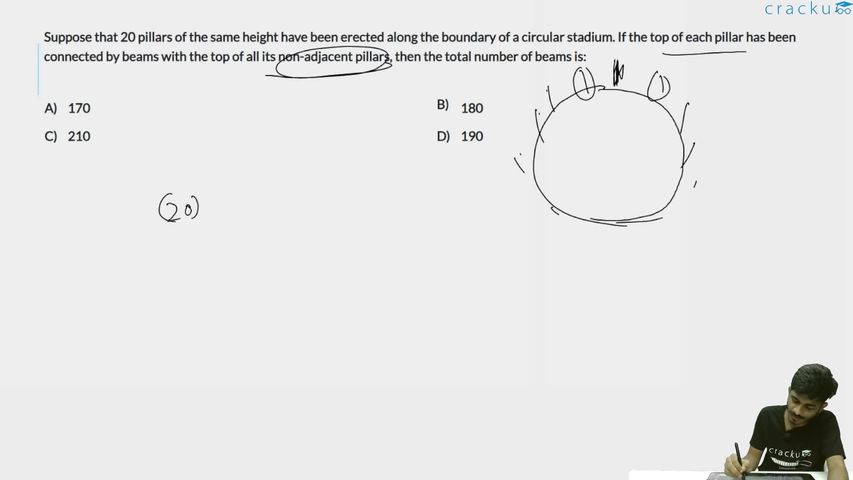
Suppose that 20 pillars of the same height have been erected along the boundary of a circular stadium. If the top of each pillar has been connected by beams with the top of all its non-adjacent pillars, then the total number of beams is:
We have a total of $$n = 20$$ identical pillars placed at equal intervals on the circumference of a circular stadium.
Any pair of pillars can potentially be connected by a beam. The number of different pairs that can be chosen from $$n$$ objects is given by the combination formula
$$^nC_2 \;=\; \frac{n(n-1)}{2}.$$
Substituting $$n = 20$$, we get
$$^{20}C_2 \;=\; \frac{20 \times 19}{2} \;=\; 190.$$
These 190 pairs represent all possible connections, including the connections between adjacent pillars (the sides of the 20-gon) and the connections between non-adjacent pillars (the chords of the 20-gon).
However, the problem states that beams are laid only between non-adjacent pillars. We must therefore exclude those pairs which are adjacent.
In a 20-sided polygon, each side joins exactly two adjacent pillars, and there are as many sides as pillars. Hence the number of adjacent pairs equals
$$20.$$
So the number of beams required is obtained by subtracting these 20 adjacent connections from the total 190 possible connections:
$$\text{Required beams} \;=\; 190 \;-\; 20 \;=\; 170.$$
Therefore, the total number of beams that can be fixed between the tops of all non-adjacent pillars is $$170$$. Hence, the correct answer is Option A.
Was this solution helpful?
Click on the Email ☝️ to Watch the Video Solution
Create a FREE account and get:
_1.webp)

Educational materials for JEE preparation

Ask our AI anything

AI can make mistakes. Please verify important information.
AI can make mistakes. Please verify important information.
