
Join Our JEE Preparation Group
Prep with like-minded aspirants; Get access to free daily tests and study material.
Sign in
Please select an account to continue using cracku.in
↓ →
Join Our JEE Preparation Group
Prep with like-minded aspirants; Get access to free daily tests and study material.
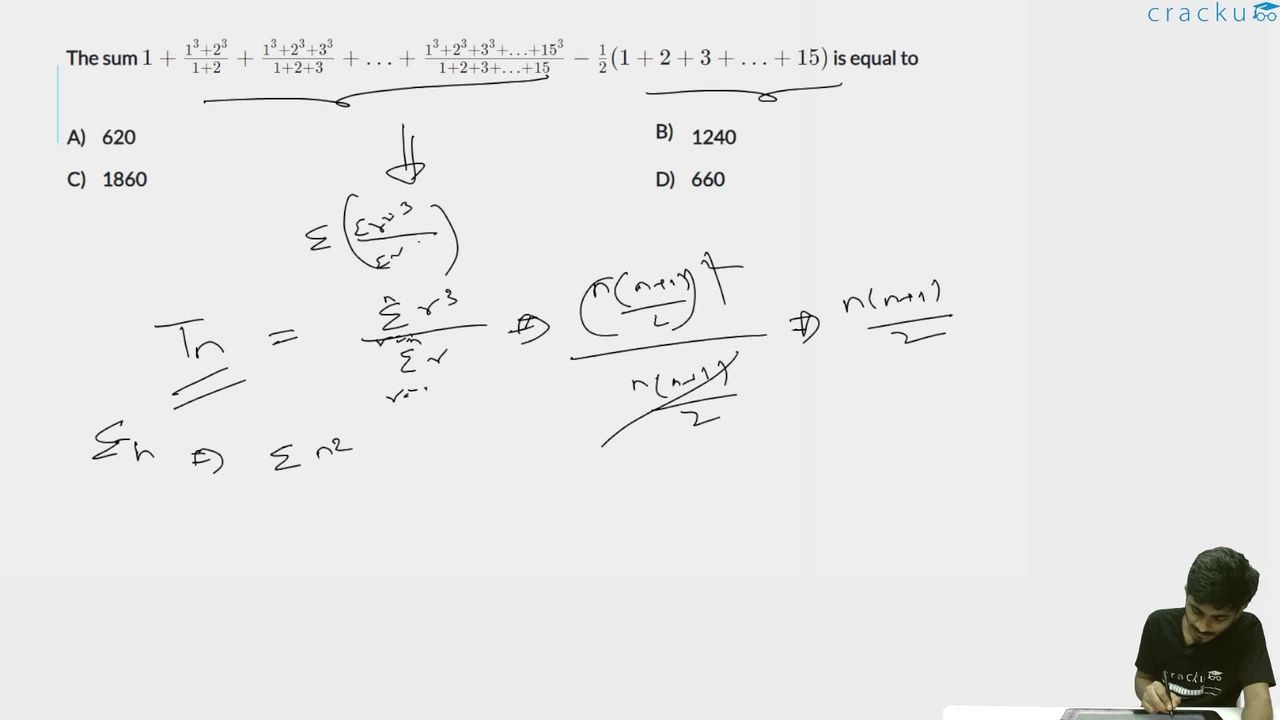
The sum $$1 + \frac{1^3 + 2^3}{1 + 2} + \frac{1^3 + 2^3 + 3^3}{1 + 2 + 3} + \ldots + \frac{1^3 + 2^3 + 3^3 + \ldots + 15^3}{1 + 2 + 3 + \ldots + 15} - \frac{1}{2}(1 + 2 + 3 + \ldots + 15)$$ is equal to
We begin by observing that every fraction in the long sum has the same general shape: the numerator is the sum of the first $$k$$ cubes and the denominator is the sum of the first $$k$$ natural numbers. Let us look at the general term more carefully.
The formula for the sum of the first $$k$$ natural numbers is stated first:
$$1+2+3+\ldots+k=\frac{k(k+1)}{2}.$$
Next, the formula for the sum of the first $$k$$ cubes is stated:
$$1^{3}+2^{3}+3^{3}+\ldots+k^{3}=\left(\frac{k(k+1)}{2}\right)^{2}.$$
Now we form the fraction occurring in the given series for a general index $$k\ge1$$:
$$\frac{1^{3}+2^{3}+\ldots+k^{3}}{1+2+\ldots+k} =\frac{\left(\dfrac{k(k+1)}{2}\right)^{2}} {\dfrac{k(k+1)}{2}} =\frac{k(k+1)}{2}.$$
Hence each term of the series, including the very first, simplifies neatly to $$\dfrac{k(k+1)}{2}$$. Therefore the entire summation part of the problem can be rewritten as a simple sum:
$$\sum_{k=1}^{15}\frac{k(k+1)}{2}.$$
We expand the numerator $$k(k+1)$$ as $$k^{2}+k$$ so that every algebraic step is visible:
$$\sum_{k=1}^{15}\frac{k(k+1)}{2} =\frac12\sum_{k=1}^{15}\bigl(k^{2}+k\bigr) =\frac12\left(\sum_{k=1}^{15}k^{2}+\sum_{k=1}^{15}k\right).$$
We now substitute the standard summation formulas one at a time. First, for the squares we have
$$\sum_{k=1}^{15}k^{2} =\frac{15(15+1)(2\cdot15+1)}{6} =\frac{15\cdot16\cdot31}{6} =\frac{7440}{6} =1240.$$
Next, for the first powers we have
$$\sum_{k=1}^{15}k=\frac{15(15+1)}{2}=15\cdot8=120.$$
Adding these two results inside the parentheses gives
$$\sum_{k=1}^{15}k^{2}+\sum_{k=1}^{15}k =1240+120=1360.$$
Multiplying by the outside factor $$\dfrac12$$ we obtain the total of all the fractions:
$$\sum_{k=1}^{15}\frac{k(k+1)}{2} =\frac12\cdot1360=680.$$
The original question, however, also asks us to subtract $$\dfrac12(1+2+3+\ldots+15)$$. We already know the inner sum is $$120$$, so one half of it is
$$\frac12(1+2+3+\ldots+15)=\frac12\cdot120=60.$$
Now we perform the final subtraction required by the problem statement:
$$680-60=620.$$
Hence, the correct answer is Option A.
Was this solution helpful?
Click on the Email ☝️ to Watch the Video Solution
Create a FREE account and get:
Educational materials for JEE preparation

Ask our AI anything

AI can make mistakes. Please verify important information.
AI can make mistakes. Please verify important information.

_1.webp)
