
Join Our JEE Preparation Group
Prep with like-minded aspirants; Get access to free daily tests and study material.
Sign in
Please select an account to continue using cracku.in
↓ →
Join Our JEE Preparation Group
Prep with like-minded aspirants; Get access to free daily tests and study material.
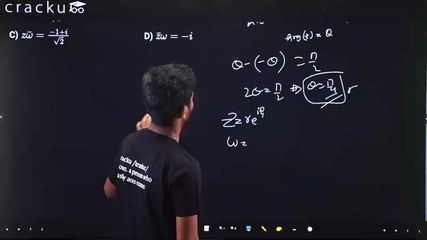
If z and $$\omega$$ are two complex numbers such that $$z\omega = 1$$ and $$\arg(z) - \arg(\omega) = \frac{\pi}{2}$$, then:
We are told that two complex numbers $$z$$ and $$\omega$$ satisfy the relations $$z\omega = 1$$ and $$\arg(z) - \arg(\omega) = \dfrac{\pi}{2}.$$
First, from $$z\omega = 1$$ we can write $$\omega = \dfrac{1}{z}.$$ For any non-zero complex number, the argument of its reciprocal is the negative of the original argument, that is, $$\arg\!\left(\dfrac{1}{z}\right) = -\arg(z).$$ We will use this fact repeatedly.
Let us denote $$\arg(z)=\theta.$$ Using the property just stated, we then have $$\arg(\omega)=\arg\!\left(\dfrac{1}{z}\right)=-\theta.$$
Now substitute these arguments in the given difference:
$$\arg(z)-\arg(\omega)=\theta-(-\theta)=2\theta.$$
But the problem tells us that this difference is $$\dfrac{\pi}{2},$$ so we set
$$2\theta=\dfrac{\pi}{2}\; \Longrightarrow\; \theta=\dfrac{\pi}{4}.$$
Thus the argument of $$z$$ is $$\dfrac{\pi}{4}.$$ Write $$z$$ in polar (modulus-argument) form:
$$z = r\,e^{\,i\pi/4}=r\!\left(\cos\dfrac{\pi}{4}+i\sin\dfrac{\pi}{4}\right) =r\!\left(\dfrac{1}{\sqrt2}+i\,\dfrac{1}{\sqrt2}\right),$$ where $$r=\lvert z\rvert>0$$ is the modulus of $$z.$$
Next, using $$\omega=\dfrac{1}{z},$$ write $$\omega$$ in polar form as well. Because $$\omega=\dfrac{1}{z}=\dfrac{1}{r}\,e^{-\,i\pi/4},$$ we have
$$\omega=\dfrac{1}{r}\!\left(\cos\!\left(-\dfrac{\pi}{4}\right) +i\sin\!\left(-\dfrac{\pi}{4}\right)\right) =\dfrac{1}{r}\!\left(\dfrac{1}{\sqrt2}-i\,\dfrac{1}{\sqrt2}\right).$$
We now compute the product $$\bar{z}\,\omega,$$ where $$\bar{z}$$ is the complex conjugate of $$z.$$ Conjugation in polar form changes the sign of the argument, so
$$\bar{z}=r\,e^{-\,i\pi/4}.$$
Multiply $$\bar{z}$$ by $$\omega$$:
$$\bar{z}\,\omega =\bigl(r\,e^{-\,i\pi/4}\bigr)\!\left(\dfrac{1}{r}\,e^{-\,i\pi/4}\right) =e^{-\,i\pi/2}.$$
We have used the fact that $$r\cdot\dfrac{1}{r}=1$$ and added the exponents of the same base $$e$$ (rule: $$e^{a}\,e^{b}=e^{a+b}$$).
Now simplify $$e^{-\,i\pi/2}$$ by recalling Euler’s formula $$e^{i\phi}=\cos\phi+i\sin\phi$$:
$$e^{-\,i\pi/2}=\cos\!\left(-\dfrac{\pi}{2}\right)+i\sin\!\left(-\dfrac{\pi}{2}\right) =0 - i = -\,i.$$
Thus we obtain the concise result
$$\bar{z}\,\omega = -i.$$
This matches Option D in the list.
Hence, the correct answer is Option D.
Was this solution helpful?
Click on the Email ☝️ to Watch the Video Solution
Create a FREE account and get:
_1.webp)

Educational materials for JEE preparation

Ask our AI anything

AI can make mistakes. Please verify important information.
AI can make mistakes. Please verify important information.
