
Join Our JEE Preparation Group
Prep with like-minded aspirants; Get access to free daily tests and study material.
Sign in
Please select an account to continue using cracku.in
↓ →
Join Our JEE Preparation Group
Prep with like-minded aspirants; Get access to free daily tests and study material.
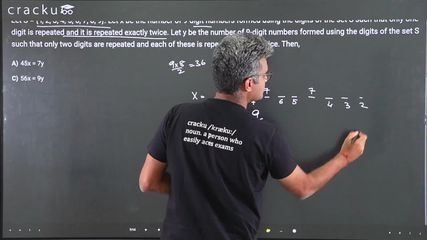
Let S = {1, 2, 3, 4, 5, 6, 7, 8, 9}. Let x be the number of 9-digit numbers formed using the digits of the set S such that only one digit is repeated and it is repeated exactly twice. Let y be the number of 9-digit numbers formed using the digits of the set S such that only two digits are repeated and each of these is repeated exactly twice. Then,
Calculating x:
In this case, we have to form a 9-digit number where only one digit is repeated, and it is repeated exactly twice.
Selecting the repeated digit: $$^9C_1=9$$ ways
Now, one digit is used twice, we need 9 - 2 = 7 more distinct digits from the remaining 8 digits in S. This can be selected in $$^8C_7=8$$ ways.
Now, all these 9 digits can be arranged in $$\dfrac{9!}{2!}$$ ways.
Total possible arrangements: $$9\times8\times\dfrac{9!}{2!}=36\times9!$$ which is equal to x.
Calculating x:
In this case, we have to form a 9-digit number where two digits are repeated, and each is repeated exactly twice.
Selecting the repeated digits: $$^9C_2=36$$ ways
Now, two digits is used twice, we need 9 - 4 = 5 more distinct digits from the remaining 7 digits in S. This can be selected in $$^7C_5=21$$ ways.
Now, all these 9 digits can be arranged in $$\dfrac{9!}{2!2!}$$ ways.
Total possible arrangements: $$36\times21\times\dfrac{9!}{2!2!}=9\times21\times9!=189\times9!$$ which is equal to y.
To find the relationship, we can divide y by x.
$$\dfrac{y}{x}=\dfrac{189\times9!}{36\times9!}$$
$$\dfrac{y}{x}=\dfrac{21}{4}$$
Or, we can say, 4y = 21x
Was this solution helpful?
Click on the Email ☝️ to Watch the Video Solution
Create a FREE account and get:
_1.webp)

Educational materials for JEE preparation

Ask our AI anything

AI can make mistakes. Please verify important information.
AI can make mistakes. Please verify important information.
