
Join Our JEE Preparation Group
Prep with like-minded aspirants; Get access to free daily tests and study material.
Sign in
Please select an account to continue using cracku.in
↓ →
Join Our JEE Preparation Group
Prep with like-minded aspirants; Get access to free daily tests and study material.
Let ABC be an equilateral triangle with orthocenter at the origin and the side BC on the line $$x+2\sqrt{2}y=4$$. If the co-ordinates of the vertex A are $$(\alpha, \beta)$$, then the greatest integer less than or equal to $$|\alpha + \sqrt{2}\beta |$$ is
Given: Orthocenter $$O(0,0)$$, Side $$BC: x + 2\sqrt{2}y - 4 = 0$$.
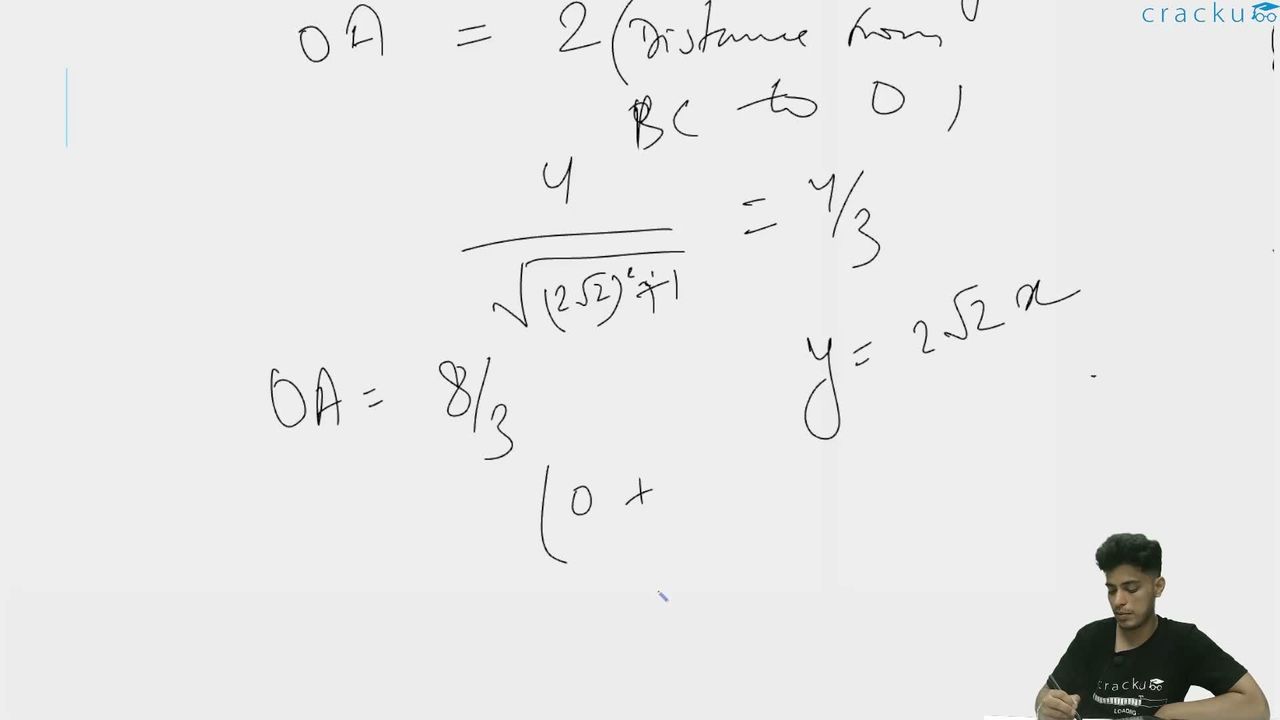
Property: In an equilateral triangle, the orthocenter is the centroid. The distance from the vertex $$A$$ to $$O$$ is twice the distance from $$O$$ to the side $$BC$$.
Distance $$O$$ to $$BC$$ ($$h$$): $$h = \frac{|0 + 0 - 4|}{\sqrt{1^2 + (2\sqrt{2})^2}} = \frac{4}{\sqrt{1+8}} = \frac{4}{3}$$.
Vertex distance: The distance $$OA = 2h = 2(\frac{4}{3}) = \frac{8}{3}$$.
Vector approach: The line $$OA$$ is perpendicular to $$BC$$. The normal vector to $$BC$$ is $$(1, 2\sqrt{2})$$. The unit vector is $$\hat{n} = (\frac{1}{3}, \frac{2\sqrt{2}}{3})$$.
Coordinates of $$A$$: Since $$A$$ is on the opposite side of the origin from $$BC$$, $$A = O - (OA)\hat{n} = (0,0) - \frac{8}{3}(\frac{1}{3}, \frac{2\sqrt{2}}{3}) = (-\frac{8}{9}, -\frac{16\sqrt{2}}{9})$$.
Evaluate Expression: $$|\alpha + \sqrt{2}\beta| = |-\frac{8}{9} + \sqrt{2}(-\frac{16\sqrt{2}}{9})| = |-\frac{8}{9} - \frac{32}{9}| = |-\frac{40}{9}| \approx 4.44$$.
Greatest Integer: $$\lfloor 4.44 \rfloor = 4$$.
The answer is 4
Was this solution helpful?
Click on the Email ☝️ to Watch the Video Solution
Create a FREE account and get:
_1.webp)

Educational materials for JEE preparation

Ask our AI anything

AI can make mistakes. Please verify important information.
AI can make mistakes. Please verify important information.
