
Join Our JEE Preparation Group
Prep with like-minded aspirants; Get access to free daily tests and study material.
Sign in
Please select an account to continue using cracku.in
↓ →
Join Our JEE Preparation Group
Prep with like-minded aspirants; Get access to free daily tests and study material.
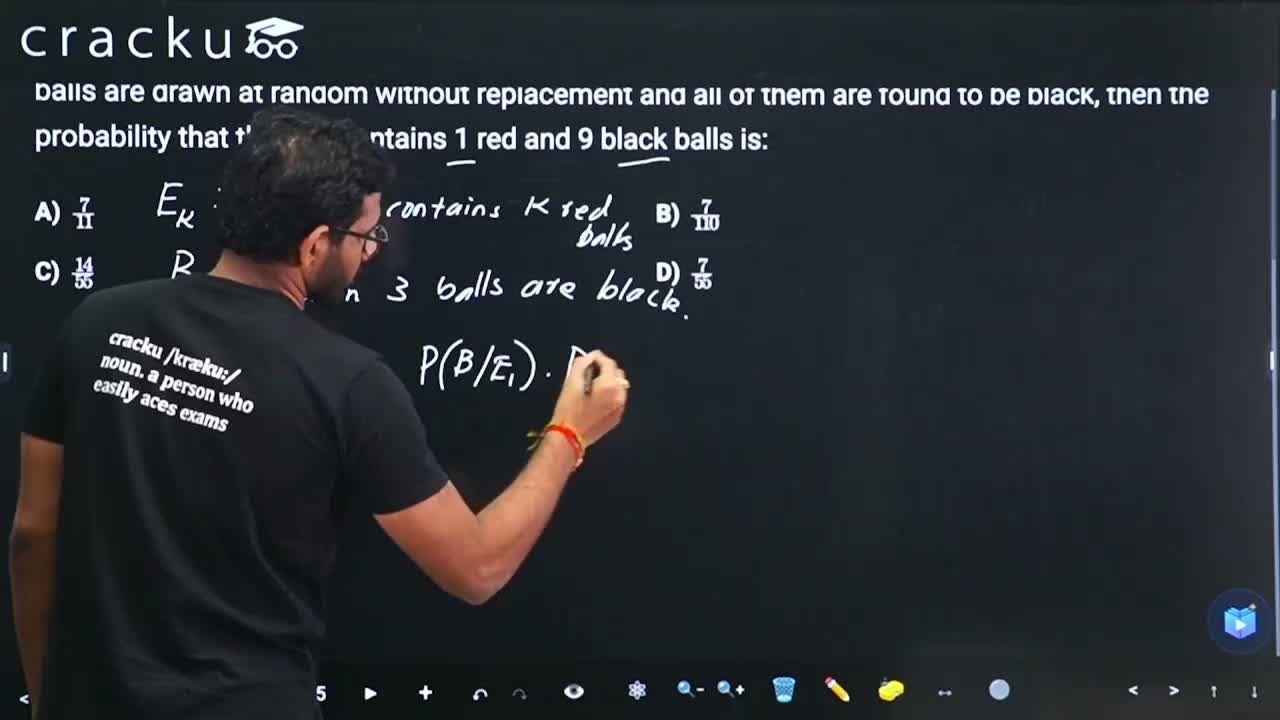
A bag contains 1O balls out of which k are red and (10 - k) are black, where $$0\leq k\leq 10$$. If three balls are drawn at random without replacement and all of them are found to be black, then the probability that the bag contains 1 red and 9 black balls is:
1. Define the Events
Let us establish the events for our conditional probability analysis:
E_k: Event that the bag contains exactly k red balls.
B: Event that all 3 drawn balls are black.
Since there is no prior information about k, all choices from 0 to 10 are equally likely:
$$P(E_k) = \frac{1}{11} \quad \text{for } k = 0, 1, 2, \dots, 10$$
2. Probability of the Condition Given k
If a bag contains k red balls, it contains (10 - k) black balls. The probability of drawing 3 black balls without replacement is given by:
$$P(B \mid E_k) = \frac{\binom{10-k}{3}}{\binom{10}{3}}$$
For the specific case of 1 red ball and 9 black balls (k = 1):
$$P(B \mid E_1) = \frac{\binom{9}{3}}{\binom{10}{3}} = \frac{84}{120}$$
3. Apply Bayes' Theorem
We need to calculate the posterior probability P(E_1 \mid B):
$$P(E_1 \mid B) = \frac{P(B \mid E_1) \cdot P(E_1)}{\sum_{k=0}^{10} P(B \mid E_k) \cdot P(E_k)}$$
Substitute the values into the formula:
$$P(E_1 \mid B) = \frac{\frac{\binom{9}{3}}{\binom{10}{3}} \cdot \frac{1}{11}}{\sum_{k=0}^{10} \frac{\binom{10-k}{3}}{\binom{10}{3}} \cdot \frac{1}{11}} = \frac{\binom{9}{3}}{\sum_{k=0}^{10} \binom{10-k}{3}}$$
4. Evaluate the Denominator
The sum in the denominator can be simplified using the Hockey-Stick Identity:
$$\sum_{k=0}^{10} \binom{10-k}{3} = \binom{3}{3} + \binom{4}{3} + \dots + \binom{10}{3} = \binom{11}{4}$$
Now compute the exact combinations:
$$\binom{9}{3} = \frac{9 \times 8 \times 7}{3 \times 2 \times 1} = 84$$
$$\binom{11}{4} = \frac{11 \times 10 \times 9 \times 8}{4 \times 3 \times 2 \times 1} = 330$$
5. Calculate Final Probability
Substitute these numbers back into the simplified fraction:
$$P(E_1 \mid B) = \frac{84}{330} = \frac{14}{55}$$
Was this solution helpful?
Click on the Email ☝️ to Watch the Video Solution
Create a FREE account and get:
_1.webp)

Educational materials for JEE preparation

Ask our AI anything

AI can make mistakes. Please verify important information.
AI can make mistakes. Please verify important information.
