
Join Our JEE Preparation Group
Prep with like-minded aspirants; Get access to free daily tests and study material.
Sign in
Please select an account to continue using cracku.in
↓ →
Join Our JEE Preparation Group
Prep with like-minded aspirants; Get access to free daily tests and study material.
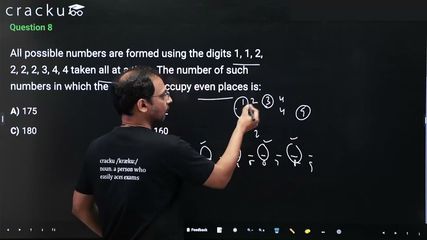
All possible numbers are formed using the digits 1, 1, 2, 2, 2, 2, 3, 4, 4 taken all at a time. The number of such numbers in which the odd digits occupy even places is:
We have the multiset of digits $$\{1,1,2,2,2,2,3,4,4\}$$ which contains a total of 9 digits.
The odd digits are $$1,1,3$$ — that is, two 1’s and one 3, giving exactly 3 odd digits. The even digits are $$2,2,2,2,4,4$$ — four 2’s and two 4’s, giving 6 even digits.
In any 9-digit number, the positions are numbered $$1,2,3,4,5,6,7,8,9$$. Even positions are $$2,4,6,8$$ (four places) and odd positions are $$1,3,5,7,9$$ (five places).
The requirement is: all odd digits must be placed only in even positions. Because there are only 3 odd digits but 4 even places, we must choose exactly 3 of those 4 even places for the odd digits, leaving the remaining one even place plus all five odd places for even digits.
First, we choose the positions for the odd digits. The number of ways to choose 3 places out of 4 is given by the combination formula $$\binom{n}{r} = \frac{n!}{r!\,(n-r)!}.$$ Substituting $$n=4,\; r=3$$ we get $$\binom{4}{3} = \frac{4!}{3!\,1!} = 4.$$
Next, we arrange the odd digits $$1,1,3$$ in the 3 chosen places. The number of distinct permutations of 3 objects in which two are identical is $$\frac{3!}{2!} = 3$$ because we divide by $$2!$$ to account for the repetition of the two 1’s.
Hence, the total number of ways to place the odd digits is $$4 \times 3 = 12.$$
Now we place the 6 even digits $$2,2,2,2,4,4$$ in the remaining 6 positions (five odd positions and the one unused even position). The number of distinct permutations of these 6 digits, with four 2’s and two 4’s, is $$\frac{6!}{4!\,2!} = \frac{720}{24 \times 2} = 15.$$
Finally, by the multiplication principle, the overall number of admissible 9-digit numbers is $$12 \times 15 = 180.$$
Hence, the correct answer is Option C.
Was this solution helpful?
Click on the Email ☝️ to Watch the Video Solution
Create a FREE account and get:
_1.webp)

Educational materials for JEE preparation

Ask our AI anything

AI can make mistakes. Please verify important information.
AI can make mistakes. Please verify important information.
