
Join Our JEE Preparation Group
Prep with like-minded aspirants; Get access to free daily tests and study material.
Sign in
Please select an account to continue using cracku.in
↓ →
Join Our JEE Preparation Group
Prep with like-minded aspirants; Get access to free daily tests and study material.
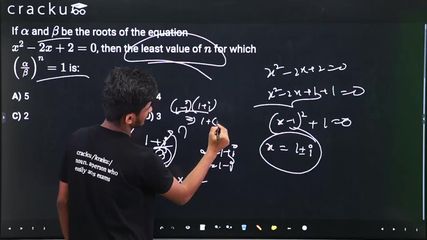
If $$\alpha$$ and $$\beta$$ be the roots of the equation $$x^{2} - 2x + 2 = 0$$, then the least value of $$n$$ for which $$\left(\frac{\alpha}{\beta}\right)^{n} = 1$$ is:
We have the quadratic equation $$x^{2}-2x+2=0$$ whose roots are denoted by $$\alpha$$ and $$\beta$$.
To find the roots, we first write the quadratic‐formula statement: for $$ax^{2}+bx+c=0,$$ the roots are $$x=\dfrac{-b\pm\sqrt{b^{2}-4ac}}{2a}.$$
Here $$a=1,\;b=-2,\;c=2.$$ Substituting these values we get
$$\alpha,\beta=\dfrac{-(-2)\pm\sqrt{(-2)^{2}-4(1)(2)}}{2(1)} =\dfrac{2\pm\sqrt{4-8}}{2} =\dfrac{2\pm\sqrt{-4}}{2} =\dfrac{2\pm2i}{2} =1\pm i.$$
So we may choose $$\alpha = 1+i,\qquad \beta = 1-i.$$
Now we calculate the ratio $$\dfrac{\alpha}{\beta}:$$
$$\frac{\alpha}{\beta} =\frac{1+i}{1-i} =\frac{(1+i)(1+i)}{(1-i)(1+i)} =\frac{(1+i)^{2}}{1^{2}-i^{2}} =\frac{1+2i+i^{2}}{1-(-1)} =\frac{1+2i-1}{2} =\frac{2i}{2} =i.$$
Thus $$\dfrac{\alpha}{\beta}=i.$$
We require the least positive integer $$n$$ for which $$ \left(\dfrac{\alpha}{\beta}\right)^{n}=1. $$ Substituting the value just found, this condition becomes $$i^{n}=1.$$
The integral powers of $$i$$ cycle as follows:
$$i^{1}=i,\; i^{2}=-1,\; i^{3}=-i,\; i^{4}=1,$$ and then the pattern repeats every four powers.
The first time we obtain $$1$$ is at the fourth power. Hence the smallest positive integer satisfying $$i^{n}=1$$ is $$n=4.$$
Therefore the least value of $$n$$ for which $$\left(\dfrac{\alpha}{\beta}\right)^{n}=1$$ is $$4.$$ Hence, the correct answer is Option B.
Was this solution helpful?
Click on the Email ☝️ to Watch the Video Solution
Create a FREE account and get:
_1.webp)

Educational materials for JEE preparation

Ask our AI anything

AI can make mistakes. Please verify important information.
AI can make mistakes. Please verify important information.
