
Join Our JEE Preparation Group
Prep with like-minded aspirants; Get access to free daily tests and study material.
Sign in
Please select an account to continue using cracku.in
↓ →
Join Our JEE Preparation Group
Prep with like-minded aspirants; Get access to free daily tests and study material.
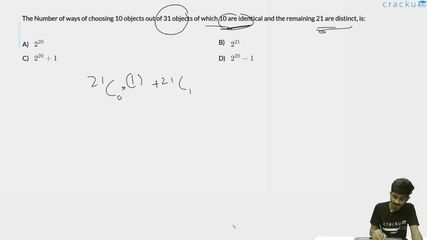
The Number of ways of choosing 10 objects out of 31 objects of which 10 are identical and the remaining 21 are distinct, is:
We have a total of 31 objects. 10 of these are identical (say identical balls) and the remaining 21 objects are all distinct. We wish to select exactly 10 objects altogether.
Let us suppose that out of the 10 identical objects we actually pick $$k$$ of them. Because they are identical, picking $$k$$ of them can be done in only one way; there is no further choice involved once the value of $$k$$ is fixed.
Having decided to take $$k$$ identical objects, we must still choose the remaining $$10-k$$ objects from the 21 distinct ones. The number of ways to choose $$10-k$$ objects out of 21 distinct objects is, by the definition of combinations,
$$\binom{21}{\,10-k\,} = \frac{21!}{(10-k)!\,(21-(10-k))!}.$$
Here $$k$$ can be any integer from 0 up to 10 (we cannot take more than 10 identical objects because we only need 10 in total). Therefore the total number of possible selections is obtained by summing the above expression over all admissible $$k$$:
$$\text{Total ways} \;=\; \sum_{k=0}^{10} \binom{21}{\,10-k\,}.$$
For convenience we perform a change of variable. Put $$r = 10-k$$. Then when $$k = 0$$ we have $$r = 10$$, and when $$k = 10$$ we have $$r = 0$$. Hence $$r$$ runs through all the integers from 0 to 10 inclusive, and the sum rewrites as
$$\text{Total ways} \;=\; \sum_{r=0}^{10} \binom{21}{\,r\,}.$$
Now we recall two standard binomial identities:
1. The Binomial-Theorem sum $$\displaystyle \sum_{r=0}^{n} \binom{n}{r} = 2^{n}.$$
2. The symmetry of binomial coefficients $$\displaystyle \binom{n}{r} = \binom{n}{\,n-r\,}.$$
For our case $$n = 21$$, an odd number. Listing all coefficients $$\binom{21}{0},\binom{21}{1},\dots,\binom{21}{21}$$, there are 22 terms in total. They come in pairs of equal value: $$\binom{21}{0} = \binom{21}{21},\,\binom{21}{1} = \binom{21}{20},$$ and so on, up to $$\binom{21}{10} = \binom{21}{11}.$$ Because 21 is odd, there is no single unpaired “middle” coefficient. Consequently, half of the full binomial sum is obtained by adding the first 11 terms (those with $$r=0$$ to $$r=10$$), and the other half is obtained by the remaining 11 terms (those with $$r=11$$ to $$r=21$$).
Hence we have
$$\sum_{r=0}^{10} \binom{21}{\,r\,} \;=\; \frac{1}{2}\,\sum_{r=0}^{21} \binom{21}{\,r\,} \;=\; \frac{1}{2}\,\bigl(2^{21}\bigr) \;=\; 2^{20}.$$
Therefore the number of ways to choose the required 10 objects is $$2^{20}.$$
Hence, the correct answer is Option A.
Click on the Email ☝️ to Watch the Video Solution
Create a FREE account and get:
_1.webp)

Educational materials for JEE preparation

Ask our AI anything

AI can make mistakes. Please verify important information.
AI can make mistakes. Please verify important information.


