
Join Our JEE Preparation Group
Prep with like-minded aspirants; Get access to free daily tests and study material.
Sign in
Please select an account to continue using cracku.in
↓ →
Join Our JEE Preparation Group
Prep with like-minded aspirants; Get access to free daily tests and study material.
Let us denote the unknown complex number by $$z$$ and write it in its rectangular (Cartesian) form: we put
$$z = x + iy,$$
where $$x$$ and $$y$$ are real numbers representing the point $$(x,y)$$ in the Argand plane.
The given condition is
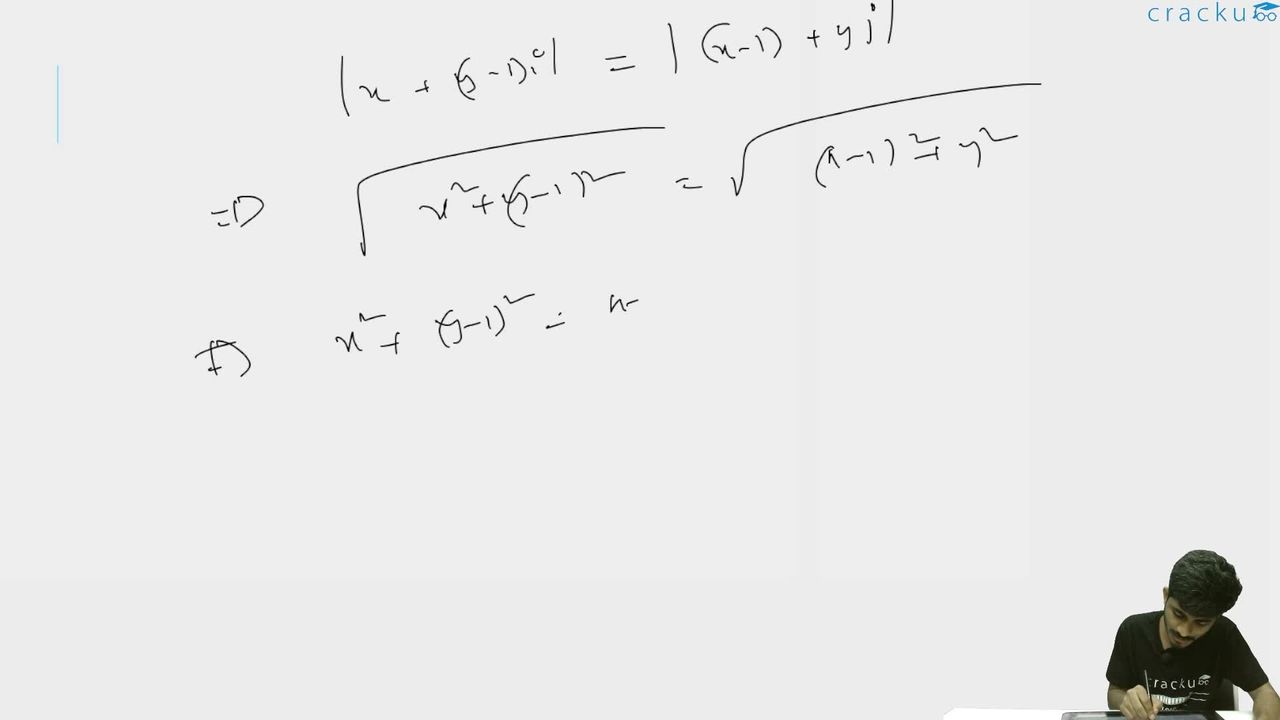
$$|z - i| = |z - 1|.$$
First we translate each modulus into the distance formula. Remember that for any two points $$(x_1,y_1)$$ and $$(x_2,y_2)$$, the distance between them is
$$\sqrt{(x_1-x_2)^2 + (y_1-y_2)^2}.$$
Here $$z - i$$ means the vector from the fixed point $$i$$ (which is the point $$(0,1)$$) to the variable point $$z = x + iy$$. So
$$|z - i| = \sqrt{(x - 0)^2 + (y - 1)^2}.$$
Similarly, $$z - 1$$ connects the fixed point $$1$$ (the point $$(1,0)$$) to $$z$$, giving
$$|z - 1| = \sqrt{(x - 1)^2 + (y - 0)^2}.$$
Because these two lengths are equal, we have the equation
$$\sqrt{(x - 0)^2 + (y - 1)^2} = \sqrt{(x - 1)^2 + (y - 0)^2}.$$
Now we square both sides to eliminate the square roots:
$$(x - 0)^2 + (y - 1)^2 = (x - 1)^2 + (y - 0)^2.$$
Writing out every term explicitly gives
$$x^2 + (y - 1)^2 = (x - 1)^2 + y^2.$$
Next we expand each squared binomial step by step:
$$x^2 + \bigl(y^2 - 2y + 1\bigr) = \bigl(x^2 - 2x + 1\bigr) + y^2.$$
Combining like terms on the left side we obtain
$$x^2 + y^2 - 2y + 1 = x^2 - 2x + 1 + y^2.$$
Notice that the terms $$x^2$$ on both sides cancel, and the terms $$y^2$$ on both sides also cancel, leaving
$$-\,2y + 1 = -\,2x + 1.$$
Subtract $$1$$ from each side; the ones disappear:
$$-\,2y = -\,2x.$$
Now divide every term by $$-2$$ to isolate $$y$$:
$$y = x.$$
Thus the locus of points satisfying the original equation is the straight line
$$y = x,$$
which plainly passes through the origin and has slope $$1$$.
Hence, the correct answer is Option C.
Was this solution helpful?
Click on the Email ☝️ to Watch the Video Solution
Create a FREE account and get:
_1.webp)

Educational materials for JEE preparation

Ask our AI anything

AI can make mistakes. Please verify important information.
AI can make mistakes. Please verify important information.
