
Join Our JEE Preparation Group
Prep with like-minded aspirants; Get access to free daily tests and study material.
Sign in
Please select an account to continue using cracku.in
↓ →
Join Our JEE Preparation Group
Prep with like-minded aspirants; Get access to free daily tests and study material.
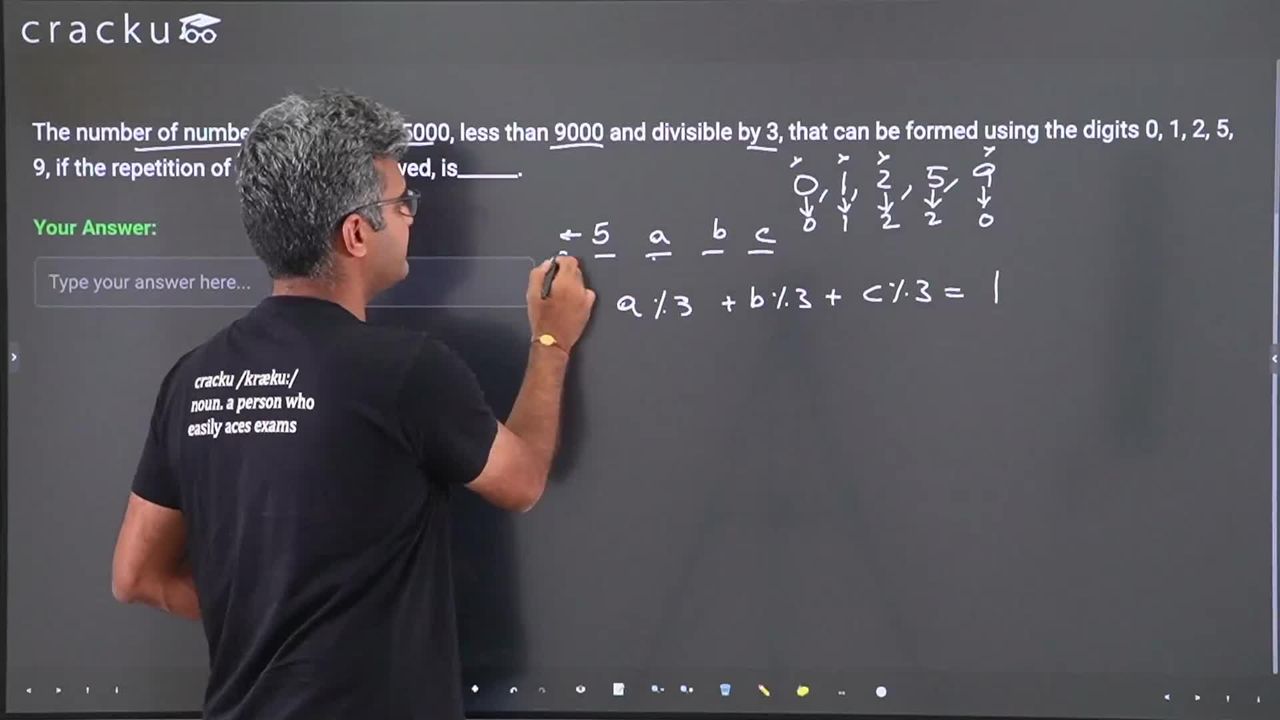
The number of numbers greater than 5000, less than 9000 and divisible by 3, that can be formed using the digits 0, 1, 2, 5, 9, if the repetition of the digits is allowed, is______.
Correct Answer: 42
The digits given are $${0,1,2,5,9} $$.
We need to make 4-digit numbers that are $$>5000$$ and $$<9000$$, and are divisible by 3.
Thus, the number is of the form $$5abc$$. The first numbe rhas to be 5 otherwise the numbers formed will not be in the given range.
For divisibility by 3 $$ 5+a+b+c \equiv 0 \pmod{3} $$ , essentially sum of the digits should be either 0 or a multiple of 3.
We form the following cases:
Case 1: All digits different
Possible set of selection: $$ (5,0,1,9), \quad \text{sum } = 15 \equiv 0 $$
The place of 5 is fixed, the remaining three digits can be arranged in $$ 3! = 6 $$
Hence, 6 possible numbers can be obtained.
Case 2: Two alike, two different
If 5 is the number that is repeated, then the possible selections are: $$ (5,5,0,2),\ (5,5,2,9) $$
Since the 5 at the first place is fixed, in each of these, the numbers can be arranged in $$ 3! = 6 \text{ ways} $$
Otherwise, if 5 is not the number repeated then the valid selections are $$(5$$, $$0$$, $$0$$, $$1)$$, $$\ (5$$, $$1$$, $$1$$, $$2)$$, $$\ (5$$, $$2$$, $$2$$, $$0)$$, $$\ (5$$, $$2$$, $$2$$, $$9)$$, $$\ (5$$, $$1$$, $$9$$, $$9)$$
In these cases, the digits can be arranged in $$ \frac{3!}{2!} = 3 \text{ ways} $$
So, the total number of numbers obtained in this case is $$ 5 \cdot 3 + 2 \cdot 6 = 15 + 12 = 27 $$
Case 3: Three alike, one different
If 5 is the digit that is repeated 3 times, the valid selections are: $$ (5,5,5,0),\ (5,5,5,9) $$
The digits can be arranged in $$ \frac{3!}{2!} = 3 \text{ ways} $$
If any other digit other than 5 is repeated 3 times, then we can have numbers 5000, 5222 and 5999 none of which are divisible by 3. hence they are not valid choices.
So, the total number of numbers obtained in this case is $$3+3=6 \text{ ways}$$
Case 4: Two pairs
The only valid arrangement here is $$ (5,5,1,1) $$ , and the digits can be arranged in $$ \frac{3!}{2!} = 3 $$. So the total number of numbers obtained is 3.
Hence, the total number of such numbers is $$ 6 + 27 + 6 + 3 = 42 $$
Was this solution helpful?
Click on the Email ☝️ to Watch the Video Solution
Create a FREE account and get:
_1.webp)

Educational materials for JEE preparation

Ask our AI anything

AI can make mistakes. Please verify important information.
AI can make mistakes. Please verify important information.
