
Join Our JEE Preparation Group
Prep with like-minded aspirants; Get access to free daily tests and study material.
Sign in
Please select an account to continue using cracku.in
↓ →
Join Our JEE Preparation Group
Prep with like-minded aspirants; Get access to free daily tests and study material.
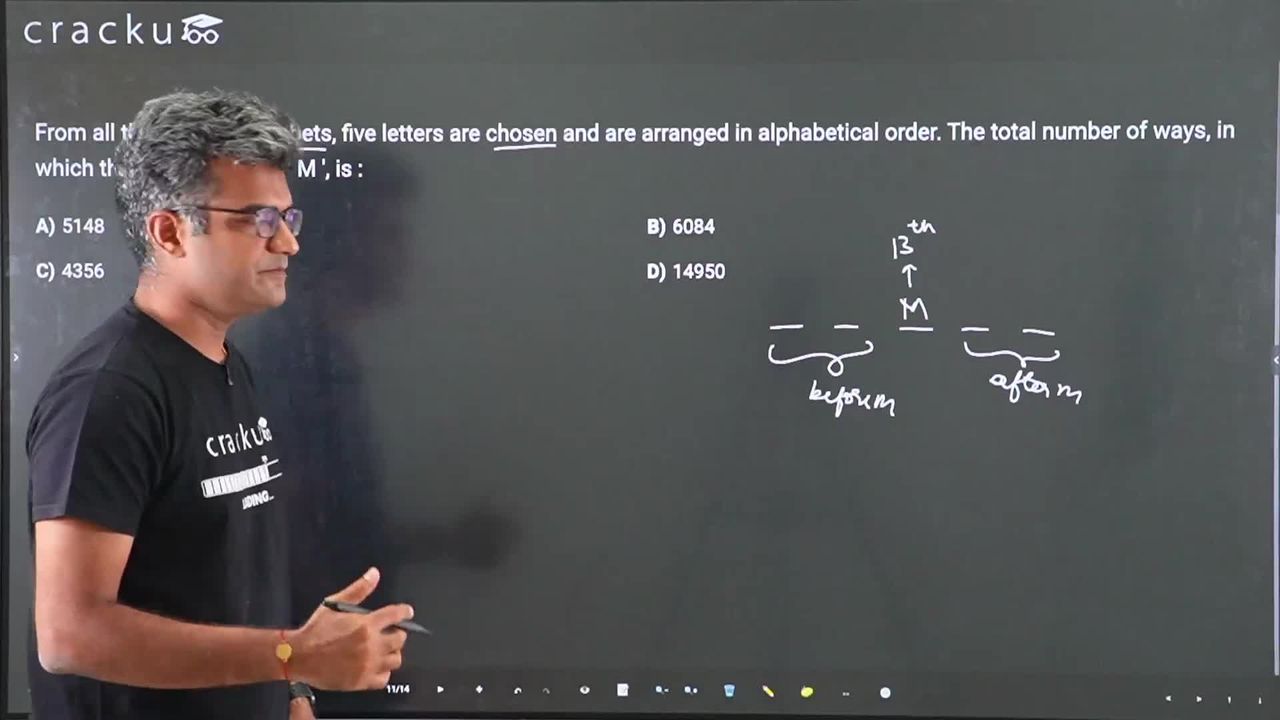
From all the English alphabets, five letters are chosen and are arranged in alphabetical order. The total number of ways, in which the middle letter is ' M ', is :
We have to select 5 alphabets and arrange them in alphabetical order such that the middle term is M.
M is the 13th term in the English alphabets.
It means that we have to select 2 alphabets out of 12, and place it on the left hand side of M and 2 alphabets out of the remaining 13, and place it on the right hand side of M.
For the left hand side of M:
Number of ways in which we select 2 alphabets out of 12 = $$12_{C_2}$$
Number of ways in which we arrange the selected alphabets in alphabetical order = 1 (only one case will be possible)
Total number of ways in which we select 2 alphabets out of 12 and arrange it in alphabetical order = $$12_{C_2}\times1=12_{C_2}=66$$
For the right hand side of M:
Number of ways in which we select 2 alphabets out of 13 = $$13_{C_2}$$
Number of ways in which we arrange the selected alphabets in alphabetical order = 1 (only one case will be possible)
Total number of ways in which we select 2 alphabets out of 13 and arrange it in alphabetical order = $$13_{C_2}\times1=13_{C_2}=78$$
Number of ways in which we can select M and place it in the middle of 5 alphabets = 1
Total number of ways in which we select 5 alphabets and arrange it in alphabetical order such that M is the middle term = $$66\times78\times1=5148$$
Hence, we can select 5 alphabets out of 26 and arrange it in alphabetical order in such a way that the middle term is M in 5148 ways.
$$\therefore\ $$ The required answer is A.
Was this solution helpful?
Click on the Email ☝️ to Watch the Video Solution
Create a FREE account and get:
_1.webp)

Educational materials for JEE preparation

Ask our AI anything

AI can make mistakes. Please verify important information.
AI can make mistakes. Please verify important information.
