
Join Our JEE Preparation Group
Prep with like-minded aspirants; Get access to free daily tests and study material.
Sign in
Please select an account to continue using cracku.in
↓ →
Join Our JEE Preparation Group
Prep with like-minded aspirants; Get access to free daily tests and study material.
Bag A contains 9 white and 8 black balls, while bag B contains 6 white and 4 black balls. One ball is randomly picked up from the bag B and mixed up with the balls in the bag A. Then a ball is randomly drawn from the bag A. If the probability, that the ball drawn is white, is $$\dfrac{p}{q},gcd(p,q)=1,$$ then $$p+q$$ is equal to
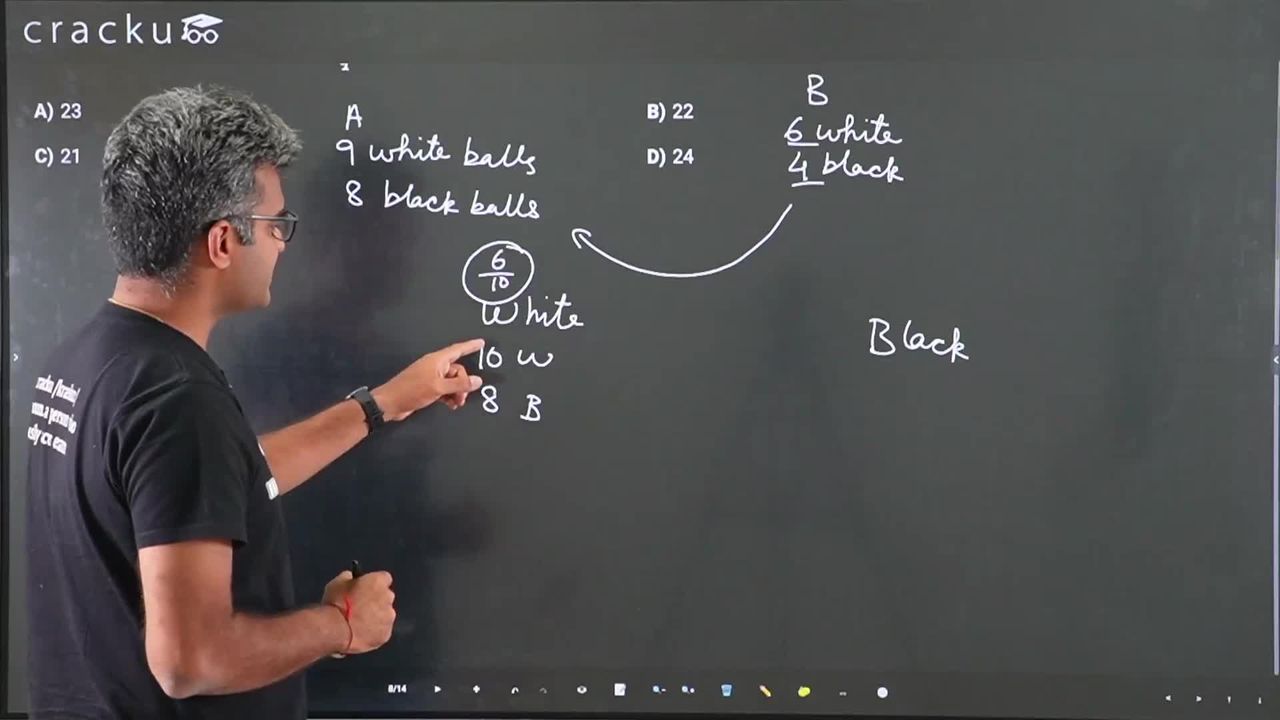
Bag A contains 9 white and 8 black balls and Bag B contains 6 white and 4 black balls.
It is given that one ball is picked from Bag B and mixed with the balls in Bag A. Then one ball is picked from Bag A and we have to find the probability that the ball picked is white.
Two cases will be formed.
Case 1: White ball is picked from Bag B and mixed with the other balls in Bag A.
Probability of picking a white ball from Bag B = $$\dfrac{6}{10}$$
Now, it is mixed with the balls in Bag A.
Bag A: 10 white and 8 black balls.
Probability of picking a white ball from Bag A = $$\dfrac{10}{18}$$
Probability of picking a white ball from Bag A given that a white ball is picked from Bag B = $$\dfrac{6}{10}\times\dfrac{10}{18}=\dfrac{1}{3}$$
Case 2: Black ball is picked from Bag B and mixed with the other balls in Bag A.
Probability of picking a black ball from Bag B = $$\dfrac{4}{10}$$
Now, it is mixed with the balls in Bag A.
Bag A: 9 white and 9 black balls.
Probability of picking a white ball from Bag A = $$\dfrac{9}{18}$$
Probability of picking a white ball from Bag A given that a black ball is picked from Bag B = $$\dfrac{4}{10}\times\dfrac{9}{18}=\dfrac{1}{5}$$
So, the probability of picking a white ball from Bag A after picking a ball from Bag B = $$\dfrac{1}{3}+\dfrac{1}{5}=\dfrac{8}{15}$$
It is in the form of $$\dfrac{p}{q}$$ where the greatest common divisor of $$(p\ ,\ q)=1$$
So, $$\dfrac{p}{q}=\dfrac{8}{15}$$
$$p+q=8+15=23$$
Hence, the sum of $$p$$ and $$q$$ is 23.
$$\therefore\ $$ The required answer is A.
Was this solution helpful?
Click on the Email ☝️ to Watch the Video Solution
Create a FREE account and get:
_1.webp)

Educational materials for JEE preparation

Ask our AI anything

AI can make mistakes. Please verify important information.
AI can make mistakes. Please verify important information.
