Join WhatsApp Icon JEE WhatsApp Group

JEE Heat Transfer Questions

Heat Transfer is an important chapter in the Thermal Physics unit of JEE Physics that explains how thermal energy moves through conduction, convection, and radiation. It covers practical and conceptual topics from heat flow through rods to the radiation laws governing hot bodies and appears reliably in JEE Main. With a mix of formula-based and conceptual questions, JEE Heat Transfer questions are a dependable scoring area for aspirants. This chapter covers thermal conduction and resistance, the analogy with electrical circuits, Newton's law of cooling, and the radiation laws including Stefan-Boltzmann and Wien's law. JEE Main tests conduction and cooling problems directly, while JEE Advanced may combine heat transfer with thermodynamics or calorimetry. Practising topic-wise JEE Questions helps you handle composite-rod and radiation problems with confidence.

A clear grasp of heat transfer complements thermodynamics and kinetic theory, rounding out your command of the entire thermal physics unit.

Heat Transfer Topic Overview

Parameter

Details

Topic Name

Heat Transfer

Subject

Physics

JEE Main Weightage

~3–4% (1–2 questions on average)

JEE Advanced Weightage

~3–5% (often combined)

Difficulty Level

Moderate

Important Concepts

Conduction, Thermal Resistance, Convection, Radiation, Newton's Law of Cooling

Recommended Practice Level

High – attempt 50+ mixed problems

Why Practice JEE Heat Transfer Questions?

  • Reliable weightage: Heat transfer contributes 1–2 questions in JEE Main most years.
  • Useful electrical analogy: Thermal resistance mirrors electrical circuits, simplifying composite problems.
  • Mix of question types: Conduction, cooling, and radiation offer varied practice.
  • Strong in Advanced: Radiation and combined heat problems appear in JEE Advanced.
  • Conceptual clarity: Radiation laws build intuition about how hot bodies emit energy.
  • Connects thermal topics: Heat transfer links calorimetry and thermodynamics.
  • Efficient revision: A compact set of laws makes review fast.

Important Concepts and Subtopics

Concept

Importance

Difficulty Level

Frequently Asked In

Conduction & Thermal Resistance

Very High

Moderate

JEE Main & Advanced

Composite Rods (Series & Parallel)

High

Moderate–High

JEE Main & Advanced

Newton's Law of Cooling

High

Moderate

JEE Main

Stefan-Boltzmann Law

Very High

Moderate

JEE Main & Advanced

Wien's Displacement Law

High

Easy–Moderate

JEE Main

Black Body Radiation

Moderate

Moderate

JEE Advanced

Preparation Strategy for JEE Heat Transfer

Concept learning: Understand the three modes of heat transfer and when each dominates. Master thermal conduction using the resistance analogy, where temperature difference plays the role of voltage and heat current the role of electric current.

Formula revision: Keep conduction, thermal-resistance, Newton's-law-of-cooling, Stefan-Boltzmann, and Wien's-law relations handy. Pairing this with structured JEE Online Coaching helps you reinforce the circuit analogy and clear doubts on radiation problems.

Problem-solving techniques: For composite rods, combine thermal resistances in series or parallel just like electrical resistors. For radiation, use Stefan-Boltzmann for total power and Wien's law for peak wavelength.

Common mistakes: Misapplying series and parallel rules for thermal resistance, forgetting the fourth-power dependence in Stefan-Boltzmann, and unit errors in temperature (using Celsius instead of Kelvin).

Exam strategy: Solve direct conduction and radiation questions first, then attempt composite-rod and combined heat problems that need more setup.

JEE Main & Advanced Weightage Analysis

Exam

Average Questions

Expected Marks

JEE Main

1–2

4–8

JEE Advanced

1–2

4–8

Heat Transfer is a steady contributor in JEE Main through conduction, cooling, and radiation questions. In JEE Advanced, it often appears combined with thermodynamics or calorimetry in multi-step problems.

Tips to Solve Heat Transfer Questions Faster

  • Use the electrical analogy to combine thermal resistances in composite-rod problems.
  • Apply Stefan-Boltzmann's fourth-power law carefully, always using Kelvin.
  • Use Wien's law to relate peak wavelength inversely to temperature.
  • For cooling, Newton's law applies for small temperature differences over the surroundings.
  • Identify the dominant mode of heat transfer to simplify the analysis.
  • Keep all temperatures in Kelvin for radiation calculations.

Reinforcing these methods with a timed JEE Mock Test helps you handle composite-rod and radiation questions efficiently.

Frequently Asked Questions

JEE Heat Transfer Questions – Important PYQs, Concepts & Weightage

Heat Transfer is an important chapter in the Thermal Physics unit of JEE Physics that explains how thermal energy moves through conduction, convection, and radiation. It covers practical and conceptual topics — from heat flow through rods to the radiation laws governing hot bodies — and appears reliably in JEE Main. With a mix of formula-based and conceptual questions, JEE Heat Transfer questions are a dependable scoring area for aspirants.

This chapter covers thermal conduction and resistance, the analogy with electrical circuits, Newton's law of cooling, and the radiation laws including Stefan-Boltzmann and Wien's law. JEE Main tests conduction and cooling problems directly, while JEE Advanced may combine heat transfer with thermodynamics or calorimetry. Practising topic-wise JEE Questions helps you handle composite-rod and radiation problems with confidence.

A clear grasp of heat transfer complements thermodynamics and kinetic theory, rounding out your command of the entire thermal physics unit.

Heat Transfer Topic Overview

Parameter

Details

Topic Name

Heat Transfer

Subject

Physics

JEE Main Weightage

~3–4% (1–2 questions on average)

JEE Advanced Weightage

~3–5% (often combined)

Difficulty Level

Moderate

Important Concepts

Conduction, Thermal Resistance, Convection, Radiation, Newton's Law of Cooling

Recommended Practice Level

High – attempt 50+ mixed problems

Why Practice JEE Heat Transfer Questions?

  • Reliable weightage: Heat transfer contributes 1–2 questions in JEE Main most years.
  • Useful electrical analogy: Thermal resistance mirrors electrical circuits, simplifying composite problems.
  • Mix of question types: Conduction, cooling, and radiation offer varied practice.
  • Strong in Advanced: Radiation and combined heat problems appear in JEE Advanced.
  • Conceptual clarity: Radiation laws build intuition about how hot bodies emit energy.
  • Connects thermal topics: Heat transfer links calorimetry and thermodynamics.
  • Efficient revision: A compact set of laws makes review fast.

Important Concepts and Subtopics

Concept

Importance

Difficulty Level

Frequently Asked In

Conduction & Thermal Resistance

Very High

Moderate

JEE Main & Advanced

Composite Rods (Series & Parallel)

High

Moderate–High

JEE Main & Advanced

Newton's Law of Cooling

High

Moderate

JEE Main

Stefan-Boltzmann Law

Very High

Moderate

JEE Main & Advanced

Wien's Displacement Law

High

Easy–Moderate

JEE Main

Black Body Radiation

Moderate

Moderate

JEE Advanced

Preparation Strategy for JEE Heat Transfer

Concept learning: Understand the three modes of heat transfer and when each dominates. Master thermal conduction using the resistance analogy, where temperature difference plays the role of voltage and heat current the role of electric current.

Formula revision: Keep conduction, thermal-resistance, Newton's-law-of-cooling, Stefan-Boltzmann, and Wien's-law relations handy. Pairing this with structured JEE Online Coaching helps you reinforce the circuit analogy and clear doubts on radiation problems.

Problem-solving techniques: For composite rods, combine thermal resistances in series or parallel just like electrical resistors. For radiation, use Stefan-Boltzmann for total power and Wien's law for peak wavelength.

Common mistakes: Misapplying series and parallel rules for thermal resistance, forgetting the fourth-power dependence in Stefan-Boltzmann, and unit errors in temperature (using Celsius instead of Kelvin).

Exam strategy: Solve direct conduction and radiation questions first, then attempt composite-rod and combined heat problems that need more setup.

JEE Main & Advanced Weightage Analysis

Exam

Average Questions

Expected Marks

JEE Main

1–2

4–8

JEE Advanced

1–2

4–8

Heat Transfer is a steady contributor in JEE Main through conduction, cooling, and radiation questions. In JEE Advanced, it often appears combined with thermodynamics or calorimetry in multi-step problems.

Tips to Solve Heat Transfer Questions Faster

  • Use the electrical analogy to combine thermal resistances in composite-rod problems.
  • Apply Stefan-Boltzmann's fourth-power law carefully, always using Kelvin.
  • Use Wien's law to relate peak wavelength inversely to temperature.
  • For cooling, Newton's law applies for small temperature differences over the surroundings.
  • Identify the dominant mode of heat transfer to simplify the analysis.
  • Keep all temperatures in Kelvin for radiation calculations.

Reinforcing these methods with a timed JEE Mock Test helps you handle composite-rod and radiation questions efficiently.

JEE Heat Transfer Questions

Question 1

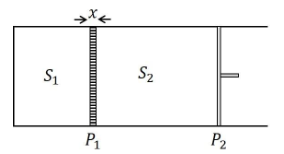
As shown in the figure, an insulated container is fitted with a thermally conducting but immovable partition ($$P_1$$) and a freely movable but thermally insulated piston ($$P_2$$). The partition $$P_1$$ with thermal conductivity $$K$$, cross sectional area $$A$$ and width $$x$$ divides the container into two sections, $$S_1$$ and $$S_2$$, each containing one mole of a monoatomic gas. The piston $$P_2$$ moves freely such that the gas in $$S_2$$ is always at the atmospheric pressure. Initially, the difference between the temperatures of $$S_1$$ and $$S_2$$ is $$\Delta T_0$$. The time it takes for the temperature difference to become $$\dfrac{\Delta T_0}{2}$$ is $$nxR/KA$$, where $$R$$ is the universal gas constant. The value of $$n$$ is:

[ Given: $$\ln 2\approx 0.7$$ ]

image
Question 2

A gas based geyser heats water flowing at the rate of 5.0 litres per minute from 27°C to 87°C. The rate of consumption of the gas is ___ g/s. (take heat of combustion of $$gas=5.0\times10^{4}J/g$$) specific heat capacity of water =4200 J/ kg.°C

Video Solution
Question 3

Which of the following best represents the temperature versus heat supplied graph for water, in the range of - 20 °C to 120 °C ?

Video Solution
Question 4

Density of water at 4 °C and 20 °C are $$1000 kg/m^{3}\text{ and }998kg/m^{3}$$ respectively. The increase in internal energy of 4 kg of water when it is heated from 4 °C to 20 °C is_____ J.
(specific heat capacity of water = $$4.2\times\ 10^3$$J / kg K. and 1 atmospheric pressure $$=10^{5}Pa$$)

Video Solution
Question 5

The temperature of a metal strip having coefficient of linear expansion $$\alpha$$ is increased from $$T_1$$ to $$T_2$$ resulting in increase of its length by $$\Delta L_1$$. The temperature is further increased from $$T_2$$ to $$T_3$$ such that the increase in its length is $$\Delta L_2$$. Given $$T_3 + T_1 = 2T_2$$ and $$T_2 - T_1 = \Delta T$$, the value of $$\Delta L_2$$ is ______.

Video Solution
Question 6

10 kg of ice at -10°C is added to 100 kg of water to lower its temperature from 25°C. Consider no heat exchange to surroundings. The decrement to the temperature of water is _____ °C.
(specific heat of ice= 2100 J/Kg.°C, specific heat of water= 4200 J/Kg.°C, latent heat of fusion of ice $$=3.36\times\ 10^5J/Kg$$)

Question 7

An aluminium and steel rods having same lengths and cross-sections are joined to make total length of 120 cm at 30°C. The coefficient of linear expansion of aluminium and steel are $$24\times10^{-6}/^{\circ}C\text{ and }1.2\times10^{-5}/^{\circ}C$$, respectively. The length of this composite rod when its temperature is raised to $$100^\circ$$ C, is ___ cm.

Question 8

A brass wire of length 2 m and radius 1 mm at 27 °C is held taut between two rigid supports. Initially, it was cooled to a temperature of -43 °C, creating a tension T in the wire. The temperature to which the wire has to be cooled in order to increase the tension in it to 1.4T, is ____ °C.

Question 9

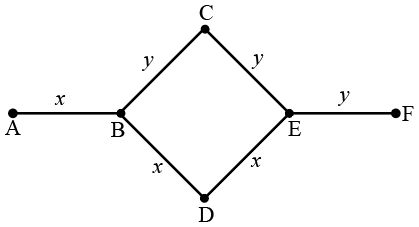
Rods $$x$$ and $$y$$ of equal dimensions but of different materials are joined as shown in figure. Temperatures of end points $$A$$ and $$F$$ are maintained at $$100 ^{o}C$$ and $$40 ^{o}C$$ respectively. Given the thermal conductivity of rod $$x$$ is three times of that of rod $$y$$, the temperature at junction points $$B$$ and $$E$$ are (close to):

Screenshot_41
Question 10

The heat extracted out of x gram of water initialy at  $$50°$$C to  cool it down to $$0°$$C is sufficient to evaporate  $$(1000 - x)$$ gram  of water also initialy at $$50°$$C. The value of $$x$$ (closest integer) is_______.  (Take Latent heat of water  $$L = 2256$$ kJ/kg K, specific heat capacity of water $$c = 4200$$ J/kg·K)

Frequently Asked Questions