Join WhatsApp Icon JEE WhatsApp Group
JEE Gravitation Questions

Gravitation is a high-scoring and conceptually elegant chapter in JEE Physics that connects Newtonian mechanics with the motion of planets and satellites. It introduces the universal law of gravitation, gravitational field and potential, and orbital mechanics topics that appear reliably in JEE Main and feature in JEE Advanced. Because most questions are formula-based with clear physical meaning, JEE Gravitation questions are an efficient scoring area for aspirants.

This chapter covers Newton's law of gravitation, acceleration due to gravity and its variation, gravitational potential energy, escape and orbital velocity, and Kepler's laws. JEE Main favours direct application of these formulas, while JEE Advanced occasionally tests deeper reasoning about energy in orbits and field calculations. Practising topic-wise JEE Questions helps you master the standard formulas and the energy approach to orbital problems

Gravitation Topic Overview

Parameter

Details

Topic Name

Gravitation

Subject

Physics

JEE Main Weightage

~3–5% (1–2 questions on average)

JEE Advanced Weightage

~4–6% (orbital and energy problems)

Difficulty Level

Moderate

Important Concepts

Newton's Law, Gravitational Field & Potential, Escape & Orbital Velocity, Kepler's Laws

Recommended Practice Level

High – attempt 60+ mixed problems

Why Practice JEE Gravitation Questions?

  • Reliable weightage: Gravitation contributes 1–2 questions in JEE Main most years.
  • Formula-based scoring: Many questions are direct applications, making them quick to solve.
  • Reinforces field concepts: The field-and-potential approach carries directly into electrostatics.
  • Strong in orbital mechanics: Satellite and energy problems appear in both JEE Main and Advanced.
  • High conceptual clarity: Kepler's laws and orbital energy build deep physical intuition.
  • Efficient revision: A compact formula set makes last-minute review effective.
  • Connects to SHM: Variation of gravity and oscillation problems link to other chapters.

Important Concepts and Subtopics

Concept

Importance

Difficulty Level

Frequently Asked In

Newton's Law of Gravitation

Very High

Easy

JEE Main

Variation of g (Altitude, Depth, Rotation)

Very High

Moderate

JEE Main & Advanced

Gravitational Field & Potential

High

Moderate

JEE Advanced

Gravitational Potential Energy

High

Moderate

JEE Main & Advanced

Escape & Orbital Velocity

Very High

Moderate

JEE Main & Advanced

Satellites & Orbital Energy

High

Moderate–High

JEE Advanced

Kepler's Laws

High

Easy–Moderate

JEE Main

Preparation Strategy for JEE Gravitation

Concept learning: Begin with Newton's universal law and the idea of gravitational field and potential. Understand how acceleration due to gravity changes with altitude, depth, and Earth's rotation, since these variations are frequently tested.

Formula revision: Keep relations for g-variation, gravitational potential energy, escape velocity, orbital velocity, and satellite energy handy. Pairing this with structured JEE Online Coaching helps you reinforce derivations and clear doubts on orbital-energy reasoning.

Problem-solving techniques: Use energy conservation for escape-velocity and orbit-change problems. For field calculations, exploit symmetry just as you would in electrostatics. Apply Kepler's third law directly for period-radius relationships.

Common mistakes: Confusing gravitational potential with potential energy, sign errors in orbital energy (which is negative for bound orbits), and misapplying g-variation formulas for depth versus altitude.

Exam strategy: Attempt direct g-variation and Kepler's-law questions first, then tackle orbital-energy and field problems that need more reasoning.

JEE Main & Advanced Weightage Analysis

Exam

Average Questions

Expected Marks

JEE Main

1–2

4–8

JEE Advanced

1–2

4–8

Gravitation is a steady contributor in JEE Main, mainly through g-variation, escape velocity, and Kepler's laws. JEE Advanced tends to test orbital energy and field reasoning with cleaner numerical answers.

Tips to Solve Gravitation Questions Faster

  • Use energy conservation for escape-velocity and orbit-transfer problems instead of force analysis.
  • Apply Kepler's third law (T² ∝ r³) directly to compare orbital periods and radii.
  • Remember that total orbital energy is negative for bound satellites watch the sign.
  • Exploit symmetry for gravitational-field problems, mirroring the electrostatics approach.
  • Distinguish g-variation with depth (linear) from variation with altitude (inverse-square).
  • Keep escape and orbital velocity relations ready, noting escape velocity is √2 times orbital velocity at the surface.

Practising these under timed conditions with a JEE Mock Test helps you solve gravitation problems quickly and avoid sign errors.

JEE Gravitation Questions

Question 1

When one moves from a point 16 km below the earth's surface to a point 16 km above the earth's surface. The change in g is approximately $$\alpha$$ %. The value of $$\alpha$$ is _______. (Take radius of the earth = 6400 km.)

Video Solution
Question 2

A planet (P$$_1$$) is moving around the star of mass 2M in the orbit of radius R. Another planet (P$$_2$$) is moving around another star of mass 4M in a orbit of radius 2R. Ratio of time periods of revolution of P$$_2$$ and P$$_1$$ is __________.

Video Solution
Question 3

The height in terms of radius of the earth (R), at which the acceleration due to gravity becomes $$\frac{g}{9}$$, where g is acceleration due to gravity on earth's surface, is ______.

Video Solution
Question 4

If a body of mass 1 kg falls on the earth from infinity, it attains velocity $$(v)$$ and kinetic energy $$(k)$$ on reaching the surface of earth. The values of $$v$$ and $$k$$ respectively are ______.
(Take radius of earth to be 6400 km and $$g = 9.8$$ m/s$$^2$$)

Video Solution
Question 5

A body of mass $$m$$ is taken from the surface of the earth to a height equal to twice the radius of earth$$(R_e)$$. The increase in potential energy will be  :
(g is acceleration due to gravity at the surface of earth) 

Video Solution
Question 6

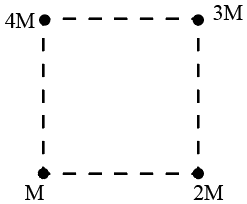
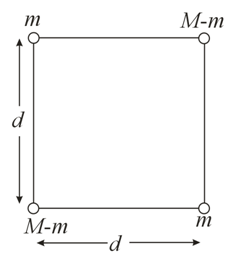
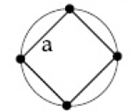
Net gravitational force at the center of a square is found to be $$F_{1}$$ when four particles having mass $$M, 2M, 3M$$ and $$4M$$ are placed at the four corners of the square as shown in the figure and it is $$F_{2}$$ when the positions of $$3M$$ and $$4M$$ are interchanged. The ratio $$\frac{F_{1}}{F_{2}}$$ is $$\frac{\alpha}{\sqrt{5}}$$ The value of $$\alpha$$ is _________.

Screenshot_40
Question 7

A particle of mass $$m$$, and angular momentum $$\ell$$ is moving in a circular orbit of radius $$r_0$$ under the influence of an attractive force $$\vec{F}(r)=-\dfrac{k}{r^2}\hat{r}$$. Keeping its angular momentum unchanged, the particle is displaced radially by a small distance $$\delta r\ll r_0$$, due to which its radial distance varies periodically. The corresponding time period is:

Question 8

Given below are two statements:
Statement I : A satellite is moving around earth in the orbit very close to the earth surface. The time period of revolution of satellite depends upon the density of earth.
Statement II: The time period of revolution of the satellite is $$T= 2\pi \sqrt{\frac{R_{e}}{g}}$$ (for satellite very close to the earth surface), where $$R_{e}$$ radius of earth and g acceleration due to gravity. 

In the light of the above statements , choose the correct answer from the options given below:

Question 9

The escape velocity from a spherical planet $$A$$ is $$10 km/s.$$ The escape velocity from another planet $$B$$ whose density and radius are 10% of those of planet $$A$$, is ______$$m/s.$$

Question 10

Initially a satellite of 100 kg is in a circular orbit of radius $$1.5R_{E}$$ This satellite can be moved to a circular orbit of radius $$3R_{E}$$ by supplying $$\alpha\times10^{6}J$$ of energy The value of $$\alpha$$ is ____. (Take Radius of Earth $$R_{E}=6\times10^{6}m\text{ and }g=10m/s^{2}$$)

Frequently Asked Questions