
Join Our JEE Preparation Group
Prep with like-minded aspirants; Get access to free daily tests and study material.
Sign in
Please select an account to continue using cracku.in
↓ →
Join Our JEE Preparation Group
Prep with like-minded aspirants; Get access to free daily tests and study material.
A planet (P$$_1$$) is moving around the star of mass 2M in the orbit of radius R. Another planet (P$$_2$$) is moving around another star of mass 4M in a orbit of radius 2R. Ratio of time periods of revolution of P$$_2$$ and P$$_1$$ is __________.
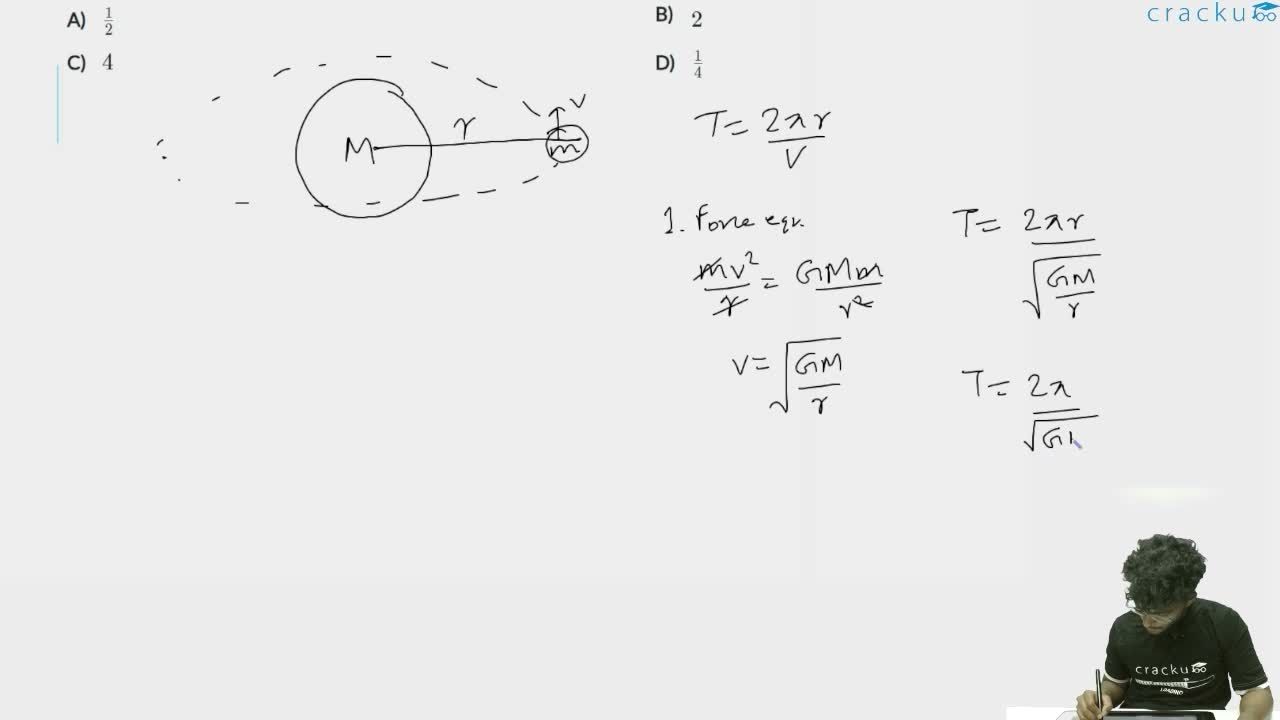
For any planet of negligible mass revolving around a much heavier star, Kepler’s third law gives the time period
$$T = 2\pi\sqrt{\frac{r^{3}}{G\,M_s}}$$
where
$$r$$ = orbital radius and $$M_s$$ = mass of the star.
Thus the time period is proportional to $$\sqrt{\dfrac{r^{3}}{M_s}}$$:
$$T \propto \sqrt{\frac{r^{3}}{M_s}}\quad -(1)$$
Planet P$$_1$$
Star mass $$M_{s1}=2M$$, orbital radius $$r_1 = R$$.
From $$(1)$$, $$T_1 \propto \sqrt{\dfrac{R^{3}}{2M}}$$.
Planet P$$_2$$
Star mass $$M_{s2}=4M$$, orbital radius $$r_2 = 2R$$.
From $$(1)$$, $$T_2 \propto \sqrt{\dfrac{(2R)^{3}}{4M}}$$.
Compute the ratio:
$$\frac{T_2}{T_1}= \sqrt{\frac{(2R)^{3}}{4M}}\;\Big/\;\sqrt{\frac{R^{3}}{2M}} =\sqrt{\frac{8R^{3}}{4M}}\;\Big/\;\sqrt{\frac{R^{3}}{2M}} =\sqrt{\frac{2R^{3}}{M}}\;\Big/\;\sqrt{\frac{R^{3}}{2M}} =\sqrt{\frac{2R^{3}}{M}\cdot\frac{2M}{R^{3}}} =\sqrt{4}=2.$$
Therefore, the time period of P$$_2$$ is twice that of P$$_1$$.
Option B which is: $$2$$
Click on the Email ☝️ to Watch the Video Solution
Create a FREE account and get:
_1.webp)

Educational materials for JEE preparation

Ask our AI anything

AI can make mistakes. Please verify important information.
AI can make mistakes. Please verify important information.


