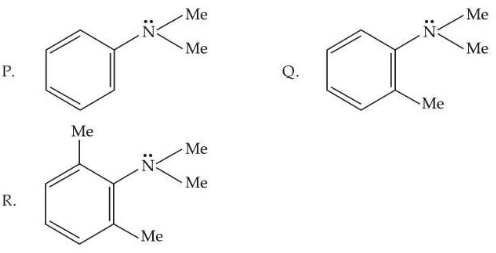
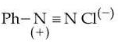
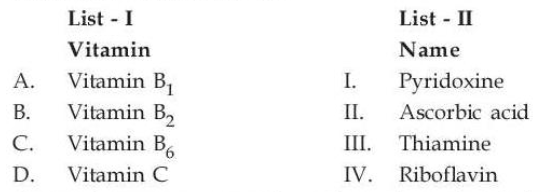
For the following questions answer them individually
Let $$\alpha, \alpha + 2, \alpha \in \mathbb{Z}$$, be the roots of the quadratic equation $$x(x+2) + (x+1)(x+3) + (x+2)(x+4) + \ldots + (x+n-1)(x+n+1) = 4n$$ for some $$n \in \mathbb{N}$$. Then $$n + \alpha$$ is equal to :
Let $$x$$ and $$y$$ be real numbers such that $$50\left(\frac{2x}{1+3i} - \frac{y}{1-2i}\right) = 31 + 17i$$, $$i = \sqrt{-1}$$. Then the value of $$10(x - 3y)$$ is :
Let $$\alpha, \beta \in \mathbb{R}$$ be such that the system of linear equations
$$x + 2y + z = 5$$
$$2x + y + \alpha z = 5$$
$$8x + 4y + \beta z = 18$$
has no solution. Then $$\frac{\beta}{\alpha}$$ is equal to :
Let $$A = \begin{bmatrix} 1 & 2 \\ 1 & \alpha \end{bmatrix}$$ and $$B = \begin{bmatrix} 3 & 3 \\ \beta & 2 \end{bmatrix}$$. If $$A^2 - 4A + I = O$$ and $$B^2 - 5B - 6I = O$$, then among the two statements : (S1): $$[(B-A)(B+A)]^T = \begin{bmatrix} 13 & 15 \\ 7 & 10 \end{bmatrix}$$ and (S2): $$\det(\text{adj}(A+B)) = -5$$,
Let A be the set of first 101 terms of an A.P., whose first term is 1 and the common difference is 5 and let B be the set of first 71 terms of an A.P., whose first term is 9 and the common difference is 7. Then the number of elements in $$A \cap B$$, which are divisible by 3, is :
The number of seven-digit numbers, that can be formed by using the digits 1, 2, 3, 5 and 7 such that each digit is used at least once, is :
The number of elements in the set $$S = \left\{(r, k) : k \in \mathbb{Z} \text{ and } {}^{36}C_{r+1} = \frac{6 \cdot {}^{35}C_r}{k^2 - 3}\right\}$$, is :
If the mean of the dataÂ

is 21, then k is one of the roots of the equation :
Let the mid points of the sides of a triangle ABC be $$\left(\frac{5}{2}, 7\right)$$, $$\left(\frac{5}{2}, 3\right)$$ and $$(4, 5)$$. If its incentre is $$(h, k)$$, then $$3h + k$$ is equal to :
Let an ellipse $$\frac{x^2}{a^2} + \frac{y^2}{b^2} = 1$$, $$a < b$$, pass through the point $$(4, 3)$$ and have eccentricity $$\frac{\sqrt{5}}{3}$$. Then the length of its latus rectum is :