
Join Our JEE Preparation Group
Prep with like-minded aspirants; Get access to free daily tests and study material.
Sign in
Please select an account to continue using cracku.in
↓ →
Join Our JEE Preparation Group
Prep with like-minded aspirants; Get access to free daily tests and study material.
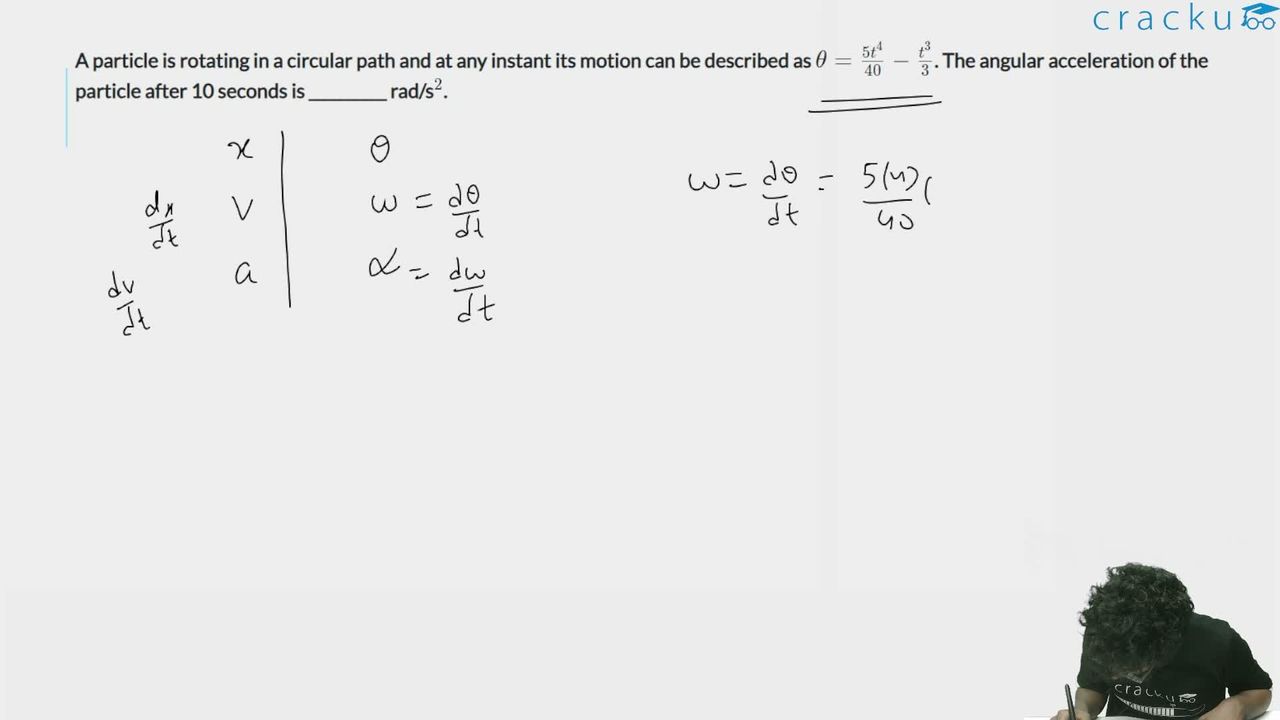
A particle is rotating in a circular path and at any instant its motion can be described as $$\theta = \frac{5t^4}{40} - \frac{t^3}{3}$$. The angular acceleration of the particle after 10 seconds is __________ rad/s$$^2$$.
The angular position as a function of time is given by $$\theta = \frac{5t^{4}}{40} - \frac{t^{3}}{3}$$.
Simplify the coefficients:
$$\theta = \frac{5}{40}\,t^{4} - \frac{1}{3}\,t^{3} = \frac{1}{8}\,t^{4} - \frac{1}{3}\,t^{3}$$
Angular velocity is the first time-derivative of angular position:
$$\omega = \frac{d\theta}{dt}$$
Differentiating term by term:
$$\omega = \frac{d}{dt}\left(\frac{1}{8}\,t^{4}\right) - \frac{d}{dt}\left(\frac{1}{3}\,t^{3}\right)
= \frac{1}{8}\,(4t^{3}) - \frac{1}{3}\,(3t^{2})
= \frac{4}{8}\,t^{3} - t^{2}
= \frac{1}{2}\,t^{3} - t^{2}$$
Angular acceleration is the second time-derivative of angular position, i.e. the first derivative of angular velocity:
$$\alpha = \frac{d\omega}{dt}$$
Differentiating $$\omega$$:
$$\alpha = \frac{d}{dt}\left(\frac{1}{2}\,t^{3}\right) - \frac{d}{dt}\left(t^{2}\right)
= \frac{1}{2}\,(3t^{2}) - 2t
= \frac{3}{2}\,t^{2} - 2t$$
Substitute $$t = 10 \text{ s}$$:
$$\alpha = \frac{3}{2}\,(10)^{2} - 2(10)
= \frac{3}{2}\,(100) - 20
= 150 - 20
= 130 \text{ rad/s}^2$$
Therefore, the angular acceleration after 10 seconds is $$130 \text{ rad/s}^2$$.
Option C which is: $$130$$
Was this solution helpful?
Click on the Email ☝️ to Watch the Video Solution
Create a FREE account and get:
_1.webp)

Educational materials for JEE preparation

Ask our AI anything

AI can make mistakes. Please verify important information.
AI can make mistakes. Please verify important information.
