
Join Our JEE Preparation Group
Prep with like-minded aspirants; Get access to free daily tests and study material.
Sign in
Please select an account to continue using cracku.in
↓ →
Join Our JEE Preparation Group
Prep with like-minded aspirants; Get access to free daily tests and study material.
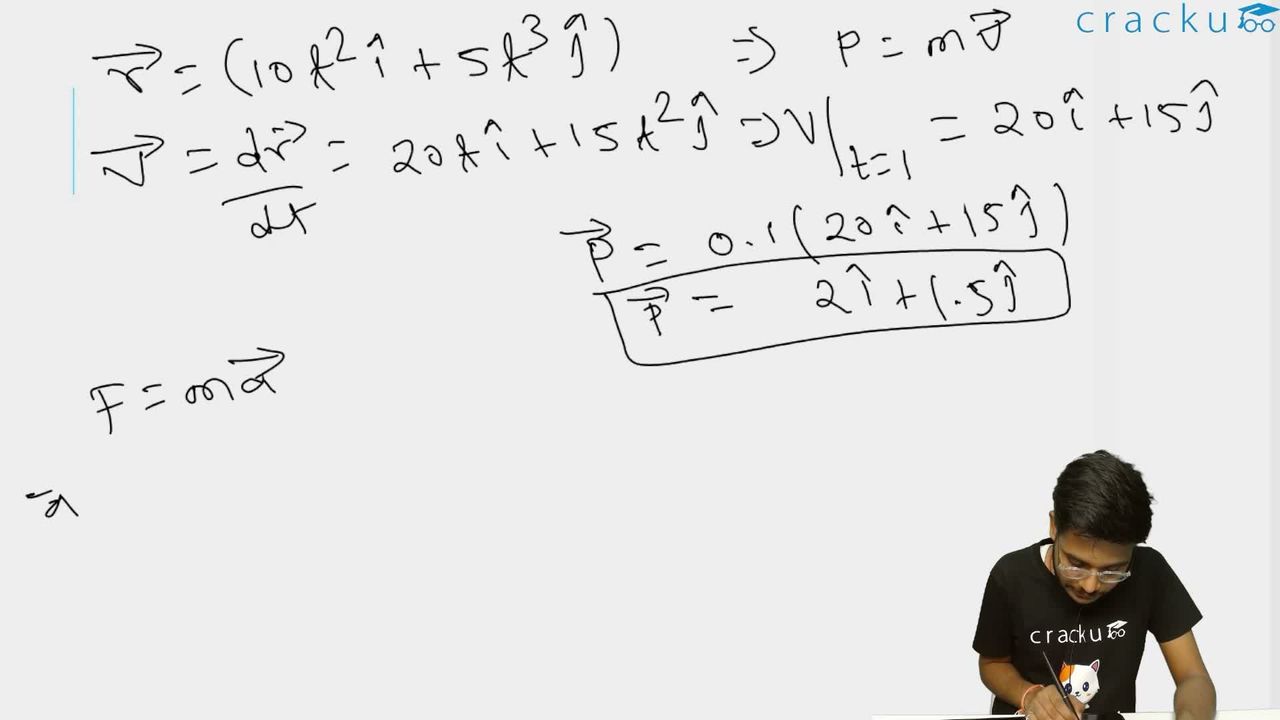
The position of an object having mass 0.1 kg as a function of time t is given as $$\vec{r} = \left(10t^2 \hat{i} + 5t^3 \hat{j}\right)$$ m. At $$t = 1$$ s, which of the following statements are correct? A. The linear momentum $$\vec{p} = \left(2\hat{i} + 1.5\hat{j}\right)$$ kg·m/s. B. The force acting on the object $$\vec{F} = \left(2\hat{i} + 3\hat{j}\right)$$ N. C. The angular momentum of the object about its origin $$\vec{L} = 15 \hat{k}$$ J·s. D. The torque acting on the object about its origin $$\vec{\tau} = 20 \hat{k}$$ N·m. Choose the correct answer from the options given below :
The position-time relation is given by $$\vec r(t)=\left(10t^{2}\,\hat i+5t^{3}\,\hat j\right)\,{\rm m}$$ and the mass is $$m=0.1\,{\rm kg}$$.
Step 1 : Linear momentum at $$t=1\,{\rm s}$$
Velocity $$\vec v=\frac{d\vec r}{dt}=\bigl(20t\,\hat i+15t^{2}\,\hat j\bigr).$$
At $$t=1$$, $$\vec v(1)=20\,\hat i+15\,\hat j\;{\rm m/s}.$$
Therefore $$\vec p=m\vec v=0.1\left(20\,\hat i+15\,\hat j\right)=2\,\hat i+1.5\,\hat j\;{\rm kg\! \cdot\! m/s}.$$
This matches statement A.
Step 2 : Force at $$t=1\,{\rm s}$$
Acceleration $$\vec a=\frac{d\vec v}{dt}=20\,\hat i+30t\,\hat j.$$
At $$t=1$$, $$\vec a(1)=20\,\hat i+30\,\hat j\;{\rm m/s^{2}}.$$
Hence $$\vec F=m\vec a=0.1\left(20\,\hat i+30\,\hat j\right)=2\,\hat i+3\,\hat j\;{\rm N}.$$
This agrees with statement B.
Step 3 : Angular momentum about the origin at $$t=1\,{\rm s}$$
Position at $$t=1$$: $$\vec r(1)=10\,\hat i+5\,\hat j\;{\rm m}.$$
Angular momentum $$\vec L=\vec r\times\vec p.$$
Using the determinant,
$$\vec L= \begin{vmatrix} \hat i & \hat j & \hat k\\ 10 & 5 & 0\\ 2 & 1.5 & 0 \end{vmatrix} =\bigl(10\cdot1.5-5\cdot2\bigr)\hat k =(15-10)\hat k =5\,\hat k\;{\rm J\! \cdot\! s}.$$ Statement C predicts $$15\,\hat k,$$ so it is incorrect.
Step 4 : Torque about the origin at $$t=1\,{\rm s}$$
Torque $$\vec\tau=\vec r\times\vec F.$$
Again,
$$\vec\tau= \begin{vmatrix} \hat i & \hat j & \hat k\\ 10 & 5 & 0\\ 2 & 3 & 0 \end{vmatrix} =\bigl(10\cdot3-5\cdot2\bigr)\hat k =(30-10)\hat k =20\,\hat k\;{\rm N\! \cdot\! m}.$$ This matches statement D.
Conclusion
Statements A, B and D are correct, while C is wrong. Therefore the right choice is:
Option D which is: A, B and D only
Click on the Email ☝️ to Watch the Video Solution
Create a FREE account and get:
_1.webp)

Educational materials for JEE preparation

Ask our AI anything

AI can make mistakes. Please verify important information.
AI can make mistakes. Please verify important information.


