
Join Our JEE Preparation Group
Prep with like-minded aspirants; Get access to free daily tests and study material.
Sign in
Please select an account to continue using cracku.in
↓ →
Join Our JEE Preparation Group
Prep with like-minded aspirants; Get access to free daily tests and study material.
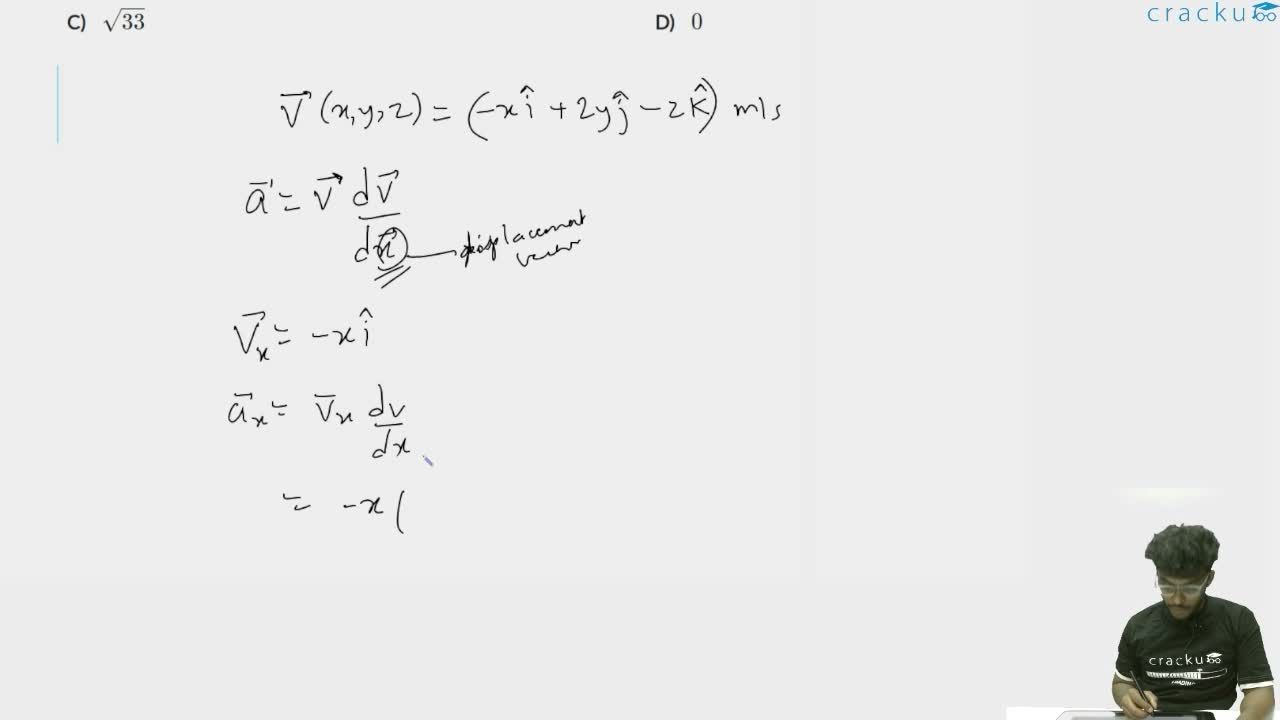
The velocity of a particle is given as $$\vec{v} = -x\hat{i} + 2y\hat{j} - z\hat{k}$$ m/s. The magnitude of acceleration at point $$(1, 2, 4)$$ is __________ m/s$$^2$$.
The velocity field is position-dependent: $$\vec v(x,y,z)= -x\hat i + 2y\hat j - z\hat k$$.
For such a field the acceleration of the particle at any instant is the material (total) derivative of velocity:
$$\vec a=\frac{d\vec v}{dt}= \left( \vec v\!\cdot\!\vec\nabla \right)\vec v,$$
because $$\partial\vec v/\partial t =0$$ (no explicit time dependence).
First write $$\vec v\!\cdot\!\vec\nabla = v_x\frac{\partial}{\partial x}+v_y\frac{\partial}{\partial y}+v_z\frac{\partial}{\partial z}= -x\frac{\partial}{\partial x}+2y\frac{\partial}{\partial y}-z\frac{\partial}{\partial z}.$$(label this operator $$-(\*)$$)
Apply operator $$(\*)$$ to each component of $$\vec v$$:
$$a_x =\left(-x\frac{\partial}{\partial x}+2y\frac{\partial}{\partial y}-z\frac{\partial}{\partial z}\right)(-x) =(-x)\left(\frac{\partial(-x)}{\partial x}\right)=(-x)(-1)=x.$$
$$a_y =\left(-x\frac{\partial}{\partial x}+2y\frac{\partial}{\partial y}-z\frac{\partial}{\partial z}\right)(2y) =(2y)\left(\frac{\partial(2y)}{\partial y}\right)= (2y)(2)=4y.$$
$$a_z =\left(-x\frac{\partial}{\partial x}+2y\frac{\partial}{\partial y}-z\frac{\partial}{\partial z}\right)(-z) =(-z)\left(\frac{\partial(-z)}{\partial z}\right)=(-z)(-1)=z.$$
Thus $$\vec a = x\hat i + 4y\hat j + z\hat k.$$
At the given point $$(x,y,z)=(1,2,4)$$:
$$\vec a = 1\hat i + 8\hat j + 4\hat k.$$
The magnitude is
$$|\vec a| = \sqrt{1^{2}+8^{2}+4^{2}}=\sqrt{1+64+16}=\sqrt{81}=9\text{ m/s}^2.$$
Option B which is: 9
Click on the Email ☝️ to Watch the Video Solution
Create a FREE account and get:
_1.webp)

Educational materials for JEE preparation

Ask our AI anything

AI can make mistakes. Please verify important information.
AI can make mistakes. Please verify important information.


