
Join Our JEE Preparation Group
Prep with like-minded aspirants; Get access to free daily tests and study material.
Sign in
Please select an account to continue using cracku.in
↓ →
Join Our JEE Preparation Group
Prep with like-minded aspirants; Get access to free daily tests and study material.
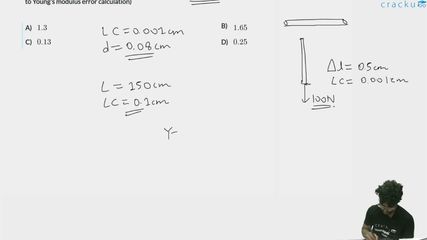
The diameter of a wire measured by a screw gauge of least count 0.001 cm is 0.08 cm. The length measured by a scale of least count 0.1 cm is 150 cm. When a weight of 100 N is applied to the wire, the extension in length is 0.5 cm, measured by a micrometer of least count 0.001 cm. The error in the measured Young's modulus is $$\alpha \times 10^9$$ N/m$$^2$$. The value of $$\alpha$$ is __________ . (Ignore the contribution of the load to Young's modulus error calculation)
For a uniform wire, Young’s modulus is defined as
$$Y=\frac{F\,L}{A\,\Delta L}$$
where
$$F$$ = applied force,
$$L$$ = original length of the wire,
$$\Delta L$$ = extension in length, and
$$A$$ = cross-sectional area $$=\dfrac{\pi d^{2}}{4}$$.
The measurements given are
Diameter $$d = 0.08\ \text{cm}=0.0008\ \text{m}$$, least count $$0.001\ \text{cm}$$
Length $$L = 150\ \text{cm}=1.5\ \text{m}$$, least count $$0.1\ \text{cm}$$
Extension $$\Delta L = 0.5\ \text{cm}=0.005\ \text{m}$$, least count $$0.001\ \text{cm}$$
Force $$F = 100\ \text{N}$$ (taken to be exact as per question)
First calculate $$Y$$ (all quantities in SI units):
Area,
$$A=\frac{\pi d^{2}}{4}= \frac{\pi (0.0008)^{2}}{4}=5.027\times 10^{-7}\ \text{m}^{2}$$
Young’s modulus,
$$Y = \frac{100 \times 1.5}{5.027\times 10^{-7}\times 0.005}$$
$$Y = 5.97\times 10^{10}\ \text{N m}^{-2}$$
The absolute instrumental errors (taken equal to the least count) are
$$\Delta d = 0.001\ \text{cm}=1\times 10^{-5}\ \text{m}$$
$$\Delta L = 0.1\ \text{cm}=1\times 10^{-3}\ \text{m}$$
$$\Delta(\Delta L) = 0.001\ \text{cm}=1\times 10^{-5}\ \text{m}$$
Relative (fractional) errors:
$$\frac{\Delta d}{d}=\frac{0.001}{0.08}=0.0125$$
$$\frac{\Delta L}{L}=\frac{0.1}{150}=6.67\times 10^{-4}$$
$$\frac{\Delta(\Delta L)}{\Delta L}=\frac{0.001}{0.5}=0.002$$
The relation $$Y\propto \dfrac{L}{d^{2}\,\Delta L}$$ gives, on differentiating,
$$\frac{\Delta Y}{Y}= \frac{\Delta L}{L}+2\frac{\Delta d}{d}+\frac{\Delta(\Delta L)}{\Delta L}$$
Substituting the relative errors:
$$\frac{\Delta Y}{Y}= 6.67\times 10^{-4}+2(0.0125)+0.002$$ $$\frac{\Delta Y}{Y}=0.000667+0.025+0.002$$ $$\frac{\Delta Y}{Y}=0.027667$$
Therefore the absolute error in $$Y$$ is
$$\Delta Y = Y \times 0.027667 = 5.97\times 10^{10} \times 0.027667$$ $$\Delta Y \approx 1.65 \times 10^{9}\ \text{N m}^{-2}$$
Comparing with $$\alpha \times 10^{9}\ \text{N m}^{-2}$$, we get $$\alpha = 1.65$$.
Hence, the correct choice is
Option B which is: $$1.65$$
Click on the Email ☝️ to Watch the Video Solution
Create a FREE account and get:
_1.webp)

Educational materials for JEE preparation

Ask our AI anything

AI can make mistakes. Please verify important information.
AI can make mistakes. Please verify important information.


