
Join Our JEE Preparation Group
Prep with like-minded aspirants; Get access to free daily tests and study material.
Sign in
Please select an account to continue using cracku.in
↓ →
Join Our JEE Preparation Group
Prep with like-minded aspirants; Get access to free daily tests and study material.
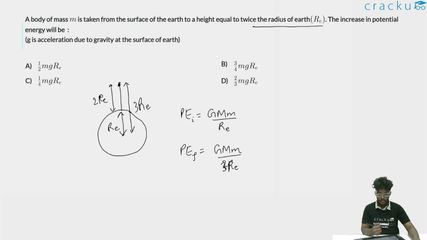
A body of mass $$m$$ is taken from the surface of the earth to a height equal to twice the radius of earth$$(R_e)$$. The increase in potential energy will be :
(g is acceleration due to gravity at the surface of earth)
The initial potential energy of the body at the surface of the earth is:
$$U_i=-\frac{GMm}{R_e}$$
The body is taken to a height $$h=2R_e$$.
The final distance of the body from the center of the earth is:
$$r=R_e+h=R_e+2R_e=3R_e$$
The final potential energy of the body at this height is:
$$U_f=-\frac{GMm}{3R_e}$$
The increase in potential energy ($$\Delta U$$) is the difference between the final and initial potential energies:
$$\Delta U=U_f-U_i$$
$$\Delta U=\left(-\frac{GMm}{3R_e}\right)-\left(-\frac{GMm}{R_e}\right)$$
$$\Delta U=\frac{GMm}{R_e}-\frac{GMm}{3R_e}$$
$$\Delta U=GMm\left(\frac{1}{R_e}-\frac{1}{3R_e}\right)$$
$$\Delta U=GMm\left(\frac{3-1}{3R_e}\right)$$
$$\Delta U=\frac{2GMm}{3R_e}$$
$$g=\frac{GM}{R_e^2}\implies GM=gR_e^2$$
$$\Delta U=\frac{2(gR_e^2)m}{3R_e}$$
$$\Delta U=\frac{2}{3}mgR_e$$
Click on the Email ☝️ to Watch the Video Solution
Create a FREE account and get:
_1.webp)

Educational materials for JEE preparation

Ask our AI anything

AI can make mistakes. Please verify important information.
AI can make mistakes. Please verify important information.


