Join WhatsApp Icon JEE WhatsApp Group

JEE Elasticity Questions

Elasticity is a compact but important chapter in the Properties of Matter unit of JEE Physics. It studies how solids deform under stress and return to shape, introducing stress, strain, and the elastic moduli that describe material behaviour. Although it carries modest weightage, JEE Elasticity questions appear regularly in JEE Main and offer quick, formula-based marks for students who learn the core relations well. This chapter covers stress and strain, Hooke's law, Young's modulus, bulk and shear modulus, Poisson's ratio, and the energy stored in a stretched wire. JEE Main tests direct numerical applications, while JEE Advanced occasionally combines elasticity with thermal expansion or oscillations. Practising topic-wise Cracku JEE Questions helps you recognise the standard problem types and apply the right modulus quickly. Because elasticity links to oscillations and waves through the idea of restoring forces, mastering it also strengthens your understanding of those connected chapters.

Elasticity Topic Overview

Parameter

Details

Topic Name

Elasticity

Subject

Physics

JEE Main Weightage

~2-3% (1 question on average)

JEE Advanced Weightage

~2-4% (often combined)

Difficulty Level

Easy to Moderate

Important Concepts

Stress, Strain, Hooke's Law, Young's Modulus, Bulk & Shear Modulus, Elastic Energy

Recommended Practice Level

Moderate - attempt 40+ mixed problems

Why Practice JEE Elasticity Questions?

  • Quick scoring: Most questions are direct and formula-based, securing fast marks in JEE Main.
  • Compact syllabus: A small number of concepts cover the entire chapter, making it efficient to master.
  • Foundation for waves: Elastic restoring forces underpin wave propagation in solids.
  • Appears with thermal physics: Elasticity combines with thermal stress in some Advanced problems.
  • High effort-to-reward ratio: Limited study time yields reliable marks.
  • Builds material intuition: Understanding moduli develops a feel for how materials behave.
  • Easy to revise: A short formula set makes last-minute review effective.

Important Concepts and Subtopics

Concept

Importance

Difficulty Level

Frequently Asked In

Stress & Strain

Very High

Easy

JEE Main

Hooke's Law & Young's Modulus

Very High

Easy-Moderate

JEE Main & Advanced

Bulk & Shear Modulus

High

Moderate

JEE Main

Poisson's Ratio

Moderate

Moderate

JEE Main

Elastic Potential Energy

High

Moderate

JEE Main & Advanced

Thermal Stress

Moderate

Moderate

JEE Advanced

Preparation Strategy for JEE Elasticity

Concept learning: Understand stress and strain as cause and effect of deformation, and learn how the three moduli (Young's, bulk, shear) describe different types of deformation. Grasp the physical meaning of Hooke's law within the elastic limit.

Formula revision: Keep relations for the three moduli, Poisson's ratio, and elastic energy stored per unit volume handy. Organised JEE Study Material helps you keep these compact relations in one place for fast revision.

Problem-solving techniques: Identify the type of deformation first to choose the correct modulus. For composite or series-wire problems, treat segments carefully and apply continuity of force where wires join.

Common mistakes: Confusing the three moduli, mishandling units of stress, forgetting that strain is dimensionless, and misapplying elastic-energy formulas.

Exam strategy: Treat elasticity questions as quick wins attempt them early to bank marks before heavier chapters.

JEE Main & Advanced Weightage Analysis

Exam

Average Questions

Expected Marks

JEE Main

1

4

JEE Advanced

0-1 (often combined)

0-4

Elasticity is a modest but steady contributor in JEE Main, usually with one direct question. In JEE Advanced, it tends to appear combined with thermal stress or oscillation problems.

Tips to Solve Elasticity Questions Faster

  • Identify the deformation type (length, volume, or shape) to pick the right modulus instantly.
  • Remember that strain is dimensionless, so stress and modulus share the same units.
  • For series wires under the same load, the force is common; for parallel, the extension is common.
  • Use the elastic-energy-per-volume relation directly when energy is asked.
  • Keep thermal-stress relations ready for combined thermal-elastic problems.
  • Convert all quantities to SI units before substituting to avoid errors.

Practising these under timed conditions with a JEE Mock Test ensures you capture the quick marks elasticity offers.

JEE Elasticity Questions

Question 1

The increase in the pressure required to decrease the volume $$(\Delta V)$$ of water is $$6.3 \times 10^7$$ N/m². The percentage decrease in the volume is _____. (Bulk modulus of water = $$2.1 \times 10^9$$ N/m².)

Video Solution
Question 2

Two wires A and B made of different materials of lengths 6.0 cm and 5.4 cm, respectively and area of cross sections $$3.0\times 10^{-5}m^{2}\text{ and }4.5\times 10^{-5}m^{2}$$, respectively are stretched by the same magnitude under a given load. The ratio of the Young's modulus of A to that of B is x : 3. The value of x is ___ .

Video Solution
Question 3

A lift of mass 1600 kg is supported by thick iron wire. If the maximum stress which the wire can withstand is $$4 \times 10^8$$ N/m$$^2$$ and its radius is 4 mm, then maximum acceleration the lift can take is _______ m/s$$^2$$.
(take g = 10 m/s$$^2$$ and $$\pi$$ = 3.14)

Video Solution
Question 4

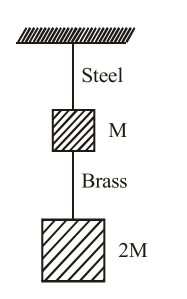
A metal string A is suspended from a rigid support and its free end is attached to a block of mass M. Second block having mass 2M is suspended at the bottom of the first block using a string B. The area of cross sections of strings A and B are same. The ratio of lengths of strings of A to B is 2 and the ratio of their Young's moduli $$(Y_A/Y_B)$$ is 0.5. The ratio of elongations in A to B is ______.

Video Solution
Question 5

The Young's modulus of steel wire of radius $$r$$ and length $$L$$ is $$Y$$. If the radius $$r$$ and length $$L$$ of the wire are doubled then the value of $$Y$$

Video Solution
Question 6

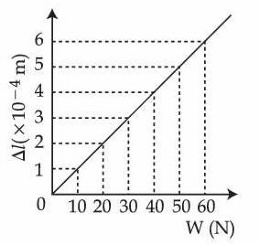
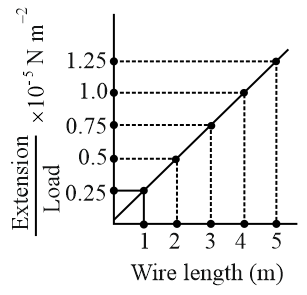
Figure represents the extension ($$\Delta l$$) of a wire of length 1 meter, suspended from the ceiling of the room at one end with a load W connected to the other end. If the cross-sectional area of the wire is $$10^{-5}$$ m$$^2$$ then the Young's modulus of the wire is __________ N/m$$^2$$.

image
Question 7

A string A of length 0.314 m and Young's modulus $$2 \times 10^{10}$$ N/m² is connected to another string B of length and Young's modulus both twice of those of A. This series combination of strings is then suspended from a rigid support and its free end is fixed to a load of mass 0.8 kg. The net change in length of the combination is _____ mm.
(radius of both the strings is 0.2 mm and acceleration due to gravity = 10 $$m/s^{2}$$) 
(Mass of both strings is to be neglected as compared to the mass of load )

Question 8

The two wires $$A$$ and $$B$$ of equal cross-section but of different materials are joined together. The ratio of Young's modulus of wire $$A$$ and wire $$B$$ is 20/11. When the joined wire is kept under certain tension the elongations in the wires $$A$$ and $$B$$ are equal. If the length of wire $$A$$ is 2.2 m, then the length of wire $$B$$ is _______ m.

Question 9

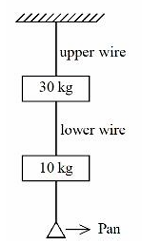
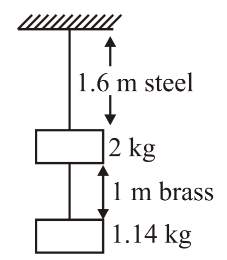
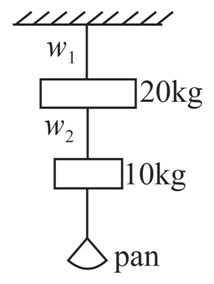
Two wires as shown in the figure below, made of steel and have breaking stress of $$12 \times 10^8$$ N/m$$^2$$. Area of cross-section of upper wire is 0.008 cm$$^2$$ and of lower wire is 0.004 cm$$^2$$. The maximum mass that can be added to pan without breaking any wire is _______ kg. (take $$g = 10$$ m/s$$^2$$)

image
Question 10

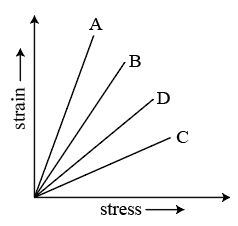
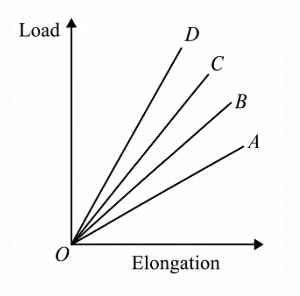
The strain-stress plot for materials A, B, C and D is shown in the figure. Which material has the largest Young's modulus?

45
Question 11

A copper wire of length 3 m is stretched by 3 mm by applying an external force. The volume of the wire is $$600 \times 10^{-6}$$ m³. The elastic potential energy stored in the wire in stretched condition would be _______  J :
(Given Young's modulus of copper $$ = 1.1 \times 10^{11}$$ N/m²)

Question 12

A cube has side length 5 cm and modulus of rigidity $$10^5$$ N/m$$^2$$. The displacement produced by a force of 10 N in the upper face of cube is _______ mm.

Question 13

A uniform wire of length $$l$$ of weight w is suspended from the roof with a weight of W at the other end. The stress in the wire at $$\frac{l}{3}$$ distance from the top is $$\left(\frac{W}{A} + \frac{2}{\gamma} \cdot \frac{w}{A}\right)$$, where A is the cross sectional area of the wire. The value of $$\gamma$$ is __________.

Question 14

A certain gas is isothermally compressed to $$\left(\frac{1}{3}\right)^{rd}$$ of its initial volume ($$V_0 = 3$$ litre) by applying required pressure. If the bulk modulus of the gas is $$3 \times 10^5$$ N/m$$^2$$, the magnitude of work done on the gas is _______ J.

Frequently Asked Questions