
Join Our JEE Preparation Group
Prep with like-minded aspirants; Get access to free daily tests and study material.
Sign in
Please select an account to continue using cracku.in
↓ →
Join Our JEE Preparation Group
Prep with like-minded aspirants; Get access to free daily tests and study material.
A lift of mass 1600 kg is supported by thick iron wire. If the maximum stress which the wire can withstand is $$4 \times 10^8$$ N/m$$^2$$ and its radius is 4 mm, then maximum acceleration the lift can take is _______ m/s$$^2$$.
(take g = 10 m/s$$^2$$ and $$\pi$$ = 3.14)
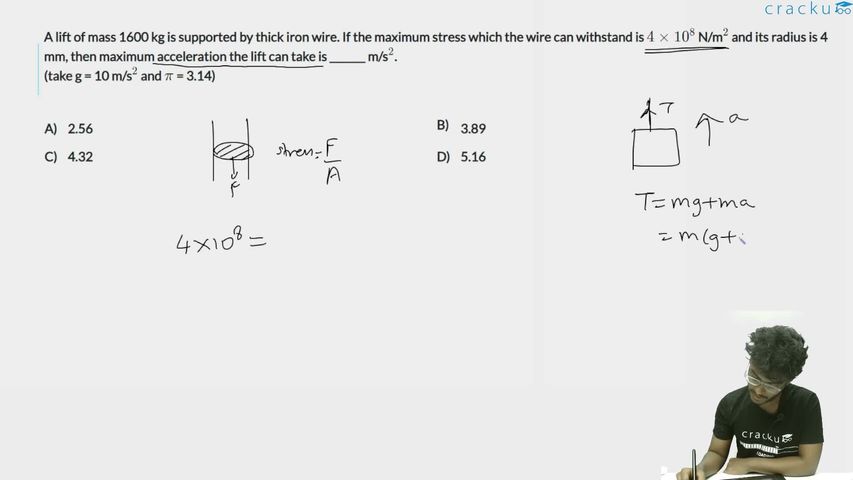
The maximum stress is the maximum force per unit area. Therefore, the maximum tension ($$ T_{max} $$) is:
$$ T_{max} = \sigma_{max} \times A $$
Where the cross-sectional area $$ A = \pi r^2 $$.
Substitute the values:
$$ T_{max} = (4 \times 10^8) \times \left(3.14 \times (4 \times 10^{-3})^2\right) $$
$$ T_{max} = (4 \times 10^8) \times (3.14 \times 16 \times 10^{-6}) $$
$$ T_{max} = 64 \times 3.14 \times 10^2 $$
$$ T_{max} = 200.96 \times 100 $$
$$ T_{max} = 20096\text{ N} $$
When the lift is accelerating upwards with a maximum acceleration $$ a $$, the net upward force is $$ T_{max} - mg $$.
According to the equation of motion:
$$ T_{max} - mg = ma $$
$$ T_{max} = m(g + a) $$
Substitute the known values into the equation:
$$ 20096 = 1600(10 + a) $$
Solve for $$ a $$:
$$ \frac{20096}{1600} = 10 + a $$
$$ 12.56 = 10 + a $$
$$ a = 12.56 - 10 $$
$$ a = 2.56\text{ m/s}^2 $$
Was this solution helpful?
Click on the Email ☝️ to Watch the Video Solution
Create a FREE account and get:
_1.webp)

Educational materials for JEE preparation

Ask our AI anything

AI can make mistakes. Please verify important information.
AI can make mistakes. Please verify important information.


