
Join Our JEE Preparation Group
Prep with like-minded aspirants; Get access to free daily tests and study material.
Sign in
Please select an account to continue using cracku.in
↓ →
Join Our JEE Preparation Group
Prep with like-minded aspirants; Get access to free daily tests and study material.
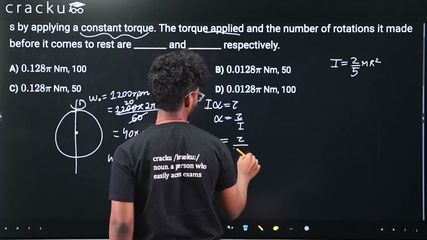
A solid sphere of radius 4 cm and mass 5 kg is rotating (rotation axis is passing through the centre of the sphere) with an angular velocity of 1200 rpm. It is brought to rest in 10 s by applying a constant torque. The torque applied and the number of rotations it made before it comes to rest are _______ and _______ respectively.
Initial angular velocity, $$\omega_0 = 1200\text{ rpm}$$
Final angular velocity, $$\omega = 0\text{ rad/s}$$ (since it is brought to rest)
Time taken to stop, $$t = 10\text{ s}$$
$$ \omega_0 = 1200 \times \frac{2\pi}{60} $$
$$ \omega_0 = 20 \times 2\pi = 40\pi\text{ rad/s} $$
Using the first equation of rotational kinematics:
$$ \omega = \omega_0 + \alpha t $$
$$ 0 = 40\pi + \alpha (10) $$
$$ 10\alpha = -40\pi $$
$$ \alpha = -4\pi\text{ rad/s}^2 $$
The magnitude of angular deceleration is $$4\pi\text{ rad/s}^2$$.
The formula for the moment of inertia of a solid sphere about an axis passing through its center is:
$$ I = \frac{2}{5}MR^2 $$
$$ I = \frac{2}{5} \times 5 \times (0.04)^2 $$
$$ I = 2 \times 0.0016 $$
$$ I = 0.0032\text{ kg}\cdot\text{m}^2 = 3.2 \times 10^{-3}\text{ kg}\cdot\text{m}^2 $$
Using Newton's second law for rotation (magnitude of torque):
$$ \tau = I |\alpha| $$
$$ \tau = (0.0032) \times (4\pi) $$
$$ \tau = 0.0128\pi\text{ N}\cdot\text{m} $$
$$ \tau = 1.28\pi \times 10^{-2}\text{ N}\cdot\text{m} $$
First, find the total angular displacement ($\theta$):
$$ \theta = \left(\frac{\omega_0 + \omega}{2}\right) t $$
$$ \theta = \left(\frac{40\pi + 0}{2}\right) \times 10 $$
$$ \theta = 20\pi \times 10 = 200\pi\text{ rad} $$
Now, convert radians to the number of rotations:
$$ N = \frac{\theta}{2\pi} $$
$$ N = \frac{200\pi}{2\pi} $$
$$ N = 100 $$
Was this solution helpful?
Click on the Email ☝️ to Watch the Video Solution
Create a FREE account and get:
_1.webp)

Educational materials for JEE preparation

Ask our AI anything

AI can make mistakes. Please verify important information.
AI can make mistakes. Please verify important information.


