
Join Our JEE Preparation Group
Prep with like-minded aspirants; Get access to free daily tests and study material.
Sign in
Please select an account to continue using cracku.in
↓ →
Join Our JEE Preparation Group
Prep with like-minded aspirants; Get access to free daily tests and study material.
Two blocks (P and Q) with respectively masses 2 kg and 1.5 kg are joined by a massless thread. These blocks are mounted on a frictionless pully which is fixed on the edge of a cube (S), as shown in the figure below. Block P is positioned on the top surface which has no friction and block Q is in contact with side-surface, having coefficient friction $$\mu$$. The cube (S) moves towards the right with acceleration of $$\frac{g}{2}$$, where g is gravitational acceleration. During this movement the block P and Q remain stationary. The value of $$\mu$$ is _______.
(take g = 10 m/s$$^2$$)
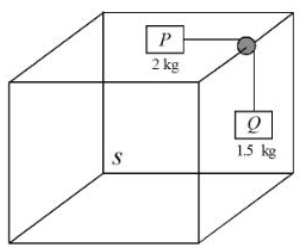
For block P, Leftward pseudo-force = $$m_P \cdot a = m_P \cdot \frac{g}{2}$$
Rightward tension force from the thread = $$T$$
Balancing the horizontal forces on block $$P$$: $$T = m_P \cdot \frac{g}{2} = 2 \cdot \frac{g}{2} = g \quad \text{--- (1)}$$
The cube pushes block $$Q$$ to the right with a normal contact force $$N$$. The leftward pseudo-force presses it against the wall:
$$N = m_Q \cdot a = m_Q \cdot \frac{g}{2} = 1.5 \cdot \frac{g}{2} = \frac{1.5g}{2}$$
Downward gravitational force = $$m_Q \cdot g = 1.5g$$
Upward tension force = $$T = g$$ (from Equation 1)
$$T + f = m_Q \cdot g$$
$$g + f = 1.5g \implies f = 0.5g \quad \text{--- (2)}$$
$$f = \mu N$$
$$0.5g = \mu \left( \frac{1.5g}{2} \right)$$
$$0.5 = \mu \cdot 0.75 \implies \mu = \frac{0.5}{0.75} = \frac{2}{3} \approx 0.67$$
Was this solution helpful?
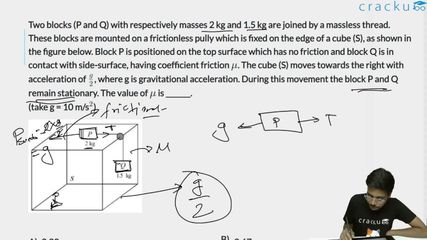
Click on the Email ☝️ to Watch the Video Solution
Create a FREE account and get:
_1.webp)

Educational materials for JEE preparation

Ask our AI anything

AI can make mistakes. Please verify important information.
AI can make mistakes. Please verify important information.


