Join WhatsApp Icon JEE WhatsApp Group
JEE Chemical Kinetics Questions

JEE Chemical Kinetics Questions

Question 1
51

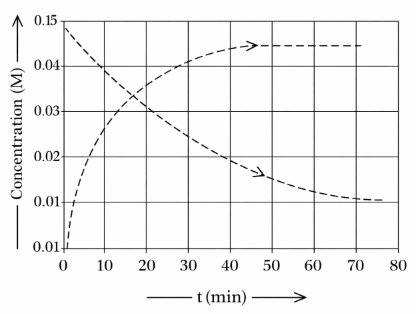
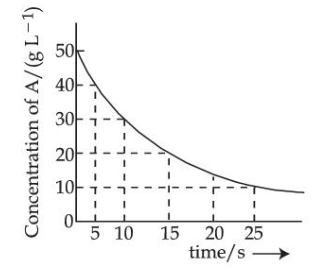
Given above is the concentration vs time plot for a dissociation reaction : $$A \rightarrow nB$$ .
Based on the data of the initial phase of the reaction (initial 10 min), the value of n is________.

Question 2

At 27 °C in presence of a catalyst, activation energy of a reaction is lowered by $$10 \text{KJ  mol}^{-1}$$. The logarithm of ratio of $$\frac{k(\text{catalysed})}{k(\text{uncatalysed})}$$ is......
(Consider that the frequency factor for both the reactions is same)

Question 3

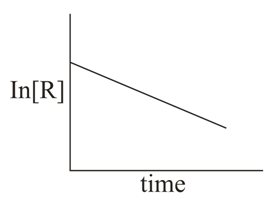
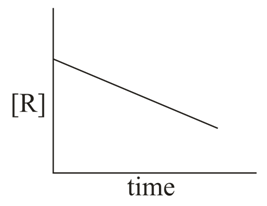
Consider the first order reaction $$R \to P$$. The fraction of molecules decomposed in the given first order reaction can be expressed as :

Question 4

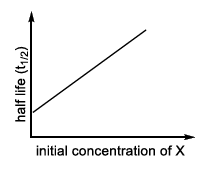
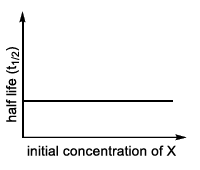
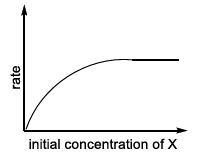
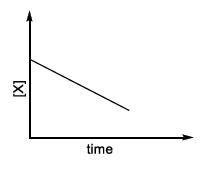
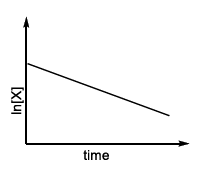
Consider the reaction $$aX \to bY$$, for which the rate constant at 30°C is $$1 \times 10^{-3}$$ mol$$^{-1}$$ L s$$^{-1}$$. Which of the following statements are true?
A. When concentration of 'X' is increased to four times, the rate of reaction becomes 16 times.
B. The reaction is a second order reaction.
C. The half-life period is independent of the concentration of X.
D. Decomposition of $$N_2O_5$$ is an example of the above reaction.
E.

image

is valid for the above reaction.
Choose the correct answer from the option given below:

Question 5

First order gas phase reaction
$$A \to B + C$$
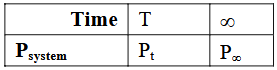
$$p_i$$ = initial pressure of gas A, $$p_t$$ = total pressure of the reaction mixture at time $$t$$
Expression of rate constant (k) is

Question 6

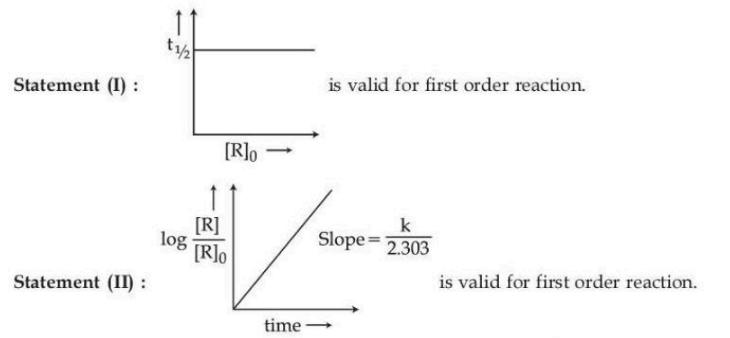
Given below are two statements :
$$R = 8.314$$ J K$$^{-1}$$ mol$$^{-1}$$ and 1 cal = 4.2 J
Statement I : When $$E_a = 12.6$$ kcal/mol, the room temperature rate constant is doubled by a 10 $$^\circ$$C increase in temperature (298 K to 308 K)
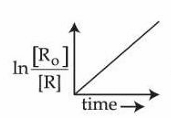
Statement II : For a first order reactions $$A \to B$$,

image


Here $$[A]_0$$ is the initial concentration of A and $$t_{1/2}$$ is half life of reaction.
In the light of the above statements, choose the correct answer from the options given below :

Question 7

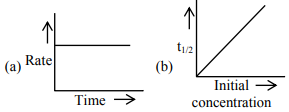
$$t_{100\%}$$ is the time required for the 100% completion of the reaction while $$t_{1/2}$$ is the time required for 50% of the reaction to be completed. Which of the following option correctly represents the relation between $$t_{100\%}$$ and $$t_{1/2}$$ for zero and first order reactions respectively?

Question 8

An organic compound undergoes first order decomposition. The time taken for decomposition to $$\left(\frac{1}{8}\right)^{th}$$ and $$\left(\frac{1}{10}\right)^{th}$$ of its initial concentration are $$t_{1/8}$$ and $$t_{1/10}$$ respectively. What is the value of $$\frac{t_{1/8}}{t_{1/10}}\times 10$$ ?
$$(\log{2}=0.3)$$

Question 9

A$$\rightarrow$$ product (First order reaction).
Three sets of experiment were performed for a reaction under similar experimental conditions:

Run 1 $$\Rightarrow$$ 100 mL of 10 M solution of reactant A

Run 2 $$\Rightarrow$$ 200 mL of 10 M solution of reactant A

Run 3 $$\Rightarrow$$ 100 mL of 10 M solution of reactant A + 100 mL of $$H_{2}O$$ added.

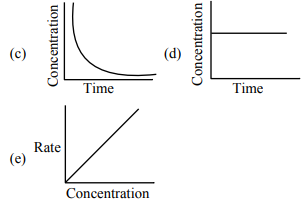
The correct variation of rate of reaction is

Question 10

Consider the general reaction given below at 400 K
$$xA(g)\rightleftharpoons yB(g).
The values of $$K_{p}\text{ and }K_{c}$$ are studied under the same condition of temperature but variation in x and y
(i)$$K_{p}=85.87\text{ and }K_{c}=2.586$$ appropriate units
(ii)$$K_{p}=0.862\text{ and }K_{c}=28.62$$ appropriate units
The values of x and yin (i) and (ii) respectively are:

Question 11

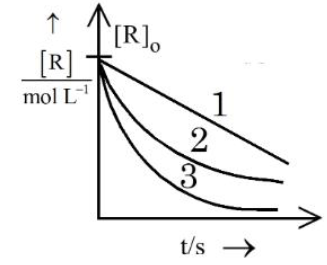
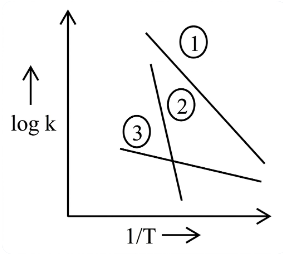
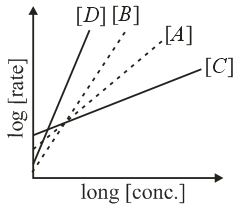
Consider the given graph showing variation of reactant concentration with time. Three different reactions were started with identical initial concentration of reactants. Which of the following statement is correct?

image
Question 12

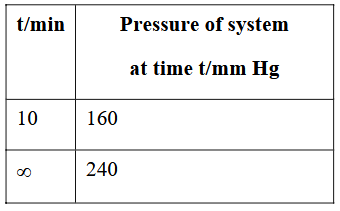
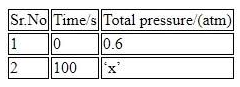
Decompasition of A is a first order reaction at T(K) and is given by $$A(g) \rightarrow B(g)+C(g)$$.
In a closed 1 L vessel, 1 bar A(g) is allowed to decompose at T(K). After 100 minutes, the total pressure was 1.5bar. What is the rate constant $$(in min^{-1})$$ of the reaction ? (log 2 = 0.3)

Question 13

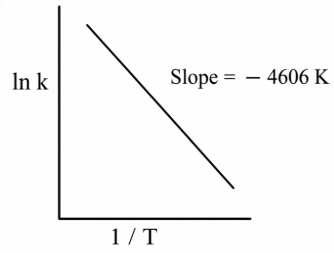
Correct statements regarding Arrhenius equation among the following are :
A. Factor $$e^{-Ea / RT}$$ corresponds to fraction of molecules having kinetic energy less than Ea.
B. At a given temperature, lower the Ea, faster is the reaction.
C. Increase in temperature by about $$10^{\circ}C$$ doubles the rate of reaction.
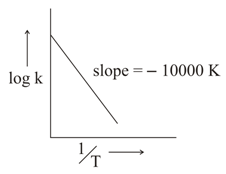
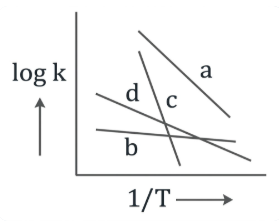
D. Plot of log k vs $$\frac{1}{T}$$ gives a straight line with slope = $$- \frac{Ea}{R}$$.
Choose the correct answer from the options given below :

Question 14

Observe the following reactions at T(K).

I. $$A\rightarrow$$products
II. $$5Br^{-}(aq)+BrO_{3}\text{ } ^{-}(aq)\rightarrow 3Br_2(aq)+3H_2O(l)$$

Both the reactions are started at 10.00 am. The rates of these reactions at 10.10 am are same. The value of $$-\frac{\triangle[Br^{-}]}{\triangle t}$$ at 10.10am. is $$2\times 10^{-4} mol \text{ }L^{-1}min^{-1}$$. The concentration of A at 10.10am is $$10^{-1}mol \text{ } L^{-1}$$. What is the first order rate constant (in min^{-1}) of reaction I?

Question 15

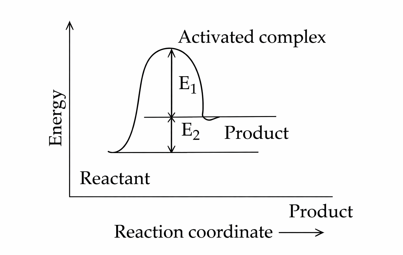
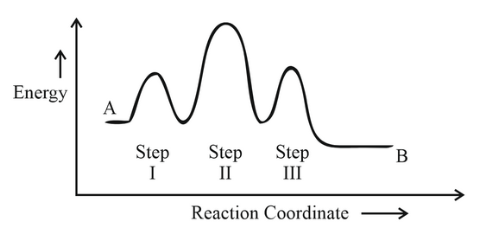
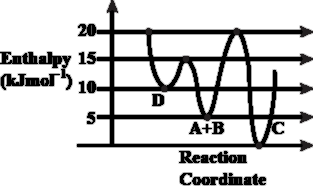
$$A\rightarrow D$$ is an endothermic reaction occurring in three steps ( elementary).
(i) $$A\rightarrow B \triangle H_{i}=+ve$$
(ii) $$B\rightarrow C \triangle H_{ii}=-ve$$
(iii) $$C\rightarrow D \triangle H_{iii}=-ve$$
Which of the following graphs between potential energy (y-axis) vs reaction coordinate (x-axis) correctly represents the reaction profile of A-> D?

Question 16

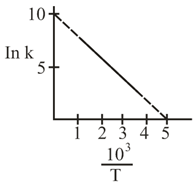
Consider $$A \xrightarrow{k_1} B$$ and $$ C \xrightarrow{k_2} D$$ are two reactions. If the rate constant ($$k_{1}$$) of the $$A \rightarrow B$$ reaction can be expressed by the followmg equation $$\log_{10}K = 14.34- \frac{1.5 \times 10^{4}}{T/K}$$ and activation energy $$C\rightarrow D$$ reaction ($$Ea_{2}$$) is $$\frac{1}{5}th$$ of the $$A\rightarrow B$$ reaction ($$Ea_{1}$$), then the value of ($$Ea_{2}$$) is _____________kJ $$mol^{-1}$$. (Nearest Integer)

Question 17

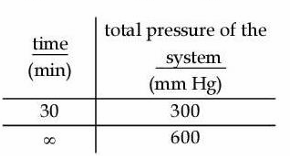
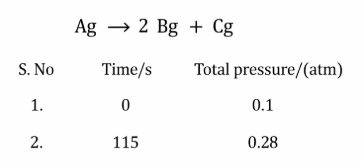
Consider the following gas phase reaction being carried out in a closed vessel at 25°C.
$$2A(g) \to 4B(g) + C(g)$$ 

image


The pressure of $$C(g)$$ at 30 minutes time interval would be _____ mm Hg. (nearest integer)

Question 18

Pre-exponential factors of two different reactions of same order are identical. Let activation energy of first reaction exceeds the activation energy of second reaction by 20 kJ $$mol^{-1}$$. If $$k_{1}\text{ and }k_{2}$$ are the rate constants of first and second reaction respectively at 300 K, then In $$\frac{k_{2}}{k_{1}}$$ will be ___.
(nearest integer) $$[R=8.3JK^{-1}mol^{-1}]$$

Question 19

The temperature at which the rate constants of the given below two gaseous reactions become equal is ______ K. (Nearest integer)

$$X \rightarrow Y $$ $$ k_{1}=10^{6}e^{\frac{-30000}{T}}$$

$$P \rightarrow Q $$ $$ k_{2}=10^{4}e^{\frac{-24000}{T}}$$

Given: ln 10 = 2.303

Question 20

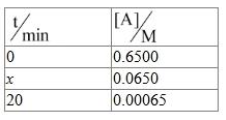
For a first order reaction A $$\to$$ B

image

$$x$$ = _________ min. (Nearest integer)

Question 21

For reaction A → P, rate constant k = 1.5 × 10$$^3$$ s$$^{-1}$$ at 27°C. If activation energy for the above reaction is 60 kJ mol$$^{-1}$$, then the temperature (in °C) at which rate constant, k = 4.5 × 10$$^3$$ s$$^{-1}$$ is __________. (Nearest integer) Given : log 2 = 0.30, log 3 = 0.48, R = 8.3 J K$$^{-1}$$ mol$$^{-1}$$, ln 10 = 2.3

Question 22

Sucrose hydrolyses in acidic medium into glucose and fructose by first order rate law with $$t_{1/2} = 3$$ hour. The percentage of sucrose remaining after 6 hours is _______. (Nearest integer)
(Given: log 2 = 0.3010 and log 3 = 0.4771)

Question 23

$$A \rightarrow B$$ (first reaction)
$$C \rightarrow D$$ (second reaction)
Consider the above two first-order reactions. The rate constant for first reaction at 500 K is double of the same at 300 K. At 500 K, 50% of the reaction becomes complete in 2 hour. The activation energy of the second reaction is half of that of first reaction. lf the rate constant at 500 K of the second reaction becomes double of the rate constant of first reaction at the same temperature; then rate constant for the second reaction at 300 K is______$$\times 10^{-1}hour^{-1}$$ (nearest integer).

Question 24

Decomposition of a hydrocarbon follows the equation $$k = (5.5 \times 10^{11} s^{-1}) e^{\frac{-28000K}{T}}$$. The activation energy of reaction is __________ kJ mol$$^{-1}$$. (Nearest Integer) Given : R = 8.3 J K$$^{-1}$$ mol$$^{-1}$$

Question 25

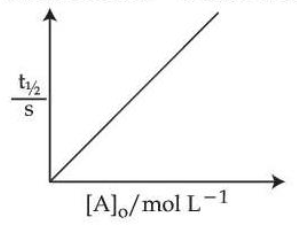
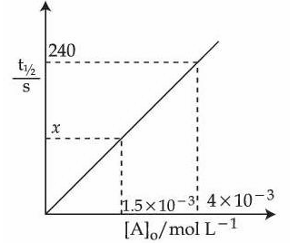
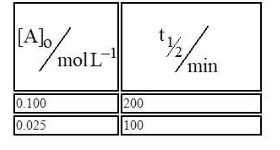
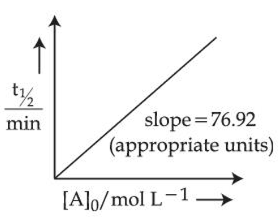
For the reaction $$A \to p$$ at  $$T K$$, the half  life ($$t_{1/2}$$) is plotted as a function of initial concentration $$[A]_o$$ of  $$A$$ as give below.

image


The value of $$x$$ in the given figure is ______ s (Nearest integer) 

Question 26

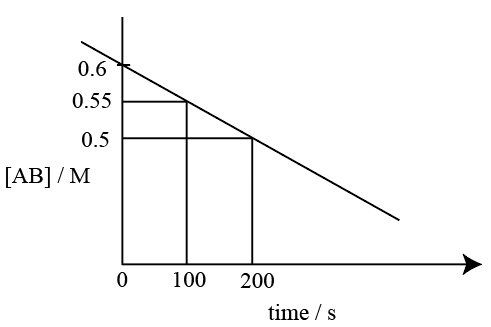
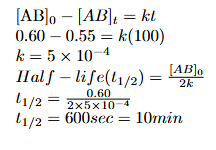
For the thermal decomposition of reactant AB(g), the following plot is constructed.

75


The half life of the reaction is 'x' min.
x= ____ min. (Nearest integer)

Video Solution
Question 27

If the half life of a first order reaction is 6.93 minutes then the time required for completion of 99% of the reaction will be _______ minutes. (Given: log 2 = 0.3010)

Question 28

The half-life of $${}^{65}Zn$$ is 245 days. After x days, 75% of original activity remained. The value of x in days is ___ . (Nearest integer)
(Given: log 3 = 0.4771 and log 2 = 0.3010)

50,000+ JEE Students Trusted Our Score Calculator

Predict your JEE Main percentile, rank & performance in seconds