
Join Our JEE Preparation Group
Prep with like-minded aspirants; Get access to free daily tests and study material.
Sign in
Please select an account to continue using cracku.in
↓ →
Join Our JEE Preparation Group
Prep with like-minded aspirants; Get access to free daily tests and study material.
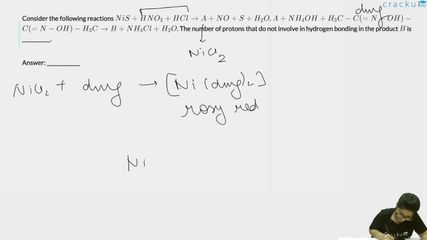
Consider the following reactions $$NiS + HNO_3 + HCl \rightarrow A + NO + S + H_2O$$. $$A + NH_4OH + H_3C - C(=N-OH) - C(=N-OH) - H_3C \rightarrow B + NH_4Cl + H_2O$$. The number of protons that do not involve in hydrogen bonding in the product $$B$$ is ___________.
Correct Answer: 12
Step 1: Identify the product “A” in the first reaction. In the reaction $$NiS + HNO_3 + HCl \;\longrightarrow\; A + NO + S + H_2O$$ nitrate ion acts as an oxidising agent, converting sulfide to elemental sulfur (S) and itself reduced to NO. The nickel remains in the +2 oxidation state and combines with two chloride ions. Hence $$A \;=\; NiCl_2.$$
Step 2: Write the second reaction with the structure of the diacetyl dioxime ligand. Diacetyl dioxime has the formula $$CH_3C(=N-OH)C(=N-OH)CH_3,$$ and reacts with $$NiCl_2$$ in the presence of ammonium hydroxide as follows: $$NiCl_2 + 2\;NH_4OH + CH_3C(=N-OH)C(=N-OH)CH_3 \;\longrightarrow\; B + NH_4Cl + H_2O.$$ In fact, one molecule of diacetyl dioxime provides two oxime groups that chelate to Ni$$^{2+}$$, giving the neutral complex $$B = Ni[CH_3C(=NOH)C(=NOH)CH_3]_2.$$
Step 3: Draw or visualise the structure of product $$B$$. It is a square-planar complex in which each diacetyl dioxime ligand is bidentate, coordinating through the two nitrogen atoms. Each ligand retains two -OH groups, which form intramolecular hydrogen bonds to the adjacent C=N nitrogens: Intramolecular H-bonds: each $$-OH$$ proton is hydrogen-bonded to the adjacent $$=N$$ atom.
Step 4: Count all the protons in $$B$$. Each ligand $$CH_3C(=NOH)C(=NOH)CH_3$$ has: • Two methyl groups, each with 3 protons → total 6 methyl protons per ligand. • Two oxime -OH protons. Since there are two ligands, total protons in $$B$$ = $$2\times(6\;{\rm methyl}) + 2\times(2\;{\rm OH}) = 12\;{\rm CH_3} + 4\;{\rm OH} = 16\;{\rm H}.$$
Step 5: Determine which protons are involved in hydrogen bonding. The four $$-OH$$ protons are tied up in intramolecular hydrogen bonds to the adjacent $$=N$$ groups. Therefore these 4 protons are involved in hydrogen bonding.
Step 6: Calculate the number of protons not involved in hydrogen bonding. Subtracting the 4 hydrogen-bonded protons from the total 16 gives: $$16 - 4 \;=\; 12.$$
Final Answer: The number of protons in product $$B$$ that do not participate in hydrogen bonding is 12.
Was this solution helpful?
Click on the Email ☝️ to Watch the Video Solution
Create a FREE account and get:
_1.webp)

Educational materials for JEE preparation

Ask our AI anything

AI can make mistakes. Please verify important information.
AI can make mistakes. Please verify important information.
