
Join Our JEE Preparation Group
Prep with like-minded aspirants; Get access to free daily tests and study material.
Sign in
Please select an account to continue using cracku.in
↓ →
Join Our JEE Preparation Group
Prep with like-minded aspirants; Get access to free daily tests and study material.
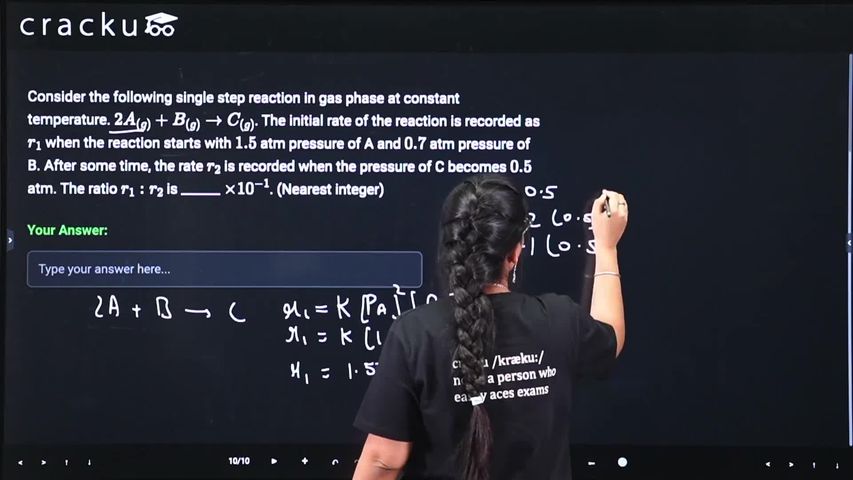
Consider the following single step reaction in gas phase at constant temperature. $$2A_{(g)} + B_{(g)} \rightarrow C_{(g)}$$. The initial rate of the reaction is recorded as $$r_1$$ when the reaction starts with $$1.5$$ atm pressure of A and $$0.7$$ atm pressure of B. After some time, the rate $$r_2$$ is recorded when the pressure of C becomes $$0.5$$ atm. The ratio $$r_1 : r_2$$ is ______ $$\times 10^{-1}$$. (Nearest integer)
Correct Answer: 315
Since the reaction $$2A_{(g)} + B_{(g)} \rightarrow C_{(g)}$$ is elementary, its rate law is $$ r = k \cdot P_A^2 \cdot P_B $$.
At $$P_A = 1.5$$ atm and $$P_B = 0.7$$ atm one finds $$ r_1 = k \times (1.5)^2 \times 0.7 = k \times 2.25 \times 0.7 = 1.575k $$.
When $$P_C$$ has increased by 0.5 atm, stoichiometry shows that $$P_A$$ decreases by $$2 \times 0.5 = 1.0$$ atm and $$P_B$$ decreases by $$1 \times 0.5 = 0.5$$ atm, giving $$P_A = 0.5$$ atm and $$P_B = 0.2$$ atm.
Under these conditions, $$ r_2 = k \times (0.5)^2 \times 0.2 = k \times 0.25 \times 0.2 = 0.05k $$.
Dividing these rates gives $$ \frac{r_1}{r_2} = \frac{1.575k}{0.05k} = \frac{1.575}{0.05} = 31.5 $$. Therefore, $$r_1 : r_2 = 31.5 = 315 \times 10^{-1}$$, so the answer is 315.
Was this solution helpful?
Click on the Email ☝️ to Watch the Video Solution
Create a FREE account and get:
_1.webp)

Educational materials for JEE preparation

Ask our AI anything

AI can make mistakes. Please verify important information.
AI can make mistakes. Please verify important information.
