91- 6303239042
Arrange the countries in order of increasing population density (number of people per sq. kms).
Sign in
Please select an account to continue using cracku.in
↓ →
Based on the information given below, answer the questions which follow.
The data on select economic indicators for entire world comprising of 7 regions namely East Asia & Pacific, Europe & Central Asia, Latin America & Caribbean, Middle East & North Africa, North America, South Asia and Sub-Saharan Africa is presented in Table-1 for the year 2017. Further, Table-2 represents the economic indicators for select countries.
GNI refers to Gross National Income (USD Billions). PPP refers to Purchasing Power Parity (USD Billions). POP refers to Population (Millions) and SA refers to Surface Area (Thousands sq. km)
Table-1: Economic Indicators for Different Regions of World

Table-2: Economic Indicators for Select Countries

Arrange the countries in order of increasing population density (number of people per sq. kms).
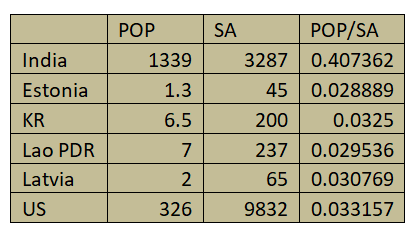
From the above table it is clear that option D is the correct answer.
For which of the region, the 'GNI per capita' is closest to that of 'GNI per capita' of world?
Loading solution...
What percentage of world's GNI is represented by combined GNI of India and US?
Loading solution...
Which region has third lowest difference between 'PPP per capita' and 'GNI per capita'?
Loading solution...
Based on the information given below, answer the questions which follow.
The occupancy rate of a hotel is the share of available rooms that are occupied during a given time. Figure- I presents quarter wise average hotel occupancy in four regions (Asia-Pacific, America, Europe and Middle East & Africa) for the year 2016. Figure-2, shows the revenue of select hotel chains worldwide in 2016.
Figure-1: Region Wise Average Hotel Occupancy Rates
Occupancy rates

Regions $$\rightarrow$$
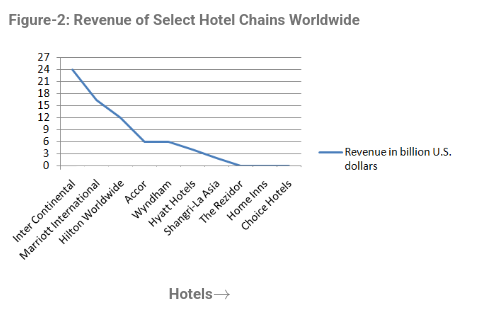
Considering the total revenue of the hotel industry in 2016 as 495.17 billion USD. what is the percentage contribution of revenue of select hotel chains to hotel industry revenue?
Loading solution...
For Hilton Worldwide, considering 70% average occupancy rate for 365 days of operations and average room rent of 350 USD per day, the total number of rooms available (in 000's) in Hilton Worldwide per day approximately are:
Loading solution...
If the number of available rooms in each of the four regions (Asia-Pacific, America, Europe and Middle East & Africa) are in the ratio 1:2:5:4, the average occupancy rate for Quarter-1 are:
Loading solution...
Assuming that there is no change in the number of available rooms in a given year in all four regions, the correct arrangement in the increasing order of average annual occupancy rates is :
Loading solution...
Based on the information answer the questions which follow.
IBM is one of the most valuable technology brand in the world. Visualizing the trends, IBM has added and dropped business segments across years. For example, "Technology Services and Cloud Platforms (TSCP)" which started in 2015 only, generated a revenue of approximately 34280 million U.S. Dollars in 2017. Table shows the Global Revenue generated by IBM in nine different segments of its business from 2010 to 2017 in millions USD.
IBM's Golbal Revenue from 2010 to 2017 (in millions U.S. Dollars)

TSCP-Technology Services & Cloud Platforms. CS-Cognitive Solutions, GBS-Global Business Services, SYS-Systems, GF-Global Financing, Other. SOFT-Software. GTS-Global Technology Services and S&T-Systems and Technology
For the year 2017, if the revenue in different segments is represented on a pie-chart, what sector angle would be represented by 'Global Business Services (GBS)'?
Loading solution...
Which segment has earned third highest cumulative revenue in the time period 2010-2017?
Loading solution...
The profit booked by IBM in year 2012 is USD 49 billion. Considering equal percentage profit margins across all segments, then approximate profit made by 'Systems and Technology' in millions USD is
Loading solution...
By how much is ratio of percentage of 'revenue from Global Business Services' to 'Total Revenue' lower than ratio of percentage of 'revenue from Cognitive Solutions' to 'Total Revenue' for the year 2016?
Loading solution...
Based on the information answer the questions which follow.
The Logistics Performance Index (LPI) is an interactive benchmarking tool created by the World Bank to help countries identify the challenges and opportunities they face in their performance on trade logistics and what they can do to improve their performance. It is a measure of the country scores on six key indicators: Customs, Infrastructure, International Shipments, Logistics Competence, Tracking & Tracing and Timeliness. Table shows the LPI indicators (on the scale of 1 to 5) of select countries on these indicators. Figure below presents the perceived performance of these indicators (on the scale of 1 to 5) of India on these 6 indicators.
Table: LPI Indicators of Select Countries in 2018

Figure: LPI Indicators for India

Considering Logistics Performance Index as the average of the scores obtained on the six parameters, the correct sequence of the countries in increasing order of LPI in the year 2018 is
Loading solution...
Arrange the countries in ascending order on the basis of score obtained on (Timeliness) - (Logistics Competence)
Loading solution...
In which year the difference between the score obtained on Timeliness between Germany and India is minimum considering the score obtained on Timeliness for Germany as 4.39, 4.45, 4.36, 4.32, 4.48 and 4.33 for 2018, 2016, 2014, 2012, 2010 and 2007 respectively?
Loading solution...
Among the following the difference in performance of which indicator in 2018 as compared to that of 2007 is minimum for India?
Loading solution...
Based on the information answer the questions which follow.
The data was collected for an industry in order to analyse the impact and importance of select parameters. The Figure represents performance of the industry on select parameters which arc Fixed Capital. Materials, Value added and Number of Factories from the year 2008-09 to 2015-16. Total inputs - (Output — Value added). Table represents select performance indicators which are Output, Number of Workers and Emoluments from the year 2008-09 to 2015-16.
Figure: Industry Indicators from 2008-09 to 2015-16

Table: Industry Indicators from 2008-09 to to 2015-16

In which of the following year annual growth rate in emoluments per worker is highest?
Loading solution...
In which of the following year fixed capital per factory is lowest?
Loading solution...
In which of the following year Material as a proportion of 'Total inputs' is highest?
Loading solution...
For how many years annual percentage growth in fixed capital is greater than annual percentage growth in number of factories?
Loading solution...
Find the value of X.
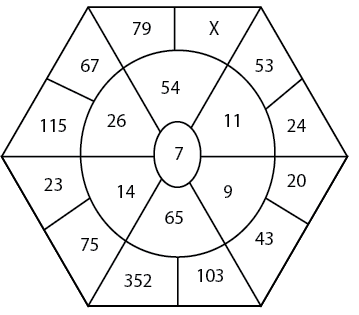
Loading solution...
Based on the information below, answer the questions which follow.
Six friends Albert, Betty, Claire, Daisy, Evan and Fred who are working in different organisations, are looking for a switch in their jobs. They came across an advertisement in the newspaper regarding a job fair being organised in New Delhi. After enrolling for the fair, different days are allotted to each one of them from Monday to Saturday not necessarily in the same order, starting from Monday. They also had to arrange for their stay in different hotels to concentrate well while preparing for the upcoming interviews namely Taj, Hilton, Crowne Plaza, Radisson, Hyatt and Marriott. Additional information provided is as follows:
i. Albert prefers to stay in Taj but not in Hilton. Albert does not work in Whirlpool and participates in the Job fair on Monday. The person who works in Whirlpool participates in the Job fair on Saturday.
ii. Fred does not stay in Hyatt but works in Himalaya.
iii. Betty and Daisy participate in the Job fair on consecutive days.
iv. Claire participates in the Job fair on the day before the person staying in Crowne Plaza but on the next day of Pepsi employee.
v. The person working with Oppo participates in the Job fair on Friday and does not stay in Hilton.
vi. Claire who is working with Nestle participates in the Job fair at a gap of one day prior to Evan.
vii. Daisy stays in Marriott and attends the conference on the last day of the week.
viii. The person working with Apple stays in Radisson.
Which of the following friend is working with Apple?
Loading solution...
Who participated in the job fair on Wednesday.?
Loading solution...
If the current salary packages of the friends working in Whirlpool, Nestle, Himalaya, Pepsi, Oppo and Apple are 20, 30. 40; 50, 60 and 70 Iakhs per annum in the same order, then at the time of participating in job fair find the average annual package of Albert, Betty and Fred?
Loading solution...
Which of the following friend is staying in Hilton:
Loading solution...
Based on the information below, answer the questions which follow.
Richie invites three of his friends Sunny, Pinky and Nancy for his birthday party organised at his home. As the party goes on till late in the night, Sunny, Pinky and Nancy choose to stay at Richie's house. Being good friends they usually stay back at each other's house. Each one of them including Richie stay either in the room painted blue or in the room painted purple. They have adequate number of rooms of both colours. The preferences which need to be fulfilled are:
i. If Sunny stays in the room painted purple, then Pinky and Richie stay in the same room as Nancy.
ii. If Pinky stays in the room painted purple, then Sunny stays in the room in which Nancy and Richie don't stay.
iii. if Nancy stays in the room painted blue, then Sunny and Richie stay in the room which Pinky has chosen.
iv. If Richie stays in the room painted Blue then Sunny and Pinky do not stay in the same room as Nancy.
Under all possible combinations which of the two friends will always have their room colours unchanged.
Loading solution...
If Richie chose to stay in the room painted blue, then in which room does Pinky stay?
Loading solution...
If Pinky does not like to stay in the blue painted room, then where will Sunny stay?
Loading solution...
Based on the information answer the questions which follow.
An agent has to send a secret message to CBI office in Delhi. He needs to compile his message using following 12 code words- Scare, Logical, Mouse, Beauty, Helping, Roses, Cats, Doctor, Arguments. Crude. Ferry and Mineral. The agent compiles the coded message and delivers it to CBI office in form of a $$4\times3$$ matrix. Each coded word has been allocated a position in the matrix ($$1\times2$$ position represents row 1 and column 2). The clues to compile the secret message are:
i. The words in $$2\times1$$ and $$3\times1$$ have the same number of letters.
ii. Roses is to the immediate left of Beauty and Mineral is immediately above Roses.
iii. The word in $$4\times3$$ is shorter than the word in $$1\times2$$.
iv. Ferry is separated from Helping horizontally by only one word Logical.
v. Arguments is at position $$2\times3$$ in the matrix and the word immediately below it has odd number of letters.
vi. Crude and Doctor are in the same horizontal row and Crude is to the right of Doctor.
vii. Cats is not in the same row or column as Mouse.
The product of the position of a coded word is 8. Identify the word.
Loading solution...
The sum of letters of which row is 19?
Loading solution...

Which word is represented in $$4\times3$$?
Loading solution...
Which of the following are placed diagonally in-the matrix?
Loading solution...
Based on the information answer the questions which follow.
Eight officers of Indian Trade Service meet for a cup of coffee at Coffee Point. The officers P, Q, R, S, T. U. V and W are seated in a circle and discuss issues related to Trade in Services, Trade in Intellectual Property Rights, Investments, Tariffs, Remedies, Standards, Trade Facilitation and Subsides not necessarily in the same order. An MBA student sitting on the next table overhears the discussion and ranks the issues as per their importance from 1 to 8. No two issues can have the same rank and no two officers can have the same position. Additional information available is:
i. P is sitting to the immediate left of S and the officer opposite to S discusses issues pertaining to Remedies.
ii. U's issue is ranked $$7^{th}$$ and there is one officer between U and the officer whose issue is ranked $$2^{nd}$$.
iii. The officer whose issue is ranked 1 is not opposite to the officer whose issue is ranked 8 who represents issues related to Investments.
iv. The ranks of the issues raised by the officers sitting opposite to each other cannot be both even or both odd.
v. The officer discussing issues related to Trade in Services is sitting opposite to T. T is sitting at a gap of one place from P.
vi. R is sitting opposite to Q and represent issues related to Standards and Trade in Intellectual Property Rights not necessarily in the same order.
vii. P's issue was ranked 4th and he was discussing issues related to Tariffs and sits opposite to the officer ranked 5th who represents issues related to Subsidies.
viii. The officers representing issues related to Trade in Services and Trade facilitation are sitting adjacent to each other.
Which officer discusses Remedies and what is its rank?
Loading solution...
If the officer V is to the immediate right of the officer representing Trade Facilitation, then the officer $$4^{th}$$ to the right of V discusses which issue?
Loading solution...
Which possible issues can be represented by W?
Loading solution...
The officer to the $$4^{th}$$ right to the officer discussing the issues related to Remedies, is discussing which issue?
Loading solution...
Based on the information answer the questions which follow.
A consultant to Department of Commerce. Government of Bianca has suggested 30 products which have high export potential. Dora an entrepreneur and prospective exporter notices that these products can be grouped in three ways- Machine made goods, Handmade goods and Intermediate goods. Among these 30 products some products are both machine made and intermediate goods but not handmade goods. Few products have a combination of handmade and machine made goods but not intermediate goods. Some products are handmade and intermediate goods but not machine made goods. Further it is seen that handmade-machine made goods are I less than machine made-intermediate goods. Similarly the total number of handmade-intermediate goods is I less than machine made-intermediate goods. There are just 4 products common across all product groups i.e. machine made-handmade- intermediate goods. Apart from this the number of only handmade goods is same as only machine made goods but less than only intermediate goods. Each product group/combination has at least one product. Dora prefers to export machine made goods and avoid hand made goods. She finds out that only handmade goods are twice the only machine made-intermediate goods and the number of only intermediate goods is an even number. Whereas her close friend Sara prefers to export intermediate goods followed by only handmade goods.
Sara and Dora prefer to export as many common products as possible in order to understand the regulatory conditions. Keeping their preferences intact, what is the maximum number of common products which can be exported by both of them?
Loading solution...
If another exporter Abeer prefers to export only intermediate goods, then the total number of products which both Abeer and Dora export are
Loading solution...
Based on the information answer the questions which follow.
Nautanki a famous play group from Eastern India is playing different shows every hour starting from 10am with a two hour lunch break from I pm to 3 pm after which the show resumes at 3 pm. Entry tickets for different shows are coded with 7 words each day. The same words are rearranged for different shows following a definite rule. For example:
Show 1 : Banana is the favourite fruit of Bina
Show 2 : the is of favourite Bina fruit Banana
Show 3 : of is fruit favourite Banana Bina the
And so on till the last show at 9 pm.
If on some other day, for the fourth show the code is 'All of Delhi welcome to the show' Then the code for entry ticket for the first show on that day is
Loading solution...
If the entry code for the show at 7 pm is 'Do things to help others in difficulty' Then the code for entry ticket for the show at 12 noon of that day was
Loading solution...
Which of the following is NOT an activity generally carried out by using a shell company?
Loading solution...
Match the Trophies and Cup associated with each Sport:

Loading solution...
Match the Biographies/Autobiographies of India's sport players:

Loading solution...
Correctly match the following terms?

Loading solution...
Which of the following Telecom Operator has launched the app based Internet calling service "WINGS" in India?
Loading solution...
Which of the following agreement is NOT related to the World Trade Organization (WTO)?
Loading solution...
LIFT has been entrusted with the responsibility of setting up of India-Africa Institute of Foreign Trade as a Centre of Excellence in the area of International Business and Trade with Pan-Africa reach. This effort of Government of India will come under which of the following types of Diplomacy?
Loading solution...
Why are the Indirect 'Taxes termed as 'Regressive Taxing Mechanisms'?
Loading solution...
Which of the following is the most exported agricultural commodity from India in terms of value?
Loading solution...
Which of the following is a correct sequence of Sea Ports of India from 'South to North'?
Loading solution...
Which of the following country is not a member of BIMSTEC?
Loading solution...
Which of the following industry is the not covered in the 'Index of Eight Core Industries' in India?
Loading solution...
Given below are the logos of various global firms. On the basis of their logo, select the correct functional area they operate in.

Loading solution...
To strengthen its maritime network and enhance trade & economic ties, Government of India has decided to invest in a port in Indonesia. The name of this port is
Loading solution...
Which of the following statement about American Businessman Elon Musk is not correct?
Loading solution...
Rand is the currency of which of the following country?
Loading solution...
Bharat Desai and Neerja Sethi, the Indian-American couple has made USD 2 Billion jackpot by selling their company to French IT major. ATOS. Name the company they sold.
Loading solution...
Which of the following company has designed the humanoid 'Sophia'?
Loading solution...
Read passage carefully. Answer the questions by selecting the most appropriate option (with reference to the passage).
PASSAGE 1
We use the word culture quite casually when referring to a variety of thoughts and actions. I would like to begin my attempt to define cultures by a focus on three of its dictionary meanings that I think are significant to our understanding of the general term-culture. We often forget that it's more essential usage is as a verb rather than as a noun, since the noun follows froth the activities involved in the verb. Thus the verb, to culture, means to cultivate. This can include at least three activities: to artificially grow microscopic organisms; to improve and refine the customs, manners and activities of one's life; to give attention to the mind as part of what goes into the making of what we call civilization, or what was thought to be the highest culture. In short, one might argue that culture is the intervention of human effort in refining and redefining that which is natural, but that it gradually takes on other dimensions in the life of the individual, and even more in the interface between the individual and society. When speaking of society, this word also requires defining. Society, it has been said, is what emerges from a network of interactions between people that follow certain agreed upon and perceptible patterns. These are determined by ideas of status, hierarchy and a sense of community governing the network. They are often, but not invariably, given a direction by those who control the essentials in how a society functions, as for instance, its economic resources, its technology and its value systems. The explanation and justification for who controls these aspects of a society introduces the question of its ideology and often its form.
The resulting patterns that can be differentiated from segment to segment of the society are frequently called its cultures. Most early societies register inequalities, The access of their members to wealth and status varies. The idea of equality therefore has many dimensions. All men and women may be said to be equal in the eyes of god, but may at the same time be extremely differentiated in terms of income and social standing, and therefore differentiated in the eyes of men and women. This would not apply to the entire society. There may be times when societies conform to a greater degree of equality, but such times may be temporary. It has been argued that on a pilgrimage, the status of every pilgrim is relatively similar but at the end returns to inequalities. Societies are not static and change their forms and their rules of functioning. Cultures are reflections of these social patterns, so they also change. My attempt in this introduction is to explain how the meaning of a concept such as culture has changed in recent times and has come to include many more facets than it did earlier. What we understand as the markers of culture have gone way beyond what we took them to be a century or two ago. Apart from items of culture, which is the way in which culture as heritage was popularly viewed, there is also the question of the institutions and social codes that determine the pattern of living, and upon which pattern a culture is constructed. Finally, there is the process of socialization into society and culture through education. There is a historical dimension to each of these as culture and history are deeply intertwined. There is also an implicit dialogue between the present and the past reflected in the way in which the readings of the past changed over historical periods.
Every. society has its cultures, namely, the patterns of how the people of that society live. In varying degrees this would refer to broad categories that shape life, such as the environment that determines the relationship with the natural world, technology that enables a control over the natural world, political-economy that organizes the larger vision of a society as a community or even as a state, structures of social relations that ensure its networks of functioning, religion that appeals to aspirations and belief, mythology that may get transmuted into literature and philosophy that teases the mind and the imagination with questions. The process of growth is never static therefore there are mutations and changes within the society. There is communication and interaction with other societies through which cultures evolve and mutate. There is also the emergence of subcultures that sometimes take the form of independent and dominant cultures or amoeba-like breakaway to form new cultures. Although cultures coincide with history and historical change, the consciousness of a category such as culture, in the emphatic sense in which the term is popularly used these days, emerges in the eighteenth century in Europe. The ideal was the culture of elite groups, therefore sometimes a distinction is made between what carne to be called 'high culture' that of the elite, and low culture' that of those regarded as not being of the elite, and sometimes described as 'popular'. Historical records of elite cultures in forms such as texts and monuments for instance, received larger patronage and symbolized the patterns of life of dominant groups. They were and are more readily available as heritage than the objects of the socially lower groups in society whose less durable cultural manifestations often do not survive. This also predisposed people to associate culture as essentially that of the elite.
What is the central idea of the passage?
Loading solution...
According to the author what are the characteristics of 'Society'?
Loading solution...
With reference to the above passage, what are the important elements of 'Culture'?
Loading solution...
Read passage carefully. Answer the questions by selecting the most appropriate option (with reference to the passage).
PASSAGE 2
Today, we have specialists in various professions, but many among them are unconcerned with the world beyond their own specialization. It is sometimes said that they arc replacing the public intellectual. But the two are not identical. There are many more academics, for instance, than existed before. But it seems that most refer not to confront authority even if it obstructs the path of free thought. Is this because they wish to pursue knowledge undisturbed, or because they are ready to discard knowledge should authority require them to do so? Or does association with national or international agencies require that critical assessments of social thought and action remain sotto voce? Today, as always, he public intellectual is expected to take a position independent of those in power, enabling him or her to question debatable ideas, irrespective of who propagates them. Reasoned critiques are often the essential starting point. The public intellectual has to see himself or herself as a person who is as close to being autonomous as is possible, and more than that, be seen by others as such.
An knowledged professional status makes it somewhat easier to be autonomous. Such status brings with it another kind of authority, conceded, even if grudgingly, by professional peers and this does make some small impact on the non-professional world. The public intellectual of today, in addition to being of such a tatus, has to have at the same time a concern for what constitutes the rights of citizens. particularly on issues of social justice, and further, there should be a readiness to raise these matters as public policy. The combination of drawing upon the professional respect that a person has garnered, together with a concern for society, can sometimes establish the moral authority of that person and ensure public support. This is a conceded qualification and not a tangible one. In the past it was those who had distanced themselves somewhat from society who were believed not to have a vested interest in the changes they were suggesting. Although this was not always so, we know that close associations, such as formal affiliation to a political party, can inhibit free-thinking and criptions for action, even if it has the advantage of providing a certain leverage to the suggestions being ade. As an attitude of mind, autonomy is more readily expected of the professional specialist or the demic. Such persons, and they are not the only ones, can suggest alternative ways of thinking, even about ems of the larger society. Their thinking should emerge from reasoned, logical analyses. Yet academics today are hesitant to defend even the right to make what might be broadly called alternative, if not rational interpretations, however sensitively they may be xpressed. This is evident from the ease with which books arc banned and pulped, or demands made that they be burned, and syllabuses changed under pressure from religious or political organizations, or the intervention of the state. Why do such actions provoke so little reaction among many academics and professionals? The answer that is usually given is that they fear the instigators who arc persons with the backing of political authority. But is this the only answer?
Is it assumed that opinions about governance and society must hinge on ideologies linked to political parties and as a result there can be no thinking about how to configure society in a manner that is independent of a necessary commitment to political parties? Surely in this day and age, it is possible to he an independent liberal in this country with ideological commitments that arc not determined solely by political parties? Being a liberal is an attitude of mind that determines the fight for space in a society when that society resists ethics and reasoned thinking. The understanding of what one is battling for assumes an ideological direction but this does not require association with a political party. And there should also be the freedom to choose one's position on an issue and this position need not be in conformity with the ideological take of a particular political party on every occasion. The public intellectual has, by definition, to be liberal, that is, to insist that there be space to present varying perspectives and that wherever possible, reason and ethics should have primacy in whatever debates are taking place. This is not a new definition and has been a recognizable part of the interface between knowledge and society since earliest times. Approximations to orthodoxy and orthopraxy have always been contested by similar approximations to heterodoxy although those leading the charge do not always have or need to have the same social identity. This is apparent among people and situations in the Indian past yet we have often ignored it or failed to recognize it. How an intellectual even without being a public intellectual, requires a more than average knowledge in his/her professional specialization and beyond that a familiarity with the context of that knowledge: how did it come about and what arc the implications for the people who use that knowledge. To be a technician (or be technically accomplished) in a specialization, however good, is not sufficient. An intellectual perspective requires that the specialized knowledge one possesses should be related to social concerns where required and to other branches of knowledge as well. Added to this it helps if that knowledge can be contextualized in an accessible way for a wider range of people to understand facets of the variegated world in which we live, and to which understanding the specialization contributes. The public intellectual uses such foundations in his/her thinking in order to extend the understanding of the world we inhabit, and to do so by insisting on space for debate and the right to informed opinion.
According to the author, 'Public Intellectual' is one who
Loading solution...
How does the author differentiate between Public Intellectuals of the past and today?
Loading solution...
With reference to the above passage, explain the relationship between Orthodoxy, Orthopraxy and Heterodoxy as proposed by the author as applicable to the Public Intellectual'
Loading solution...
Read passage carefully. Answer the questions by selecting the most appropriate option (with reference to the passage).
PASSAGE 3
We love information. Especially in times of crisis. Have you ever noticed your tendency to become glued to the television or Internet when disaster strikes? It is human nature to try to gather as much information as possible, to make sense and create meaning when we don't understand what is happening. We seek information for another reason too, control. We operate under the illusion that if we can gain more information, we will not only understand what is happening, we might just be able to control it. I am not suggesting that there is no value to information or to clearly defined reporting and accountability relationships for routine business operations. I am instead calling out the temptation that an information-centred approach to agility offers: there's a desire to settle into the illusion that information will give you control, when in many situations it is simply not possible to gather or process enough information to be effective when it counts.
Recognizing that there are many situations that you not only cannot control but cannot predict is a radical mind-set and practice shift for most. It requires that you decide whether your goal is to reduce the perception of uncertainty or to actually become more effective in its midst. It also involves more than a simple reconfiguration of the organisation chart and job descriptions. It require relinquishing the illusion of control that lies at the very foundation of most management training and business practice. This shift is being made in one of the most hierarchal, command-and-control organizations in the country, the United States military. Recognizing the insidious nature of information age strategies and their tendency to lead to either analysis paralysis or the false security of convenient stories, the U.S. military has begun to make a fundamental shift in its approach to VUCA (volatility, uncertainty, complexity, and ambiguity), a shift from information to interactions. This change does not begin with restructuring and redeployments but with a fundamental shift in mind-set. In fact, the term. VUCA was first coined by the U.S. Army War College to describe increasingly complex and unpredictable combat conditions." VUCA has become shorthand for the reality of life in the twenty-first century. Most business approaches to VUCA focus on strategies to reduce
uncertainty. These strategies tend to centre around gaining greater control, including amassing more and better information, minimizing risk, and improving planning and analysis. While risk and uncertainty reduction are valid strategies, they do not necessarily make an organization more agile, for two reasons: ( 1) collecting more and better information takes time and may foster the illusion of control and comfort when, in reality, it is impossible to gather all available information in complex, changing contexts, let alone fully analyze and make meaning of, it and (2) planning and analysis are dependent on relatively stable contexts. Another liability of information-centred approaches is that they typically lead to more questions and the need to gather more information to reduce the uncertainty created by the information already collected. There is an even more significant liability of the information-centred approach to agility: our preconceptions lead us to filter out information that does not align with our expectations. Under the stress of an unexpected challenge or opportunity, our ability to access our higher thinking capacity can be reduced, leading us to fall back on the version of the story we expected. Warnings of terrorist threats before 9/11 and potential malfunctions of crucial components prior to the Challenger space shuttle disaster went unheeded because they did not fit the narrative that was co-constructed by leaders during years of experience and expectation. Agile leaders, teams and organizations know they cannot afford to get caught up in a story. They arc
instead learning how they might be more effective by focusing on their interactions with one another and with the available information in the dynamic present moment.
Let me emphasize that this is a shift away from an overreliance on information. I am not suggesting you curtail important industry and market data analysis, or take this as encouragement to blindly make decisions when further investigation is warranted. I am encouraging you to shift away from the false comfort such information can offer, and toward the relational context in which you make sense of it, decide and act. When we make the shift from information to interaction, we may be called to shift more than our relationship to external information; we may need to shift the way we perceive ourselves as well. The agility shift requires that we value our capacity to connect and build relationships over-or at least as much' as-our hard-won expertise. Years of experience, training and credentials are, of course, still valuable. But their value is minimal without the networks to which the skills, knowledge, experience, and resource awareness are linked. In other words, separating the process of "knowing what" and "knowing how" from the process of "knowing who" significantly diminishes agility capacity. The shift from information to interaction values the human system in which all meaning and action take place. Rather than problematizing this system as non-objective or messy, the agility shift embraces it and engages it more fully. You may not be able to control or predict what happens. but with a conscious, continuous commitment to interacting within your web of relationships and resources, you will be more effective than you ever imagined. The agility shift is first and foremost a shift in mind-set. This mind-set values interactions within the dynamic present moment. It is also a shift from the false comfort of "a plan" to achieving a state of readiness to find opportunity in the unexpected.
With reference to the above passage what is the author's stand with regard to Information'?
Loading solution...
According to the author what causes 'analysis-paralysis"?
Loading solution...
With reference to the above passage, 'agility shift' is
Loading solution...
According to the author, why do we 'love' information?
Loading solution...
Read passage carefully. Answer the questions by selecting the most appropriate option (with reference to the passage).
PASSAGE 4
While majoring in computer science isn't a requirement to participate in the Second Machine Age, what skills do liberal arts graduates specifically possess to contribute to this brave new world? Another major oversight in the debate has been the failure to appreciate that a good liberal arts education teaches many skills that are not only valuable to the general world of business, but are in fact vital to innovating the next wave of breakthrough tech-driven products and services. Many defenses of the value of a liberal arts education have been launched, of course, with the emphasis being on the acquisition of fundamental thinking and communication skills, such as critical thinking, logical argumentation, and good communication skills. One aspect of liberal arts education that has been strangely neglected in the discussion is the fact that the humanities and social sciences are devoted to the study of human nature and the nature of our communities and larger societies. Students who pursue degrees in the liberal arts disciplines tend to be particularly motivated to investigate what makes us human: how we behave and why we behave as we do. They're driven to explore how our families and our public institutions-such as our schools and legal systems-operate, and could operate better, and how governments and economies work, or as is so often the case, are plagued by dysfunction. These
students learn a great deal from their particular courses of study and apply that knowledge to today's issues, the leading problems to be tackled, and various approaches for analyzing and addressing those problems.
The greatest opportunities for innovation in the emerging era are in applying evolving technological capabilities to finding better ways to solve human problems like social dysfunction and political corruption; finding ways to better educate children; helping people live healthier and happier lives by altering harmful behaviors; improving our working conditions; discovering better ways to tackle poverty; Improving healthcare and making it more affordable; making our governments more accountable, from the local level up to that of global affairs; and finding optimal ways to incorporate intelligent, nimble machines into our work lives so that we are empowered to do more of the work that we do best, and to let the machines do the rest. Workers with a solid liberal arts education have a strong foundation to build on in pursuing these goals. One of the most immediate needs in technology innovation is to invest
products and services with more human qualities. with more sensitivity to human needs and desires. Companies and entrepreneurs that want to succeed today and in the future must learn to consider in all aspects of their product and service creation how they can make use of the new technologies to make them more humane. Still, many other liberal arts disciplines also have much to provide the world of technological innovation. The study of psychology, for example, can help people build products that are more attuned to our emotions and ways of thinking. Experience in Anthropology can additionally help companies understand cultural and individual behavioural factors that should be considered in developing products and in marketing them. As technology allows for more machine intelligence and our lives become increasingly populated by the Internet of things and as the gathering of data about our lives and analysis of it allows for more discoveries about our behaviour, consideration of how new products and services can be crafted for the optimal enhancement of our lives and the nature of our communities, workplaces and governments will be of vital importance. Those products and services developed with the keeneSt sense of how they' can serve our human needs and complement our human talents will have a distinct competitive advantage. Much of the criticism of the liberal arts is based on the false assumption that liberal arts students lack rigor in comparison to those participating in the STEM disciplines and that they are 'soft' and unscientific whereas those who study STEM fields learn the scientific method. In fact the liberal arts teach many methods of rigorous inquiry and analysis, such as close observation and interviewing in ways that hard science adherents don't always appreciate. Many fields have long incorporated the scientific method and other types of data driven scientific inquiry and problem solving. Sociologists have developed sophisticated mathematical models of societal networks. Historians gather voluminous data on centuries-old household expenses, marriage and divorce rates, and the world trade, and use data to conduct statistical analyses, identifying trends and contributing factors to the phenomena they are studying. Linguists have developed high-tech models of the evolution of language, and they've made crucial contributions to the development of one of the technologies behind the rapid advance of automation- natural language processing, whereby computers are able to communicate with the, accuracy and personality of Siri and Alexa. It's also important to debunk the fallacy that liberal arts students who don't study these quantitative analytical methods have no 'hard' or relevant skills. This gets us back to the arguments about the fundamental ways of thinking, inquiring, problem solving and communicating that a liberal arts education teaches.
What is the central theme of the passage?
Loading solution...
How can companies gain an edge in today's era of technological innovation?
Loading solution...
What is the author's opinion with regard to the contribution of students of liberal arts and those of STEM, in this new technological age?
Loading solution...
Read passage carefully. Answer the questions by selecting the most appropriate option (with reference to the passage).
PASSAGE 5
For policy makers to this day. GDP remains the definitive yardstick for economic performance, permitting them to assess the health and progress of a nation's economy and, by extension, people's lives. Yet GDP's dominance has brought criticism. It fails to capture changes to an economy's structure, such as the shifts to a service-led or technology-based economy. Some have protested that it fails to capture the unofficial or black market economy. Others have asserted that any purely economic indicator by itself may be inadequate to truly measure society's progress. It is therefore no surprise that over the last several decades, economists, • sociologists, and other academics have devised other metrics for tracking happiness, well-being, and social progress, some of which have garnered a substantial following. Implicit in these metrics is a challenge to GDP as the dominant measure of human progress-despite the fact that these measures sometimes themselves rely on GDP or some variance of GDP and come with limitations of their own. Even so, GDP remains a compelling measure of economic as well as social progress inasmuch as improvements in economic GDP translate into social progress. Policymakers have nevertheless become interested in these alternative measures, which, even if they do not displace GDP as the most prominent measure of economic growth, have value in complementing GDP in future assessments for economic and living standard progress. Furthermore, these proposed additions to GDP remind us that the endgame for public policy is progress and improved living standards rather than GDP growth for growth's sake. Nonetheless. these rankings reveal that consistently richer Countries (in terms of GDP) rank at the top of the indices and poorer ones at the bottom. For example, happiness indices reflect a demand that happiness be recognized as a criterion for government policy. First published in 2012, the World Happiness Report measures happiness by indexing GDP per capita alongside social support, life expectancy, freedom, generosity, and the absence of corruption. Of the 155 Countries collated in the 2017 World floppiness Report, the ten happiest countries, in descending order, are Norway. Denmark, Iceland, Switzerland. Finland, the Netherlands, Canada, New Zealand, Australia, and Sweden. The ten least happy countries, beginning with the least happy, are the Central African Republic, Burundi, Tanzania, Syria, Rwanda, Togo, Guinea, Liberia, South Sudan, and Yemen: While the United States is the largest country in GDP terms, it ranks fourteenth on the 2017 happiness index. A more traditional measure that goes beyond GDP alone is the United Nations' Human Development Index (HIM). First published in 1990, the HDI assesses longevity, education, and income across each nation's population, on the premise "that people and their capabilities should be the ultimate criteria for assessing the development of a country, not economic growth alone." The HDI reveals how two countries with the same level of gross national income (GNI)-that is, the total domestic output (GDP) plus foreign GDP generated by citizens abroad, minus domestic output created by foreigners-can end up with such different outcomes. In this way, it allows observers to compare the relative effectiveness of different policy choices and capital investments. In this index, Norway, Australia. and Switzerland rank at the top, with GNIs above USS40,000, and the Central African Republic, Niger, and Chad arc at the bottom of the index, all with GNIs of less than US$2,000 per capita. Some of these measures move beyond individuals and attempt a holistic assessment of the health of society. Since its founding in 2012, the Social Progress Imperative has offered a Social Progress Index that examines a range of social and environmental indicators beyond GDP, from access to electricity to religious tolerance; to measure three distinct dimensions of social progress: Basic Human Needs, Foundations of Wellbeing, and Opportunity. The 2017 Social Progress Index covers 133 countries and 94 percent of the world's population. The world as a whole would score 64.85 in Social Progress based on an average of all countries. On average, the top cluster of fourteen countries ranked as having "very high social progress"-including Denmark, Finland, Iceland, Norway, and Switzerland among others-scores 94.92 on Basic Human Needs, Foundations of Wellbeing, and Opportunity. The cluster of seven countries described as having' very low social progress" include the Central African Republic, Afghanistan. Chad, Angola, Niger, Guinea, and Yemen. For this cluster the average dimension scores of Basic Human Needs, Foundations of Wellbeing, and Opportunity are 42.67, 45.42, and 27.74. What can we learn from these various indices? While noneconomic factors such as health, well-being, and quality of life matter to humanity, economic measures such as GDP generally correlate to success in the other areas, with a small amount of variation among those who are awarded the top spot. In a nutshell, economic growth underpins all else; a country needs economic growth to achieve happiness, well-being, and ultimately human progress. To be sure, GDP estimates provide a snapshot of GDP at a single point in time, but nothing more. A large GDP can indicate that a country is rich yet mask that its economy might be struggling and scarcely growing.
What is the author's opinion regarding GDP as a measure for economic performance of a country?
Loading solution...
What are the characteristics of non GDP measures?
Loading solution...
According to the passage, what is the difference between using just GDP measures and using non GDP measures in policy making?
Loading solution...
Create a word using all jumbled alphabets as provided in the table below and identify its appropriate meaning.

Loading solution...

Loading solution...

Loading solution...
Choose the correct answer from the options provided below to indicate the most appropriate word to complete the pair.
CICERONE: GUIDE::DRAGOMAN:..........?
Loading solution...
SYLVAN: WOODS:: TERRESTRIAL:.........?
Loading solution...
Select the most appropriate pair of words from the given option to meaningfully complete sentence(s).
Despite being the .......... partner in the relationship, the franchiser does not always have all the .............
Loading solution...
With large classes, it is difficult for teachers to ....... regular essay type questions for homework because ......... long answers would take too much time.
Loading solution...
'Patriotism is the last refuge of scoundrel', says Johnson. In the modem world where the cunning selfish people ........ and the hard working, conscientious people ......... The quotation holds good.
Loading solution...
Match the correct answers.

Loading solution...

Loading solution...
Identify the error in the sentences given below.
The job is much worse than I expected. (a) / If I would have realised (b)/ how awful it was going to be (c) / I would not have accepted it. (d)
Loading solution...
While luminaries of the dance world (a)/has no dearth of opportunities to display their art (b). /upcoming dancers suffer from (c)/an unfortunate lack of exposure (d).
Loading solution...
Identify the origin/ source of the words given below.
Auto-da-fe (Noun)
The ceremony for pronouncing judgment by the Inquisition which was followed by the execution of sentence by secular authorities; broadly, the burning of a heretic.
Loading solution...
Voracious (Adjective)
To devour
Loading solution...
Echt (Adjective)
True, genuine, real and authentic
Loading solution...
Aegis (Noun)
Under the protection of
Loading solution...
Choose the appropriate answer for rephrasing the underlined portion of the sentence.
Sky-Airlines recently announced aggressive cost-cutting measures ranging from a new airport check-in procedures that encourage passengers to use self-service kiosks and reductions in the size of its fleet.
Loading solution...
Although the square root of a negative number has no real value, it is not necessarily true that equations involving imaginary numbers like these are practically inapplicable.
Loading solution...
The sentences given in each question, when properly sequenced, form a coherent paragraph. Each sentence is labelled with a letter. Choose the most logical order of sentences from among the given choices to construct a coherent paragraph.
A. But, clearly, the government still has the final say.
B. In the past few years, the Reserve Bank of India might have wrested considerable powers from the government when it comes to monetary policy.
C. The RBI's announcements on certain issues become effective only ,after the government notifies them.
D. Isn't it time the government vested the RBI with powers to sanction such changes, leaving their ratification later?
Loading solution...
A. All levels of demand, whether individual, aggregate, local, national, or international are subject to change.
B. At the same time, science and technology add new dimensions to products, their uses and the methods used to market them.
C. Aggregate demand fluctuates with changes in the level of business activity, GNP and national income.
D. The demand of individuals tend to vary with changing needs and rising income.
Loading solution...
A Business Group has 3 Companies X,Y,Z and a Trust P which is engaged in charitable activities. Each group company has to donate 5% of its own funds to the Trust, excluding the loan which the company has taken from other companies of the group. X has given a loan to Y which is equivalent to 10% of the funds of Y. After receiving the loan, Y has funds which are 2 times the funds of Z. If Z gave Rs. 10,000 as donation to the Trust P, how much is the approximate contribution of 'Y' to the Trust P ?
Loading solution...
A bucket contains 200cc of liquid. A solid ball is dropped in the bucket resulting in the rise of liquid level to 1.3 times of its original level. If the radius of the base of the bucket is 3 cm and the radius of the surface of the liquid level is 1 cm more than the radius of the base of the bucket before the ball is dropped. Find the volume of the solid metal ball.
Loading solution...
P.....Q
R.....S
T.....U
V.....W
Using 5 dots in each of the lines PQ, RS, TU and VW as the vertices, how many triangles can be drawn such that the base is on any one of the above lines?
Loading solution...
In the triangle PQR, S is the midpoint of QR. X is any point on PR. T is the point on QR such that PT || SX. If the area of triangle PQR is 5.8 sq. cm. then the area of triangle RTX is
Loading solution...
Given $$P(x,y) = x^2+ xy + y^2; Q(x,y) = x^2- xy + y^2.$$ Find the value of $$P(7, Q(9,4))$$
Loading solution...
In the given figure, PA=QB and PRQ is the arc of the circle, centre of which is O such that angle POQ = 90°. If AB= 25$$\sqrt{2}$$cm and the perpendicular distance of AB from centre O is 30cm. Find the area of the shaded region?
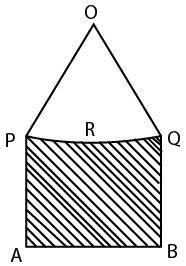
Loading solution...
The roots of quadratic equation $$y^2 -8y + 14$$ are $$\alpha$$ and $$\beta$$. Find the value of $$(1 + \alpha + \beta^2)(1 + \beta + \alpha^2)$$
Loading solution...
$$\frac{1}{\log_x yz + 1} + \frac{1}{\log_y xz + 1} + \frac{1}{\log_z xy + 1}$$ = ?
Loading solution...
Ram, Ravi and Ratan can alone finish an assignment in 9 days, 12 days and 15 days respectively. They decide to complete a work by working in turns. Ram works alone on Monday, Ravi does the work alone on Tuesday, followed by Ratan working alone on Wednesday & so on. What proportion of the complete work is done by Ravi?
Loading solution...
Let $$S_1$$ be a square of side 4 cm. Circle $$C_1$$ circumscribes the square $$S_1$$ such that all its corners are on $$C_1$$. Another square $$S_2$$ circumscribes the circle $$C_1$$. Circle $$C_2$$ circumscribes the square $$S_2$$, and square $$S_3$$ circumscribes circle $$C_2$$, & so on. If $$A_N$$ is the area between the square $$S_N$$ and the circle $$C_N$$, where N is the natural number. then the ratio of sum of all $$A_N$$ to $$A_l$$ is
Loading solution...
Joseph diametrically crosses a semi-circular playground and takes 48 seconds less than if he crosses the playground along the semi-circular path. If he walks 50 metres in one minute, the diameter of playground is
Loading solution...
Garima had only Rs. 200. Rs. 500 and Rs. 2000 notes in her wallet. She goes to Shoppers Stop. purchases some dresses and gives half of her Rs. 2000 notes & in turn receives same number of Rs. 200 notes. She then goes to a restaurant and gives all her Rs. 500 notes and receives thirty Rs. 2000 notes, which increases the number of Rs. 2000 notes she had by. 75%.- If now she has fifty Rs. 200 notes. what were the original number of Rs. 2000 and Rs. 200 notes she had at the start?
Loading solution...
A metallic solid is made up of a solid cylindrical base with a solid cone on its top. The radius of the base of the cone is 5 cm. and the ratio of the height of the cylinder and the cone is 3:2. A cylindrical hole is drilled through the solid with height equal to 2/$$3^{rd}$$ of the height of solid. What should be the radius (in cm) of the hole so that the volume of the hole is 1/$$3^{rd}$$ of the volume of the metallic solid after drilling?
Loading solution...
Nitin installed an overhead tank on the roof of his newly constructed house. Three taps are connected to the tank: 2 taps A and B to fill the tank and one tap C to empty it. Tap A alone can fill the tank in 12 hours, while tap B alone takes one and a half times more time than tap A to fill the tank completely. Tap C alone can empty a completely filled tank in 36 hours. Yesterday, to fill the tank, Nitin first opened tap A, and then after 2 hours opened tap B also. However after 6 hours he realised that tap C was open from the very beginning. He quickly closes tap C. What will be the total time required to fill the tank?
Loading solution...
At the foot of the mountain, the angle of elevation of the summit at the top of the mountain is 45°. After ascending 100 metres, at a slope of 30° up the mountain towards the summit. the angle of elevation of the summit is 60°. Find the height of the summit.
Loading solution...
Land Cruiser Prado, the latest SUV from Toyota Motors, consumes diesel at the rate of $$\frac{1}{400}\left\{ \frac{1000}{x} + x\right\}$$litres per Km. when travelling at the speed of x km/hr. The diesel costs Rs. 65 per litre and the driver is paid Rs. 50 per hour. Find the steady speed that will minimize the total cost of a 1000 km trip?
Loading solution...
In a survey on the viewership of the TV channels, 73% of those surveyed viewed at least one of the three Channels: Star Plus, Sab TV, and Sony. 38% of those surveyed viewed Star Plus, 39% viewed Sony, and 23% viewed Sab TV. 11% of all those surveyed viewed all the three channels. What percentage of those surveyed, viewed more than one of the three TV channels?
Loading solution...
A physical therapist of Russian football team knows that the team will play 40% of its matches on artificial turf, this season. Because of his vast experience, he•knows that a football player's chances of incurring a knee injury is 50% higher if he is playing on artificial turf instead of grass. If the player's chances of a knee injury on artificial turf is 0.42, what is the probability that a football player with knee injury, incurred the injury while playing on grass?
Loading solution...
The square root of $$1 + x^2 + \sqrt{1 + x^2 + x^4}$$is
Loading solution...
$$\log_2 x.\log_{\frac{x}{64}}2 = \log_{\frac{x}{16}}2$$; then $$x = ?$$
Loading solution...
Start your IIM journey with the right preparation and crack CAT 2026.

Educational materials for CAT preparation
 Share
Share