JEE WhatsApp Group



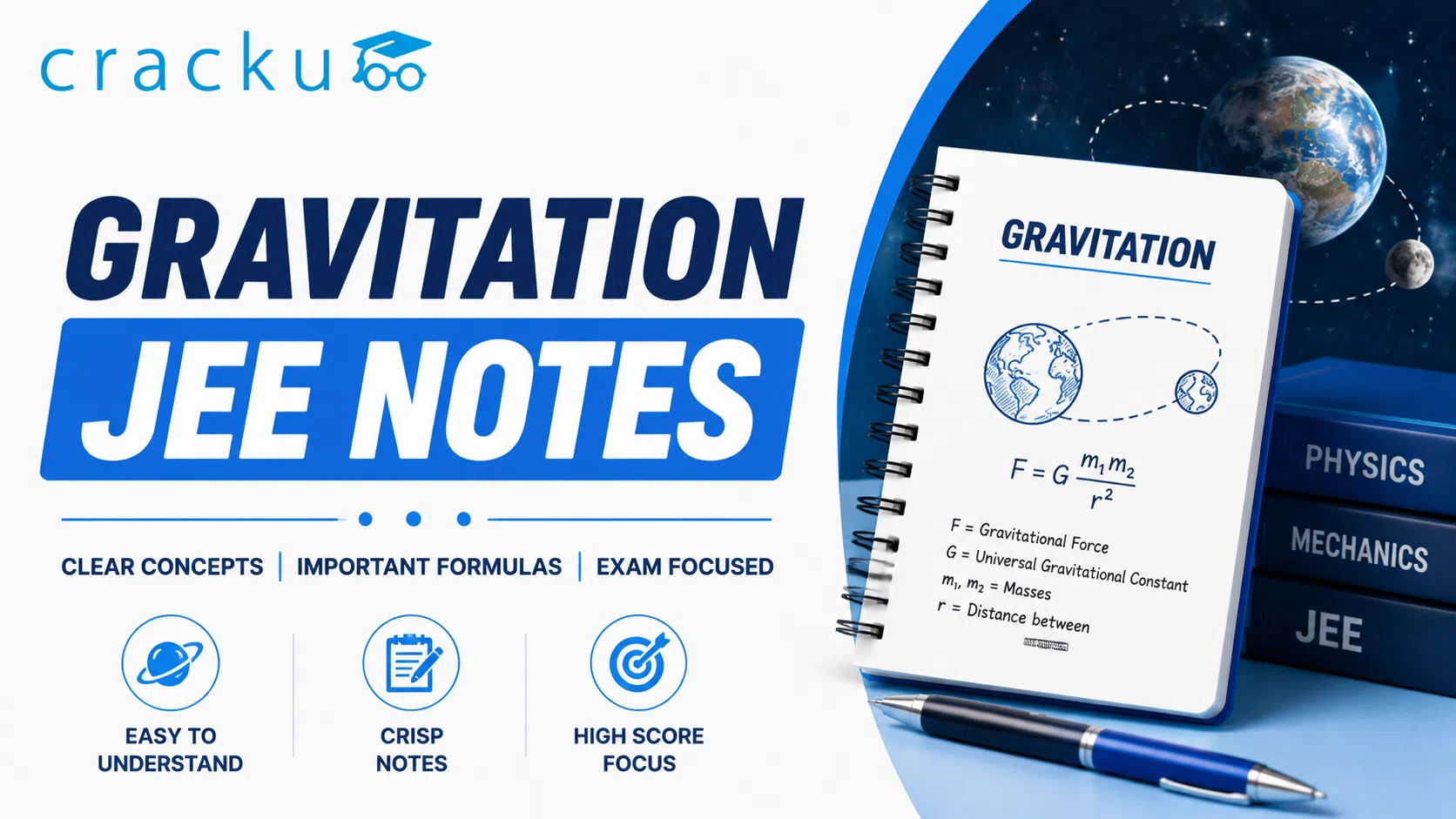
Every object in the universe attracts every other object. The apple falls, the Moon orbits the Earth, and the Earth orbits the Sun, all because of one force, and Newton pulled those observations into a single law. Gravity is the weakest of the four fundamental forces, yet it rules the motion of planets, stars and galaxies, because it reaches across infinite distance and is always attractive. These Gravitation JEE questions based notes cover Newton's law, the variation of g, field and potential, escape and orbital velocity, satellites and Kepler's laws, in a format built for fast revision.
Gravitation JEE Notes: Important Concepts
Newton's Law of Universal Gravitation
Any two masses attract each other with a force proportional to the product of the masses and inversely proportional to the square of the distance between their centres.
> F = Gm₁m₂/r²
Here F is the gravitational force, m₁ and m₂ are the two masses, r is the distance between their centres, and G is the universal gravitational constant.
G = 6.674 × 10^{-1}¹ N·m²/kg², with dimensions [M^{-1}L³T^{-2}].
Four properties matter in problems. The force is always attractive, it acts along the line joining the two centres, it obeys Newton's third law so both masses feel equal and opposite pulls, and it is a central force, depending only on r and never on angle.
Worked example: find the gravitational force between the Earth (M = 6 × 10²⁴ kg) and a 70 kg person standing on the surface (R = 6.4 × 10⁶ m).
F = GMm/R² = (6.674 × 10^{-1}¹ × 6 × 10²⁴ × 70)/(6.4 × 10⁶)²
= (6.674 × 6 × 70 × 10¹³)/(40.96 × 10¹²) = 2803.1 × 10¹³/(40.96 × 10¹²) ≈ 684 N
This is the person's weight, mg, which confirms that surface gravity gives g ≈ 9.8 m/s².
Principle of Superposition
When several masses are present, the net gravitational force on any one of them is the vector sum of the individual forces:
Fnet = F₁ + F₂ + F₃ + ...
Each pair is treated separately, then the results are added as vectors, never as plain numbers.
---
Acceleration Due to Gravity and Its Variation
A freely falling object near the surface accelerates downward at g, which comes straight from Newton's law applied to the Earth and the object.
> g = GM/R², about 9.8 m/s², often taken as 10 m/s² for quick work
The value of g is not the same everywhere. It changes with height, with depth, with latitude because the Earth rotates, and with the shape of the Earth.
Variation with Height
| Case Formula | |
| ------------------------------------------- | ----------------------------------- |
| Exact, at height h | g(h) = g[R/(R + h)]² = g/(1 + h/R)² |
| Approximation when h is much smaller than R | g(h) ≈ g(1 − 2h/R) |
As height increases, g decreases.
Worked example: find g at a height equal to the radius of the Earth.
g(h) = g[R/(R + h)]² = g[R/(R + R)]² = g(1/2)² = g/4
So g(h) = 9.8/4 = 2.45 m/s²
Variation with Depth
At depth d below the surface, assuming uniform density:
g(d) = g(1 − d/R)
Here g falls linearly with depth, and at the centre of the Earth, where d = R, g(d) = 0.
Worked example: at what depth is g reduced to 75% of its surface value?
g(d) = g(1 − d/R) = 0.75g
1 − d/R = 0.75, so d/R = 0.25 and d = 0.25R
Taking R = 6400 km, d = 0.25 × 6400 = 1600 km
Variation with Latitude
The Earth's rotation with angular velocity ω reduces the effective g:
g(λ) = g − Rω²cos²λ, where λ is the latitude
At the equator, λ = 0, so g is at its minimum, g − Rω². At the poles, λ = 90°, the rotational term vanishes and g is at its maximum.
JEE tip: use the exact height formula g/(1 + h/R)² whenever h is comparable to R, and the approximation g(1 − 2h/R) only when h is far smaller than R. Questions are often set specifically to catch the wrong choice. Note also that g falls off as the square with height but only linearly with depth.
---
Gravitational Field, Potential and Potential Energy
Rather than tracking the force between two particular masses, it helps to describe what a mass does to the space around it. Any other mass placed there then feels a force.
Gravitational field intensity (Eg): the gravitational force per unit mass at a point. It is a vector, pointing toward the source mass.
Gravitational potential (V): the work done per unit mass by an external agent in bringing a mass from infinity to that point without acceleration. It is a scalar and is always negative, because gravity attracts.
Point Mass
| Quantity Formula | |
| --------------------- | ----------------------------- |
| Field | Eg = GM/r², directed toward M |
| Potential | V = −GM/r |
| Relation between them | Eg = −dV/dr |
Uniform Solid Sphere
| Region Field Eg Potential V | | |
| ---------------------------- | ----------------------------------------- | ------------------- |
| Outside (r ≥ R) | GM/r², same as a point mass at the centre | −GM/r |
| On the surface (r = R) | GM/R² = g | −GM/R |
| Inside (r < R) | (GM/R³)r, rising linearly with r | −(GM/2R³)(3R² − r²) |
The inside result is worth noting: the field grows linearly from zero at the centre up to g at the surface, then falls off as an inverse square beyond it.
Gravitational Potential Energy
For two point masses separated by r:
> U = −Gm₁m₂/r
Three consequences follow. U is always negative, since a bound system holds less energy than one pulled apart. U = 0 at infinity, which is the reference point. And a larger, meaning less negative, U corresponds to higher energy.
Near the surface the familiar U = mgh is an approximation of this general formula, valid only when h is much smaller than R.
Binding Energy
Binding energy is the minimum energy needed to free a mass from another mass's gravitational grip, that is, to carry it out to infinity. For a two-body system it equals the magnitude of U.
| Situation Binding energy | |
| ------------------------------ | ---------------- |
| Mass m on the Earth's surface | BE = GMm/R = mgR |
| Satellite in orbit of radius r | BE = GMm/2r |
Worked example: a body of mass 500 kg sits on the Earth's surface. Find its gravitational potential energy and binding energy, taking g = 10 m/s² and R = 6.4 × 10⁶ m.
U = −GMm/R = −mgR = −500 × 10 × 6.4 × 10⁶ = −3.2 × 10¹⁰ J
Binding energy = 3.2 × 10¹⁰ J = 32 GJ
---
Escape Velocity and Orbital Velocity
Escape Velocity
Throw a ball up and it returns, but throw it fast enough and it never comes back. The minimum speed for that is the escape velocity.
> ve = √(2GM/R) = √(2gR)
For the Earth, ve = √(2 × 9.8 × 6.4 × 10⁶) ≈ 11.2 km/s.
The derivation is a one-line energy argument. At escape velocity the total energy is exactly zero, so the object barely reaches infinity with nothing left over:
½mve² − GMm/R = 0, which gives ve = √(2GM/R)
Note: escape velocity does not depend on the mass of the escaping object, does not depend on the direction of projection, and is √2 times the orbital velocity at the surface.
Worked example: the escape velocity from a planet's surface is 4 km/s. Find its radius if the average density is 5 × 10³ kg/m³.
ve = √(2gR), and g = GM/R² = G(4/3)πR³ρ/R² = (4/3)πGρR
ve = √[2 × (4/3)πGρR × R] = R√(8πGρ/3)
R = ve/√(8πGρ/3) = 4000/√(8π × 6.674 × 10^{-1}¹ × 5000/3)
= 4000/√(2.795 × 10⁻⁶) = 4000/(1.672 × 10^{-3}) ≈ 2.39 × 10⁶ m ≈ 2390 km
Orbital Velocity
A satellite in orbit is in continuous free fall. It keeps falling toward the Earth while moving sideways fast enough that the curved surface falls away beneath it at the same rate.
For a satellite at height h, with orbit radius r = R + h:
> vo = √(GM/r) = √[gR²/(R + h)]
Just above the surface, where h is nearly zero, vo = √(gR) ≈ 7.9 km/s for the Earth.
The two speeds are linked by ve = √2 · vo. Give an orbiting satellite enough extra speed to reach ve and it escapes.
Time Period of a Satellite
| Case Formula | |
| ---------------- | ------------------------------------------- |
| General | T = 2πr/vo = 2π√(r³/GM) = 2π√[(R + h)³/gR²] |
| Near the surface | T = 2π√(R/g) ≈ 84.6 minutes for the Earth |
---
Satellites and Kepler's Laws
Energy of a Satellite in Orbit
For a satellite of mass m in a circular orbit of radius r:
| Quantity Value | |
| ---------------- | --------------------- |
| Kinetic energy | KE = ½mvo² = GMm/2r |
| Potential energy | PE = −GMm/r |
| Total energy | E = KE + PE = −GMm/2r |
The key relations are KE = −E, PE = 2E and |PE| = 2 × KE. The total energy is negative, which is exactly what confirms the satellite is bound rather than escaping.
Geostationary and Polar Satellites
| Property Geostationary Polar | | |
| ----------------------------- | ----------------- | --------------------- |
| Orbit plane | Equatorial | Passes over the poles |
| Time period | 24 hours | About 100 minutes |
| Height | About 36,000 km | About 800 km |
| Appears from Earth | Stationary | Moves across the sky |
| Use | Communication, TV | Weather, mapping |
Worked example: find the height of a geostationary satellite above the Earth's surface, taking g = 9.8 m/s², R = 6400 km and T = 24 hours.
From T = 2π√(r³/gR²):
r³ = T²gR²/4π² = (86400)² × 9.8 × (6.4 × 10⁶)²/4π²
= (7.465 × 10⁹ × 9.8 × 4.096 × 10¹³)/39.48 = 2.997 × 10²³/39.48 = 7.59 × 10²¹
r = ∛(7.59 × 10²¹) ≈ 4.23 × 10⁷ m = 42300 km
Height = r − R = 42300 − 6400 = 35900 km ≈ 36000 km
Kepler's Three Laws
Kepler found these empirically before Newton, who later showed all three follow from the law of gravitation.
1. Law of orbits. Every planet moves in an elliptical orbit with the Sun at one of the two foci.
2. Law of areas. The line joining a planet to the Sun sweeps out equal areas in equal times, so a planet moves faster when nearer the Sun and slower when farther away. In symbols, dA/dt = L/2m = constant, which is simply conservation of angular momentum.
3. Law of periods. The square of the time period is proportional to the cube of the semi-major axis:
> T² ∝ a³, so T₁²/T₂² = a₁³/a₂³, and for circular orbits T² = (4π²/GM)r³
Worked example: a planet has an orbital radius twice that of the Earth. Find its time period in Earth years.
By the third law, Tp²/TE² = rp³/rE³ = (2rE)³/rE³ = 8
Tp² = 8TE², so Tp = 2√2 · TE ≈ 2.83 Earth years
Worked example: a satellite orbits at a height where g is one-fourth of its surface value. Find the height, the orbital velocity and the time period.
(a) g(h) = g/4 means g/(1 + h/R)² = g/4, so (1 + h/R)² = 4 and h = R = 6400 km. The orbit radius is r = 2R.
(b) vo = √(gR²/r) = √(gR²/2R) = √(gR/2) = √[(9.8 × 6.4 × 10⁶)/2] ≈ 5.6 km/s
(c) T = 2πr/vo = (2π × 2 × 6.4 × 10⁶)/5600 ≈ 14,360 s ≈ 4 hours
JEE tip: Kepler's third law is the fastest tool for comparing two orbits, since T is proportional to r raised to the power 3/2. Knowing the ratio of radii gives the ratio of periods immediately, with no need to compute either one.
---
Gravitation Formula Sheet and JEE Important Points
Formulas at a Glance using JEE formula sheet
| Quantity or situation Formula | |
| ----------------------------------- | -------------------------------------------------------------- |
| Newton's law of gravitation | F = Gm₁m₂/r², G = 6.674 × 10^{-1}¹ N·m²/kg² |
| Superposition | Fnet = F₁ + F₂ + F₃ + ... (vector sum) |
| Surface gravity | g = GM/R² |
| g with height (exact) | g(h) = g/(1 + h/R)² |
| g with height (small h) | g(h) ≈ g(1 − 2h/R) |
| g with depth | g(d) = g(1 − d/R), zero at the centre |
| g with latitude | g(λ) = g − Rω²cos²λ |
| Field and potential of a point mass | Eg = GM/r², V = −GM/r, Eg = −dV/dr |
| Sphere, outside | Eg = GM/r², V = −GM/r |
| Sphere, inside | Eg = (GM/R³)r, V = −(GM/2R³)(3R² − r²) |
| Potential energy | U = −Gm₁m₂/r, and U ≈ mgh near the surface |
| Binding energy, surface | BE = GMm/R = mgR |
| Binding energy, orbit | BE = GMm/2r |
| Escape velocity | ve = √(2GM/R) = √(2gR) ≈ 11.2 km/s for Earth |
| Orbital velocity | vo = √(GM/r) = √[gR²/(R + h)], about 7.9 km/s near the surface |
| Relation between the two | ve = √2 · vo |
| Time period | T = 2π√(r³/GM), and 2π√(R/g) ≈ 84.6 min near the surface |
| Satellite energies | KE = GMm/2r, PE = −GMm/r, E = −GMm/2r |
| Energy relations | KE = −E, PE = 2E, |PE| = 2KE |
| Kepler's second law | dA/dt = L/2m = constant |
| Kepler's third law | T² ∝ a³, T² = (4π²/GM)r³ |
Common Mistakes to Avoid
1. Using the height approximation when h is large. The form g(1 − 2h/R) holds only for h much smaller than R, so a satellite question needs the exact formula.
2. Treating depth like height. The variation with depth is linear, g(1 − d/R), while the variation with height goes as an inverse square.
3. Dropping the minus sign on potential and potential energy. V and U are always negative, and a missing sign flips the physics of a bound system.
4. Adding forces as scalars. Superposition is a vector sum, so directions have to be resolved before adding.
5. Assuming escape velocity depends on the projected mass or direction. It depends only on the planet's M and R.
6. Using R rather than r = R + h in orbital formulas. Orbital velocity and period need the orbit radius measured from the Earth's centre.
7. Confusing binding energy on the surface with that in orbit. The surface value is GMm/R, while the orbital value is GMm/2r, differing by a factor of two.
8. Forgetting that total energy is negative for a bound orbit. A positive total energy means the object is not bound at all.
9. Applying Kepler's third law with diameters or heights. The law needs the semi-major axis, or the orbit radius measured from the centre.
10. Mixing units. Radii given in kilometres must become metres before going into any formula containing G or g.
Quick Revision Notes for Gravitation
- F = Gm₁m₂/r² is always attractive, central, and obeys Newton's third law.
- g = GM/R² on the surface. It falls as an inverse square with height and linearly with depth, reaching zero at the centre.
- g is greatest at the poles and least at the equator, because of the rotational term Rω²cos²λ.
- Field is a vector, potential is a scalar, and they are linked by Eg = −dV/dr.
- Inside a uniform sphere the field grows linearly with r, and outside it the sphere acts like a point mass at the centre.
- U = −Gm₁m₂/r, zero at infinity and negative everywhere else. Binding energy is its magnitude.
- ve = √(2gR) ≈ 11.2 km/s, independent of the escaping mass and its direction.
- vo = √(gR) ≈ 7.9 km/s near the surface, and ve = √2 · vo.
- For an orbiting satellite, KE = −E, PE = 2E, and the total energy is negative.
- Near-surface orbital period is about 85 minutes, and a geostationary orbit sits at roughly 36,000 km with a 24-hour period.
- Kepler: elliptical orbits, equal areas in equal times from angular momentum conservation, and T² ∝ a³.
Useful benchmarks for sanity checks: orbital velocity about 8 km/s, escape velocity about 11.2 km/s, and a near-surface orbital period of about 85 minutes. If an answer lands far from these, something has gone wrong in the arithmetic.