Domain and Range

Rarely Tested

Domain:
Some general rules to be followed while determining the domain of a function:
1. The denominator of a function must be non-zero.
2. For even-indexed roots (e.g., √x), the argument must be non-negative.
3. The argument of a logarithm must be strictly positive. The base of logarithm must be positive but not 1.

Range:
1. Replace f(x) with y.
2. Solve the equation for x.
3. Analyze the new expression for any restrictions on y (similar like domain).

Example: For y = 1 / x, solving for x gives x = 1 / y. Since y is in the denominator, y cannot be 0. Therefore, the Range is (βˆ’βˆž 0) U,(0, ∞).

Question 1

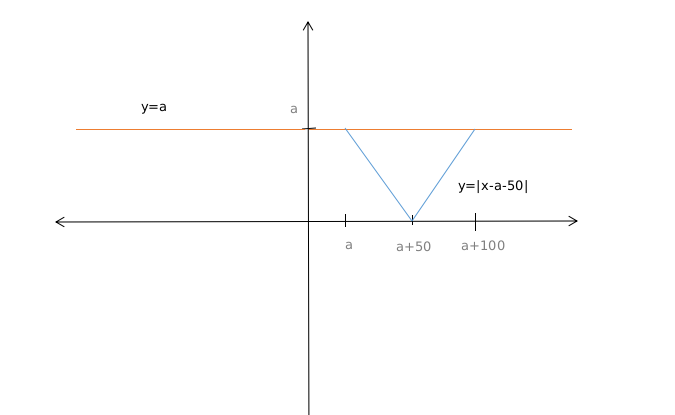
Let $$0 \leq a \leq x \leq 100$$ and $$f(x) = \mid x - a \mid + \mid x - 100 \mid + \mid x - a - 50\mid$$. Then the maximum value of f(x) becomes 100 when a is equal to

Question 2

For real values of x, the range of the function $$f(x)=\dfrac{2x-3}{2x^{2}+4x-6}$$ is

Question 3

Let $$f(x)=\frac{x}{(2x-1)}$$ and $$g(x)=\frac{x}{(x-1)}$$. Then the domain of the function $$h(x)=f(g(x))+g(f(x))$$ is all real numbers except

Log in to view all questions

Go back to topics

Join CAT 2026 course by 5-Time CAT 100%iler

Start your IIM journey with the right preparation and crack CAT 2026.