91- 6303239042
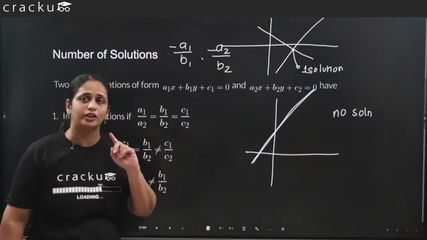
Equations with 2 variables: Consider two equations ax+by=c and mx+ny=p. Each of these equations represent two lines on the x-y coordinate plane. The solution of these equations is the point of intersection.
- If $$ \frac{a}{m}=\frac{b}{n}\neq\frac{c}{p}$$: This means that both the equations have the same slope but different intersect and hence are parallel to each. Hence, there is no point of intersection and no solution.
- If $$ \frac{a}{m}\neq\frac{b}{n}$$: They have different slopes and hence must intersect at some point. This results in a Unique solution.
- $$ \frac{a}{m}=\frac{b}{n}=\frac{c}{p}$$: The two lines have the same slope and intercept. Hence they are the same lines. As they have infinite points common between them, there are infinite many solutions possible.
- Parallel lines → No solution
- Intersecting lines → Unique solution
- Coincident lines → Infinite solutions