91- 6303239042
How to find HCF?
Step 1: Express the given number in its prime factorisation form
Step 2: Identify only the prime factors that are common to all the numbers given.
Step 3: Take the lowest power of each common prime factor and multiply them.
Example: Find the HCF of 18 and 120
18 = 2 x 3$$^2$$
120 = 2$$^3$$ x 3 x 5
Common primes → 2 and 3 → Lowest powers are 2$$^1$$ and 3$$^1$$
HCF = 2 x 3 = 6
How to find LCM?
Step 1: Express the given number in its prime factorisation form
Step 2: Identify all the prime factors that appear in any of the factorisation
Step 3: Take the highest power of every prime factor present and multiply them.
Example: Find the HCF of 60 and 90
60 = 2$$^2$$ x 3 x 5
90 = 2 x 3$$^2$$ x 5
Highest power of all primes → 2$$^2$$ , 3$$^2$$, 5
HCF = 2$$^2$$ x 3$$^2$$ x 5= 180
Basic formulas:
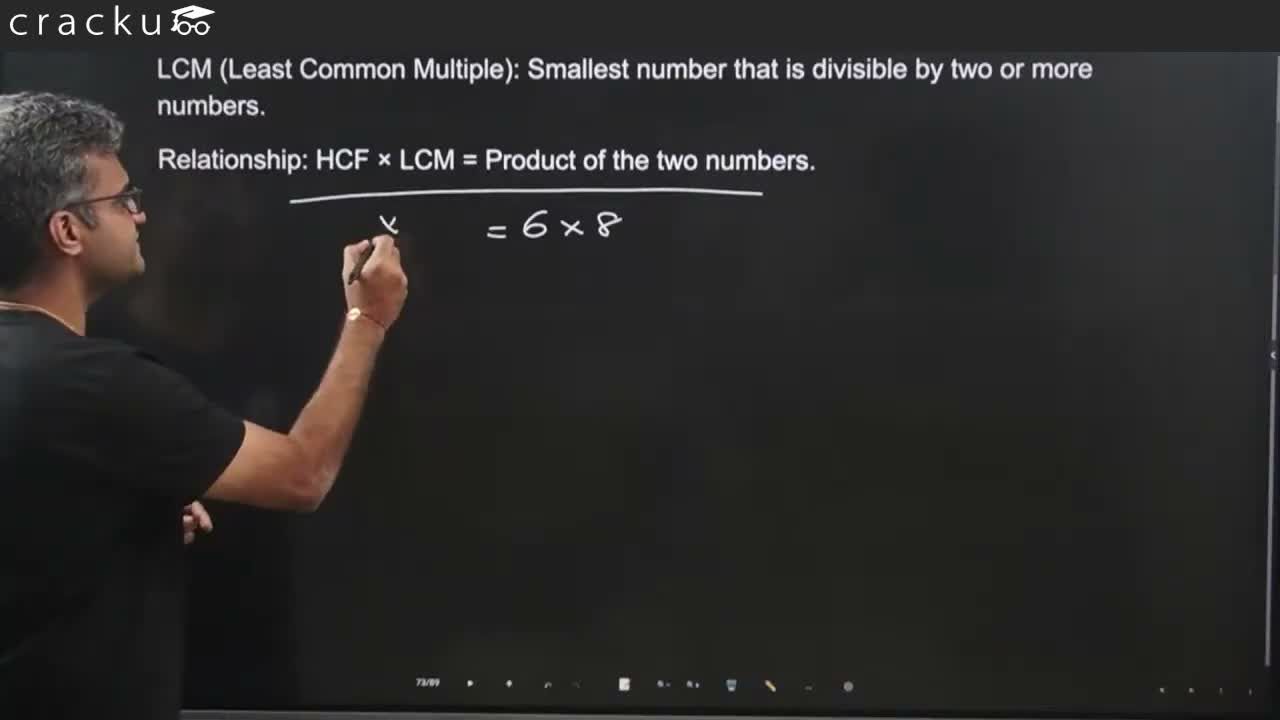
HCF * LCM of two numbers = Product of two numbers
The greatest number dividing a, b and c leaving remainders of $$x_1$$, $$x_2$$ and $$x_3$$ is the HCF of (a-$$x_1$$), (b-$$x_2$$) and (c-$$x_3$$).
The greatest number dividing a, b and c (a<b<c) leaving the same remainder each time is the HCF of (c-b), (c-a), (b-a).
LCM of fractions = LCM of numerators / HCF of denominators
HCF of fractions = HCF of numerators / LCM of denominators
HCF of $$(a^m - 1)$$ and $$(a^n - 1)$$ is $$(a^{gcd(m, n)} - 1)$$