91- 6303239042
How many iron balls, each of radius 1 cm, can be made from a sphere whose radius is 8 cm?
Sign in
Please select an account to continue using cracku.in
↓ →
How many iron balls, each of radius 1 cm, can be made from a sphere whose radius is 8 cm?
Volume(V) of the sphere with radius R=8 cm is given by V= $$\frac{4}{3} \pi R^{3}$$.
= $$\frac{4}{3} \pi(8^{3})$$= $$\frac{4}{3} \pi (512) cm^{3}$$.
and Volume (v) of each iron ball with radius r= 1cm is given by v= $$\frac{4}{3} \pi r^{3}$$.
= $$\frac{4}{3} \pi (1^{3})$$= $$\frac{4}{3} \pi cm^{3}$$.
Let say 'n' iron balls each of volume 'v' are required to form a sphere of volume 'V'.
=> Total volume of 'n' iron balls = Volume of the sphere
=> $$n\times v$$ = V
=> n= $$V\div v$$ = $$\frac{4}{3} \pi (512)\div \frac{4}{3} \pi$$ = 512.
Hence 512 iron balls are required in total to form the sphere.
If a is between 0 and 1, which of the following statements is (are) true?
(i) $$a^2$$ - 1> 0
(ii) $$a^2$$ + 1 > 0
(iii) $$a^2$$ - a > 0
Loading solution...
The following pie chart provides information about the revenue share of six companies P, Q, R, S,T, U as a percentage of the total car market(in Rs.)in the year 2010. These are the only six companies producing car in the market.
Revenue share
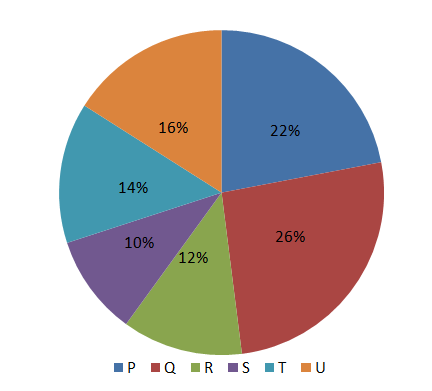
If the revenue share of company T increases by 20% in the year 2011, then find the percentage increase in the
revenue share of these six companies in the year 2011 assuming that all the other companies except T
generated the same revenue as they did in the year 2010.
Loading solution...

In how many years will Rs. 2 lakh double itself at 11.5% per annum simple interest?
Loading solution...
If AB + C = D, find A and C given that when B = 6, D = 30 and when B = 8, D = 36.
Loading solution...
If $$y^2$$ + 3y - 18 ≥ 0, which of the following is true?
Loading solution...

In how many different ways can 3 red balls, 2 blue balls and 4 yellow balls be arranged so that the balls of the same color come together? (Consider the balls are not identical except for the colour)
Loading solution...
The following table shows the courier charges (in Rs.) for sending 1 kg parcel from one city to another.

Among the following, the charges will be the least for sending a parcel from:-
Loading solution...
Three numbers X, Y and Z are in the ratio of 12: 15: 25. If the sum of twice of these numbers is 614, the ratio between the difference of Y and X and the difference of Z and Y is:-
Loading solution...
.webp)
Ankush and Babulal walk around circular track.They start at 9 a.m. from the same point in the opposite directions.Ankush and Babulal walk at a speed of 3 rounds per hour and 5 rounds per hour respectively. How many times shall they cross each other until 10.30 a.m.?
Loading solution...
The monthly incomes of Amit and Bharat are in the ratio of 5:4, their monthly expenses are in the ratio of 19:21, and their monthly savings are in the ratio of 37:18. If the total annual savings of Amit and Bharat is Rs.1,32,000, Amit’s monthly income is:-
Loading solution...
In a circle of radius 6 cm, arc AB makes an angle of 114° with centre of the circle O.
What is angle ABO?
Loading solution...
.webp)
In a survey conducted among 120 houses, it was found that 50 read Times of India, 60 read Indian Express and 48 read Hindustan Times; 20 read Times of India and Indian Express, 18 read Times of India and Hindustan Times and 24 read Indian Express and Hindustan Times. If 10 read all three, how many read only one newspaper?
Loading solution...
The length of the minute of a watch is 42 mm. The area swept by it in 30 minutes (in $$mm^2$$) by taking π as 3.14 is:-
Loading solution...
If (x + 4) is a factor of $$x^3 + 2x^2 + bx + 68$$, what is the value of b?
Loading solution...
.webp)
Rakesh covers 12 km at 6 km/hr, 36 km at 9 km/hr and then 32 km at 4 km/hr. Find the approximate
average speed in covering the whole distance.
Loading solution...
Two pipes A and B can fill a cistern in 120 minutes and 150 minutes respectively. There is also an outlet C.If all the three pipes are opened together, the cistern gets filled in 100 minutes. How much time will be taken by C to empty full tank?
Loading solution...
Ramesh works A hours a day and rests B hours a day. This pattern continues for 1 week, with an exactly opposite pattern next week, and so on for four weeks. Every fifth week he adopts a new pattern which then continues for the next four weeks. When he works longer than he rests, his wage per hour is three times what he earns per hour when he rests longer than he works. The following table shows his daily working hours for the week numbered 1 to 13.

A week consists of six days and a month consists of four weeks. If Ramesh is paid Rs. 60 per working hour in
the $$1^{st}$$ week, what is his salary for the $$1^{st}$$ month? (Assume that he is paid half his wages for his resting hours on duty)
Loading solution...
.webp)
In a box, there are eight yellow and four black balls. If three balls are drawn at random, what is the probability that two are yellow and one black?
Loading solution...
If $$\tan A + \cot A = \sqrt 5$$, What is the value of $$\tan^3 A + \cot ^3 A$$?
Loading solution...
Two balls were bought for Rs. 37.40 at a discount of 15%. What must be the marked price of each of the ball?
Loading solution...

Find the value of a, if:
Modulus(2a-3)=3a+2
Loading solution...
From a jar of wine containing 32 litres, 4 litres is drawn out, and the jar is filled up with water. If the same proportion of wine is further drawn out two more times, what proportion of wine to water will be there in the resulting mixture?
Loading solution...
The geometric mean proportion between $$30 + \sqrt200$$ and $$54 - \sqrt648$$ is:
Loading solution...
Anil is twice as good a student as Bharat and is able to finish a work in 30 minutes less than Bharat’s time. Find the time in which both of them can finish the same work together?
Loading solution...
The river flows from west to east and on the way then turns left. After going some distance it encounters a hill. It goes around the hill counter-clockwise in a quarter circle, and then turns right. In which direction is the river finally following?
Loading solution...
Based on the statement given below which of the following option is correct:-
Whenever Preeti’s father is in town, she abstains from school and goes to her aunt’s house.
Loading solution...
Four friends, namely, Liyaqat, Lillian, Lima and Lalit are sitting on a horizontally placed wooden bench, all looking towards the same direction.
If:
There is at least one person sitting between Lillian and Lima;
Liyaqat is towards the right of Lima but not towards the right of Lalit;
Lalit is seated immediately next to Lillian; &
Lima is seated at one of the extreme corners of the bench.
Which of the following is definitely true?
Loading solution...
Ali, Benu, Cutty and Dolly play four different games among Basketball, Cricket, Kabaddi and Hockey. Ali does not play Basketball or Cricket. Benu does not play Kabaddi or Hockey. Cutty plays Hockey and Dolly plays either Basketball or Hockey. Who plays cricket?
Loading solution...
A National Highway road network has parallel and perpendicular roads running north south or east west only. Junctions/Intersections on this road network are marked as R1, R2, R3, R4… All roads are at exactly half a kilometer distance from each other. The following is known about junctions R1, R2, R3, R4, R8 and R24.
“R1’ is east of ‘R2’ and west of ‘R3’; ‘R8’ is southwest of ‘R3’ and southwest of R2. ‘R2’ is southeast of ‘R24’. Which junctions are the farthest south and the farthest east?
Loading solution...
125 small but identical cubes have been put together to form a large cube. How many such small cubes will be required to cover this large cube completely?
Loading solution...
Five boys Ganesh, Hitesh, Ishan, Jaikee and Kailash always compete with one another. Ishan gets more marks than Kailash and Jaikee gets less marks than Ganesh. Hitesh gets more marks than Jaikee and Kailash.
Whose marks among the following could be the lowest?
Loading solution...
Below given question has a main statement followed by four statements labeled A, B, C and D. Choose the ordered pair of statements, where the first statement implies the second and the two statements is logically consistent with the main statement.
All cubes are round in shape.
(A) Figure A is not round in shape.
(B) Figure A is a cube.
(C) Figure A is not a cube.
(D) Figure A is round in shape.
Loading solution...
If a + b means a is sister of b,
a - b means a is brother of b,
a x b means a is daughter of b,
a ÷ b means a is mother of b,
Which of the following relationship shows that p and r are wife and husband?
Loading solution...
In a code language FRIGHTENS is written as 106; SIMILARLY is written as 118; How would
DEMONITISATION be written in the same language?
Loading solution...
Four packets P, Q, R and S, three wallets A, B and C are kept on a table one after the other in a row from left to right. Wallet C has as many items to its left as to its right. No packet is at any extreme end of the row.Packet P is kept to the immediate left of packet R. Packet P is to the immediate right of wallet A. What is kept third from left end of the row on the table?
Loading solution...
A green grocer sells five types of fruits- Apple, Black berry, Banana, Cherry and Peach. Black berry is more fresh and heavier then Peach. Apple is heavier than Banana and more fresh then Cherry. Cherry is heavier then Black berry, but less fresh than Peach. Banana is heavier than Black berry, but less fresh than it.
Which of the following is the lightest of all the fruits?
Loading solution...
2 3 7 4 3 2 1 5 7 3 2 7 1 0 9 8 7 5 4 7 2 3
Find the number of 7 in the given series that are followed by an even number but are not preceded by a prime
number?
Loading solution...
Each of the three kids gets at least one color box out of 6 color boxes, at least one tiffin box out of 6 tiffin box and at least one chocolate box out of 6 chocolate boxes so that the total number of the items that each of them gets is the same. No one gets the same number of tiffin boxes, color boxes and chocolate boxes. Then which of the following can be TRUE?
Loading solution...
A, B, C, D, E, F and G are seven members in a family, out of which there are three females and four males. There are two architects, two travel agents, one teacher, one engineer and one doctor. No lady is either a teacher or an engineer. C is a travel agent and is married to A, who is a teacher. F, the engineer, is married to D, who is neither a travel agent nor a doctor. No two ladies have the same profession. B is the sister of G who is an architect.
What is E’s profession?
Loading solution...
There are six members - Pills, Qills, Rills, Sills, Tills and Uills in a family. There are two married couples.Qills is Bengali and is the father of Tills. Uills is the grandfather of Rills. Uills is from Tamil Naidu. Sills is the grandmother of Tills and Sills is from Punjab. There is one Bengali, one Tamilian, one Punjabi, one Telegu and two Haryanvis in the family. The Telegu person is a female and married. Nobody who is a grandchild is married.
Which of the following two are married couples?
Loading solution...
Complete the below given series:-
0, 6, 6, 20, 20, ____.
Loading solution...
Looking at Samir, Rahul said, “Your only brother is the father of my daughter’s father”. How is Samir related to Rahul?
Loading solution...
Kapila, Meenal , Rishi , Pradeep and Lalita have five flats in different buildings of five different colours- Blue, White, Red, Orange and Green. The Green building is the shortest of all the buildings and Pradeep’s flat is in it. The building in which Lalita’s flat is located, is neither Blue nor White in colour and is taller than the building in which Meenal’s and Rishi’s flats are located. One person’s name starts with the same letter as the first letter of the building’s colour in which he resides and it is the second tallest of all. Which of the following can be TRUE about the resident of the building, its colour and its height?
Loading solution...
Five theatres PVR, DT, Chanakya, Regal and Maratha Mandir screen two out of ten films based on
Romance, Thriller, Horror, Adventure, Children, Drama, Documentary, History, Religion and Cartoon. Each
theatre exhibits only two films and allots two different slots for them, wherein slot I is before slot II. Chanakya screens a Horror film in the first slot, while Maratha Mandir exhibits a Historical film in the second slot. DT exhibits a thriller film in the second slot and Regal exhibits a documentary film.
Drama must be exhibited only in the second slot. The children’s film and the Cartoon film are exhib ited in the same theatre while the religious film is not in the
first slot. If Chanakya screens a Religious film in its second slot, then which of the films can be screened by theatre Regal?
Loading solution...
Three girls K, L, M and three boys N, Z and P are sitting around a table facing inwards playing cards. K and L do not sit next to each other. Z and P are opposite each other. M is sitting to the immediate right of P. If K is not between Z and M, then N is not next to P. Which of the following is not an arrangement (in clockwise direction) satisfying the conditions given above?
Loading solution...
Ten candidates appear for an interview and six of them are selected. There are two M.Techs, two MBAs, two MBBS and four LLB among the candidates. At least one MBA candidate is selected, of the six selected
candidates, exactly one must be an M.Tech candidate. If two MBBS candidates are selected, then which of the following statements can be TRUE?
Loading solution...
All students are young; some young are short; all short are stout; most stout are clever; all clever are courageous, then which of the following is most definitely false?
Loading solution...
Arvind, Saurabh, Romy and Denu, have different qualifications. Their qualifications are MBA, B.Tech, M.Tech and LLB - not necessarily in that order. Arvind and Romy are not MBAs, whereas Saurabh and Romy are not LLB; Romy and Denu are not B.Tech, whereas Denu and Arvind are not M.Tech.
If Saurabh is a B.Tech then which of the following should be an MBA?
Loading solution...
Five delegates P, Q, R, S and T are forwarding their files to one another. P sends his file to Q, S and T, T sends his files to R while P and R exchange their files with each other. Q sends his file to S who sends his files to T. If P has to forward his files to R, then in how many ways P can forward files to R?
Loading solution...
Read the passage carefully and answer the question that follows.
Passage I
I once made a statement in a room full of college students that the most important thing a young person could
acquire in college might be a sense of her own limitations. I realised when I said it that it was not a very
fashionable thing to say. Popular books on how to therapy, stress the glorious potential of every human being
and urge us to accept ourselves, finally, as being only a little lower than the angels. I heartily approve of any celebration of human potential, but I believe that we must acknowledge our potential for limitless evil as well. We must understand what we can do in the way of evil before we can even pretend to be good. This is the
beginning of morality, the psychological or spiritual or, in a religious tradition, the mythical basis that makes morality possible. One of the most moral book of the past century is Joseph Conrad’s Heart of Darkness, because Conrad faces the problem of evil in people. He tells us that we must recognize in ourselves the ability to put the head of our enemy on stick and dance around a fire with it, and only when we recognize that can we even begin to deal with any moral question at all. Students who have been nourished on pop psychology and told “I’ m O.K.” have some trouble dealing with Conrad, and some of them regard him as perverse.
I am amazed at the number of educated people who believe that we are somehow better , more moral, than our
ancestors were. I have seen otherwise intelligent people grow red in the face at the suggestion that human
beings are not better now - less cruel , more considerate , less animalistic , more humane- than they were when
Nero ruled Rome or when the Pharaohs ruled Egypt or , when the Druids at Stonehenge readied their sacrifices.
In one way we are more likely to have become dull to our potential for evil (and so discover it suddenly and with disastrous consequences) today than we were a few centuries ago. This is because we actively suppress the
kind of self-knowledge that makes intelligent moral decisions possible. Sin and guilt are such old -fashioned
terms that most of us are embarrassed by the very words.
The beginning of morality is based on:-
Loading solution...
One would assume from this passage that the author probably taught:-
Loading solution...
The author’s attitude towards popular how to books could be described as:-
Loading solution...
Read the passage carefully and answer the question that follows.
Passage II
Science made some progress in the middle Ages but the spirit of modern science was born with the
Renaissance. Science in the middle ages struggled against restrictions and there were many fetters to be
destroyed before it could continue unhampered. Superstitions were common and to the masses were much
more acceptable then were scientific explanations. The Renaissance brought about an interest in all things
pertaining to men and the thirst for new achievements led to a critical observation of natural phenomena. The
spirit of learning was manifested in science. Scientists of the 16th century made the first effective protest
against the medieval scientific method of accepting theories before investigation had verified them. Francis
Bacon pointed out that classical scientific conclusions did not represent mature knowledge and implored men to
explore the realms of nature. Descartes brought out the necessity of questioning everything. He was the
forerunner of science.
Outlook towards science in the middle ages can be best describe as:-
Loading solution...
Another word for FETTERS is:-
Loading solution...
How were the scientists of the 16th century different from those of the medieval times?
Loading solution...
Read the passage carefully and answer the question that follows.
Passage III
How can an organization’s sales operations be improved? One of the keys to becoming more effective is to first determine the type of “selling process” which needs to be used. In other words, the role the salesperson must play has to be identified.
There are three different processes sales staff can adopt: narrative, suggestive and consultative. The narrative approach depends on the salesperson moving quickly into a standardized presentation. Every buyer receives the same presentation. Emphasis is on highlighting benefits and how the product or service can help the buyer. This is an effective approach if the buying motive for all customers is the same. This process is well suited where there are a great number of prospectuses to be called on.
The suggestive approach depends on the seller being in a position to offer alternative recommendations. This is quite different from the narrative approach as the presentation is tailored to the individual customer. Here, the salesperson must initiate some discussion in order to get the buyer in a positive frame of mind.
An example of this process would be a restaurant wine steward who has checked with the waiter what food the customer has ordered and then opens by saying that either “this or that” particular wine would go best with the food ordered. This is an excellent approach where one doesn’t have much time with the customer but is able to acquire some basic information and then offer a particular recommendation. This process is well suited for products and services. However, it does require the salesperson to acquire basic information from the customer before moving on to the presentation.
The consultative approach requires the salesperson to have a thorough understanding of the customer and what the customer is trying to achieve. The role of the salesperson is to become an adviser or consultant and she must acquire a great deal of information from the customer. With this information, the salesperson can plan what to offer the customer. In this case, the salesperson must tailor the presentation to highlight how the salesperson’s product or service can be of help. This approach will usually require a number of sales calls as the buying process may be complex. The consultative approach requires a wide variety of skills, including probing, listening, analysis, creativity and persuasiveness.
The other two approaches typically require fewer skills. Hiring, training, motivating and rewarding sales people needs to be linked to the type of sales process being used and this is where the problem starts.
Many organizations, which should be using a consultative approach, use a narrative approach. They use standardized methods and do not tailor presentations to individual customers. You see this in many industries. When this is the case, price becomes a key criterion for the customer.
A key issue in developing a professional sales organization is first establishing the sales process. When that decision has been made, all other sales decision, including hiring, training and rewards can be linked to it.
How would you describe the writer’s style?
Loading solution...
In paragraph 3, ' In order to ' is used:-
Loading solution...
In paragraph 8, 'key criterion' is closest in meaning to:-
Loading solution...
According to the passage which of the approaches is the most complicated.
Loading solution...
The writer is probably:-
Loading solution...
Which of the following selling approach may work best for a new technological product that is first of its kind?
Loading solution...
Read the passage carefully and answer the question that follows.
Passage IV
Excerpt from Delhi Daily
‘Delhi Belly’ restaurant provides a dining experience like no other! A rustic atmosphere, along with delicious
food, it provides an opportunity to soak up the local flavor. Recently relocated to the old market area, Delhi
Belly is especially popular for lunch. At the counter, you can place your order for one of Delhi Belly’s three daily lunch specials or one of several Delhi snacks, all at reasonable prices. Once you get your food, choose a seat at one of the four charming communal tables. By the time you are ready to carry your leaf plate to the trash bin, you have experienced some of the best food and one of the most charming companies our city has to offer.
Restaurant review
Yesterday, I was exposed to what has been called “a dining experience like no other.”At lunchtime, Delhi Belly
is so crowded; I wondered when the authorities had last visited the establishment. The line snaked out of the
door to the corner, and by the time I reached the counter, I was freezing. I decided on the ‘Delhi Belly lunch
special’. It turned out to be the blandest food I have ever eaten. At Delhi Belly, you sit at one of four long tables. The couple sitting across from me was having an argument. The truck driver next to me told me more than I wanted to know about highway taxes. After I had tasted all of the food on my plate, I rose to leave, whereupon one of the people working behind the counter yelled at me to clean up after myself. Throwing away that plate of food was the most enjoyable part of dining at Delhi Belly.
If you go to lunch at Delhi Belly, you could expect to see:-
Loading solution...
Which of the following illustrates the restaurant critic’s opinion of the food at Delhi Belly?
Loading solution...
The main purpose of the restaurant review is to:-
Loading solution...
Choose the word or the phrase that has most nearly the same meaning for the word given below.
PERFIDY
Loading solution...
Choose the word or the phrase that has most nearly the same meaning for the word given below.
SABOTAGE
Loading solution...
Choose the word or the phrase that has most nearly the opposite meaning for the word given below.
BASHFUL
Loading solution...
Complete the analogy.
POSTURE : BEARING::____________
Loading solution...
From the options given below, find the closest substitute for the underlined expression.
He secured a job in the films because he was good at producing voice sounds.
Loading solution...
A word and its definition is given followed by four sentences. Choose the option that best fits with the definition.
Maneuvering:
Loading solution...
The following question has a set of three statements. Each statement can be classified as one of the following:-
(i) Facts, which deal with pieces of information that one has heard, seen or read, and which are open to discovery or verification (the answer option indicates such a statement with an 'F').
(ii) Inferences, which are conclusions drawn about the unknown, on the basis of the known (the answer option indicates such a statement with an 'I').
(iii) Judgements, which are opinions th at imply approval or disapproval of persons, objects, situations and occurrences in the past, the present or the future (the answer option indicates such a statement with a 'J').
Identify the Fact(F), Judgement(J) and Inference(I) from the given sentences.
1. God created the earth
2. God exists
3. Wine tastes better than beer
Loading solution...
The following question has a set of three statements. Each statement can be classified as one of the following:
(i) Facts, which deal with pieces of information that one has heard, seen or read, and which are open to discovery or verification (the answer option indicates such a statement with an 'F').
(ii) Inferences, which are conclusions drawn about the unknown, on the basis of the known (the answer option indicates such a statement with an 'I').
(iii) Judgements, which are opinions that imply approval or disapproval of persons, objects, situations and occurrences in the past, the present or the future (the answer option indicates such a statement with a 'J').
Identify the Fact(F), Judgement(J) and Inference(I) from the given sentences.
1. Weather forecast says 80% chance of thunderstorms, It’s a good idea to bring an umbrella.
2. My throat is sore and my nose is running, I have probably caught a cold.
3. There are over 40 million volumes in the university library, they probably have a copy of the famous book ‘Savitri’.
Loading solution...
Which of the given figure of speech has been employed in the formation of the following sentence?
"I am so tired that I can sleep for a year."
Loading solution...
Fill in the blank using appropriate prepositions.
"A plane flies ______ the clouds."
Loading solution...
_________________ varies directly with vibrating body's amplitude.
Loading solution...
Which of the following is true?
Loading solution...
Human eye is most sensitive to which color in the day light?
Loading solution...
What is the Data Capacity of a standard size CD ROM?
Loading solution...
Indian Railways generates highest revenue from which of the following?
Loading solution...
A hash function guarantees integrity of a message. It guarantees that message has not been:-
Loading solution...
Sections 299 to 377 of Indian Penal Code are:-
Loading solution...
Which of the following is true about Stand Up India Loan Scheme?
Loading solution...
Google has introduced a unique feature that guides users through ‘shortcuts’ that are more easily accessible by:-
Loading solution...
Who of the following has launched an e-commerce startup for farm equipment rental?
Loading solution...
India has met goal of elimination of which of the following disease (as specified by World Health
Organization (WHO) under its GET2020)?
Loading solution...
The three languages included in the Eighth Schedule of the Constitution by the $$71^{st}$$ amendment are:-
Loading solution...
Which of the following gas/es is/are used to disinfect water in sewage treatment facilities?
Loading solution...
Which of the following is an election that is called earlier than expected?
Loading solution...
After discovery of which of the following methods the date of the Harappan Civilization (2300-1750 BC) has been fixed?
Loading solution...
Which of the following about plants is correct?
Loading solution...
With reference to BrahMos, which of the following statements is/are correct?
1. It is a ramjet supersonic cruise missile being developed by BrahMos Aerospace, a joint venture between ISRO
of India and NPO Mashinostroeyenia (NPOM) of Russia.
2. It can be launched from submarines, ships, aircraft or land against ships and land-based targets.
3. India and Russia have agreed to double the range of the BrahMos supersonic cruise missile follow ing India’s entry into the Missile Technology Control Regime (MTCR).
Select the correct answer using the code given below.
Loading solution...
With reference to ‘HIV and AIDS (Prevention and Control) Bill, 2017’, consider which of the following statements is/are true?
1. It seeks to prevent and control the spread of HIV and AIDS, prohibits discrimination against persons with HIV and AIDS.
2. It make s anti- retroviral therapy a legal right of HIV/AIDS patient.
3. It has provisions to safeguard the property rights of HIV positive p eople.
4. Every HIV infected person below the age of 18 years has the right to resid e in a shared household and enjoy the facilities of the household.
Loading solution...
How many angular bleed lines are present on the new Indian rupee 2000 bank note?
Loading solution...
Which of the following banned the ‘manjha’ used for flying kites?
Loading solution...
Who said,The greater number of fortresses you hold the weaker will be your power. Let all our forces will be on the sea, because if we should not be powerful at the sea, everything at once be against us.......Let it be known for certain that as long as you may be powerful at the sea ......’?
Loading solution...
‘Vote on account’ is dealt in which of the following articles of the Indian Constitution?
Loading solution...
The Taj Mahal is threatened due to:-
Loading solution...
The below given painting ‘The Persistence of Memory’ is one of the most recognizable pieces in art history.
Who was the painter?

Loading solution...
Who is the famous sports personality in the image below?

Loading solution...
Start your IIM journey with the right preparation and crack CAT 2026.

Educational materials for CAT preparation
 Share
Share