91- 6303239042
 CAT WhatsApp Group


 Preferred Source

 Google Discover

CAT Exam Details
Planning for CAT 2026 becomes easier when the exam details are clear first. CAT 2026 will be conducted in approximately 170 cities. Registration begins on August 3 and closes on September 22, giving you limited application time. The exam will last 120 minutes and include three sections, each receiving exactly 40 minutes.
Before preparing formulas, reading passages, or solving mock papers, check eligibility, fees, syllabus, and selection requirements carefully. A clear picture of the CAT exam pattern can help you plan preparation without unnecessary confusion. Keep the official website, iimcat.ac.in, bookmarked and rely on verified information before completing registration.
CAT Exam Date
CAT 2026 will be conducted by IIM Indore on Sunday, November 29, 2026. The examination will take place in three sessions across approximately 170 cities. Candidates can choose five preferred test cities during the registration process. The admit card download facility begins on November 4, 2026. Candidates should complete application formalities early instead of waiting for deadlines.
CAT 2026 Event | Date and Time |
Registration Starts | August 3, 2026, 10:00 AM |
Registration Ends (Extended Date) | September 22, 2026, 5:00 PM |
Admit Card Download | November 4, 2026 |
CAT 2026 Test Date | November 29, 2026 |
Exam Sessions | Three sessions |
Test Cities | Approximately 170 cities |
Also Read: CAT 2026 Registration Date Extended, Official Updated PDF
CAT Exam Eligibility
CAT eligibility mainly depends on your graduation qualification and marks. Candidates should check their academic status before submitting the application form. The basic requirements remain applicable across recognised academic backgrounds.
CAT Age Limit
CAT 2026 does not prescribe an upper age limit for candidates. Therefore, working professionals can also apply for the examination. The eligibility requirements focus mainly on educational qualifications and required marks.
CAT Educational Qualification
Candidates need a Bachelor's degree from a recognised university or educational institution. General, EWS, and NC-OBC candidates require at least 50% marks or equivalent CGPA. SC, ST, and PwBD candidates require at least 45% marks or equivalent CGPA.
Candidates holding recognised professional qualifications can also apply for CAT 2026. Eligible qualifications include CA, CS, CMA, and FIAI qualifications. The applicable minimum marks requirement depends upon the candidate's category.
Candidate Category | Minimum Marks |
General, EWS, NC-OBC | 50% or equivalent CGPA |
SC, ST, PwBD | 45% or equivalent CGPA |
Professional Qualification Holders | Applicable category requirement |
If your university awards CGPA, follow its prescribed conversion method. When no conversion method exists, the specified official formula should be followed.
Also Read: Minimum Percentage Required for CAT 2026? Check Now
CAT Eligibility for Final-Year Students
Final-year Bachelor's degree candidates can apply for CAT 2026. Candidates awaiting final results can also submit applications during the registration window. Selected candidates must later provide proof of completing degree requirements. The required certificate should come from the Principal or Registrar of the institution. Individual IIMs can specify separate deadlines for submitting this certificate. Final-year candidates should therefore monitor admission instructions after receiving their CAT results.
CAT Eligibility for Engineering and Non-Engineering Students
CAT does not restrict applicants based on their graduation stream or academic specialisation. Candidates from engineering, commerce, science, arts, medicine, and humanities can apply. The important requirement is fulfilling the prescribed graduation criteria and marks. Your graduation subject does not decide which CAT section you can attempt. Every candidate faces VARC, DILR, and QA during the examination. However, individual IIMs may consider academic background during their admission process. For example, an engineering graduate may feel comfortable with quantitative questions. A commerce graduate may already understand percentages and financial calculations. Still, regular practice remains important across all three sections.
CAT Eligibility for Working Professionals
Working professionals can apply for CAT 2026 while continuing their current employment. Previous work experience is not mandatory for registering for CAT. Candidates should report their employment details accurately during application. Individual IIMs follow their own shortlisting and admission criteria after CAT results. Work experience can carry weight in certain institute-level selection processes. Therefore, candidates should maintain accurate employment records throughout the admission process.
Also Read: IIM Admission Criteria 2026: Complete Eligibility Guide
CAT Exam Reservation Policy
CAT 2026 follows Reservation Policy applicable under Indian government requirements. Candidates belonging to reserved categories must upload valid certificates during registration. Category details should be checked carefully before completing final application submission.
Category | Reservation |
Scheduled Caste | 15% |
Scheduled Tribe | 7.5% |
NC-OBC | 27% |
EWS | Up to 10% |
PwBD | 5% (Horizontal) |
The applicable Central Government category list remains important for reservation eligibility. No category change will be accepted after CAT registration. Reserved-category candidates must also satisfy minimum academic eligibility requirements.
PwD Criteria:
The PwBD category covers candidates recognised under the Rights of Persons with Disabilities Act. The applicable benchmark generally requires at least 40% certified disability. The recognised disability categories include the following areas:
- Blindness and low vision
- Deaf and hard of hearing
- Locomotor disabilities
- Autism and intellectual disabilities
- Specific learning disabilities
- Mental illness
- Multiple disabilities
- Other specified disabilities under the applicable schedule
Candidates should upload the required disability certificate during registration. A UDID card is also encouraged for candidates applying under the PwBD category.
CAT Exam Syllabus
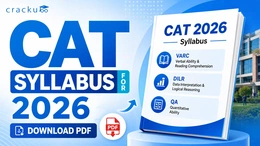
CAT 2026 Syllabus covers three broad sections, namely VARC, DILR, and QA. The examination assesses reading ability, logical reasoning, data interpretation, and quantitative skills. Preparation should cover core concepts alongside regular question practice.
Section | Key Topics |
VARC | Reading Comprehension, Para Jumbles, Para Summary, Odd Sentence |
DILR | Tables, Charts, Arrangements, Games, Puzzles, Logical Sets |
QA | Arithmetic, Algebra, Geometry, Number System, Modern Mathematics |
Reading Comprehension forms an important part of the VARC preparation strategy. Regular reading helps improve comprehension, interpretation, and the ability to identify central arguments.
DILR preparation should include different set formats instead of repeating one question style. Tables, graphs, arrangements, distribution, games, and caselets deserve regular practice.
QA preparation usually begins with arithmetic and then moves toward advanced topics. Percentages, ratios, averages, profit and loss, time-work, and mixtures need consistent attention.
CAT Exam Pattern
CAT 2026 will contain three sections with a total testing duration of 120 minutes. Each section receives exactly 40 minutes during the examination. Candidates cannot move between sections while answering another section.
CAT Exam Section-Wise Pattern (Tentative)
The official notification confirms three sections and their 40-minute sectional allocation. The question distribution below follows the recent CAT structure and remains tentative.
CAT Section | Questions | Time |
Verbal Ability and Reading Comprehension | 24 | 40 minutes |
Data Interpretation and Logical Reasoning | 22 | 40 minutes |
Quantitative Ability | 22 | 40 minutes |
Total | 68 | 120 minutes |
CAT uses a combination of multiple-choice and non-MCQ questions. Correct answers generally carry three marks, while incorrect MCQs attract one negative mark. Non-MCQ questions (TITA) generally do not carry negative marking. Candidates should verify the final marking instructions before examination day. CAT authorities can revise the question distribution or marking structure when required.
CAT Exam Sectional Time Allocation
Each CAT section receives exactly 40 minutes for solving questions. Once a section begins, candidates cannot move back to another section.
Section | Time Available | Section Switching |
VARC | 40 minutes | Not allowed |
DILR | 40 minutes | Not allowed |
QA | 40 minutes | Not allowed |
This fixed structure makes time management important from the first question. Spending excessive time on one difficult question can reduce your remaining opportunities. A practical approach is to scan the section before committing to lengthy questions. Marking easier questions first can help maintain a steady pace during the section.
CAT Exam Duration
CAT 2026 will have a total duration of 120 minutes. Candidates receive three separate 40-minute blocks for VARC, DILR, and QA. The section timer remains separate throughout the examination. Once 40 minutes end, the system moves candidates to the next section automatically. Candidates therefore need a different time strategy for every section. PwBD candidates can receive applicable accommodations under the examination guidelines. Candidates should check their eligibility and required documentation while completing registration.
Also Read: CAT Exam Pattern 2026, Marking Scheme, Total Questions
CAT Exam Fees
The CAT 2026 registration fee is ₹2,700 for General, EWS, and NC-OBC candidates. SC, ST, and PwBD candidates need to pay ₹1,350.
Candidate Category | CAT 2026 Registration Fee |
General | ₹2,700 |
EWS | ₹2,700 |
NC-OBC | ₹2,700 |
SC | ₹1,350 |
ST | ₹1,350 |
PwBD | ₹1,350 |
Candidates should complete payment only through the official CAT registration portal. The sole official CAT website for CAT 2026 is iimcat.ac.in. Before submitting your application, check every personal detail against your original documents. Verify your name, date of birth, academic marks, category, photographs, and contact details carefully. Keep the payment receipt and completed application details available for future reference. Candidates should also review their five preferred test cities before final submission. The CAT Centre will try to allot a preferred location wherever possible. However, high demand can result in allocation near the selected preferences. Once the centre is allotted, changes are not permitted.
CAT Exam Details: Conclusion
CAT Exam Details 2026 provide candidates with a clear understanding of important aspects such as exam dates, eligibility criteria, syllabus, pattern, fees and registration requirements. Knowing these details early helps aspirants plan their preparation strategy and avoid mistakes during the application process. With CAT 2026 scheduled for November 29, 2026, candidates should focus on building strong concepts across VARC, DILR and QA while regularly practising mock tests and previous questions. Staying updated through the official CAT website and following a structured preparation plan can improve your chances of achieving a strong percentile.