Let us assume units of Aurels, Brins, Crowns, and Zentars to be A, B, C and D, respectively.
We are given the travel cost of Jano to be 3500A in Statement 1.
We are also given the travel cost of Kira to be 8000A in Statement 1 and 4000B in Statement 2.
We are also given the travel cost of Lian to be 36000C in statement 3.
We know that the travel cost has to be constant throughout, so by equating the travel costs of Kira, we get,
8000A = 4000B
B = 2A ---(1)
We are also given the value of C to be 0.5 Z.
C = 0.5Z ---(2)
So, the travel cost of Lian = 36000C = 36000*0.5Z = 18000Z
Let us put the known information in the table, and we get,
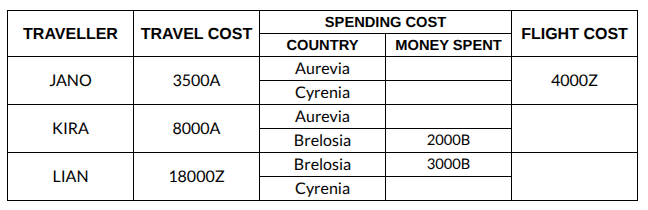
We are given that the spending cost of any individual is different in different cities.
We are given that the spending amounts are amongst {1000, 2000, 3000} in their local currencies and also told that there were two spends of 1000 and one spend of 3000, which makes the total spending amount 2000, to be 3 because there are 6 spending amounts in total.
One 2000 and one 3000 are already assigned in the above table, so we will be left with two spends of 1000 and two spends of 2000 to be assigned.
Kira has already spent 2000, so the only amount that she must have spent is 1000, as she cannot spend 2000 twice in different countries.
Lian has already spent 3000, so the only amount that she must have spent is 2000. If she spent 1000, then Jano will be left with two 2000s, which is not possible.
We can also conclude that Jano spend 1000 and 2000 in some order in the two countries.
The flight costs are given as 4000Z, 5000Z, and 6000Z, out of which 4000Z is for Jano and 5000Z and 6000Z are for Kira and Lian, in some order.
Filling up the table with these values, we get,
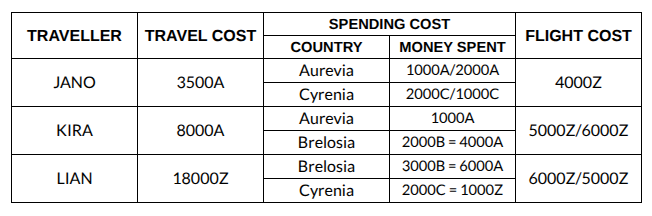
Travel Cost = Spending Cost + Flight Cost
For Kira,
Travel Cost = 8000A
Spending Cost = 1000A + 4000A = 5000A
Flight Cost = 5000Z/6000Z
CASE 1: Flight cost of Kira = 5000Z and Flight cost of Lian = 6000Z
If we assume the Flight cost to be 5000Z, then we get,
8000A = 5000A + 5000Z
3000A = 5000Z
A = $$\frac{5}{3}$$Z
For Lian,
Travel Cost = 18000Z
Spending Cost = 6000A + 1000Z = 6000$$\times\ \frac{5}{3}$$Z + 1000Z = 11000Z
Flight Cost = Travel Cost - Spending Cost = 18000Z - 11000Z = 7000Z
But in our assumption, the Flight Cost of Lian is 6000Z, which does not match the above answer.
So, we can eliminate this case.
CASE 2: Flight cost of Kira = 6000Z and Flight cost of Lian = 5000Z
If we assume the Flight cost to be 6000Z, then we get,
8000A = 5000A + 6000Z
3000A = 6000Z
A = 2Z
For Lian,
Travel Cost = 18000Z
Spending Cost = 6000A + 1000Z = 6000*2Z + 1000Z = 13000Z
Flight Cost = Travel Cost - Spending Cost = 18000Z - 13000Z = 5000Z
In our assumption, the Flight Cost of Lian is 5000Z, which matches the above answer.
So, Flight cost of Kira = 6000Z, Flight cost of Lian = 5000Z and A = 2Z.
Filling the table with calculated values all in the currency of Z, we get,
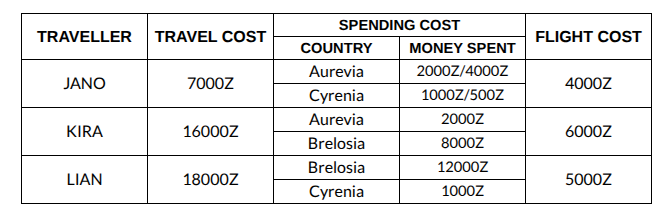
In the case of Zano,
Spending Cost = Travel Cost - Flight Cost = 7000Z - 4000Z = 3000Z
In the first case, the Spending Cost = 2000Z + 1000Z = 3000Z
In the second case, the Spending Cost = 4000Z + 500Z = 4500Z
We obtained a spending cost of 3000Z only in the first case, so we can eliminate the second case.
The final table looks like,
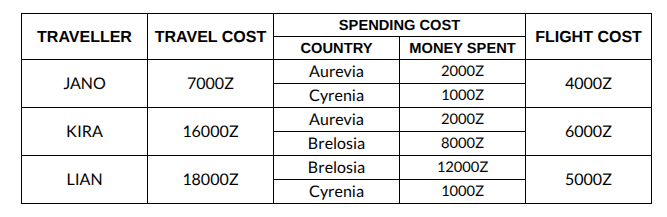
Statement 1) Jano spent 2000 in Aurevia
Jano spent 2000Z in Aurevia = 1000A in Aurevia.
So, this option is incorrect.
Statement 2) Lian spent 2000 in Cyrenia
Lian spent 1000Z in Cyrenia = 2000C in Cyrenia.
So, this option is correct.
Statement 3) Jano spent 2000 in Cyrenia
Jano spent 1000Z in Cyrenia = 2000C in Cyrenia.
So, this option is correct.
Statement 4) Kira spent 1000 in Aurevia
Kira spent 2000Z in Aurevia = 1000A in Aurevia.
So, this option is correct.
Hence, the correct answer is option A.
 CAT WhatsApp Group
 Share
Share