Daily Share Price Variability (SPV) is defined as (Day’s high price - Day’s low price) / (Average of the opening and closing prices during the day). Which among the shares A, C, D and F had the highest SPV on that day?
Sign in
Please select an account to continue using cracku.in
↓ →
The chart below shows the price data for seven shares - A, B, C, D, E, F, and G as a candlestick plot for a particular day. The vertical axis shows the price of the share in rupees. A share whose closing price (price at the end of the day) is more than its opening price (price at the start of the day) is called a bullish share; otherwise, it is called a bearish share. All bullish and bearish shares are shown in green and red colour respectively.
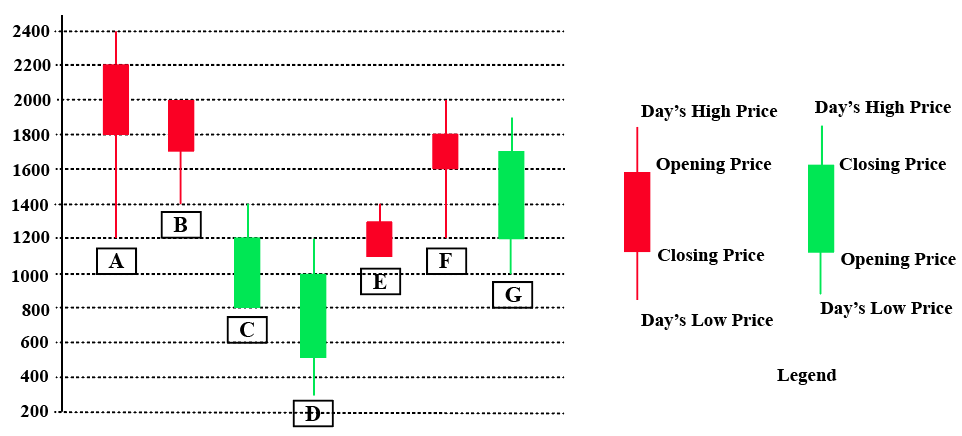
Daily Share Price Variability (SPV) is defined as (Day’s high price - Day’s low price) / (Average of the opening and closing prices during the day). Which among the shares A, C, D and F had the highest SPV on that day?
Writing down the values given in the candlestick chart in the form of a table for ease of calculation,
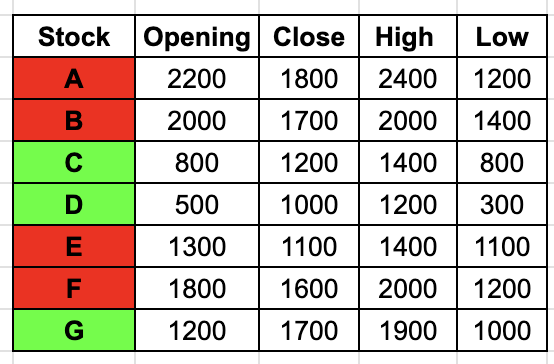
We are given that, Daily Share Price Variability (SPV) is defined as (Day’s high price - Day’s low price) / (Average of the opening and closing prices during the day)
Calculating it for the four options,
Stock F: 800/1700=8/17
Stock A: 1200/2000=3/5
Stock D: 900/750=90/75=6/5
Stock C: 600/1000=3/5
Clearly Stock D has the highest SPV.
Daily Share Price Variability (SPV) is defined as (Day’s high price - Day’s low price) / (Average of the opening and closing prices during the day). How many shares had an SPV greater than 0.5 on that day?
Writing down the values given in the candlestick chart in the form of a table for ease of calculation,
We are given that, Daily Share Price Variability (SPV) is defined as (Day’s high price - Day’s low price) / (Average of the opening and closing prices during the day)
Calculating it for the stocks
Stock A: 1200/2000=3/5
Stock B: 600/1850=60/185
Stock C: 600/1000=3/5
Stock D: 900/750=90/75=6/5
Stock E: 300/1200=1/4
Stock F: 800/1700=8/17
Stock G: 900/1450=90/145
We need to check for stocks greater than 0.5 on that day,
Stock A, Stock C, Stock D, Stock G have SPV greater than 0.5 that day.
Hence, the answer is 4.
Daily loss for a share is defined as (Opening price - Closing price) / (Opening price). Which among the shares A, B, F and G had the highest daily loss on that day?
Writing down the values given in the candlestick chart in the form of a table for ease of calculation,
Daily loss for a share is defined as (Opening price - Closing price) / (Opening price)
Calculating this for the options:
Stock A: 400/2200=2/11
Stock B: 300/2000=3/20
Stock F: 200/1800=1/9
Stock G gained money that day
Hence Stock A has the highest Daily Loss.
What would have been the percentage wealth gain for a trader, who bought equal numbers of all bullish shares at opening price and sold them at their day’s high?
Writing down the values given in the candlestick chart in the form of a table for ease of calculation,
There are three bullish shares, C D and G
Lets say a trader buys one share of each of these stocks, and sells them at their day's high
One share of C at opening is 800, sells at 1400
One share of D at opening is 500, 1200
One share of G at opening is 1200, 1900
Total Investment is 2500, and total money after selling is 4500
That is an 80% return since, $$\dfrac{\left(4500-2500\right)}{2500}=0.8$$
Six web surfers M, N, O, P, X, and Y each had 30 stars which they distributed among four bloggers A, B, C, and D. The number of stars received by A and B from the six web surfers is shown in the figure below.
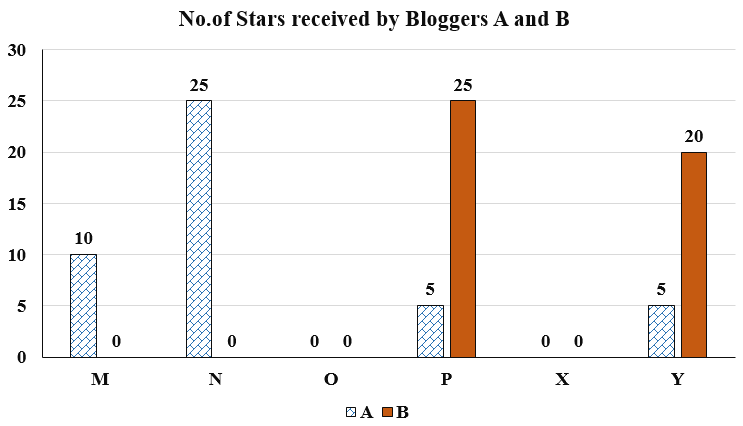
The following additional facts are known regarding the number of stars received by the bloggers from the surfers.
1. The numbers of stars received by the bloggers from the surfers were all multiples of 5 (including 0).
2. The total numbers of stars received by the bloggers were the same.
3. Each blogger received a different number of stars from M.
4. Two surfers gave all their stars to a single blogger.
5. D received more stars than C from Y.
What was the total number of stars received by D?
We can note down the data from the chart into the form of a table, that gives us,
We are told that D receives more stars than C from Y. Considering Y has already given 25 stars, it will give 0 stars to C and 5 stars to D.
The only two surfers who have not given any stars to A or B is O and X, and these are the two surfers to give all of their stars to a single blogger.
We are also told that M gives different stars to the four bloggers,
Since he has already given 0 and 10, the remaining distinct stars should add up to 20. The only numbers that are remaining that add up to 20 are 5 and 15.
We know that X rewards one of C or D 30 stars and O rewards one of C or D 30 stars. Given that, M could not have rewarded D 15 stars, since Y rewarded D 5 stars, and D is also going to rewarded 30 stars by O or X, and since the total is same for all, which is 45. This is not possible.
This means that, M rewarded C 15 stars and D 5 stars.
This gives us two cases,
Case-1
Case-2
We can use these two cases to answer the questions,
D was rewarded 45 stars in total.
What was the number of stars received by D from Y?
We can note down the data from the chart into the form of a table, that gives us,
We are told that D receives more stars than C from Y. Considering Y has already given 25 stars, it will give 0 stars to C and 5 stars to D.
The only two surfers who have not given any stars to A or B is O and X, and these are the two surfers to give all of their stars to a single blogger.
We are also told that M gives different stars to the four bloggers,
Since he has already given 0 and 10, the remaining distinct stars should add up to 20. The only numbers that are remaining that add up to 20 are 5 and 15.
We know that X rewards one of C or D 30 stars and O rewards one of C or D 30 stars. Given that, M could not have rewarded D 15 stars, since Y rewarded D 5 stars, and D is also going to rewarded 30 stars by O or X, and since the total is same for all, which is 45. This is not possible.
This means that, M rewarded C 15 stars and D 5 stars.
This gives us two cases,
Case-1
Case-2
We can use these two cases to answer the questions,
D received 5 stars from Y.
How many surfers distributed their stars among exactly 2 bloggers?
We can note down the data from the chart into the form of a table, that gives us,
We are told that D receives more stars than C from Y. Considering Y has already given 25 stars, it will give 0 stars to C and 5 stars to D.
The only two surfers who have not given any stars to A or B is O and X, and these are the two surfers to give all of their stars to a single blogger.
We are also told that M gives different stars to the four bloggers,
Since he has already given 0 and 10, the remaining distinct stars should add up to 20. The only numbers that are remaining that add up to 20 are 5 and 15.
We know that X rewards one of C or D 30 stars and O rewards one of C or D 30 stars. Given that, M could not have rewarded D 15 stars, since Y rewarded D 5 stars, and D is also going to rewarded 30 stars by O or X, and since the total is same for all, which is 45. This is not possible.
This means that, M rewarded C 15 stars and D 5 stars.
This gives us two cases,
Case-1
Case-2
We can use these two cases to answer the questions,
M distributed among 3 bloggers, N among 2 bloggers, O among 1, P among 2, X among 1, Y among 3
Hence 2 surfers distribute their stars among 2 bloggers.
Which of the following can be determined with certainty?
I. The number of stars received by C from M
II. The number of stars received by D from O
We can note down the data from the chart into the form of a table, that gives us,
We are told that D receives more stars than C from Y. Considering Y has already given 25 stars, it will give 0 stars to C and 5 stars to D.
The only two surfers who have not given any stars to A or B is O and X, and these are the two surfers to give all of their stars to a single blogger.
We are also told that M gives different stars to the four bloggers,
Since he has already given 0 and 10, the remaining distinct stars should add up to 20. The only numbers that are remaining that add up to 20 are 5 and 15.
We know that X rewards one of C or D 30 stars and O rewards one of C or D 30 stars. Given that, M could not have rewarded D 15 stars, since Y rewarded D 5 stars, and D is also going to rewarded 30 stars by O or X, and since the total is same for all, which is 45. This is not possible.
This means that, M rewarded C 15 stars and D 5 stars.
This gives us two cases,
Case-1
Case-2
We can use these two cases to answer the questions,
There are two cases formed since we cannot identify for certain two whom did O reward the stars to,
We can identify the number of stars rewarded by M to C.
Hence only statement 1 can be identified uniquely.
The game of QUIET is played between two teams. Six teams, numbered 1, 2, 3, 4, 5, and 6, play in a QUIET tournament. These teams are divided equally into two groups. In the tournament, each team plays every other team in the same group only once, and each team in the other group exactly twice. The tournament has several rounds, each of which consists of a few games. Every team plays exactly one game in each round.
The following additional facts are known about the schedule of games in the tournament.
1. Each team played against a team from the other group in Round 8.
2. In Round 4 and Round 7, the match-ups, that is the pair of teams playing against each other, were identical. In Round 5 and Round 8, the match-ups were identical.
3. Team 4 played Team 6 in both Round 1 and Round 2.
4. Team 1 played Team 5 ONLY once and that was in Round 2.
5. Team 3 played Team 4 in Round 3. Team 1 played Team 6 in Round 6.
6. In Round 8, Team 3 played Team 6, while Team 2 played Team 5.
How many rounds were there in the tournament?
We are told that there are six teams, that are divided into two groups.
Teams in the same group will play each other only once, and teams in different group will play each other twice.
Calculating the combinations, there is going to be $$^3C_2$$ games among teams in the same group among them, and since there is two groups, total such games will be 6.
Now, teams in different group play each other twice. Calculating the combinations for this,
From the first group, a team can be chosen in three ways, and from the second group, a team can be chosen in three ways. Total ways two teams from different groups can play each other is 3x3 which is 9. And since they play each other twice, that is 9+9 games of this combination.
Total number of games is 18+6=24
It is given that each team plays one game in each round, that means there is going to be 3 matchups in each round. And given, there is 24 games to played in this format, the number of rounds will be 24/3=8
The tournament will have 8 rounds.
Now that we know there are going to be 8 rounds in the tournament, let us identify the teams in a particular group, that will help us build the matchups.
We are told that Round 8 teams from different groups play each other, and Teams 1 and 5 play only once. This means, 1 and 5 have to be on the same group. It is also told that 4 and 6 play each other twice, that means 4 and 6 have to be in different groups. Looking at the matches from Round 8 that is given to us, 3 played 6 and 2 played 5. We already know 1 and 5 are in the same group, so 2 must be in the other group. Among 3 and 6, if we were to place 3 in the group with 1 and 5, 4 and 6 would have to be in the same group, which is not possible, hence 6 is with 1 and 5, giving us the final combination of groups.
Now, using the given information to build the matchups for the 8 rounds.
Rounds marked with the same colour represent the fact that the matchups are identical. Now we know that each team plays a game in each round, we know 2 out of the 3 matches for Round 2 and 8, and we can identify the third matchups as well. Giving us this resulting table.
We are told that Round 4 and 7 are identical, that means they are the matchups between teams from two different groups,
We look at the matchups that are remaining among the 6 teams where both the games are left to play.
Right away we identify that 6 is yet to play 2 twice and 5 once. We are looking for teams playing twice, so both Round 4 and 7 has a matchups between 2 and 6. This means 6 will play 5 in Round 3 and using that we can identify the third matchup in Round 3 as well.
Now, we can identify that 1 is yet to play 3 both the times, 2 once. And we are looking for teams playing each other twice, so we can fill in the remaining values in the table as well.
. This is the final table.
The tournament will have 8 rounds.
What is the number of the team that played Team 1 in Round 5?
We are told that there are six teams, that are divided into two groups.
Teams in the same group will play each other only once, and teams in different group will play each other twice.
Calculating the combinations, there is going to be $$^3C_2$$ games among teams in the same group among them, and since there is two groups, total such games will be 6.
Now, teams in different group play each other twice. Calculating the combinations for this,
From the first group, a team can be chosen in three ways, and from the second group, a team can be chosen in three ways. Total ways two teams from different groups can play each other is 3x3 which is 9. And since they play each other twice, that is 9+9 games of this combination.
Total number of games is 18+6=24
It is given that each team plays one game in each round, that means there is going to be 3 matchups in each round. And given, there is 24 games to played in this format, the number of rounds will be 24/3=8
The tournament will have 8 rounds.
Now that we know there are going to be 8 rounds in the tournament, let us identify the teams in a particular group, that will help us build the matchups.
We are told that Round 8 teams from different groups play each other, and Teams 1 and 5 play only once. This means, 1 and 5 have to be on the same group. It is also told that 4 and 6 play each other twice, that means 4 and 6 have to be in different groups. Looking at the matches from Round 8 that is given to us, 3 played 6 and 2 played 5. We already know 1 and 5 are in the same group, so 2 must be in the other group. Among 3 and 6, if we were to place 3 in the group with 1 and 5, 4 and 6 would have to be in the same group, which is not possible, hence 6 is with 1 and 5, giving us the final combination of groups.
Now, using the given information to build the matchups for the 8 rounds.
Rounds marked with the same colour represent the fact that the matchups are identical. Now we know that each team plays a game in each round, we know 2 out of the 3 matches for Round 2 and 8, and we can identify the third matchups as well. Giving us this resulting table.
We are told that Round 4 and 7 are identical, that means they are the matchups between teams from two different groups,
We look at the matchups that are remaining among the 6 teams where both the games are left to play.
Right away we identify that 6 is yet to play 2 twice and 5 once. We are looking for teams playing twice, so both Round 4 and 7 has a matchups between 2 and 6. This means 6 will play 5 in Round 3 and using that we can identify the third matchup in Round 3 as well.
Now, we can identify that 1 is yet to play 3 both the times, 2 once. And we are looking for teams playing each other twice, so we can fill in the remaining values in the table as well.
. This is the final table.
The team that played Team 1 in Round 5 is 4.
Which team among the teams numbered 2, 3, 4, and 5 was not part of the same group?
We are told that there are six teams, that are divided into two groups.
Teams in the same group will play each other only once, and teams in different group will play each other twice.
Calculating the combinations, there is going to be $$^3C_2$$ games among teams in the same group among them, and since there is two groups, total such games will be 6.
Now, teams in different group play each other twice. Calculating the combinations for this,
From the first group, a team can be chosen in three ways, and from the second group, a team can be chosen in three ways. Total ways two teams from different groups can play each other is 3x3 which is 9. And since they play each other twice, that is 9+9 games of this combination.
Total number of games is 18+6=24
It is given that each team plays one game in each round, that means there is going to be 3 matchups in each round. And given, there is 24 games to played in this format, the number of rounds will be 24/3=8
The tournament will have 8 rounds.
Now that we know there are going to be 8 rounds in the tournament, let us identify the teams in a particular group, that will help us build the matchups.
We are told that Round 8 teams from different groups play each other, and Teams 1 and 5 play only once. This means, 1 and 5 have to be on the same group. It is also told that 4 and 6 play each other twice, that means 4 and 6 have to be in different groups. Looking at the matches from Round 8 that is given to us, 3 played 6 and 2 played 5. We already know 1 and 5 are in the same group, so 2 must be in the other group. Among 3 and 6, if we were to place 3 in the group with 1 and 5, 4 and 6 would have to be in the same group, which is not possible, hence 6 is with 1 and 5, giving us the final combination of groups.
Now, using the given information to build the matchups for the 8 rounds.
Rounds marked with the same colour represent the fact that the matchups are identical. Now we know that each team plays a game in each round, we know 2 out of the 3 matches for Round 2 and 8, and we can identify the third matchups as well. Giving us this resulting table.
We are told that Round 4 and 7 are identical, that means they are the matchups between teams from two different groups,
We look at the matchups that are remaining among the 6 teams where both the games are left to play.
Right away we identify that 6 is yet to play 2 twice and 5 once. We are looking for teams playing twice, so both Round 4 and 7 has a matchups between 2 and 6. This means 6 will play 5 in Round 3 and using that we can identify the third matchup in Round 3 as well.
Now, we can identify that 1 is yet to play 3 both the times, 2 once. And we are looking for teams playing each other twice, so we can fill in the remaining values in the table as well.
. This is the final table.
2, 3 and 4 were part of the same group. 5 is the answer.
What is the number of the team that played Team 1 in Round 7?
We are told that there are six teams, that are divided into two groups.
Teams in the same group will play each other only once, and teams in different group will play each other twice.
Calculating the combinations, there is going to be $$^3C_2$$ games among teams in the same group among them, and since there is two groups, total such games will be 6.
Now, teams in different group play each other twice. Calculating the combinations for this,
From the first group, a team can be chosen in three ways, and from the second group, a team can be chosen in three ways. Total ways two teams from different groups can play each other is 3x3 which is 9. And since they play each other twice, that is 9+9 games of this combination.
Total number of games is 18+6=24
It is given that each team plays one game in each round, that means there is going to be 3 matchups in each round. And given, there is 24 games to played in this format, the number of rounds will be 24/3=8
The tournament will have 8 rounds.
Now that we know there are going to be 8 rounds in the tournament, let us identify the teams in a particular group, that will help us build the matchups.
We are told that Round 8 teams from different groups play each other, and Teams 1 and 5 play only once. This means, 1 and 5 have to be on the same group. It is also told that 4 and 6 play each other twice, that means 4 and 6 have to be in different groups. Looking at the matches from Round 8 that is given to us, 3 played 6 and 2 played 5. We already know 1 and 5 are in the same group, so 2 must be in the other group. Among 3 and 6, if we were to place 3 in the group with 1 and 5, 4 and 6 would have to be in the same group, which is not possible, hence 6 is with 1 and 5, giving us the final combination of groups.
Now, using the given information to build the matchups for the 8 rounds.
Rounds marked with the same colour represent the fact that the matchups are identical. Now we know that each team plays a game in each round, we know 2 out of the 3 matches for Round 2 and 8, and we can identify the third matchups as well. Giving us this resulting table.
We are told that Round 4 and 7 are identical, that means they are the matchups between teams from two different groups,
We look at the matchups that are remaining among the 6 teams where both the games are left to play.
Right away we identify that 6 is yet to play 2 twice and 5 once. We are looking for teams playing twice, so both Round 4 and 7 has a matchups between 2 and 6. This means 6 will play 5 in Round 3 and using that we can identify the third matchup in Round 3 as well.
Now, we can identify that 1 is yet to play 3 both the times, 2 once. And we are looking for teams playing each other twice, so we can fill in the remaining values in the table as well.
. This is the final table.
The team that played Team 1 in Round 7 is 3.
What is the number of the team that played Team 6 in Round 3?
We are told that there are six teams, that are divided into two groups.
Teams in the same group will play each other only once, and teams in different group will play each other twice.
Calculating the combinations, there is going to be $$^3C_2$$ games among teams in the same group among them, and since there is two groups, total such games will be 6.
Now, teams in different group play each other twice. Calculating the combinations for this,
From the first group, a team can be chosen in three ways, and from the second group, a team can be chosen in three ways. Total ways two teams from different groups can play each other is 3x3 which is 9. And since they play each other twice, that is 9+9 games of this combination.
Total number of games is 18+6=24
It is given that each team plays one game in each round, that means there is going to be 3 matchups in each round. And given, there is 24 games to played in this format, the number of rounds will be 24/3=8
The tournament will have 8 rounds.
Now that we know there are going to be 8 rounds in the tournament, let us identify the teams in a particular group, that will help us build the matchups.
We are told that Round 8 teams from different groups play each other, and Teams 1 and 5 play only once. This means, 1 and 5 have to be on the same group. It is also told that 4 and 6 play each other twice, that means 4 and 6 have to be in different groups. Looking at the matches from Round 8 that is given to us, 3 played 6 and 2 played 5. We already know 1 and 5 are in the same group, so 2 must be in the other group. Among 3 and 6, if we were to place 3 in the group with 1 and 5, 4 and 6 would have to be in the same group, which is not possible, hence 6 is with 1 and 5, giving us the final combination of groups.
Now, using the given information to build the matchups for the 8 rounds.
Rounds marked with the same colour represent the fact that the matchups are identical. Now we know that each team plays a game in each round, we know 2 out of the 3 matches for Round 2 and 8, and we can identify the third matchups as well. Giving us this resulting table.
We are told that Round 4 and 7 are identical, that means they are the matchups between teams from two different groups,
We look at the matchups that are remaining among the 6 teams where both the games are left to play.
Right away we identify that 6 is yet to play 2 twice and 5 once. We are looking for teams playing twice, so both Round 4 and 7 has a matchups between 2 and 6. This means 6 will play 5 in Round 3 and using that we can identify the third matchup in Round 3 as well.
Now, we can identify that 1 is yet to play 3 both the times, 2 once. And we are looking for teams playing each other twice, so we can fill in the remaining values in the table as well.
. This is the final table.
Team that played Team 6 in Round 3 was Team 5.
Two students, Amiya and Ramya are the only candidates in an election for the position of class representative. Students will vote based on the intensity level of Amiya’s and Ramya’s campaigns and the type of campaigns they run. Each campaign is said to have a level of 1 if it is a staid campaign and a level of 2 if it is a vigorous campaign. Campaigns can be of two types, they can either focus on issues, or on attacking the other candidate.
If Amiya and Ramya both run campaigns focusing on issues, then
• The percentage of students voting in the election will be 20 times the sum of the levels of campaigning of the two students. For example, if Amiya and Ramya both run vigorous campaigns, then 20 × (2+2)%, that is, 80% of the students will vote in the election.
• Among voting students, the percentage of votes for each candidate will be proportional to the levels of their campaigns. For example, if Amiya runs a staid (i.e., level 1) campaign while Ramya runs a vigorous (i.e., level 2) campaign, then Amiya will receive 1/3 of the votes cast, and Ramya will receive the other 2/3. The above-mentioned percentages change as follows if at least one of them runs a campaign attacking their opponent.
• If Amiya runs a campaign attacking Ramya and Ramya runs a campaign focusing on issues, then 10% of the students who would have otherwise voted for Amiya will vote for Ramya, and another 10% who would have otherwise voted for Amiya, will not vote at all.
• If Ramya runs a campaign attacking Amiya and Amiya runs a campaign focusing on issues, then 20% of the students who would have otherwise voted for Ramya will vote for Amiya, and another 5% who would have otherwise voted for Ramya, will not vote at all.
• If both run campaigns attacking each other, then 10% of the students who would have otherwise voted for them had they run campaigns focusing on issues, will not vote at all.
If both of them run staid campaigns attacking the other, then what percentage of students will vote in the election?
If both Ramya and Amiya run staid campaigns, the intensity of each staid campaign is 1
So total number of voters that would vote for them if they focused on issues will be 20x(1+1)%=40%
This means if they had both ran regarding issues, then they would get 20% of votes each.
We are told that both of them run attacking campaigns,
And the rule for mutual attacking campaign is 10% of voters who would have voted for each candidate will not vote.
That means 10% of 20% of each candidate will not vote, now that it is a mutually attacking campaign.
That means, each candidate receives 18% of the votes.
Total votes received is 36%.
What is the minimum percentage of students who will vote in the election?
We want the minimum vote share, that means both the candidates run staid campaigns.
And, both the campaigns should be attacking, since we see that if one candidate runs an attacking campaign whereas the other candidate runs an issues campaign, a fair number of voters get transferred to the other candidate's vote share.
This points to us to a scenario where both the campaigns are staid and attacking, which is nothing but the scenario described in the previous question.
If both Ramya and Amiya run staid campaigns, the intensity of each staid campaign is 1
So total number of voters that would vote for them if they focused on issues will be 20x(1+1)%=40%
This means if they had both ran regarding issues, then they would get 20% of votes each.
We are told that both of them run attacking campaigns,
And the rule for mutual attacking campaign is 10% of voters who would have voted for each candidate will not vote.
That means 10% of 20% of each candidate will not vote, now that it is a mutually attacking campaign.
That means, each candidate receives 18% of the votes.
Total votes received is 36%, which is the minimum possible.
If Amiya runs a campaign focusing on issues, then what is the maximum percentage of votes that she can get?
Amiya runs a campaign on issues, and we need to find the maximum vote share that she can get.
We are trying to maximise the number of voters for Amiya, that means Amiya needs to run a vigorous campaign.
Since, we are trying to increase the vote share for Amiya, we want as many voters as possible transferred from Ramya's share to Amiya's votes.
As the number of votes a candidate receives is proportional to the intensity level of the campaign, we want Ramya also to run a vigorous AND attacking campaign, so that her votes are transferred to Amiya.
In this scenario we have 20x(2+2)% of the people voting, 80% of the people. Of that, if both had ran issues campaign, they would have each received 40% of the votes.
Now, we want Ramya to run an attacking campaign, where 20% of the people that would have voted for her vote for Amiya.
So 20% of 40% of the votes are transferred to Amiya. That is 8% of the votes. And we are also told that, 5% that would have voted for her dont vote, so 5% of 40% dont vote, that is 2% of the voters.
Final Tally is Amiya gets 48% of the votes, and Ramya gets 30% of the votes.
If Ramya runs a campaign attacking Amiya, then what is the minimum percentage of votes that she is guaranteed to get?
We are looking for the minimum possible number of votes that Ramya can get when she runs an attacking campaign.
To minimise the number of votes, we can have Ramya run a staid campaign to minimise the votes, so minimum intensity, which will get her 20% of the votes if she ran with issues. Now that she is running with attacking, she will loose 20% of the votes to Amiya and 5% of the votes will not vote anymore.
That is a total 25% loss. Remaining votes she will get is 75% of the 20% which will leave her with 15% of the votes.
What is the maximum possible voting margin with which one of the candidates can win?
We are looking for the minimum possible number of votes that Ramya can get and maximise the number of votes that Amiya can get.
We can borrow the scenario from the previous question where Ramya runs an attacking campaign, and we minimised the number of votes she can get.
To minimise the number of votes, we can have Ramya run a staid campaign to minimise the votes, so minimum intensity, which will get her 20% of the votes if she ran with issues. Now that she is running with attacking, she will loose 20% of the votes to Amiya and 5% of the votes will not vote anymore.
That is a total 25% loss. Remaining votes she will get is 75% of the 20% which will leave her with 15% of the votes.
And to maximise the number of votes Amiya can get, we will have her run an vigorous issues campaign, which will give her 2x20% of the votes, that is 40% of the votes. And since Ramya has been running an attacking campaign, 20% of her votes are transferred to Amiya. 20% of the 20% of the votes which is 4% that were going to Ramya will now go to Amiya. That will bring up Amiya's tally up to 44% leaving Ramya's tally at 15%.
The difference in the votes will be 44-15=29%.
This is the maximum possible vote difference between the two candidates that is possible.
The chart below provides complete information about the number of countries visited by Dheeraj, Samantha and Nitesh, in Asia, Europe and the rest of the world (ROW).
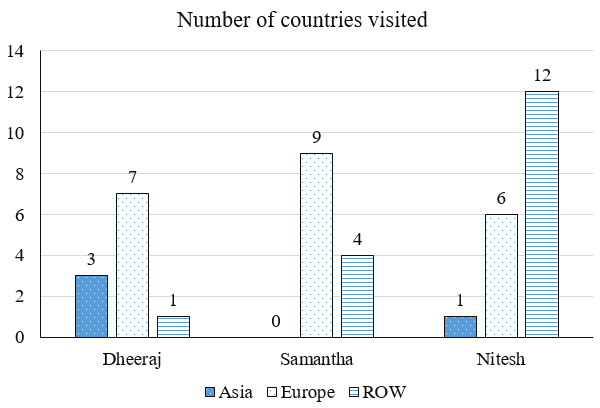
The following additional facts are known about the countries visited by them.
1. 32 countries were visited by at least one of them.
2. USA (in ROW) is the only country that was visited by all three of them.
3. China (in Asia) is the only country that was visited by both Dheeraj and Nitesh, but not by Samantha.
4. France (in Europe) is the only country outside Asia, which was visited by both Dheeraj and Samantha, but not by Nitesh.
5. Half of the countries visited by both Samantha and Nitesh are in Europe.
How many countries in Asia were visited by at least one of Dheeraj, Samantha and Nitesh?
Writing down the data with us in a table form.
But this includes countries which have been visited by one person, two people and three people. Essentially, there is an overlap of countries.
It is given to us that 32 distinct countries were visited among the three people,
Using that we can write down the equations,
$$I+II+III=32$$...(1)
$$I+2II+3III=43$$...(2)
Where I, II, and III denote the number of countries visited exactly by 1 of them, 2 of them and all of them.
We are told that USA(ROW) is the only country which was visited by all three people, that means $$III=1$$
Subtracting Equation 1 from 2 we get, $$II+2III=11$$
And since III=1 we get $$II=9$$
So, we are looking for 9 countries visited by exactly 2 people, and 22 countries visited by exactly 1 person.
Using the information from the problem set, we can note down the following,
We can see that Dheeraj visited only 1 country in ROW so every other value in that column has to be zero for wherever Dinesh is present. And Samantha has not visited any country in Asia so every value with Samantha present in Asia should be zero as well.
We have the following distribution, we are looking for 9 countries visited by exactly 2 people. And we have identified 2 countries, that means, 7 were countries were visited by both Samantha and Nitesh only. And given that half the countries visited by both of them are in Europe, and total number of countries visited by both of them is 7(only two of them)+1(USA)=8, they visited 4 countries in Europe together and 3 countries in ROW together. And using that information, we can fill in the rest of the table as well. Since we know the number of countries visited by each of them in a particular continent.
How many countries in Asia were visited by at least one of Dheeraj, Samantha and Nitesh is 3.
How many countries in Europe were visited only by Nitesh?
Writing down the data with us in a table form.
But this includes countries which have been visited by one person, two people and three people. Essentially, there is an overlap of countries.
It is given to us that 32 distinct countries were visited among the three people,
Using that we can write down the equations,
$$I+II+III=32$$...(1)
$$I+2II+3III=43$$...(2)
Where I, II, and III denote the number of countries visited exactly by 1 of them, 2 of them and all of them.
We are told that USA(ROW) is the only country which was visited by all three people, that means $$III=1$$
Subtracting Equation 1 from 2 we get, $$II+2III=11$$
And since III=1 we get $$II=9$$
So, we are looking for 9 countries visited by exactly 2 people, and 22 countries visited by exactly 1 person.
Using the information from the problem set, we can note down the following,
We can see that Dheeraj visited only 1 country in ROW so every other value in that column has to be zero for wherever Dinesh is present. And Samantha has not visited any country in Asia so every value with Samantha present in Asia should be zero as well.
We have the following distribution, we are looking for 9 countries visited by exactly 2 people. And we have identified 2 countries, that means, 7 were countries were visited by both Samantha and Nitesh only. And given that half the countries visited by both of them are in Europe, and total number of countries visited by both of them is 7(only two of them)+1(USA)=8, they visited 4 countries in Europe together and 3 countries in ROW together. And using that information, we can fill in the rest of the table as well. Since we know the number of countries visited by each of them in a particular continent.
Number of countries visited by only Nitesh is 2.
How many countries in the ROW were visited by both Nitesh and Samantha?
Writing down the data with us in a table form.
But this includes countries which have been visited by one person, two people and three people. Essentially, there is an overlap of countries.
It is given to us that 32 distinct countries were visited among the three people,
Using that we can write down the equations,
$$I+II+III=32$$...(1)
$$I+2II+3III=43$$...(2)
Where I, II, and III denote the number of countries visited exactly by 1 of them, 2 of them and all of them.
We are told that USA(ROW) is the only country which was visited by all three people, that means $$III=1$$
Subtracting Equation 1 from 2 we get, $$II+2III=11$$
And since III=1 we get $$II=9$$
So, we are looking for 9 countries visited by exactly 2 people, and 22 countries visited by exactly 1 person.
Using the information from the problem set, we can note down the following,
We can see that Dheeraj visited only 1 country in ROW so every other value in that column has to be zero for wherever Dinesh is present. And Samantha has not visited any country in Asia so every value with Samantha present in Asia should be zero as well.
We have the following distribution, we are looking for 9 countries visited by exactly 2 people. And we have identified 2 countries, that means, 7 were countries were visited by both Samantha and Nitesh only. And given that half the countries visited by both of them are in Europe, and total number of countries visited by both of them is 7(only two of them)+1(USA)=8, they visited 4 countries in Europe together and 3 countries in ROW together. And using that information, we can fill in the rest of the table as well. Since we know the number of countries visited by each of them in a particular continent.
Number of countries in ROW visited by both Nitesh and Samantha is 3+1=4.
How many countries in Europe were visited by exactly one of Dheeraj, Samantha and Nitesh?
Writing down the data with us in a table form.
But this includes countries which have been visited by one person, two people and three people. Essentially, there is an overlap of countries.
It is given to us that 32 distinct countries were visited among the three people,
Using that we can write down the equations,
$$I+II+III=32$$...(1)
$$I+2II+3III=43$$...(2)
Where I, II, and III denote the number of countries visited exactly by 1 of them, 2 of them and all of them.
We are told that USA(ROW) is the only country which was visited by all three people, that means $$III=1$$
Subtracting Equation 1 from 2 we get, $$II+2III=11$$
And since III=1 we get $$II=9$$
So, we are looking for 9 countries visited by exactly 2 people, and 22 countries visited by exactly 1 person.
Using the information from the problem set, we can note down the following,
We can see that Dheeraj visited only 1 country in ROW so every other value in that column has to be zero for wherever Dinesh is present. And Samantha has not visited any country in Asia so every value with Samantha present in Asia should be zero as well.
We have the following distribution, we are looking for 9 countries visited by exactly 2 people. And we have identified 2 countries, that means, 7 were countries were visited by both Samantha and Nitesh only. And given that half the countries visited by both of them are in Europe, and total number of countries visited by both of them is 7(only two of them)+1(USA)=8, they visited 4 countries in Europe together and 3 countries in ROW together. And using that information, we can fill in the rest of the table as well. Since we know the number of countries visited by each of them in a particular continent.
Number of countries in EU visited by exactly 1 person is 12.
Educational materials for CAT preparation