How many units of currency A did the outlet buy on that day?
789
456
123
0.-
Clear All
Sign in
Please select an account to continue using cracku.in
↓ →
The base exchange rate of a currency X with respect to a currency Y is the number of units of currency Y which is equivalent in value to one unit of currency X. Currency exchange outlets buy currency at buying exchange rates that are lower than base exchange rates, and sell currency at selling exchange rates that are higher than base exchange rates.
A currency exchange outlet uses the local currency L to buy and sell three international currencies A, B, and C, but does not exchange one international currency directly with another. The base exchange rates of A, B and C with respect to L are in the ratio 100:120:1. The buying exchange rates of each of A, B, and C with respect to L are 5% below the corresponding base exchange rates, and their selling exchange rates are 10% above their corresponding base exchange rates. The following facts are known about the outlet on a particular day:
1. The amount of L used by the outlet to buy C equals the amount of L it received by selling C.
2. The amounts of L used by the outlet to buy A and B are in the ratio 5:3.
3. The amounts of L the outlet received from the sales of A and B are in the ratio 5:9.
4. The outlet received 88000 units of L by selling A during the day.
5. The outlet started the day with some amount of L, 2500 units of A, 4800 units of B, and 48000 units of C.
6. The outlet ended the day with some amount of L, 3300 units of A, 4800 units of B, and 51000 units of C.
How many units of currency A did the outlet buy on that day?
It is given that the base exchange rates of A, B and C with respect to L are in the ratio 100:120:1. Let us assume that base exchange rates are '100a', '120a' and 'a' in that order.
It is given that the buying exchange rates of each of A, B, and C with respect to L are 5% below the corresponding base exchange rates. Therefore, we can say that the buying exchange rates are 95a, 114a, 0.95a.
It is given that the selling exchange rates of each of A, B, and C with respect to L are 10% above their corresponding base exchange rates. Therefore, we can say that the selling exchange rates are 110a, 132a, 1.1a.
We know about the opening and closing units in stock for each currency. Let us draw the table accordingly.

Let 'p', 'q' and 'r' be the number of units of currency A, B and C bought by the outlet on that day.
Then, we can say that the outlet sold 'p - 800', 'q' and 'r-3000' units of currency A, B and C respectively.

It is given that the amount of L used by the outlet to buy C equals the amount of L it received by selling C.
$$\Rightarrow$$ 0.95a*r = 1.1a*(r - 3000)
$$\Rightarrow$$ 0.15r = 3300
$$\Rightarrow$$ r = 22000
It is also given that the amounts of L used by the outlet to buy A and B are in the ratio 5:3.
$$\Rightarrow$$ $$\dfrac{p*95a}{q*114a} = \dfrac{5}{3}$$
$$\Rightarrow$$ p = 2q
Also, the amounts of L the outlet received from the sales of A and B are in the ratio 5:9.
$$\Rightarrow$$ $$\dfrac{(p-800)*110a}{q*132a} = \dfrac{5}{9}$$
$$\Rightarrow$$ $$\dfrac{(2q-800)*110a}{q*132a} = \dfrac{5}{9}$$
$$\Rightarrow$$ q = 600
Therefore, p = 2q = 2*600 = 1200.
It is given that the outlet received 88000 units of L by selling A during the day.
$$\Rightarrow$$ (p-800)*110a = 88000
$$\Rightarrow$$ (1200-800)*110a = 88000
$$\Rightarrow$$ 44000a = 88000
$$\Rightarrow$$ a = 2
We can fill the entire table and answer all the questions.

From the table we can see that the currency outlet bought 1200 units of A.
How many units of currency C did the outlet sell on that day?
It is given that the base exchange rates of A, B and C with respect to L are in the ratio 100:120:1. Let us assume that base exchange rates are '100a', '120a' and 'a' in that order.
It is given that the buying exchange rates of each of A, B, and C with respect to L are 5% below the corresponding base exchange rates. Therefore, we can say that the buying exchange rates are 95a, 114a, 0.95a.
It is given that the selling exchange rates of each of A, B, and C with respect to L are 10% above their corresponding base exchange rates. Therefore, we can say that the selling exchange rates are 110a, 132a, 1.1a.
We know about the opening and closing units in stock for each currency. Let us draw the table accordingly.
Let 'p', 'q' and 'r' be the number of units of currency A, B and C bought by the outlet on that day.
Then, we can say that the outlet sold 'p - 800', 'q' and 'r-3000' units of currency A, B and C respectively.
It is given that the amount of L used by the outlet to buy C equals the amount of L it received by selling C.
$$\Rightarrow$$ 0.95a*r = 1.1a*(r - 3000)
$$\Rightarrow$$ 0.15r = 3300
$$\Rightarrow$$ r = 22000
It is also given that the amounts of L used by the outlet to buy A and B are in the ratio 5:3.
$$\Rightarrow$$ $$\dfrac{p*95a}{q*114a} = \dfrac{5}{3}$$
$$\Rightarrow$$ p = 2q
Also, the amounts of L the outlet received from the sales of A and B are in the ratio 5:9.
$$\Rightarrow$$ $$\dfrac{(p-800)*110a}{q*132a} = \dfrac{5}{9}$$
$$\Rightarrow$$ $$\dfrac{(2q-800)*110a}{q*132a} = \dfrac{5}{9}$$
$$\Rightarrow$$ q = 600
Therefore, p = 2q = 2*600 = 1200.
It is given that the outlet received 88000 units of L by selling A during the day.
$$\Rightarrow$$ (p-800)*110a = 88000
$$\Rightarrow$$ (1200-800)*110a = 88000
$$\Rightarrow$$ 44000a = 88000
$$\Rightarrow$$ a = 2
We can fill the entire table and answer all the questions.
From the table we can see that the currency outlet sold 19000 units of currency C. Hence, option B is the correct answer.
What was the base exchange rate of currency B with respect to currency L on that day ?
It is given that the base exchange rates of A, B and C with respect to L are in the ratio 100:120:1. Let us assume that base exchange rates are '100a', '120a' and 'a' in that order.
It is given that the buying exchange rates of each of A, B, and C with respect to L are 5% below the corresponding base exchange rates. Therefore, we can say that the buying exchange rates are 95a, 114a, 0.95a.
It is given that the selling exchange rates of each of A, B, and C with respect to L are 10% above their corresponding base exchange rates. Therefore, we can say that the selling exchange rates are 110a, 132a, 1.1a.
We know about the opening and closing units in stock for each currency. Let us draw the table accordingly.
Let 'p', 'q' and 'r' be the number of units of currency A, B and C bought by the outlet on that day.
Then, we can say that the outlet sold 'p - 800', 'q' and 'r-3000' units of currency A, B and C respectively.
It is given that the amount of L used by the outlet to buy C equals the amount of L it received by selling C.
$$\Rightarrow$$ 0.95a*r = 1.1a*(r - 3000)
$$\Rightarrow$$ 0.15r = 3300
$$\Rightarrow$$ r = 22000
It is also given that the amounts of L used by the outlet to buy A and B are in the ratio 5:3.
$$\Rightarrow$$ $$\dfrac{p*95a}{q*114a} = \dfrac{5}{3}$$
$$\Rightarrow$$ p = 2q
Also, the amounts of L the outlet received from the sales of A and B are in the ratio 5:9.
$$\Rightarrow$$ $$\dfrac{(p-800)*110a}{q*132a} = \dfrac{5}{9}$$
$$\Rightarrow$$ $$\dfrac{(2q-800)*110a}{q*132a} = \dfrac{5}{9}$$
$$\Rightarrow$$ q = 600
Therefore, p = 2q = 2*600 = 1200.
It is given that the outlet received 88000 units of L by selling A during the day.
$$\Rightarrow$$ (p-800)*110a = 88000
$$\Rightarrow$$ (1200-800)*110a = 88000
$$\Rightarrow$$ 44000a = 88000
$$\Rightarrow$$ a = 2
We can fill the entire table and answer all the questions.
From the table we can see that the base exchange rate of currency B with respect to currency L was 240.
What was the buying exchange rate of currency C with respect to currency L on that day?
It is given that the base exchange rates of A, B and C with respect to L are in the ratio 100:120:1. Let us assume that base exchange rates are '100a', '120a' and 'a' in that order.
It is given that the buying exchange rates of each of A, B, and C with respect to L are 5% below the corresponding base exchange rates. Therefore, we can say that the buying exchange rates are 95a, 114a, 0.95a.
It is given that the selling exchange rates of each of A, B, and C with respect to L are 10% above their corresponding base exchange rates. Therefore, we can say that the selling exchange rates are 110a, 132a, 1.1a.
We know about the opening and closing units in stock for each currency. Let us draw the table accordingly.
Let 'p', 'q' and 'r' be the number of units of currency A, B and C bought by the outlet on that day.
Then, we can say that the outlet sold 'p - 800', 'q' and 'r-3000' units of currency A, B and C respectively.
It is given that the amount of L used by the outlet to buy C equals the amount of L it received by selling C.
$$\Rightarrow$$ 0.95a*r = 1.1a*(r - 3000)
$$\Rightarrow$$ 0.15r = 3300
$$\Rightarrow$$ r = 22000
It is also given that the amounts of L used by the outlet to buy A and B are in the ratio 5:3.
$$\Rightarrow$$ $$\dfrac{p*95a}{q*114a} = \dfrac{5}{3}$$
$$\Rightarrow$$ p = 2q
Also, the amounts of L the outlet received from the sales of A and B are in the ratio 5:9.
$$\Rightarrow$$ $$\dfrac{(p-800)*110a}{q*132a} = \dfrac{5}{9}$$
$$\Rightarrow$$ $$\dfrac{(2q-800)*110a}{q*132a} = \dfrac{5}{9}$$
$$\Rightarrow$$ q = 600
Therefore, p = 2q = 2*600 = 1200.
It is given that the outlet received 88000 units of L by selling A during the day.
$$\Rightarrow$$ (p-800)*110a = 88000
$$\Rightarrow$$ (1200-800)*110a = 88000
$$\Rightarrow$$ 44000a = 88000
$$\Rightarrow$$ a = 2
We can fill the entire table and answer all the questions.
From the table we can see that the buying exchange rate of currency C with respect to currency L was 1.9. Hence, we can say that option D is the correct answer.
Each visitor to an amusement park needs to buy a ticket. Tickets can be Platinum, Gold, or Economy. Visitors are classified as Old, Middle-aged, or Young. The following facts are known about visitors and ticket sales on a particular day:
1. 140 tickets were sold.
2. The number of Middle-aged visitors was twice the number of Old visitors, while the number of Young visitors was twice the number of Middle-aged visitors.
3. Young visitors bought 38 of the 55 Economy tickets that were sold, and they bought half the total number of Platinum tickets that were sold.
4. The number of Gold tickets bought by Old visitors was equal to the number of Economy tickets bought by Old visitors.
If the number of Old visitors buying Platinum tickets was equal to the number of Middle-aged visitors buying Platinum tickets, then which among the following could be the total number of Platinum tickets sold?
Let 'x' be the the number of Old visitors. Then, the number of middle-aged visitors = 2x.
Also, the number of Young visitors = 2*2x = 4x
$$\Rightarrow$$ x+2x+4x = 140
$$\Rightarrow$$ x = 20
It is given that total of 55 Economy tickets were sold out.
It is given that Young visitors half the total number of Platinum tickets that were sold.
Let 'Y' be the number of Platinum tickets bought by the Young visitors.
Then,the number of Platinum tickets sold = 2Y.
Consequently, we can say that the number of Gold tickets sold = 140 - 55 - 2Y = 85 - 2Y.
Let us assume that 'Z' is the number of Economy tickets bought by the Old visitors. It is given that the number of Gold tickets bought by Old visitors was equal to the number of Economy tickets bought by Old visitors.
It is given that the number of Old visitors buying Platinum tickets was equal to the number of Middle-aged visitors buying Platinum tickets.
20 - 2Z = (Y+2Z) - 20
Y + 4Z = 40
2Y + 8Z = 80
2Y = 80 - 8Z
We can see that Z can take only integer values. Therefore, we can say that the the total number of Platinum tickets sold will be a multiple of 8. Hence, option D is the correct answer.
If the number of Old visitors buying Platinum tickets was equal to the number of Middle-aged visitors buying Economy tickets, then the number of Old visitors buying Gold tickets was
Let 'x' be the the number of Old visitors. Then, the number of middle-aged visitors = 2x.
Also, the number of Young visitors = 2*2x = 4x
$$\Rightarrow$$ x+2x+4x = 140
$$\Rightarrow$$ x = 20
It is given that total of 55 Economy tickets were sold out.
It is given that Young visitors half the total number of Platinum tickets that were sold.
Let 'Y' be the number of Platinum tickets bought by the Young visitors.
Then,the number of Platinum tickets sold = 2Y.
Consequently, we can say that the number of Gold tickets sold = 140 - 55 - 2Y = 85 - 2Y.
Let us assume that 'Z' is the number of Economy tickets bought by the Old visitors. It is given that the number of Gold tickets bought by Old visitors was equal to the number of Economy tickets bought by Old visitors.
It is given that the number of Old visitors buying Platinum tickets was equal to the number of Middle-aged visitors buying Economy tickets.
20 - 2Z = 17 - Z
$$\Rightarrow$$ Z = 3
Therefore, we can say that the number of Old visitors buying Gold tickets = 3
If the number of Old visitors buying Gold tickets was strictly greater than the number of Young visitors buying Gold tickets, then the number of Middle-aged visitors buying Gold tickets was
Let 'x' be the the number of Old visitors. Then, the number of middle-aged visitors = 2x.
Also, the number of Young visitors = 2*2x = 4x
$$\Rightarrow$$ x+2x+4x = 140
$$\Rightarrow$$ x = 20
It is given that total of 55 Economy tickets were sold out.
It is given that Young visitors half the total number of Platinum tickets that were sold.
Let 'Y' be the number of Platinum tickets bought by the Young visitors.
Then,the number of Platinum tickets sold = 2Y.
Consequently, we can say that the number of Gold tickets sold = 140 - 55 - 2Y = 85 - 2Y.
Let us assume that 'Z' is the number of Economy tickets bought by the Old visitors. It is given that the number of Gold tickets bought by Old visitors was equal to the number of Economy tickets bought by Old visitors.
It is given that the number of Old visitors buying Gold tickets was strictly greater than the number of Young visitors buying Gold tickets.
Z > 42 - Y
$$\Rightarrow$$ Z + Y > 42 ... (1)
The number of Middle-aged visitors buying Gold tickets = 43 - (Y+Z)
Since (Y+Z) > 42, then We can say that (Y+Z)$$_{min}$$ = 43.
Hence, the number of Middle-aged visitors buying Gold tickets = 43 - 43 = 0
Which of the following statements MUST be FALSE?
Let 'x' be the the number of Old visitors. Then, the number of middle-aged visitors = 2x.
Also, the number of Young visitors = 2*2x = 4x
$$\Rightarrow$$ x+2x+4x = 140
$$\Rightarrow$$ x = 20
It is given that total of 55 Economy tickets were sold out.
It is given that Young visitors half the total number of Platinum tickets that were sold.
Let 'Y' be the number of Platinum tickets bought by the Young visitors.
Then,the number of Platinum tickets sold = 2Y.
Consequently, we can say that the number of Gold tickets sold = 140 - 55 - 2Y = 85 - 2Y.
Let us assume that 'Z' is the number of Economy tickets bought by the Old visitors. It is given that the number of Gold tickets bought by Old visitors was equal to the number of Economy tickets bought by Old visitors.
Let us check with the help of options.
Option (A): The numbers of Gold and Platinum tickets bought by Young visitors were equal.
Y = 42 - Y
$$\Rightarrow$$ Y = 21. Hence, this statement can be true.
Option (B): The numbers of Middle-aged and Young visitors buying Gold tickets were equal
43 - (Y+Z) = 42 - Y
$$\Rightarrow$$ Z = 1. Hence, this statement can be true.
Option (C): The numbers of Old and Middle-aged visitors buying Platinum tickets were equal
20 - 2Z = (Y+2Z) - 20
$$\Rightarrow$$ Y+4Z = 40. Hence, this statement can be true.
Option (D): The numbers of Old and Middle-aged visitors buying Economy tickets were equal
Z = 17 - Z
$$\Rightarrow$$ Z = 8.5. This is not possible as Z has to be an integer. Hence, we can say that this statement is false.
An agency entrusted to accredit colleges looks at four parameters: faculty quality (F), reputation (R), placement quality (P), and infrastructure (I). The four parameters are used to arrive at an overall score, which the agency uses to give an accreditation to the colleges. In each parameter, there are five possible letter grades given, each carrying certain points: A (50 points), B (40 points), C (30 points), D (20 points), and F (0 points). The overall score for a college is the weighted sum of the points scored in the four parameters. The weights of the parameters are 0.1, 0.2, 0.3 and 0.4 in some order, but the order is not disclosed. Accreditation is awarded based on the following scheme:
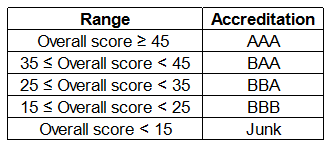
Eight colleges apply for accreditation, and receive the following grades in the four parameters (F, R, P, and I):
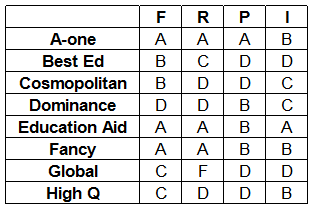
It is further known that in terms of overall scores:
1. High Q is better than Best Ed;
2. Best Ed is better than Cosmopolitan; and
3. Education Aid is better than A-one.
What is the weight of the faculty quality parameter?
It is given that: High Q > Best Ed > Cosmopolitan and Education Aid > A-one
We can say that High Q > Cosmopolitan
We can see that both High Q and Cosmopolitan got same points in reputation (R) and placement quality (P). High Q received more points in infrastructure (I) than Cosmopolitan whereas Cosmopolitan received more points in faculty Quality (F) than High Q.
Hence, we can say that Infrastructure's weight should be greater than Faculty quality. i.e. I > F
Similarly, We can see that both Best Ed and Cosmopolitan got same points in faculty Quality (F) and placement quality (P). Best Ed received more points in reputation (R) than Cosmopolitan whereas Cosmopolitan received more points in infrastructure (I) than Best Ed.
Hence, we can say that reputation's weight should be greater than infrastructure. i.e. R > I
Similarly, We can see that both Education Aid and A-one got same points in faculty Quality (F) and reputation (R). Education Aid received more points in infrastructure (I) than A-one whereas A-one received more points in placement quality (P) than Education Aid.
Hence, we can say that reputation's weight should be greater than infrastructure. i.e. I > P
So basically there are two possible cases: R > I > P > F or R > I > F > P
Case 1: Order of weights assigned = R > I > P > F
R = 0.4, I = 0.3. P = 0.2, F = 0.1
In this case overall score received by Best Ed = 0.1*40+0.4*30+0.2*20+0.3*20 = 26
In this case overall score received by High Q = 0.1*30+0.4*20+0.2*20+0.3*40 = 27
We can see that High Q's overall score is higher than Best Ed. Hence, this is a possible case.
Case 2: Order of weights assigned = R > I > F > P
R = 0.4, I = 0.3. P = 0.1, F = 0.2
In this case overall score received by Best Ed = 0.2*40+0.4*30+0.1*20+0.3*20 = 28
In this case overall score received by High Q = 0.2*30+0.4*20+0.1*20+0.3*40 = 28
We can see that High Q's overall score is not greater than the overall score received Best Ed. Hence, this case is not possible.
Now that we know the weight of each parameter, we can calculate the overall score and accreditation received by each college.
We can see that weight of the faculty quality parameter = 0.1. Hence,option D is the correct answer.
How many colleges receive the accreditation of AAA?
It is given that: High Q > Best Ed > Cosmopolitan and Education Aid > A-one
We can say that High Q > Cosmopolitan
We can see that both High Q and Cosmopolitan got same points in reputation (R) and placement quality (P). High Q received more points in infrastructure (I) than Cosmopolitan whereas Cosmopolitan received more points in faculty Quality (F) than High Q.
Hence, we can say that Infrastructure's weight should be greater than Faculty quality. i.e. I > F
Similarly, We can see that both Best Ed and Cosmopolitan got same points in faculty Quality (F) and placement quality (P). Best Ed received more points in reputation (R) than Cosmopolitan whereas Cosmopolitan received more points in infrastructure (I) than Best Ed.
Hence, we can say that reputation's weight should be greater than infrastructure. i.e. R > I
Similarly, We can see that both Education Aid and A-one got same points in faculty Quality (F) and reputation (R). Education Aid received more points in infrastructure (I) than A-one whereas A-one received more points in placement quality (P) than Education Aid.
Hence, we can say that reputation's weight should be greater than infrastructure. i.e. I > P
So basically there are two possible cases: R > I > P > F or R > I > F > P
Case 1: Order of weights assigned = R > I > P > F
R = 0.4, I = 0.3. P = 0.2, F = 0.1
In this case overall score received by Best Ed = 0.1*40+0.4*30+0.2*20+0.3*20 = 26
In this case overall score received by High Q = 0.1*30+0.4*20+0.2*20+0.3*40 = 27
We can see that High Q's overall score is higher than Best Ed. Hence, this is a possible case.
Case 2: Order of weights assigned = R > I > F > P
R = 0.4, I = 0.3. P = 0.1, F = 0.2
In this case overall score received by Best Ed = 0.2*40+0.4*30+0.1*20+0.3*20 = 28
In this case overall score received by High Q = 0.2*30+0.4*20+0.1*20+0.3*40 = 28
We can see that High Q's overall score is not greater than the overall score received Best Ed. Hence, this case is not possible.
Now that we know the weight of each parameter, we can calculate the overall score and accreditation received by each college.
From the table, we can see that three received the accreditation of AAA.
What is the highest overall score among the eight colleges ?
It is given that: High Q > Best Ed > Cosmopolitan and Education Aid > A-one
We can say that High Q > Cosmopolitan
We can see that both High Q and Cosmopolitan got same points in reputation (R) and placement quality (P). High Q received more points in infrastructure (I) than Cosmopolitan whereas Cosmopolitan received more points in faculty Quality (F) than High Q.
Hence, we can say that Infrastructure's weight should be greater than Faculty quality. i.e. I > F
Similarly, We can see that both Best Ed and Cosmopolitan got same points in faculty Quality (F) and placement quality (P). Best Ed received more points in reputation (R) than Cosmopolitan whereas Cosmopolitan received more points in infrastructure (I) than Best Ed.
Hence, we can say that reputation's weight should be greater than infrastructure. i.e. R > I
Similarly, We can see that both Education Aid and A-one got same points in faculty Quality (F) and reputation (R). Education Aid received more points in infrastructure (I) than A-one whereas A-one received more points in placement quality (P) than Education Aid.
Hence, we can say that reputation's weight should be greater than infrastructure. i.e. I > P
So basically there are two possible cases: R > I > P > F or R > I > F > P
Case 1: Order of weights assigned = R > I > P > F
R = 0.4, I = 0.3. P = 0.2, F = 0.1
In this case overall score received by Best Ed = 0.1*40+0.4*30+0.2*20+0.3*20 = 26
In this case overall score received by High Q = 0.1*30+0.4*20+0.2*20+0.3*40 = 27
We can see that High Q's overall score is higher than Best Ed. Hence, this is a possible case.
Case 2: Order of weights assigned = R > I > F > P
R = 0.4, I = 0.3. P = 0.1, F = 0.2
In this case overall score received by Best Ed = 0.2*40+0.4*30+0.1*20+0.3*20 = 28
In this case overall score received by High Q = 0.2*30+0.4*20+0.1*20+0.3*40 = 28
We can see that High Q's overall score is not greater than the overall score received Best Ed. Hence, this case is not possible.
Now that we know the weight of each parameter, we can calculate the overall score and accreditation received by each college.
From the table we can see that Education Aid scored the highest overall score = 48.
How many colleges have overall scores between 31 and 40, both inclusive?
It is given that: High Q > Best Ed > Cosmopolitan and Education Aid > A-one
We can say that High Q > Cosmopolitan
We can see that both High Q and Cosmopolitan got same points in reputation (R) and placement quality (P). High Q received more points in infrastructure (I) than Cosmopolitan whereas Cosmopolitan received more points in faculty Quality (F) than High Q.
Hence, we can say that Infrastructure's weight should be greater than Faculty quality. i.e. I > F
Similarly, We can see that both Best Ed and Cosmopolitan got same points in faculty Quality (F) and placement quality (P). Best Ed received more points in reputation (R) than Cosmopolitan whereas Cosmopolitan received more points in infrastructure (I) than Best Ed.
Hence, we can say that reputation's weight should be greater than infrastructure. i.e. R > I
Similarly, We can see that both Education Aid and A-one got same points in faculty Quality (F) and reputation (R). Education Aid received more points in infrastructure (I) than A-one whereas A-one received more points in placement quality (P) than Education Aid.
Hence, we can say that reputation's weight should be greater than infrastructure. i.e. I > P
So basically there are two possible cases: R > I > P > F or R > I > F > P
Case 1: Order of weights assigned = R > I > P > F
R = 0.4, I = 0.3. P = 0.2, F = 0.1
In this case overall score received by Best Ed = 0.1*40+0.4*30+0.2*20+0.3*20 = 26
In this case overall score received by High Q = 0.1*30+0.4*20+0.2*20+0.3*40 = 27
We can see that High Q's overall score is higher than Best Ed. Hence, this is a possible case.
Case 2: Order of weights assigned = R > I > F > P
R = 0.4, I = 0.3. P = 0.1, F = 0.2
In this case overall score received by Best Ed = 0.2*40+0.4*30+0.1*20+0.3*20 = 28
In this case overall score received by High Q = 0.2*30+0.4*20+0.1*20+0.3*40 = 28
We can see that High Q's overall score is not greater than the overall score received Best Ed. Hence, this case is not possible.
Now that we know the weight of each parameter, we can calculate the overall score and accreditation received by each college.
From the table we can see that none of the mentioned college received an overall scores between 31 and 40, both inclusive. Hence, option A is the correct answer.
Fun Sports (FS) provides training in three sports - Gilli-danda (G), Kho-Kho (K), and Ludo (L). Currently it has an enrollment of 39 students each of whom is enrolled in at least one of the three sports. The following details are known:
1. The number of students enrolled only in L is double the number of students enrolled in all the three sports.
2. There are a total of 17 students enrolled in G.
3. The number of students enrolled only in G is one less than the number of students enrolled only in L.
4. The number of students enrolled only in K is equal to the number of students who are enrolled in both K and L.
5. The maximum student enrollment is in L.
6. Ten students enrolled in G are also enrolled in at least one more sport.
What is the minimum number of students enrolled in both G and L but not in K?
Let 'x' be the number of students enrolled in all three sports. Then the number of students enrolled only in L = 2x
It is given that there are a total of 17 students enrolled in G. Also, ten students enrolled in G are also enrolled in at least one more sport. Hence, the number of students enrolled in only G = 17 - 10 = 7
The number of students enrolled only in G is one less than the number of students enrolled only in L. Hence, the number of students enrolled only in L = 7+1
$$\Rightarrow$$ 2x = 8
$$\Rightarrow$$ x = 4
Let us assume that 'y' students are enrolled in K and L but not G. Then, the number of students enrolled only in K = y + 4
Let us assume that 'z' be the the number of students enrolled in G and K but not L. Then, the number of students enrolled G and L bot not K = 10 - 4 - z = 6 - z
It is given that a total of 39 students in the sports.
7 + z + 4 + 6 - z + 8 + y + y + 4 = 39
$$\Rightarrow$$ y = 5
Number of students enrolled in G = 17
Number of students enrolled in K = 9 + 4 + 5 + z = 18 + z
Number of students enrolled in L = 6 - z + 4 + 5 + 8 = 23 - z
It is given that the maximum student enrollment is in L.
$$\Rightarrow$$ 23 - z > 18 + z
$$\Rightarrow$$ 2z < 5
$$\Rightarrow$$ z < 2.5
Therefore, we can say that z can take three values = {0, 1, 2}
The number of students enrolled in both G and L but not in K = 6 - z. This number will be minimum when 'z' is maximum. z_{max} = 2
Therefore, the minimum number of students enrolled in both G and L but not in K = 6 - 2 = 4
If the numbers of students enrolled in K and L are in the ratio 19:22, then what is the number of students enrolled in L?
Let 'x' be the number of students enrolled in all three sports. Then the number of students enrolled only in L = 2x
It is given that there are a total of 17 students enrolled in G. Also, ten students enrolled in G are also enrolled in at least one more sport. Hence, the number of students enrolled in only G = 17 - 10 = 7
The number of students enrolled only in G is one less than the number of students enrolled only in L. Hence, the number of students enrolled only in L = 7+1
$$\Rightarrow$$ 2x = 8
$$\Rightarrow$$ x = 4
Let us assume that 'y' students are enrolled in K and L but not G. Then, the number of students enrolled only in K = y + 4
Let us assume that 'z' be the the number of students enrolled in G and K but not L. Then, the number of students enrolled G and L bot not K = 10 - 4 - z = 6 - z
It is given that a total of 39 students in the sports.
7 + z + 4 + 6 - z + 8 + y + y + 4 = 39
$$\Rightarrow$$ y = 5
Number of students enrolled in G = 17
Number of students enrolled in K = 9 + 4 + 5 + z = 18 + z
Number of students enrolled in L = 6 - z + 4 + 5 + 8 = 23 - z
It is given that the maximum student enrollment is in L.
$$\Rightarrow$$ 23 - z > 18 + z
$$\Rightarrow$$ 2z < 5
$$\Rightarrow$$ z < 2.5
Therefore, we can say that z can take three values = {0, 1, 2}
It is given that the numbers of students enrolled in K and L are in the ratio 19:22.
$$\dfrac{18+z}{23-z} = \dfrac{19}{22}$$
z = 1 which is a possible solution as well.
In this case the number of students enrolled in L = 23 - z = 23 - 1 = 22. Hence, option C is the correct answer.
Due to academic pressure, students who were enrolled in all three sports were asked to withdraw from one of the three sports. After the withdrawal, the number of students enrolled in G was six less than the number of students enrolled in L, while the number of students enrolled in K went down by one. After the withdrawal, how many students were enrolled in both G and K?
Let 'x' be the number of students enrolled in all three sports. Then the number of students enrolled only in L = 2x
It is given that there are a total of 17 students enrolled in G. Also, ten students enrolled in G are also enrolled in at least one more sport. Hence, the number of students enrolled in only G = 17 - 10 = 7
The number of students enrolled only in G is one less than the number of students enrolled only in L. Hence, the number of students enrolled only in L = 7+1
$$\Rightarrow$$ 2x = 8
$$\Rightarrow$$ x = 4
Let us assume that 'y' students are enrolled in K and L but not G. Then, the number of students enrolled only in K = y + 4
Let us assume that 'z' be the the number of students enrolled in G and K but not L. Then, the number of students enrolled G and L bot not K = 10 - 4 - z = 6 - z
It is given that a total of 39 students in the sports.
7 + z + 4 + 6 - z + 8 + y + y + 4 = 39
$$\Rightarrow$$ y = 5
Number of students enrolled in G = 17
Number of students enrolled in K = 9 + 4 + 5 + z = 18 + z
Number of students enrolled in L = 6 - z + 4 + 5 + 8 = 23 - z
It is given that the maximum student enrollment is in L.
$$\Rightarrow$$ 23 - z > 18 + z
$$\Rightarrow$$ 2z < 5
$$\Rightarrow$$ z < 2.5
Therefore, we can say that z can take three values = {0, 1, 2}
Hence, the number of students enrolled in K = 18 + z = {18, 19, 20}
It is given that after withdrawal the number of students enrolled in K went down by one. This one student must have left sports K. Hence we can say that the remaining 3 students must have left either G or L.
Before withdraw there were a total of 24 students were enrolled in exactly 1 sports, 11 students were enrolled in exactly 2 courses and 4 students were enrolled in all three courses.
The students which were enrolled in all three sports, withdrew from one of the sports. Hence, we can say that now the number of students who were enrolled in exactly 2 courses = 11 + 4 = 15.
It is given that the number of students enrolled in G was six less than the number of students enrolled in L. Let 'a' be the number of students who were enrolled in G and K but not L. Then, the number of students who were enrolled in L and K but not G = a + 5
Consequently, we can say that the number of students enrolled in G and L but not K = 15 - (2a + 5) = 10 - 2a
Number of students enrolled in this case = a + a+5 + 9 = 14 + 2a. We can see that '14+2a' is an even number. It is given that the number of students enrolled in K went down by one. Therefore, we can say that the number of students enrolled in K earlier was an odd number.
Hence, the number of students enrolled in K = 18 + z = {18, 19, 20}
We can see that only '19' is an odd number. Hence, we can say that the number of students enrolled in K after withdrawal = 18
$$\Rightarrow$$ 14 + 2a = 18
$$\Rightarrow$$ a = 2
From the diagram we can see that the number of students enrolled in both G and K = 2.
Due to academic pressure, students who were enrolled in all three sports were asked to withdraw from one of the three sports. After the withdrawal, the number of students enrolled in G was six less than the number of students enrolled in L, while the number of students enrolled in K went down by one. After the withdrawal, how many students were enrolled in both G and L?
Let 'x' be the number of students enrolled in all three sports. Then the number of students enrolled only in L = 2x
It is given that there are a total of 17 students enrolled in G. Also, ten students enrolled in G are also enrolled in at least one more sport. Hence, the number of students enrolled in only G = 17 - 10 = 7
The number of students enrolled only in G is one less than the number of students enrolled only in L. Hence, the number of students enrolled only in L = 7+1
$$\Rightarrow$$ 2x = 8
$$\Rightarrow$$ x = 4
Let us assume that 'y' students are enrolled in K and L but not G. Then, the number of students enrolled only in K = y + 4
Let us assume that 'z' be the the number of students enrolled in G and K but not L. Then, the number of students enrolled G and L bot not K = 10 - 4 - z = 6 - z
It is given that a total of 39 students in the sports.
7 + z + 4 + 6 - z + 8 + y + y + 4 = 39
$$\Rightarrow$$ y = 5
Number of students enrolled in G = 17
Number of students enrolled in K = 9 + 4 + 5 + z = 18 + z
Number of students enrolled in L = 6 - z + 4 + 5 + 8 = 23 - z
It is given that the maximum student enrollment is in L.
$$\Rightarrow$$ 23 - z > 18 + z
$$\Rightarrow$$ 2z < 5
$$\Rightarrow$$ z < 2.5
Therefore, we can say that z can take three values = {0, 1, 2}
Hence, the number of students enrolled in K = 18 + z = {18, 19, 20}
It is given that after withdrawal the number of students enrolled in K went down by one. This one student must have left sports K. Hence we can say that the remaining 3 students must have left either G or L.
Before withdraw there were a total of 24 students were enrolled in exactly 1 sports, 11 students were enrolled in exactly 2 courses and 4 students were enrolled in all three courses.
The students which were enrolled in all three sports, withdrew from one of the sports. Hence, we can say that now the number of students who were enrolled in exactly 2 courses = 11 + 4 = 15.
It is given that the number of students enrolled in G was six less than the number of students enrolled in L. Let 'a' be the number of students who were enrolled in G and K but not L. Then, the number of students who were enrolled in L and K but not G = a + 5
Consequently, we can say that the number of students enrolled in G and L but not K = 15 - (2a + 5) = 10 - 2a
Number of students enrolled in this case = a + a+5 + 9 = 14 + 2a. We can see that '14+2a' is an even number. It is given that the number of students enrolled in K went down by one. Therefore, we can say that the number of students enrolled in K earlier was an odd number.
Hence, the number of students enrolled in K = 18 + z = {18, 19, 20}
We can see that only '19' is an odd number. Hence, we can say that the number of students enrolled in K after withdrawal = 18
$$\Rightarrow$$ 14 + 2a = 18
$$\Rightarrow$$ a = 2
From the diagram we can see that the number of students enrolled in both G and L = 6. Hence, option A is the correct answer.
According to a coding scheme the sentence:
"Peacock is designated as the national bird of India" is coded as 5688999 35 1135556678 56 458 13666689 1334 79 13366
This coding scheme has the following rules:
a: The scheme is case-insensitive (does not distinguish between upper case and lower case letters).
b: Each letter has a unique code which is a single digit from among 1,2,3, …, 9.
c: The digit 9 codes two letters, and every other digit codes three letters.
d: The code for a word is constructed by arranging the digits corresponding to its letters in a non-decreasing sequence.
Answer these questions on the basis of this information.
What best can be concluded about the code for the letter L?
We can see that India's code is 13366 therefore we can say that I's code is either 3 or 6.
Also, we can see that code for word "is" is 35 therefore we can say that I's code is 3. Consequently, we can say that S's code is 5.
Also, we can see that code of word 'as' is 56 therefore we can say that A's code is 6. Consequently, we can say that S's code is 5.
There is only one letter 'O' common in words 'of' and 'national'. In code word as well only digit '9' is common in both. Hence, we can say that letter 'O' is assigned numerical '9'. Consequently, we can say that F is assigned number 7.
It is given that '9' is assigned to only two alphabets one of them is 'O'. We can see that there are three 9's in Peacock's code. One of the digit '9' is used for 'O'.Remaining two 9's must represent same letter. We can see that only letter 'C' has appeared twice in Peacock. Therefore, we can say that 'C' is assigned number '9'.
In word national 'N' has appeared twice. In code only digit '6' has appeared more than once. Hence, we can say that code of letter N is '6'. Consequently, we can say that code for letter 'D' is '1' because in India rest of the numerals are already taken.
In words, 'the' and 'national' only letter 't' is common. In code as well only digit '8' is common in two codes. Hence, we can say that letter code for letter 't' is 8.
In words, 'the' and 'peacock' only letter 'e' is common. In code as well only digit '5' is common in two codes. Hence, we can say that letter code for letter 'e' is 5. Consequently, we can say that leftover letter, in word "the", 'H's code is 4.
We can see that code for word "NATIONAL" is 13666689. Hence, we can say that code for the letter L is '1'.
Hence, option A is the correct answer.
What best can be concluded about the code for the letter B?
We can see that India's code is 13366 therefore we can say that I's code is either 3 or 6.
Also, we can see that code for word "is" is 35 therefore we can say that I's code is 3. Consequently, we can say that S's code is 5.
Also, we can see that code of word 'as' is 56 therefore we can say that A's code is 6. Consequently, we can say that S's code is 5.
There is only one letter 'O' common in words 'of' and 'national'. In code word as well only digit '9' is common in both. Hence, we can say that letter 'O' is assigned numerical '9'. Consequently, we can say that F is assigned number 7.
It is given that '9' is assigned to only two alphabets one of them is 'O'. We can see that there are three 9's in Peacock's code. One of the digit '9' is used for 'O'.Remaining two 9's must represent same letter. We can see that only letter 'C' has appeared twice in Peacock. Therefore, we can say that 'C' is assigned number '9'.
In word national 'N' has appeared twice. In code only digit '6' has appeared more than once. Hence, we can say that code of letter N is '6'. Consequently, we can say that code for letter 'D' is '1' because in India rest of the numerals are already taken.
In words, 'the' and 'national' only letter 't' is common. In code as well only digit '8' is common in two codes. Hence, we can say that letter code for letter 't' is 8.
In words, 'the' and 'peacock' only letter 'e' is common. In code as well only digit '5' is common in two codes. Hence, we can say that letter code for letter 'e' is 5. Consequently, we can say that leftover letter, in word "the", 'H's code is 4.
We can see that code for word "NATIONAL" is 13666689. Hence, we can say that code for the letter L is '1'.
We can see that code for word "BIRD" is 1334. 1 corresponds to D and one 3 corresponds to I. Hence, we can say that code for letters 'R' and 'B' are '3' and '4' in any order.
Therefore, we can say that for letter 'B' there are two possible numbers: 3 or 4
Hence, option A is the correct answer.
For how many digits can the complete list of letters associated with that digit be identified?
We can see that India's code is 13366 therefore we can say that I's code is either 3 or 6.
Also, we can see that code for word "is" is 35 therefore we can say that I's code is 3. Consequently, we can say that S's code is 5.
Also, we can see that code of word 'as' is 56 therefore we can say that A's code is 6. Consequently, we can say that S's code is 5.
There is only one letter 'O' common in words 'of' and 'national'. In code word as well only digit '9' is common in both. Hence, we can say that letter 'O' is assigned numerical '9'. Consequently, we can say that F is assigned number 7.
It is given that '9' is assigned to only two alphabets one of them is 'O'. We can see that there are three 9's in Peacock's code. One of the digit '9' is used for 'O'.Remaining two 9's must represent same letter. We can see that only letter 'C' has appeared twice in Peacock. Therefore, we can say that 'C' is assigned number '9'.
In word national 'N' has appeared twice. In code only digit '6' has appeared more than once. Hence, we can say that code of letter N is '6'. Consequently, we can say that code for letter 'D' is '1' because in India rest of the numerals are already taken.
In words, 'the' and 'national' only letter 't' is common. In code as well only digit '8' is common in two codes. Hence, we can say that letter code for letter 't' is 8.
In words, 'the' and 'peacock' only letter 'e' is common. In code as well only digit '5' is common in two codes. Hence, we can say that letter code for letter 'e' is 5. Consequently, we can say that leftover letter, in word "the", 'H's code is 4.
We can see that code for word "NATIONAL" is 13666689. Hence, we can say that code for the letter L is '1'.
We can see that code for word "DESIGNATED" is 1135556678. Hence, we can say that code for the letter 'G' is '7'.
We can see that code for word "PEACOCK" is 5688999. Hence, we can say that code for the letters 'P' and 'K' is '8'.
Digit '1' is used for L and D only. We can not figure out the third letter for which digit 1 is used.
Digit '2' is not used for any letter. Hence, we can not figure out all the letters for which digit 2 is correct code.
Digit '3' is used for letter 'I' only. Hence, we can not figure out all the letters for which digit 3 is correct code.
Digit '4' is used for letters 'H' and one of 'B' and 'R'. Hence, we can not figure out all the letters for which digit 4 is correct code.
Digit '5' is used for letters 'S' and 'E'. We can not figure out the third letter for which digit 5 is used.
Digit '6' is used for letters 'A' and 'N'. We can not figure out the third letter for which digit 6 is used.
Digit '7' is used for letters 'G' and 'F'. We can not figure out the third letter for which digit 7 is used.
Digit '8' is used for letters 'T', 'P' and K. Hence, we can say that this is one of the digit for which the complete list of letters associated is known.
Digit '9' is used for letters 'C' and 'O'. Hence, we can say that this is one of the digit for which the complete list of letters associated is known.
Therefore, we can say that for only two digits (8 and 9), the complete list of letters associated is known. Hence, option B is the correct answer.
Which set of letters CANNOT be coded with the same digit?
We can see that India's code is 13366 therefore we can say that I's code is either 3 or 6.
Also, we can see that code for word "is" is 35 therefore we can say that I's code is 3. Consequently, we can say that S's code is 5.
Also, we can see that code of word 'as' is 56 therefore we can say that A's code is 6. Consequently, we can say that S's code is 5.
There is only one letter 'O' common in words 'of' and 'national'. In code word as well only digit '9' is common in both. Hence, we can say that letter 'O' is assigned numerical '9'. Consequently, we can say that F is assigned number 7.
It is given that '9' is assigned to only two alphabets one of them is 'O'. We can see that there are three 9's in Peacock's code. One of the digit '9' is used for 'O'.Remaining two 9's must represent same letter. We can see that only letter 'C' has appeared twice in Peacock. Therefore, we can say that 'C' is assigned number '9'.
In word national 'N' has appeared twice. In code only digit '6' has appeared more than once. Hence, we can say that code of letter N is '6'. Consequently, we can say that code for letter 'D' is '1' because in India rest of the numerals are already taken.
In words, 'the' and 'national' only letter 't' is common. In code as well only digit '8' is common in two codes. Hence, we can say that letter code for letter 't' is 8.
In words, 'the' and 'peacock' only letter 'e' is common. In code as well only digit '5' is common in two codes. Hence, we can say that letter code for letter 'e' is 5. Consequently, we can say that leftover letter, in word "the", 'H's code is 4.
We can see that code for word "NATIONAL" is 13666689. Hence, we can say that code for the letter L is '1'.
We can see that code for word "DESIGNATED" is 1135556678. Hence, we can say that code for the letter 'G' is '7'.
We can see that code for word "PEACOCK" is 5688999. Hence, we can say that code for the letters 'P' and 'K' is '8'.
Let us check this by options:
(A) S,E,Z: If letter 'Z' is assigned code '5' then this case is possible.
(B) I,B,M: If letters 'B' and 'M' are assigned code '3' then this case is possible.
(C) S,U,V: If letters 'U' and 'V' are assigned code '5' then this case is possible. But in that case digit 5 will have 4 letters associated with it which is not possible. Hence, this is the answer.
(D) X,Y,Z: If letters 'X', 'Y' and 'Z' are assigned code '2' then this case is possible.
Each of the 23 boxes in the picture below represents a product manufactured by one of the following three companies: Alfa, Bravo and Charlie. The area of a box is proportional to the revenue from the corresponding product, while its centre represents the Product popularity and Market potential scores of the product (out of 20). The shadings of some of the boxes have got erased.

The companies classified their products into four categories based on a combination of scores (out of 20) on the two parameters - Product popularity and Market potential as given below:

The following facts are known:
1. Alfa and Bravo had the same number of products in the Blockbuster category.
2. Charlie had more products than Bravo but fewer products than Alfa in the No-hope category.
3. Each company had an equal number of products in the Promising category.
4. Charlie did not have any product in the Doubtful category, while Alfa had one product more than Bravo in this category
5. Bravo had a higher revenue than Alfa from products in the Doubtful category.
6. Charlie had a higher revenue than Bravo from products in the Blockbuster category.
7. Bravo and Charlie had the same revenue from products in the No-hope category.
8. Alfa and Charlie had the same total revenue considering all products.
Considering all companies' products, which product category had the highest revenue?
Let us divide the given figure in four quadrants (Q1, Q2, Q3, Q4).
Let us solve this problem by considering only one category at a time.
(A) Blockbuster category: We have two information regarding Blockbuster category.
1. Alfa and Bravo had the same number of products in the Blockbuster category.
There are a total of 7 products in Blockbuster category. Alfa already has two products in blockbuster category. If Alfa has 3 products in blockbuster category then Bravo will also have 3 products in Blockbuster category which is not possible as there are 2 products of Charlie. Hence, we can say that Alfa and Bravo have 2 products each in Blockbuster category whereas Charlie has 3 products in Blockbuster category.
2. It is also given that Charlie had a higher revenue than Bravo from products in the Blockbuster category.
We know that one of the product 1 and 2 is from Charlie and the other is from Bravo.
If product 1 is from Charlie, then we can say that products 1, 7 and 5 are from Charlie. Therefore, revenue generated by products in Charlie category = 2 + 4 + 6 = 12 units. (Assuming area of a square to be 1 unit)
In this case product 2 and product n are from Bravo.Therefore, revenue generated by products in Bravo category = 6 + 9 = 15 units.
We can see that products from Charlie have a higher revenue than Bravo. Hence, this case in not possible.
Therefore, we can say that Product 1 is from Bravo and Product 2 is from Charlie. We have determined each product's company name in Blockbuster category.
(B) No-hope category: We have two information regarding No-hope category.
(1) Charlie had more products than Bravo but fewer products than Alfa in the No-hope category. Bravo and Charlie had the same revenue from products in the No-hope category.There are a total of 6 products in no-hope category.
Therefore, we can say that Alfa, Charlie and Bravo have 3, 2 and 1 products in No-hope category in that order.
Bravo and Charlie had the same revenue from products in the No-hope category.
Revenue generated for Bravo in the No-hope category = 4 units. We need same revenue for Charlie which ha s 2 products in this category. Hence, we can say that Product 10 and one of product 8 and 9 is from Charlie and other is from Alfa. Let's assume that product 8 is from Charlie and product 9 is from Alfa.
(C) Doubtful category: We have two information regarding Doubtful category.
(1). Charlie did not have any product in the Doubtful category, while Alfa had one product more than Bravo in this category .
(2). Bravo had a higher revenue than Alfa from products in the Doubtful category.
We can see that there are a total of 7 products in this category. Hence, we can say that 4 products are from Alfa and 3 products are from Bravo.
We can see that one of product 14, 15 and 16 is from Bravo company and others are from Alfa company. Bravo will have higher revenue than Alfa only when product no. 14 is from Bravo and others (15 and 16) are from Alfa category.
In this case total revenue by Bravo = Product 14 + Product 19 + Product 20 = 9 + 6 + 2 = 17
Similarly, total revenue by Charlie = Product 15 + Product 16 + Product 17 + Product 18 = 6 + 1 + 1 + 4 = 12
(D) Promising category: We have only 1 direct information regarding Promising category.
1. Each company had an equal number of products in the Promising category.
There are a total of 3 products in promising category with different revenue. Therefore, we can say that each company had 1 product in promising category. We are given that Alfa and Charlie had the same total revenue considering all products. We can calculate the revenue generated by Alfa and Charlie from the products in categories.
Revenue generated by Charlie from all categories except Promising = From Blockbuster + From No-hope + From Doubtful
$$\Rightarrow$$ (9+6+2) + (3+1) + (0) = 21 units
Revenue generated by Alfa from all categories except Promising = From Blockbuster + From No-hope + From Doubtful
$$\Rightarrow$$ (6+3) + (4+2+1) + (1+6+4+1) = 28 units
We can see the difference between revenue generated by Charlie and Alfa from remaining categories is 7 units. Hence, we can say that Charlie's product's revenue should be 7 units more than Alfa's product's revenue in Promising category. That is possible only in one case where product 22 is from Charlie and product 21 is form Alfa. Consequently, we can say that product 23 is from Bravo. Now we have identified each product's company name we can answer all the questions.
Revenue generated by the products in Promising category = 2 + 9 + 3 = 14 units.
Revenue generated by the products in Doubtful category = 1 + 9 + 4 + 6 + 2 + 1 + 6 = 29 units.
Revenue generated by the products in No-hope category = 4 + 4 + 3 + 2 + 1 + 1 = 15 units.
Revenue generated by the products in Blockbuster category = 6 + 3 + 6 + 2 + 4 + 6 + 9 = 36 units.
We can see that the revenue generated is the highest for Blockbuster category. Hence, option B is the correct answer.
Which of the following is the correct sequence of numbers of products Bravo had in No-hope, Doubtful, Promising and Blockbuster categories respectively?
Let us divide the given figure in four quadrants (Q1, Q2, Q3, Q4).
Let us solve this problem by considering only one category at a time.
(A) Blockbuster category: We have two information regarding Blockbuster category.
1. Alfa and Bravo had the same number of products in the Blockbuster category.
There are a total of 7 products in Blockbuster category. Alfa already has two products in blockbuster category. If Alfa has 3 products in blockbuster category then Bravo will also have 3 products in Blockbuster category which is not possible as there are 2 products of Charlie. Hence, we can say that Alfa and Bravo have 2 products each in Blockbuster category whereas Charlie has 3 products in Blockbuster category.
2. It is also given that Charlie had a higher revenue than Bravo from products in the Blockbuster category.
We know that one of the product 1 and 2 is from Charlie and the other is from Bravo.
If product 1 is from Charlie, then we can say that products 1, 7 and 5 are from Charlie. Therefore, revenue generated by products in Charlie category = 2 + 4 + 6 = 12 units. (Assuming area of a square to be 1 unit)
In this case product 2 and product n are from Bravo.Therefore, revenue generated by products in Bravo category = 6 + 9 = 15 units.
We can see that products from Charlie have a higher revenue than Bravo. Hence, this case in not possible.
Therefore, we can say that Product 1 is from Bravo and Product 2 is from Charlie. We have determined each product's company name in Blockbuster category.
(B) No-hope category: We have two information regarding No-hope category.
(1) Charlie had more products than Bravo but fewer products than Alfa in the No-hope category. Bravo and Charlie had the same revenue from products in the No-hope category.There are a total of 6 products in no-hope category.
Therefore, we can say that Alfa, Charlie and Bravo have 3, 2 and 1 products in No-hope category in that order.
Bravo and Charlie had the same revenue from products in the No-hope category.
Revenue generated for Bravo in the No-hope category = 4 units. We need same revenue for Charlie which ha s 2 products in this category. Hence, we can say that Product 10 and one of product 8 and 9 is from Charlie and other is from Alfa. Let's assume that product 8 is from Charlie and product 9 is from Alfa.
(C) Doubtful category: We have two information regarding Doubtful category.
(1). Charlie did not have any product in the Doubtful category, while Alfa had one product more than Bravo in this category .
(2). Bravo had a higher revenue than Alfa from products in the Doubtful category.
We can see that there are a total of 7 products in this category. Hence, we can say that 4 products are from Alfa and 3 products are from Bravo.
We can see that one of product 14, 15 and 16 is from Bravo company and others are from Alfa company. Bravo will have higher revenue than Alfa only when product no. 14 is from Bravo and others (15 and 16) are from Alfa category.
In this case total revenue by Bravo = Product 14 + Product 19 + Product 20 = 9 + 6 + 2 = 17
Similarly, total revenue by Charlie = Product 15 + Product 16 + Product 17 + Product 18 = 6 + 1 + 1 + 4 = 12
(D) Promising category: We have only 1 direct information regarding Promising category.
1. Each company had an equal number of products in the Promising category.
There are a total of 3 products in promising category with different revenue. Therefore, we can say that each company had 1 product in promising category. We are given that Alfa and Charlie had the same total revenue considering all products. We can calculate the revenue generated by Alfa and Charlie from the products in categories.
Revenue generated by Charlie from all categories except Promising = From Blockbuster + From No-hope + From Doubtful
$$\Rightarrow$$ (9+6+2) + (3+1) + (0) = 21 units
Revenue generated by Alfa from all categories except Promising = From Blockbuster + From No-hope + From Doubtful
$$\Rightarrow$$ (6+3) + (4+2+1) + (1+6+4+1) = 28 units
We can see the difference between revenue generated by Charlie and Alfa from remaining categories is 7 units. Hence, we can say that Charlie's product's revenue should be 7 units more than Alfa's product's revenue in Promising category. That is possible only in one case where product 22 is from Charlie and product 21 is form Alfa. Consequently, we can say that product 23 is from Bravo. Now we have identified each product's company name we can answer all the questions.
Bravo had in No-hope, Doubtful, Promising and Blockbuster categories respectively = 1, 3, 1, 2. Hence, option A is the correct answer.
Which of the following statements is NOT correct?
Let us divide the given figure in four quadrants (Q1, Q2, Q3, Q4).
Let us solve this problem by considering only one category at a time.
(A) Blockbuster category: We have two information regarding Blockbuster category.
1. Alfa and Bravo had the same number of products in the Blockbuster category.
There are a total of 7 products in Blockbuster category. Alfa already has two products in blockbuster category. If Alfa has 3 products in blockbuster category then Bravo will also have 3 products in Blockbuster category which is not possible as there are 2 products of Charlie. Hence, we can say that Alfa and Bravo have 2 products each in Blockbuster category whereas Charlie has 3 products in Blockbuster category.
2. It is also given that Charlie had a higher revenue than Bravo from products in the Blockbuster category.
We know that one of the product 1 and 2 is from Charlie and the other is from Bravo.
If product 1 is from Charlie, then we can say that products 1, 7 and 5 are from Charlie. Therefore, revenue generated by products in Charlie category = 2 + 4 + 6 = 12 units. (Assuming area of a square to be 1 unit)
In this case product 2 and product n are from Bravo.Therefore, revenue generated by products in Bravo category = 6 + 9 = 15 units.
We can see that products from Charlie have a higher revenue than Bravo. Hence, this case in not possible.
Therefore, we can say that Product 1 is from Bravo and Product 2 is from Charlie. We have determined each product's company name in Blockbuster category.
(B) No-hope category: We have two information regarding No-hope category.
(1) Charlie had more products than Bravo but fewer products than Alfa in the No-hope category. Bravo and Charlie had the same revenue from products in the No-hope category.There are a total of 6 products in no-hope category.
Therefore, we can say that Alfa, Charlie and Bravo have 3, 2 and 1 products in No-hope category in that order.
Bravo and Charlie had the same revenue from products in the No-hope category.
Revenue generated for Bravo in the No-hope category = 4 units. We need same revenue for Charlie which ha s 2 products in this category. Hence, we can say that Product 10 and one of product 8 and 9 is from Charlie and other is from Alfa. Let's assume that product 8 is from Charlie and product 9 is from Alfa.
(C) Doubtful category: We have two information regarding Doubtful category.
(1). Charlie did not have any product in the Doubtful category, while Alfa had one product more than Bravo in this category .
(2). Bravo had a higher revenue than Alfa from products in the Doubtful category.
We can see that there are a total of 7 products in this category. Hence, we can say that 4 products are from Alfa and 3 products are from Bravo.
We can see that one of product 14, 15 and 16 is from Bravo company and others are from Alfa company. Bravo will have higher revenue than Alfa only when product no. 14 is from Bravo and others (15 and 16) are from Alfa category.
In this case total revenue by Bravo = Product 14 + Product 19 + Product 20 = 9 + 6 + 2 = 17
Similarly, total revenue by Charlie = Product 15 + Product 16 + Product 17 + Product 18 = 6 + 1 + 1 + 4 = 12
(D) Promising category: We have only 1 direct information regarding Promising category.
1. Each company had an equal number of products in the Promising category.
There are a total of 3 products in promising category with different revenue. Therefore, we can say that each company had 1 product in promising category. We are given that Alfa and Charlie had the same total revenue considering all products. We can calculate the revenue generated by Alfa and Charlie from the products in categories.
Revenue generated by Charlie from all categories except Promising = From Blockbuster + From No-hope + From Doubtful
$$\Rightarrow$$ (9+6+2) + (3+1) + (0) = 21 units
Revenue generated by Alfa from all categories except Promising = From Blockbuster + From No-hope + From Doubtful
$$\Rightarrow$$ (6+3) + (4+2+1) + (1+6+4+1) = 28 units
We can see the difference between revenue generated by Charlie and Alfa from remaining categories is 7 units. Hence, we can say that Charlie's product's revenue should be 7 units more than Alfa's product's revenue in Promising category. That is possible only in one case where product 22 is from Charlie and product 21 is form Alfa. Consequently, we can say that product 23 is from Bravo. Now we have identified each product's company name we can answer all the questions.
Let us check all options.
Option (A): Alfa's revenue from Blockbuster products was the same as Charlie's revenue from Promising products
Alfa's revenue from Blockbuster products = 6 + 3 = 9 units.
Charlie's revenue from Promising products = 9 units. Hence, this statement is true.
Option (B): Bravo's revenue from Blockbuster products was greater than Alfa's revenue from Doubtful products.
Bravo's revenue from Blockbuster products = 6 + 4 = 10 units.
Alfa's revenue from Doubtful products = 6 + 4 +1 + 1 = 12 units. Hence, this statement is false.
Option (C): Bravo and Charlie had the same revenues from No-hope products.
Bravo's revenue from No-hope products = 4 units.
Charlie's revenue from No-hope products = 3 + 1 = 4 units. Hence, this statement is true.
Option (D): The total revenue from No-hope products was less than the total revenue from Doubtful products
Revenue generated by the products in Doubtful category = 1 + 9 + 4 + 6 + 2 + 1 + 6 = 29 units.
Revenue generated by the products in No-hope category = 4 + 4 + 3 + 2 + 1 + 1 = 15 units. Hence, this statement is true.
We can see that statement mentioned in option B is false. Therefore, option B is the correct answer.
If the smallest box on the grid is equivalent to revenue of Rs.1 crore, then what approximately was the total revenue of Bravo in Rs. crore?
Let us divide the given figure in four quadrants (Q1, Q2, Q3, Q4).
Let us solve this problem by considering only one category at a time.
(A) Blockbuster category: We have two information regarding Blockbuster category.
1. Alfa and Bravo had the same number of products in the Blockbuster category.
There are a total of 7 products in Blockbuster category. Alfa already has two products in blockbuster category. If Alfa has 3 products in blockbuster category then Bravo will also have 3 products in Blockbuster category which is not possible as there are 2 products of Charlie. Hence, we can say that Alfa and Bravo have 2 products each in Blockbuster category whereas Charlie has 3 products in Blockbuster category.
2. It is also given that Charlie had a higher revenue than Bravo from products in the Blockbuster category.
We know that one of the product 1 and 2 is from Charlie and the other is from Bravo.
If product 1 is from Charlie, then we can say that products 1, 7 and 5 are from Charlie. Therefore, revenue generated by products in Charlie category = 2 + 4 + 6 = 12 units. (Assuming area of a square to be 1 unit)
In this case product 2 and product n are from Bravo.Therefore, revenue generated by products in Bravo category = 6 + 9 = 15 units.
We can see that products from Charlie have a higher revenue than Bravo. Hence, this case in not possible.
Therefore, we can say that Product 1 is from Bravo and Product 2 is from Charlie. We have determined each product's company name in Blockbuster category.
(B) No-hope category: We have two information regarding No-hope category.
(1) Charlie had more products than Bravo but fewer products than Alfa in the No-hope category. Bravo and Charlie had the same revenue from products in the No-hope category.There are a total of 6 products in no-hope category.
Therefore, we can say that Alfa, Charlie and Bravo have 3, 2 and 1 products in No-hope category in that order.
Bravo and Charlie had the same revenue from products in the No-hope category.
Revenue generated for Bravo in the No-hope category = 4 units. We need same revenue for Charlie which ha s 2 products in this category. Hence, we can say that Product 10 and one of product 8 and 9 is from Charlie and other is from Alfa. Let's assume that product 8 is from Charlie and product 9 is from Alfa.
(C) Doubtful category: We have two information regarding Doubtful category.
(1). Charlie did not have any product in the Doubtful category, while Alfa had one product more than Bravo in this category .
(2). Bravo had a higher revenue than Alfa from products in the Doubtful category.
We can see that there are a total of 7 products in this category. Hence, we can say that 4 products are from Alfa and 3 products are from Bravo.
We can see that one of product 14, 15 and 16 is from Bravo company and others are from Alfa company. Bravo will have higher revenue than Alfa only when product no. 14 is from Bravo and others (15 and 16) are from Alfa category.
In this case total revenue by Bravo = Product 14 + Product 19 + Product 20 = 9 + 6 + 2 = 17
Similarly, total revenue by Charlie = Product 15 + Product 16 + Product 17 + Product 18 = 6 + 1 + 1 + 4 = 12
(D) Promising category: We have only 1 direct information regarding Promising category.
1. Each company had an equal number of products in the Promising category.
There are a total of 3 products in promising category with different revenue. Therefore, we can say that each company had 1 product in promising category. We are given that Alfa and Charlie had the same total revenue considering all products. We can calculate the revenue generated by Alfa and Charlie from the products in categories.
Revenue generated by Charlie from all categories except Promising = From Blockbuster + From No-hope + From Doubtful
$$\Rightarrow$$ (9+6+2) + (3+1) + (0) = 21 units
Revenue generated by Alfa from all categories except Promising = From Blockbuster + From No-hope + From Doubtful
$$\Rightarrow$$ (6+3) + (4+2+1) + (1+6+4+1) = 28 units
We can see the difference between revenue generated by Charlie and Alfa from remaining categories is 7 units. Hence, we can say that Charlie's product's revenue should be 7 units more than Alfa's product's revenue in Promising category. That is possible only in one case where product 22 is from Charlie and product 21 is form Alfa. Consequently, we can say that product 23 is from Bravo. Now we have identified each product's company name we can answer all the questions.
Total revenue generated by Bravo products alone = From Blockbuster + From No-hope + From Doubtful + From Promising
$$\Rightarrow$$ (6+4) + (4) + (9+6+2) + (3) = 34 units
One box is equivalent to Rs. 1 crore therefore, we can say that total revenue generated by Bravo = Rs. 34 crores. Hence, option C is the correct answer.
Seven candidates, Akil, Balaram, Chitra, Divya, Erina, Fatima, and Ganeshan, were invited to interview for a position. Candidates were required to reach the venue before 8 am. Immediately upon arrival, they were sent to one of three interview rooms: 101, 102, and 103. The following venue log shows the arrival times for these candidates. Some of the names have not been recorded in the log and have been marked as ‘?’.

Balaram: I was the third person to enter Room 101.
Chitra: I was the last person to enter the room I was allotted to.
Erina: I was the only person in the room I was allotted to.
Fatima: Three people including Akhil were already in the room that I was allotted to when I entered it.
Ganeshan : I was one among the two candidates allotted to Room 102.
What best can be said about the room to which Divya was allotted?
It is given that there were a total of 3 rooms and seven candidates. Ganeshan said that he was one among the two candidates allotted to Room 102 whereas Erina said that she is the only person in the room she was allotted to. Therefore, we can say that there were 1 and 4 candidates in either 101 or 103 room. But it is given that Balaram was the third person to enter in the Room 101 therefore we can say that there were 4 candidates in Room 101 and only 1 candidate in room 103.
Fatima said that three people including Akhil were already in the room that I was allotted to when I entered it. Hence, we can say that Fatima was the last person to enter in 101 and Akhil is the first person who entered in room 101.
Chitra said that she was the last person to enter the room she was allotted to. Hence, we can say that Chitra was allotted room no 102 and she entered after Ganeshan.
Erina was the only person in room no 103.
Balaram said he was third to enter room no 101. Hence, we can say that Divya was second person who entered in room 101.
Since Chitra and Fatima were already in by 7:40 AM we can say that the candidate who entered at 7:45 am is Erina.
From the table we can see that Divya was allotted room no 101. Hence, option A is the correct answer.
Who else was in Room 102 when Ganeshan entered?
It is given that there were a total of 3 rooms and seven candidates. Ganeshan said that he was one among the two candidates allotted to Room 102 whereas Erina said that she is the only person in the room she was allotted to. Therefore, we can say that there were 1 and 4 candidates in either 101 or 103 room. But it is given that Balaram was the third person to enter in the Room 101 therefore we can say that there were 4 candidates in Room 101 and only 1 candidate in room 103.
Fatima said that three people including Akhil were already in the room that I was allotted to when I entered it. Hence, we can say that Fatima was the last person to enter in 101 and Akhil is the first person who entered in room 101.
Chitra said that she was the last person to enter the room she was allotted to. Hence, we can say that Chitra was allotted room no 102 and she entered after Ganeshan.
Erina was the only person in room no 103.
Balaram said he was third to enter room no 101. Hence, we can say that Divya was second person who entered in room 101.
Since Chitra and Fatima were already in by 7:40 AM we can say that the candidate who entered at 7:45 am is Erina.
From the table we can see that Ganeshan is the first person to enter in room 102.Hence, option D is the correct answer.
When did Erina reach the venue?
It is given that there were a total of 3 rooms and seven candidates. Ganeshan said that he was one among the two candidates allotted to Room 102 whereas Erina said that she is the only person in the room she was allotted to. Therefore, we can say that there were 1 and 4 candidates in either 101 or 103 room. But it is given that Balaram was the third person to enter in the Room 101 therefore we can say that there were 4 candidates in Room 101 and only 1 candidate in room 103.
Fatima said that three people including Akhil were already in the room that I was allotted to when I entered it. Hence, we can say that Fatima was the last person to enter in 101 and Akhil is the first person who entered in room 101.
Chitra said that she was the last person to enter the room she was allotted to. Hence, we can say that Chitra was allotted room no 102 and she entered after Ganeshan.
Erina was the only person in room no 103.
Balaram said he was third to enter room no 101. Hence, we can say that Divya was second person who entered in room 101.
Since Chitra and Fatima were already in by 7:40 AM we can say that the candidate who entered at 7:45 am is Erina.
From the table we can see that Erina reached the venue at 7:45 am. Hence, option A is the correct answer.
If Ganeshan entered the venue before Divya, when did Balaram enter the venue?
It is given that there were a total of 3 rooms and seven candidates. Ganeshan said that he was one among the two candidates allotted to Room 102 whereas Erina said that she is the only person in the room she was allotted to. Therefore, we can say that there were 1 and 4 candidates in either 101 or 103 room. But it is given that Balaram was the third person to enter in the Room 101 therefore we can say that there were 4 candidates in Room 101 and only 1 candidate in room 103.
Fatima said that three people including Akhil were already in the room that I was allotted to when I entered it. Hence, we can say that Fatima was the last person to enter in 101 and Akhil is the first person who entered in room 101.
Chitra said that she was the last person to enter the room she was allotted to. Hence, we can say that Chitra was allotted room no 102 and she entered after Ganeshan.
Erina was the only person in room no 103.
Balaram said he was third to enter room no 101. Hence, we can say that Divya was second person who entered in room 101.
Since Chitra and Fatima were already in by 7:40 AM we can say that the candidate who entered at 7:45 am is Erina.
In the question it is given that Ganeshan entered the venue before Divya. Therefore, we can say that Ganesh must have entered with Akhil at 7:10 am. In that case, Divya and Balaram must have entered at 7:15 am and 7:25 am respectively. Hence, option A is the correct answer.
There are only four brands of entry level smartphones called Azra, Bysi, Cxqi, and Dipq in a country.
Details about their market share, unit selling price, and profitability (defined as the profit as a percentage of the revenue) for the year 2016 are given in the table below:
In 2017, sales volume of entry level smartphones grew by 40% as compared to that in 2016. Cxqi offered a 40% discount on its unit selling price in 2017, which resulted in a 15% increase in its market share. Each of the other three brands lost 5% market share. However, the profitability of Cxqi came down to half of its value in 2016. The unit selling prices of the other three brands and their profitability values remained the same in 2017 as they were in 2016.
The brand that had the highest revenue in 2016 is:
Let '100x' be the number of smartphones sold in year 2016.
Total revenue generated by Azra = 40x*15000 = Rs. 600000x
Total revenue generated by Bysi = 25x*20000 = Rs. 500000x
Total revenue generated by Cxqi = 15x*30000 = Rs. 450000x
Total revenue generated by Dipq = 20x*25000 = Rs. 500000x
We can see that revenue generated by Azra is the highest among all four brands. Hence, option C is the correct answer.
The brand that had the highest profit in 2016 is:
Let '100x' be the number of smartphones sold in year 2016.
Total revenue generated by Azra = 40x*15000 = Rs. 600000x
Profitability is defined as the profit as a percentage of the revenue. Therefore, profit generated by Azra = $$\dfrac{10}{100}$$*600000x = Rs. 60000x
Total revenue generated by Bysi = 25x*20000 = Rs. 500000x
Profit generated by Bysi = $$\dfrac{30}{100}$$*500000x = Rs. 150000x
Total revenue generated by Cxqi = 15x*30000 = Rs. 450000x
Profit generated by Cxqi = $$\dfrac{40}{100}$$*450000x = Rs. 180000x
Total revenue generated by Dipq = 20x*25000 = Rs. 500000x
Profit generated by Dipq = $$\dfrac{30}{100}$$*500000x = Rs. 150000x
We can see that profit generated by Cxqi is the highest among all four brands. Hence, option C is the correct answer.
The brand that had the highest profit in 2017 is:
Let '100x' be the number of smartphones sold in year 2016. Then the number of smartphones sold in 2017 = 1.4*100x = 140x
It is given that Cxqi offered a 40% discount on its unit selling price in 2017 i.e. selling price in 2017 = 0.6*30000 = Rs. 18000
Also Cxqi's merket share increased by 15% whereas the other three brands lost 5% market share.
Amount of profit generated by Azra = $$\dfrac{10}{100}$$*15000*49x = 73500x
Amount of profit generated by Bysi = $$\dfrac{30}{100}$$*20000*28x = 168000x
Amount of profit generated by Cxqi = $$\dfrac{20}{100}$$*18000*42x = 151200x
Amount of profit generated by Dipq = $$\dfrac{30}{100}$$*25000*21x = 157500x
We can see that brand Bysi generated maximum profit in year 2017. Hence, option A is the correct answer.
The complete list of brands whose profits went up in 2017 from 2016 is:
Let '100x' be the number of smartphones sold in year 2016.
Total revenue generated by Azra = 40x*15000 = Rs. 600000x
Profitability is defined as the profit as a percentage of the revenue. Therefore, profit generated by Azra = $$\dfrac{10}{100}$$*600000x = Rs. 60000x
Total revenue generated by Bysi = 25x*20000 = Rs. 500000x
Profit generated by Bysi = $$\dfrac{30}{100}$$*500000x = Rs. 150000x
Total revenue generated by Cxqi = 15x*30000 = Rs. 450000x
Profit generated by Cxqi = $$\dfrac{40}{100}$$*450000x = Rs. 180000x
Total revenue generated by Dipq = 20x*25000 = Rs. 500000x
Profit generated by Dipq = $$\dfrac{30}{100}$$*500000x = Rs. 150000x
It is given that the market sales increased by 40%. Therefore, the number of smartphones sold in 2017 = 1.4*100x = 140x
It is given that Cxqi offered a 40% discount on its unit selling price in 2017 i.e. selling price in 2017 = 0.6*30000 = Rs. 18000
Also Cxqi's merket share increased by 15% whereas the other three brands lost 5% market share.
Amount of profit generated by Azra = $$\dfrac{10}{100}$$*15000*49x = 73500x
Amount of profit generated by Bysi = $$\dfrac{30}{100}$$*20000*28x = 168000x
Amount of profit generated by Cxqi = $$\dfrac{20}{100}$$*18000*42x = 151200x
Amount of profit generated by Dipq = $$\dfrac{30}{100}$$*25000*21x = 157500x
We can see that profit of brands Azra, Bysi and Dipq increased in the year 2017 as compared to 2016. Hence, option A is the correct answer.
Educational materials for CAT preparation