Sign in
Please select an account to continue using cracku.in
↓ →
 CAT WhatsApp Group
The passage below is accompanied by four questions. Based on the passage, choose the best answer for each question
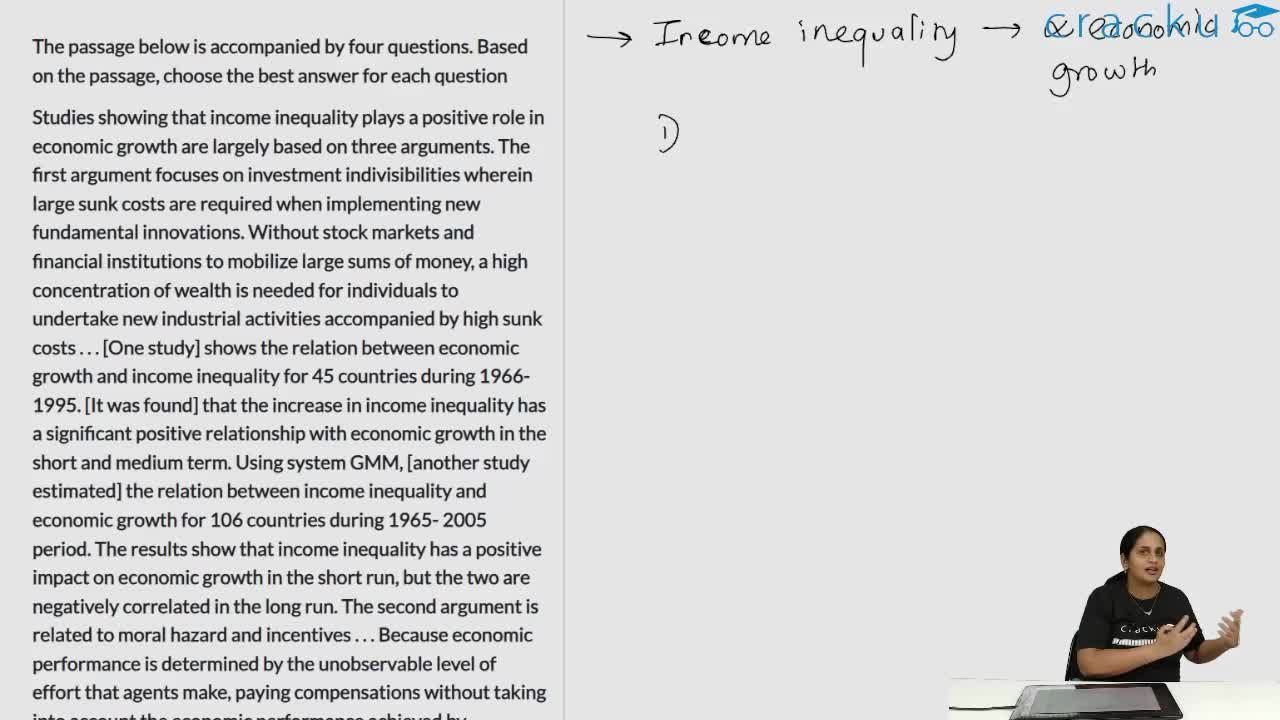
Studies showing that income inequality plays a positive role in economic growth are largely based on three arguments. The first argument focuses on investment indivisibilities wherein large sunk costs are required when implementing new fundamental innovations. Without stock markets and financial institutions to mobilize large sums of money, a high concentration of wealth is needed for individuals to undertake new industrial activities accompanied by high sunk costs . . . [One study] shows the relation between economic growth and income inequality for 45 countries during 1966-1995. [It was found] that the increase in income inequality has a significant positive relationship with economic growth in the short and medium term. Using system GMM, [another study estimated] the relation between income inequality and economic growth for 106 countries during 1965- 2005 period. The results show that income inequality has a positive impact on economic growth in the short run, but the two are negatively correlated in the long run. The second argument is related to moral hazard and incentives . . . Because economic performance is determined by the unobservable level of effort that agents make, paying compensations without taking into account the economic performance achieved by individual agents will fail to elicit optimum effort from the agents. Thus, certain income inequalities contribute to growth by enhancing worker motivation . . . and by giving motivation to innovators and entrepreneurs . . . Finally, [another study] point[s] out that the concentration of wealth or stock ownership in relation to corporate governance contributes to growth. If stock ownership is distributed and owned by a large number of shareholders, it is not easy to make quick decisions due to the conflicting interests among shareholders, and this may also cause a free-rider problem in terms of monitoring and supervising managers and workers. . . .
Various studies have examined the relationships between income inequality and economic growth, and most of these assert that a negative correlation exists between the two. . . . Analyzing 159 countries for 1980-2012, they conclude that there exists a negative relation between income inequality and economic growth; when the income share of the richest 20% of population increases by 1%, the GDP decreases by 0.08%, whereas when the income share of the poorest 20% of population increases by 1%, the GDP increases by 0.38%. Some studies find that inequality has a negative impact on growth due to poor human capital accumulation and low fertility rates . . . while [others] point out that inequality creates political instability, resulting in lower investment. . . . [Some economists] argue that widening income inequality has a negative impact on economic growth because it negatively affects social consensus or social capital formation. One important research topic is the correlation between democratization and income redistribution. [Some scholars] explain that social pressure for income redistribution rises as income inequality increases in a democratic society. In other words, when democratization extends suffrage to a wider class of people, the increased political power of low- and middle-income voters results in broader support for income redistribution and social welfare expansion. However . . . if the rich have more political influence than the poor, the democratic system actually worsens income inequality rather than improving it.
The passage presents an overview of different views on how income inequality relates to economic growth. The passage begins by explaining three ways inequality might help growth: investment indivisibilities, incentive effects, and concentrated corporate governance, which are backed by evidence, though there are signs this may change in the long run. The passage then moves on to discuss evidence from different countries and reasons why inequality could hurt growth over time [such as weaker human capital, etc.] Among the options, Option D best reflects both the possible benefits and the time-related caution in the passage.
The other options either exaggerate the claim or capture only a part of the argument. Option A focuses only on the difference between short- and long-term effects, which is just one part of the passage, not the main point. Option B is inaccurate because it says the passage only looks at certain channels and ignores opposing evidence, but the passage actually covers both sides. Option C is also misleading because it claims the author argues that inequality speeds up growth, when the passage really just presents different findings in a neutral way. The correct answer is therefore option D.
Click on the Email ☝️ to Watch the Video Solution
Create a FREE account and get:
Book Free CAT Mentorship
Get personalized CAT strategy from a 99%iler
500+ students mentored
OTP Verification
Enter the 6-digit code sent to your phone
Booking Summary
Enter OTP
Didn't receive the OTP?

Educational materials for CAT preparation

Ask our AI anything

AI can make mistakes. Please verify important information.
AI can make mistakes. Please verify important information.
 91- 6303239042