Sign in
Please select an account to continue using cracku.in
↓ →
 CAT WhatsApp Group
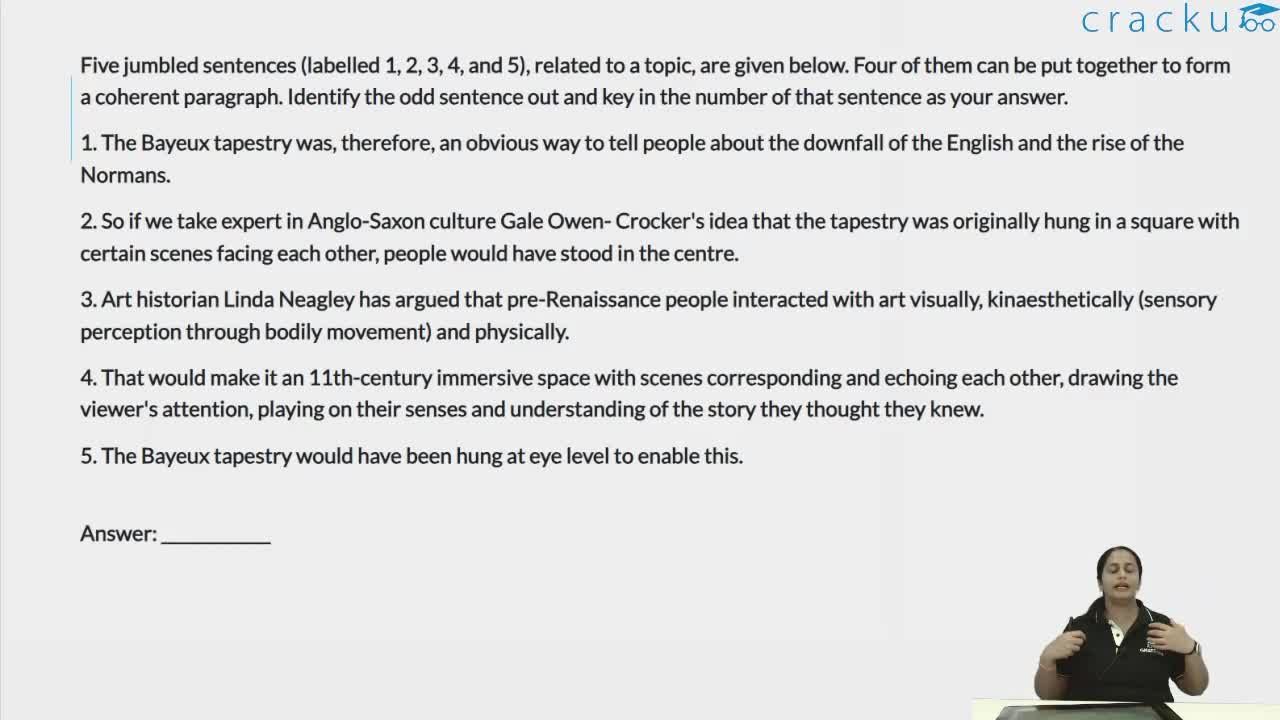
Five jumbled sentences (labelled 1, 2, 3, 4, and 5), related to a topic, are given below. Four of them can be put together to form a coherent paragraph. Identify the odd sentence out and key in the number of that sentence as your answer.
1. The Bayeux tapestry was, therefore, an obvious way to tell people about the downfall of the English and the rise of the Normans.
2. So if we take expert in Anglo-Saxon culture Gale Owen- Crocker's idea that the tapestry was originally hung in a square with certain scenes facing each other, people would have stood in the centre.
3. Art historian Linda Neagley has argued that pre-Renaissance people interacted with art visually, kinaesthetically (sensory perception through bodily movement) and physically.
4. That would make it an 11th-century immersive space with scenes corresponding and echoing each other, drawing the viewer's attention, playing on their senses and understanding of the story they thought they knew.
5. The Bayeux tapestry would have been hung at eye level to enable this.
Correct Answer: 1

The sentences focus on one main idea: how people may have originally seen and experienced the Bayeux Tapestry, especially through physical immersion and interaction with art before the Renaissance. Most of the sentences work together to explain a scholarly argument about how the tapestry was arranged in space and how viewers engaged with it through their senses.
Sentences 3, 2, 5, and 4 are closely connected. Sentence 3 introduces Linda Neagley’s idea that people before the Renaissance interacted with art not just by looking, but also through physical movement and touch. Sentence 2 uses this idea to suggest, based on Gale Owen-Crocker, that the Bayeux Tapestry may have been hung in a square, with viewers standing in the middle. Sentence 5 adds a practical detail, saying the tapestry was likely hung at eye level to support this kind of viewing. Sentence 4 then explains that this setup would create an immersive space like in the 11th century, where scenes reflect each other and shape how viewers experience the story through their senses.
Sentence 1, on the other hand, is different from the rest. It makes a historical point, saying the tapestry was an “obvious way to tell people about the downfall of the English and the rise of the Normans.” This sentence, unlike the rest, does not connect logically with the discussion of display arrangement and sensory engagement developed in the other sentences. It introduces a different line of thought and therefore does not fit the coherent paragraph formed by the remaining four. Therefore, sentence 1 is the odd sentence out.
Click on the Email ☝️ to Watch the Video Solution
Create a FREE account and get:
Book Free CAT Mentorship
Get personalized CAT strategy from a 99%iler
500+ students mentored
OTP Verification
Enter the 6-digit code sent to your phone
Booking Summary
Enter OTP
Didn't receive the OTP?

Educational materials for CAT preparation

Ask our AI anything

AI can make mistakes. Please verify important information.
AI can make mistakes. Please verify important information.
 91- 6303239042