91- 6303239042
“On a wing and a prayer the Indian team landed in Heathrow to take on their formidable opponents”. From the above sentence it can be inferred that the Indian team was
Sign in
Please select an account to continue using cracku.in
↓ →
“On a wing and a prayer the Indian team landed in Heathrow to take on their formidable opponents”. From the above sentence it can be inferred that the Indian team was
The phrase "On a wing and a prayer" means to do something without preparation and hoping to succeed. From the sentence it can be inferred that the Indian team was under prepared and hoping to succeed.
Hence, the correct answer is Option D
It _____________ not look like a great deal today, but back then it was a coup: no man before ___________ to import tea directly into Ireland. The option that will best fill the blanks in the
above sentences would be:
Loading solution...
“It was AC Milan’s success in Europe in the sixties that introduced the ‘libero’ as the Italian default and, a quarter of a century later, it was AC Milan’s success in Europe that killed it off.” Which of the following was not implied in the above sentence?
Loading solution...

Choose the odd one:
Loading solution...
The 2001 census showed a sharp decline in the literacy rate compared to 1991, but the 2006 literacy rate increase suggests that India progressed in literacy between 1991 and 2006.
Which of the following statements, if true, best refutes the above argument?
Loading solution...
Ravindra Dubey was guilty of embezzlement. It means that Ravindra Dubey
Loading solution...
.webp)
Read the sentences and choose the option that best arrange them in a logical order.
A. Some of these are tangible while others are not.
B. The micro factors look at brand building, product development, competition, pricing, decision making within organizations etc.
C. Another way to classify these factors is to distinguish which of them are macro in nature and which of them are micro.
D. The macro factors comprise government policies, state of the economy, changing demographics etc.
E.The factors influencing forecasts include social, technological, economic, political, religious, ethnic, governmental, and natural factors.
Loading solution...
Read the following passage and provide appropriate answers for the questions
There is an essential and irreducible ‘duality’ in the normative conceptualization of an individual person. We can see the person in terms of his or her ‘agency’, recognizing and respecting his or her ability to form goals, commitments, values, etc., and we can also see the person in terms of his or her ‘well-being’. This dichotomy is lost in a model of exclusively self- interested motivation, in which a person’s agency must be entirely geared to his or her own well-being. But once that straitjacket of self-interested motivation is removed, it becomes possible to recognize the indisputable fact that the person’s agency can well be geared to considerations not covered - or at least not fully covered - by his or her own well-being. Agency may be seen as important (not just instrumentally for the pursuit of well-being, but also intrinsically), but that still leaves open the question as to how that agency is to be evaluated and appraised. Even though the use of one’s agency is a matter for oneself to judge, the need for careful assessment of aims, objective, allegiances, etc., and the conception of the good, may be important and exacting. To recognize the distinction between the ‘agency aspect’ and the ‘well-being aspect’ of a person does not require us to take the view that the person’s success as an agent must be independent, or completely separable from, his or her success in terms of well-being. A person may well feel happier and better off as a result of achieving what he or she wanted to achieve - perhaps for his or her family, or community, or class, or party, or some other cause. Also it is quite possible that a person’s well-being will go down as a result of frustration if there is some failure to achieve what he or she wanted to achieve as an agent, even though those achievements are not directly concerned with his or her well-being. There is really no sound basis for demanding that the agency aspect and the well-being aspect of a person should be independent of each other, and it is, I suppose, even possible that every change in one will affect the other as well. However, the point at issue is not the plausibility of their independence, but the sustainability and relevance of the distinction. The fact that two variables may be so related that one cannot change without the other, does not imply that they are the same variable, or that they will have the same values, or that the value of one can be obtained from the other on basis of some simple transformation. The importance of an agency achievement does not rest entirely on the enhancement of well-being that it may indirectly cause. The agency achievement and well-being achievement, both of which have some distinct importance, may be casually linked with each other, but this fact does not compromise the specific importance of either. In so far as utility - based welfare calculations concentrate only on the well- being of the person, ignoring the agency aspect, or actually fails to distinguish between the agency aspect and well-being aspect altogether, something of real importance is lost.
According to the ideas in the passage, the following are not true expect:
Loading solution...
In the case of Japan, there is a strong empirical evidence to suggest that systematic departure
from self-interested behavior, in the direction of duty, loyalty and goodwill have played a substantial part in industrial success.Which of the following in closest to the ideas presented in the passage?
Loading solution...

Of the options presented below, which one is the best example for the ideas propounded in the passage?
Loading solution...
Read the sentences given below and choose the option that is best in accordance with the ideas in the passage.
I.There is a need to distinguish between the agency aspect and the well-being aspect of a person.
II.A person can be conceptualized in terms of either agency or well-being.
III.A person is important, not just instrumentally, for the pursuit of well-being
Loading solution...
The idea of agency, as used in the passage, is implied in all the options given below, except:
Loading solution...

Which of the following sentences is grammatically incorrect?
Loading solution...
Alfredo, Diego and Lionel are discussing Argentinean football.
Alfredo: Argentina was a football powerhouse.
Diego: Argentina is a football powerhouse.
Lionel: Argentina will be a football powerhouse.
Which of the following cannot be inferred from the above conversation?
Loading solution...
Choose the grammatically correct sentence from the options given below.
Loading solution...

Ethologists, people who study animal behavior, have traditionally divided an organism’s actions into two categories: learned behavior (based on experience) and instinctive behavior (based on genotype). Some current scholars reject this distinction, claiming that all behavior is a predictable interaction of experience and genotype.
Which of the following, if true, most strengthens the arguments made in the sentence above?
Loading solution...
The benefits of psychotherapy result not only from the advice the therapist gives but also from the supportive relationship offered to the patient. Even though this relationship may cost large amounts of money over many years, most patients interpret the therapist’s concern for them as genuine and identify this caring relationship as the primary factor in improving their mental health. However, recent studies have found that only eight percent of therapist/patient relationships continue after the patient terminates formal paid visits.
Which of the following is in accordance with the ideas contained in the passage? Choose the best option.
Loading solution...
Most of the Asian countries have trade-deficit with China. Bangladesh’s trade deficit with China this year has increased by 35%. Despite large increases in exports to China, Indonesia’s trade deficit with China continues to increase. So does that of South Korea, home of Samsung Electronics, one of the world’s largest manufacturers of electronic gadgets.
Which of the following, if true, would be most inconsistent with the above passage?
Loading solution...

All who studied commerce enjoy sports. No tax consultant enjoys sports. All those who enjoy sports love classical music.
If the above sentences are true, which of the following also must be true?
Loading solution...
The head ___________ was annoyed to see a _________ in the soup.
The option that would best fill the blanks in the above sentence would be:
Loading solution...
Which word is the opposite of the word
‘hypothesize’?
Loading solution...

Read the sentences and choose the option that best arranges them in a logical order.
A. In fact, it is considered as a dumping ground for unwanted people in quite a few organizations.
B. In many parts of the country, traditional castes such as Kothari, Kotwal, Bhandari and Bhandarkar have for generations been dealing in procuring, stocking, distributing goods and merchandise.
C. This is due to the fact that Indian traders have been trading with many parts of the world.
D. However, though the concept of warehousing has been prevalent for over 2000 years, the warehouse has not yet obtained due recognition in modern times.
E. The concept of warehousing or stores function is not new in India.
Loading solution...
Concurrence means all of the following except:
Loading solution...
Read the sentences and choose the option that best arranges them in a logical order.
i. All it has to do is to drive up the inflation rate-examples are the damage Lyndon Johnson’s inflationary policies did to the US economy and the damage which consistently pro-inflationary policies have done to the economy of Italy.
ii.It is easy, the record shows, for a government to do harm to its domestic economy.
iii.Contrary to what economists confidently promised forty years ago, business cycles have not been abolished.
iv.They still operate pretty much the way they have been operating for the past 150 years
v.But there is not the slightest evidence that any government policy to stimulate the economy has impact, whether that policy be Keynesian, monetarist, supply - side or neoclassical.
Loading solution...

When income tax rates are reduced, there is an increase in taxable income, and an increase in
taxable income results in increased total income tax revenues for the government. Which of the following is analogues to the argument above in terms of its logical features?
Loading solution...
Not wanting to present an unwanted optimistic picture in the board meeting, the CEO estimated the sales growth _____________.
The option that will best fill the blank in the above sentence would be:
Loading solution...
Read the following passage and provide appropriate answers for the questions
The idea of demarcating certain areas within the country as special economic zones to promote investment and growth is not new. A large country unable to provide the kind of facilities and environment that can attract foreign investment throughout the country often finds it feasible and attractive to carve up some of its areas where such facilities can be provided. The laws and procedures for setting up new industries are waived to make the area business-friendly with developed infrastructure and a one-window interaction with government. In addition, huge tax benefits are promised to lure investors. China’s experience shows that if chalked out and implemented with care such a policy can accelerate the flow of capital and technology from abroad and thereby speed up growth.
However, SEZs may not be the best option in all situations to clear the bottlenecks in growth.
India’s experience with export processing zones (EPZs) bears this out. They have failed in India for the simple reason that the factors that made the SEZs successful in China have been absent here. In India, as in China, EPZs were thought of as a way of providing an escape route from the stranglehold of control that prevailed over the Indian economy. But even while promising to ease the rigours of controls, Indian policy-makers could not give up their penchant for micromanaging from the centre and undoing the promised relaxations with all kinds of qualifications and “guidelines”.
Over last two decades India has evolved into a market economy and much of governmental control has disappeared, but the flow of foreign direct investment has not reached anywhere near the levels of China. Besides, infrastructure building has fallen far short of what is required. Even after three years of the enactment of the Electricity Act (2003), private investment in electricity generation is still a trickle with the states refusing to give up the monopoly of their electricity boards in the matter of purchase of the power generated. While swearing by growth, governments at both the centre and the states cite the fiscal responsibility laws to plead their helplessness in making the required investments to improve infrastructure.
Given the situation, the SEZs have apparently been thought of as a simple way out. In its enthusiasm for SEZs the commerce ministry forgot two critical lessons of the Chinese experience, viz., that an SEZ must be of an adequate size to provide opportunities for reaping the benefits of large-scale operations and their number should be few. Every industry or economic activity worth its name is now seeking SEZ status. Proposals are now being floated to invite foreign educational institutions to come to India with promises of SEZ treatment! The finance ministry apprehends a loss of nearly 1,75,000 crore in direct taxes, customs duties and excise duties over the next five years.
The objective of the author in writing the above passage seems to be to
Loading solution...

The author’s arguments suggest the following conclusions, except
Loading solution...
The author does not oppose
Loading solution...
The passage was most likely written in the year:
Loading solution...
Read the following passage and provide appropriate answers for the questions
This is one of the unanswered questions that I want to explore. I believe that this is certainly one of the
deeper questions about technology. Why do I say so? Without evolution technologies seem to be born
independently and improve independently. Each must come from some unexplained mental process,
some form of creativity or thinking outside the box that brings it into existence and separately develops
it. With evolution, new technologies would be birthed in some precise way from previous ones, albeit with considerable mid-wifing, and develop though some understood process of adaptation. In other words, if
we could understand evolution, we could understand the most precious of processes: innovation. But, let
me define evolution before I proceed further. The word evolution has two general meanings. One is the
gradual development of something, as with the evolution of ballet or the English madrigal. The other
is the process by which all objects of some class are related by ties of common descent from the collection of earlier objects. The latter is what I mean by evolution.
Which of the following can be inferred from the passage?
I. The author’s main concern is to develop a theory of innovation.
II. The author is interested in putting forth a theory of technological evolution.
III. The author believes before developing a theory of technological evolution, one needs to investigate whether technology evolves at all.
IV. Evolution, as the author puts it, is a sense of common relatedness.
Loading solution...
I. In 1867, S. Colum Gilfillan, a sociologist traced the evolution of ships from the dugout canoe to the modern steamship of the day.
II. Many theories propose the existence of a technology in many forms. From these variations, some perform better and are selected for further use and development.
III. Till date the people who have thought hardest about the general questions of technology have only been social scientists. They have viewed technology from the outside as stand-alone objects without studying earlier technologies.
IV. Some technologies, for example, the laser, the jet engine, the radar, the quick sort algorithm and the locomotive just appear, or at least they seem to just appear unlike novel biological species which are versions of earlier objects.
V. Radar descends from radio but you can vary 1930s radio circuits as radically you like but you will never get radar. Radar requires a different principle.
Assuming the above statements are true, which option would most strengthen the author’s premise that the question that he has identified has not been solved as yet?
Loading solution...
on the basis of the following letter.
To the Chairman:
Dear Mr. Sailesh,
At the December 3, 2011 meeting, it was decided that no two officers would hold positions on the same committee. It has recently come to my attention that both Chaitanya Rao and Ajit Singh will be serving in
some capacity on the Cultural Committee, and both have been nominated for officer status. As you know,
this is in direct disregard for the rules as voted by the Members Council last December 3, 2011. I would
hope that sufficient action be taken by the Disciplinary Committee (on which committee both of the above are members) so that this problem will be remedied.
Sincerely,
Arvind Singh
Which of the following is an essential flaw that the writer of the letter overlooked?
Loading solution...
If both the nominations are confirmed, which of the following exhaustively and reasonably, describes actions that may occur in the near future?
Loading solution...
on the basis of the information given in the following case.
Due to increased competition, Ginger Automobiles, the Indian subsidiary of Pepper Automobile Company (PAC) reported lower sales and profits. PAC expects its new model Limo, developed especially for value conscious customers of India and China, would revive its fortunes. In order to prevent customers from uying competing products, PAC announced the launch of Limo six months before schedule. Due to unrest in its Indian supplier’s plant, deliveries of essential components for its main plant was hampered, and hence it decided to launch Limo in China only as per the original plan. Within a short span of time, Limo captured 30% market share in China, which was 200% higher than expected. Indian customers who had looked forward to purchasing Limo were becoming increasingly unhappy to the non-availability of Limo in India. Ginger’s dealers were worried about loss of business from the customers who might switch to other cars.
Statement I: In the Chinese market, Baft, and Hebe, are competing models in Limo’s target
market. Due to increase in sales of Limo by 200%, Baft and Hebe saw their market share decline by 10%.
Statement II: Baft and Hebe were not desired by the customers due to their new features.
Which of the following conclusions can be most justifiably made?
Loading solution...
Unhappy customers will not only leave the company, but also spread negative publicity about the company. The best way, among the options below, to deal with customers is
Loading solution...
Mr. Murugan from Chennai experienced the comfort of Limo during his visit to China. He was willing to deposit an approximate price of Limo to buy the first available unit from Mr. Ahmed, a dealer in Chennai, known for fair dealing. Ginger Automobile is yet to announce the actual price, and the process for allocation of the vehicles. In order to maximise his cash flow, Mr. Ahmed should
Loading solution...
On the basis of the information given in the following case.
Tina a blast furnace expert, who works as a technology trouble-shooter stays in Jamshedpur. She has got an important assignment in Delhi, which requires six hours to complete. The work is so critical that she has to start working the moment she reaches the client’s premises. She is considering various options for her onward and return journey between Jamshedpur to Delhi.A quick search revealed that ticket from Jamshedpur to Delhi is available in two trains. Trains 12801 and 12443 depart from Jamshedpur station at 06:45 hrs and 15.55 hrs and reach Delhi next day at 04:50 hrs and 10:35 hrs respectively. Trains 12444 and 12802 start from Delhi at 17:20 hrs and 22:20 hrs and reach Jamshedpur next day at 10:35 hrs and 20:05 hrs respectively. Another option is to reach Ranchi by a three hour road trip and take a flight to Delhi from Ranchi. The distance between Ranchi and Delhi is covered in 105 minutes both-ways by any of the scheduled flights. Air India operates two flights, AI 9810 and AI 810, which depart Ranchi at 8:00 hrs and 15:25 hrs respectively. Flight number IT-3348 operated by Kingfisher Airlines departs Ranchi at 19:20 hrs. Return flights operated by Air India, AI 9809 and AI 809, depart Delhi at 5:50 hrs and 11:00 hrs respectively. Flight number IT-3347 operated by Kingfisher Airlines departs Delhi at 17:10 hrs.From Tina’s home Jamshedpur railway station is five minutes drive, and her destination at Delhi is 90 minutes and 30 minutes drive from airport and railway station respectively. One has to reach the airport at least one hour before the scheduled departure to complete the boarding procedure. At every railway station she loses five minutes in navigating through the crowd.
If Tina wants to minimize the total time out of Jamshedpur, the best option for her, from the options given below, is:
Loading solution...
Tina gets a message that her work has to be completed between 9:00 hrs. and 17:00 hrs. If
she wants minimize the total time out of Jamshedpur, the best option, from the options given below, for her among the following is to go by
Loading solution...
Tina has to appear for an exam on 8 th of January in Jamshedpur and she can start from her
residence in Jamshedpur only after 16:00 hrs of the same day. Choose the option, from the options given below, that will help her to minimize the total time out of Jamshedpur.
Loading solution...
If Tina decides to minimize the in-between waiting period, the option that she should choose from the options given below, will be:
Loading solution...
on the basis of the information given in the following case.
Teknik Group of industries had businesses in different sectors ranging from manufacturing, construction, fish farming and hotels. These different businesses operated as semi-independent units managed by the unit level managers. Teknik’s management had an internal consultancy group called as Business Advisory Group (known internally as BAG). The 15 experts in BAG were hired personally by Mr. Teknikwala, the owner of Teknik, who wanted this core group of experts to help his organization grow fast without facing the typical growth hurdles. Most of them were specialists in fields like law, information technology, human resource management, and operations management. Almost all of them had experience spanning decades in the industry. Whenever any of the units faced any significant all units and it represented an extra work for those who were involved. This coordination was required to understand the different work processes and the users’ requirements. This coordination activity was being extensively managed by the old timers as they were familiar with internal processes and people in the different units. An external consultant was also hired for customization and implementation After two months, BAG teams had to fortnightly present their progress to Ms. Teknikwali’s team. In the last meeting Ms. Teknikwali was dissatisfied. She explained her thinking that since ERP impacted every aspect of the business, the roll out had to be done faster. She wanted Mr. Shiv to get the implementation completed ahead of schedule. In the meeting she asked Mr. Shiv to get the people in IT team to be more productive. Not willing to disagree, Mr. Shiv committed to a roll-out schedule of complete ERP system in 6 months instead of earlier decided 14 months. Next day, Mr. Shiv presented the revised project milestone to BAG members. He told them that in order to meet the deadline, the members were expected to work on week-ends till the completion of the project. Along with that, they were also expected to maintain their earlier standards of delivery time and quality for the normal trouble-shooting and internal advisory work. Mr. Shiv also pointed out that anyone whose performance did not meet the expectations would be subjected to formal disciplinary action. The meeting ended without any member commenting on Shiv’s ideas, although Mr. Shiv heard a lot of mumbling in the corridor. Over the week, Shiv noticed that the members seemed to avoid him and he had to make extra effort to get ideas from them. After a fortnight Shiv reviewed the attendance register and found the Mr. Lal, an old time member, had not come during the week-ends and certain decisions were held up due to lack of inputs from Mr. Lal. Mr. Shiv issued a written reprimand to Mr. Lal. He was speechless on receiving the reprimand but kept silent. It has been three days since that incident. Some of the senior members had put in request for transfer to other business units. It was rumoured that four problems, the unit level managers would put up a request for help to BAG. The problems ranged from installation of internal MIS systems, to financial advice related to leasing of equipment, to handling of employee grievances. Over a period of 20 years, Teknik’s revenues grew from 100 crore 10,000 crore with guidance of BAG and due to Mr. Tekinwala’s vision. Given its reputation in the industry, many people wanted to start their careers in BAG. Often young MBAs fresh out of business schools would apply. However their applications used to be rejected by Mr. Teknikwala, who had a preference for people with extensive industry experience. Things changed after the unfortunate demise of Mr. Teknikwala. His daughter Miss. Teknikwali took up the family business. She was an MBA from one of the premier business schools, and was working in a different company when Mr. Tekinwala passed away. She preferred that BAG developed new ideas and therefore inducted freshly graduated MBAs from premier business schools. She personally supervised the recruitment and selection process. Now the entire group constituted of 50 specialists, out of which 35 were the old time members. She also changed the reporting relationships in the BAG group with some of the older members being made to report to the new members. In IT team, Mr. Shiv, a newly recruited MBA, was made in-charge. For the older members it was a shock. However, as most of them were on the verge of retirement, and it would be challenging to search for new jobs while competing with younger professionals, they decided to play along. After one month, all business units were caught up in the ERP fever. This was an idea pushed by Ms. Teknikwali who the need the need to replace the old legacy systems with latest ERP system integrating all the units of Teknik. This was heavily influenced by her experience in the previous where an ERP system was already up and running. Therefore she was not aware of the difference between installing an ERP system and working on an already installed one. The ERP mplementation in Teknik Group required extensive coordination with senior level managers of senior legal experts had agreed to an offer from a law firm. Other senior members would sporadically come in late to work, citing health reasons. Almost all senior members now wanted a weekly work-routine to be prepared and given to them in advance so that they could deliver as per the schedule. This insistence on written communication was a problem as urgent problems or ad-hoc requests could not be foreseen and included. Also normal services to other business units were being unattended to, and there were complaints coming from the unit heads.
Which of the following could have been a better response of Mr. Shiv to Ms. Teknikwali’s request
to re-schedule the ERP implementation?
Loading solution...
Which of the following can be identified as the immediate cause for the problems in BAG?
Loading solution...
How should Mr. Shiv cope with the situation now? Choose the best option, considering Mr. Shiv’s career would be at stake if the ERP project fails, and assuming that for carrying out the options, he has the necessary authority to do so.
Loading solution...
Of all the problems being faced in BAG, which of the following is neither discussed nor hinted at?
Loading solution...
After her father’s demise, the best way Ms. Teknikwali could have gone about dealing with BAG group would have been to:
Loading solution...
It can be inferred from the above case that implementation of an ERP package in an organization requires creation of a team that has:
Loading solution...
on the basis of the information given in the following case.
Vivekananda Memorial Elocution Competition (VMEC) in Viswavijay Public School (VPS) has a history of forty years. Apart from the founder’s day and annual day celebrations, it is the most important event of the school.
In recent times, due to the increased popularity of reality shows on television channels, and for various other reasons, the elocution competition lost its appeal. Interest of both students and parents has been eroding over a period of time. To ensure sufficient audience, Mr. Ivan, Head of English Department, introduced choral recitation for junior section as a part of elocution competition. Three classes, each consisting of forty students, get short- listed for the final performance of choral singing on the day of VMEC. Most of the parents and family members of these students attend the function to encourage them. This initiative increased the number of people attending the elocution competition. Some teachers are unhappy with the emphasis given on the elocution competition, since they are expected to be present at the school on the day of competition,
which normally happens on a weekend to accommodate the working parents. The teachers were not granted leave on the day of VMEC and they used to be unhappy regarding this aspect.
Ms Shabina, the principal of VPS, is aware that some of her teachers are unhappy. She wants to
be seen as fair and just. Which option is the best one that she should exercise?
Loading solution...
A group of unhappy teachers have come up with a list of action plans for the consideration of their
colleagues. The action plans are listed below.
I. Exposing Mr. Ivan’s intentions behind the inclusion of choral recitation.
II. Conduct an open house discussion to gauge the unhappiness and to identify possible solutions.
III. Introduce music and dance competition in same format as elocution competition
IV. Demand compensation for their work on the day of VMEC.
Mr. Zacharia, one of the senior teachers and a well wisher of VPS, is asked to go through the action plans and make recommendations that benefits VPS the most. He would recommend:
Loading solution...
Answer the questions on the basis of the information given in the following case.
Dev Anand, CEO of a construction company, recently escaped a potentially fatal accident. Dev had failed to notice a red light while driving his car and attending to his phone calls. His well-wishers advised him to get
a suitable replacement for the previous driver Ram Singh, who had resigned three months back. Ram Singh was not just a driver, but also a trusted lieutenant for Dev Anand for the last five years. Ram
used to interact with other drivers and gathered critical information that helped Dev in successfully bidding for different contracts. His inputs also helped Dev to identify some dishonest employees, and to
retain crucial employees who were considering attractive offers from his competitors. Some of the senior employees did not like the informal influence of Ram and made it difficult for him to continue in the
firm. Dev provided him an alternative job with one of his relatives. During the last three months Dev has considered different candidates for the post. The backgrounds of the candidates are given in the table below.
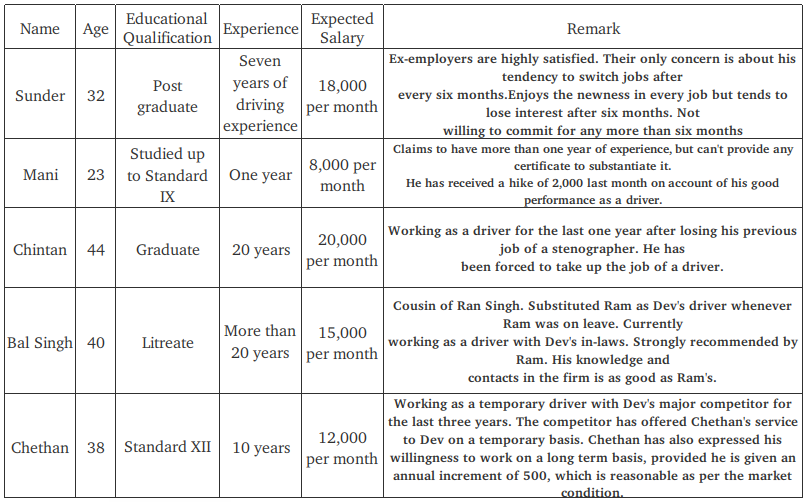
Dev is primarily looking for a stable and trustworthy driver, who can be a suitable replacement for Ram. His family members do not want Dev to appoint a young driver, as most of them are inexperienced. Dev’s driver is an employee of the firm and hence the appointment has to be routed through the HR manager of the firm. The HR manager prefers to maintain parity among all employees of the firm. He also needs to ensure that the selection of a new driver does not lead to discontent among the senior employees of the firm.
From his perspective, and taking into account the family’s concerns, Mr. Dev would like to have
Loading solution...
In order to resolve the conflicting preferences, one of Dev’s friends suggested Dev, his family members and the HR manager to identify their most and the least preferred candidates without considering the concerns of other stakeholders.
I. Dev’s most and least preferred candidates: Bal Singh and Chetan respectively
II. Family members’ most and least preferred candidates: Bal Singh and Chintan respectively
III. HR manager’s most and least preferred candidates: Chethan and Bal Singh respectively
Which of the above three statements is/are in conformity with the information provided in the passage?
Loading solution...
Who among the following five candidates is most likely to be rejected by the GM (HR)?
Loading solution...
based on the case given below.
Ethical – a person is called unethical, when he deviates from principles. The principles and their use is often guided by two definitions: Moral: society’s code for individual survival Ethics: An individual’s code for society survival Naresh was a small time civil contractor in a small city. His major clients were the residents who wanted ad-hoc work like painting, building extensions to be done. His just prices had made him a preferred contractor for most of the clients who preferred him over other civil contractors. Always he followed the principle that client had to be kept happy – only by doing so it would be a win-win situation for both. However due to the unpredictability of such orders from residents, Naresh used to be idle for substantial part of the year. As a consequence, he could not expand his business. His two children were growing up and his existing business could not support their expenses. The medical expense of his elderly parents was another drain on his resources. The constant rise of prices in medical care and medicines was another issue. For Naresh, family’s concern was predominant. Naresh was, therefore, under pressure to expand his business. He was the sole earning member of his family, and he had to ensure their well being. He thought that by expanding his business, not only would he be able to care for his family in a better way, as well as offer employment to more number of masons and labourers. That would benefit their families as well. Naresh drew the boundary of his society to include himself, his family members, his employees and their family members. For expansion, the only option in the city was to enlist= as a contractor for government work. Before deciding, he sought advice from another contractor, Srikumar, who had been working on government projects for a long period of time. Srikumar followed the principle of always helping others, because he believed that he would be helped back in return some day. Srikumar had just one advice “The work is given to those who will win the bidding process and at the same time will give the maximum bribe. Prices quoted for work have to include bribes, else the bills will not get cleared and the supervisors will find multiple faults with the execution of work. This ensures survival and prosperity for contractors”. When asked about other contractors, Srikumar said “The government contractors are like a micro-society in themselves, almost like a brotherhood. Within that, they are highly competitive; however towards any external threat they are united to ensure no harm happens to any of their members”.
Naresh decided to work as a government contractor. Following Srikumar’s advice, he
inflated the prices so that he could pay the bribes out the bills received.
Loading solution...
A new supervisor had joined a government department where both Naresh and Srikumar were bidding for work. During the bidding process for a particular project, in an open meeting with all contractors and officers from the department, he produced a document which had the rates at which Naresh had worked for private clients for similar building related work. He accused Naresh and Srikumar of over-pricing for government work and threatened to disqualify them from the bidding process, if the rates are not brought down. Faced with that situation, Naresh gave a written reply that “I use materials of inferior quality for private work, and that is the reason for price difference”. Srikumar supported Naresh in the meeting by saying that he had seen Naresh’s work and he agreed. In this situation, it can be concluded that:
Loading solution...
Lankawala, another contractor, when faced with the new supervisor’s demand to reduce prices for government work, asked him to guarantee that no bribes would be taken, and only then prices would be reduced. This was said in front of everyone. At this the supervisor forced Lankawala out of the meeting and threatened to black-list him. Lankawala did not say anything and walked away. Blacklisting of a contractor by one government department implied that Lankawala would not be able to participate in any government departments’ works. In late evening, the city was abuzz with the news that the supervisor’s dead body was seen on the
railway tracks. In the investigations that followed, no one who attended the meeting recounted the happenings in the meeting to the police. Getting involved in murder cases could lead to unpredictable outcomes such as becoming the potential suspect, or an accessory to the crime. Furthermore, cases could drag on for years, and one would have to appear in court as witnesses in response to court’s summons. This, for a contractor, was a serious threat to his business due to the disruptions created. However, Naresh wanted to speak out but was pressurized by Srikumar and other contractors not to, and as a result he did not. Due to this, the case was closed unresolved with no one found guilty. In this situation, it can be concluded that:
Loading solution...
on the basis of the information given in the following case.
Saral Co. is operating in seven north-eastern states of the country. The organization has a history of participative decision making, wherein people deliberate openly about pros and cons of every important decision, and a broad consensus is taken before taking the final decision. In Saral Co. every employee gets a salary proportional to the sales achieved. A new General Manager (GM) joined during the beginning of this month and challenged the organization’s sole focus on sales to determine salaries. He urged the top management to include two more additional parameters in determining the salaries of the employees, viz. collection of information about competitors and the quality of relationship with the retailers.
Manohar, the highest earning employee for the last three years, vehemently opposes the GM’s
proposal. Which of the following could be most likely reason for him to oppose the proposal?
Loading solution...
The top management of Saral Co. refused to implement the proposal of new GM from the beginning of next month, which of the following could be the most justified reason for the management’s refusal?
Loading solution...
Three Vice Presidents (VP) regularly visit the plant on different days. Due to labour unrest, VP (HR) regularly visits the plant after a gap of 2 days. VP (Operations) regularly visits the plant after a gap of 3 days. VP (Sales) regularly visits the plant after a gap of 5 days. The VPs do not deviate from their individual schedules. CEO of the company meets the VPs when all the three VPs come to the plant together. CEO is on leave from January 5 th to January 28 th , 2012. Last time CEO met the VPs on January 3, 2012. When is the next time CEO will meet all the VPs ?
Loading solution...
Ramesh analysed the monthly salary figures of five vice presidents of his company. All the salary figures are integers. The mean and the median salary figures are 5 lakh, and the only mode is 8 lakh. Which of the options below is the sum (in lakh) of the highest and the lowest salaries?
Loading solution...
based on the following information
The following graphs shows the revenue (in $ million) of three companies in their initial six years of operations, in an economy which is characterized by a persistent inflation.

In 2010, which could be a valid statement about the revenues (adjusted for inflation) of these
three companies?
Loading solution...
The difference in the average percentage increase in revenues, from 4th to 6th year, of Yahoo and Facebook is:
Loading solution...
What would have been Facebook’s revenue (in $ million) in its sixth year of operation if the
company had matched Google’s percentage growth in revenues from the fifth to the sixth year?
Choose the option that is nearest to the answer.
Loading solution...
Tina, Mina, Gina, Lina and Bina are 5 sisters, aged in that order, with Tina being the eldest. Each of them had to carry a bucket of water from a well to their house. Their buckets’ capacities were proportional to their ages. While returning, equal amount of water got splashed out of their buckets. Who lost maximum amount of water as a percentage of the bucket capacity?
Loading solution...
Ram, a farmer, managed to grow shaped- watermelons inside glass cases of different shapes. The shapes he used were: a perfect cube, hemi-spherical, cuboid, cylindrical along with the normal spherical shaped watermelons. Thickness of the skin was same for all the shapes. Each of the glass cases was so designed that the total volume and the weight of the all the water- melons would be equal irrespective of the shape.
A customer wants to but water-melons for making juice, for which the skin of the water- melon has to be peeled off, and therefore is a waste. Which shape should the customer buy?
Loading solution...
A man borrows 6000 at 5% interest, on reducing balance, at the start of the year. If he repays 1200 at the end of each year, find the amount of loan outstanding, in , at the beginning of the third year.
Loading solution...
A spherical metal of radius 10 cm is molten and made into 1000 smaller spheres of equal sizes. In this process the surface area of the metal is increased by:
Loading solution...
Gopal sells fruit juice mixture using orange juice and pineapple juice. Gopal prepares this mixture by drawing out a jug of orange juice from a 10 litre container filled with orange juice, and replacing it with pineapple juice. If Gopal draws out another jug of the resultant mixture and replaces it with pineapple juice, the container will have equal volumes of orange juice and pineapple juice. The volume of the jug in litres, is
Loading solution...
Nikhil’s mother asks him to buy 100 pieces of sweets worth 100/-. The sweet shop has 3 kinds of sweets, kajubarfi, gulabjamun and sandesh. Kajubarfi costs 10/- per piece, gulabjamun costs 3/- per piece and sandesh costs 50 paise per piece. If Nikhil decides to buy at least one sweet of each type, how many gulabjamuns should he buy?
Loading solution...
A potter asked his two sons to sell some pots in the market. The amount received for each pot was same as the number of pots sold. The two brothers spent the entire amount on some packets of potato chips and one packet of banana chips. One brother had the packet of banana chips along with some packets of potato chips, while the other brother just had potato chips. Each packet of potato chips costs 10/- and the packet of banana chips costs less than 10/-. The packets of chips were divided between the two brothers so each brother received equal number of packets. How much money should one brother give to the other to make the division financially equitable?
Loading solution...
A city has a park shaped as a right angled triangle. The length of the longest side of this park is 80 m. The Mayor of the city wants to construct three paths from the corner point opposite to the longest side such that these three paths divide the longest side into four equal segments. Determine the sum of the squares of the lengths of the three paths.
Loading solution...
Answer question based on the following information.
Ramya, based in Shanpur, took her car for a 400 km trip to Rampur. She maintained a log of the odometer readings and the amount of petrol she purchased at different petrol pumps at different prices (given below). Her car already had 10 litres of petrol at the start of the journey, and she first purchased petrol at the start of the journey, as given in table below, and she had 5 litres remaining at the end of the journey.

What has been the mileage (in kilometers per litre) of her car over the entire trip?
Loading solution...
Her car’s tank-capacity is 35 litres. Petrol costs 45/- litre in Rampur. What is the minimum
amount of money she would need for purchasing petrol for the return trip from Rampur to Shanpur, using the same route? Assume that the mileage of the car remains unchanged throughout the route, and she did not use her car to travel around in Rampur.
Loading solution...
A medical practitioner has created different potencies of a commonly used medicine by dissolving tables in water and using the resultant solution. Potency 1 solution: When 1 tablet is dissolved in 50
ml, the entire 50 ml is equivalent to one dose. Potency 2 solution: When 2 tablets are dissolved in
50 ml, the entire 50 ml of this solution is equivalent to 2 doses, ... and so on. This way he can give fractions of tablets based on the intensity of infection and the age of the patient. For particular patient, he administers 10 ml of potency 1, 15 ml of potency 2 and 30 ml of potency 4. The dosage administered to the patient is equivalent to
Loading solution...
Ram prepares solutions of alcohol in water according to customers’ needs. This morning Ram has prepared 27 litres of a 12% alcohol solution and kept it ready in a 27 litre delivery container to be shipped to the customer. Just before delivery, he finds out that the customer had asked for 27 litres of 21% alcohol solution. To prepare what the customer wants, Ram replaces a portion of 12% solution by 39% solution. How many litres of 12% solution are replaced?
Loading solution...
City Bus Corporation runs two buses from terminus A to terminus B,one from each of the terminuses such that each bus makes 5 round trips in a day. There are no stops in between. These buses ply back and forth on the same route at different but uniform speeds. Each morning the buses start at 7 AM from the respective terminuses. They meet for the first time at a distance of 7 km from terminus A. Their next meeting is at a distance of 4 km from terminus B, while travelling in opposite directions. Assuming that the time taken by the buses at the terminuses is negligibly small, and the cost of running a bus is 20 per km, find the daily cost of running the buses (in )
Loading solution...
Shyam, a fertilizer salesman, sells directly to farmers. He visits two villages A and B. Shyam starts from A, and travels 50 meters to the East, then 50 meters North-East at exactly 45° to his earlier direction, and then another 50 meters East to reach village B. If the shortest distance between villages A and B is in the form of $$a\sqrt{b+\sqrt{c}}$$ meters, Find the value of a+b+c.
Loading solution...
Three truck drivers, Amar, Akbar and Anthony stop at a road side eating joint. Amar orders 10
rotis, 4 plates of tadka, and a cup of tea. Akbar orders 7 rotis, 3 plates of tadka, and a cup of tea. Amar pays 80 for the meal and Akbar pays 60. Meanwhile, Anthony orders 5 rotis, 5 plates of tadka and 5 cups of tea. How much (in ) will Anthony pay?
Loading solution...
A computer program was tested 300 times before its release. The testing was done in three stages
of 100 tests each. The software failed 15 times in Stage I, 12 times in Stage II, 8 times in Stage III, 6 times in both Stage I and Stage II, 7 times in both Stage II and Stage III, 4 times in both Stage I and Stage III, and 4 times in all the three stages. How many times the software failed in a single stage only?
Loading solution...
Suresh, who runs a bakery, uses a conical shaped equipment to write decorative labels (e.g., Happy
Birthday etc.) using cream. The height of this equipment is 7 cm and the diameter of the base is 5 mm. A full charge of the equipment will write 330 words on an average. How many words can be written using three fifth of a litre of cream?
Loading solution...
The following pie chart shows the percentage distribution of runs scored by a batsman in a test innings.

If the batsman has scored a total of 306 runs, how
many 4s and 6s did he hit?
Loading solution...
If 5 of the dot balls had been hit for 4s, and if two of the shots for which the batsman scored 3 runs each had fetched him one run instead, what would have been the central angle of the sector corresponding to the percentage of runs scored in 4s? {Use data from the previous question}
Loading solution...
Carpenter Rajesh has a circular piece of plywood of diameter 30 feet. He has cut out two disks of diameter 20 feet and 10 feet. What is the diameter of the largest disk that can be cut out from the remaining portion of the plywood piece?
Loading solution...
Lionel and Ronaldo had a discussion on the ages of Jose’s sons. Ronaldo made following statements about Jose’s sons:
i. Jose has three sons.
ii. The sum of the ages of Jose’s sons is 13.
iii. The product of the ages of the sons is the same as the age of Lionel.
iv. Jose’s eldest son, Zizou weighs 32 kilos.
v. The sum of the ages of the younger sons of Jose is 4.
vi. Jose has fathered a twin.
vii. Jose is not the father of a triplet.
viii. The LCM of the ages of Jose’s sons is more than the sum of their ages.
Which of the following combination gives information sufficient to determine the ages of Jose’s sons?
Loading solution...
Ram and Shyam form a partnership (with Shyam as working partner) and start a business by
investing 4000 and 6000 respectively. The conditions of partnership were as follows:
1. In case of profits till 200,00 per annum, profits would be shared in the ratio of the invested capital.
2.Profits from 200,001 till 400,000 Shyam would take 20% out of the profit, before the division of remaining profits, which will then be based on ratio of invested capital.
3.Profits in excess of 400,000, Shyam would take 35% out of the profits beyond 400,000, before the division of remaining profits, which will then be based on ratio of invested capital.
If Shyam’s share in a particular year was 367000, which option indicates the total business
profit (in ) for that year?
Loading solution...
A property dealer bought a rectangular piece of land at 1000/sq. ft. The length of the plot is less than twice its breadth. Due to its size, there were no buyers for the full plot. Hence he decided to sell it in smaller sized pieces as given below. The largest square from one end was sold at 1200/sq. ft. From the remaining rectangle the largest square was sold at 1150/sq. ft. Due to crash in the property prices, the dealer found it difficult to make profit from the sale of the remaining part of the land. If the ratio of the perimeter of the remaining land to the perimeter of the original land is 3 : 8, at what price (in ) the remaining part of the land is to be sold such that the dealer makes an overall profit of 10%?
Loading solution...
Start your IIM journey with the right preparation and crack CAT 2026.

Educational materials for CAT preparation
 Share
Share