91- 6303239042



 Group
 Group


 Preferred Source

 Google Discover
VITEEE Exam Pattern 2027
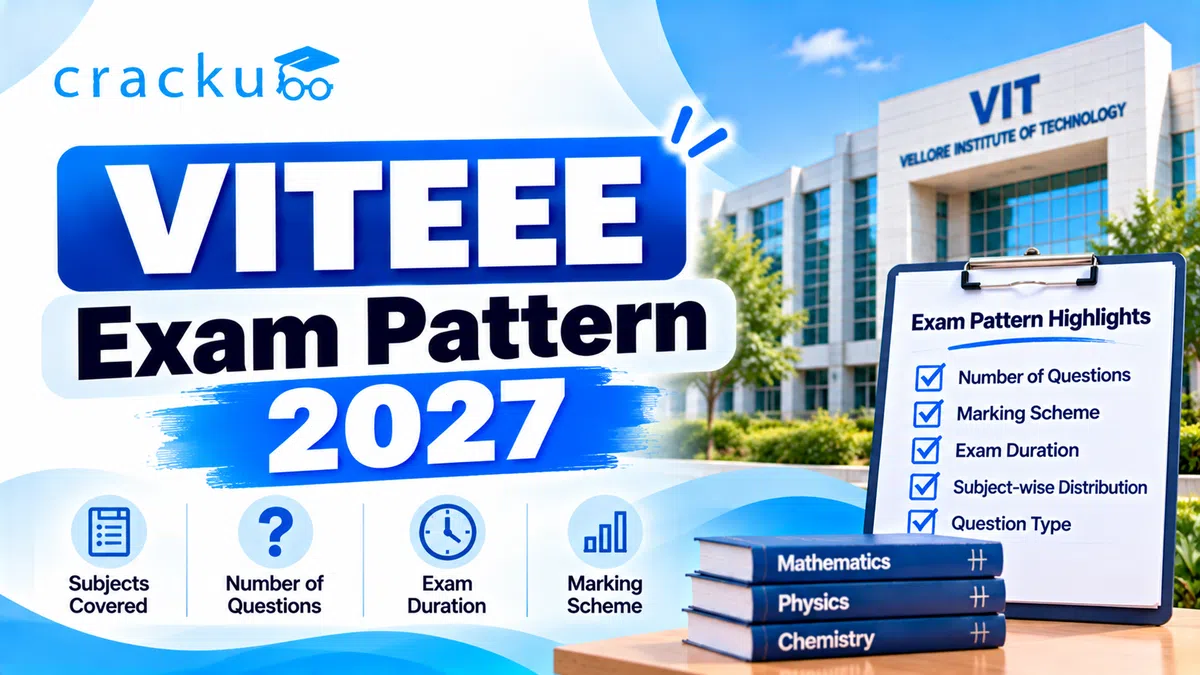
The VITEEE Exam Pattern 2027 includes 100 multiple-choice questions (MCQs) carrying a maximum of 400 marks, with an examination duration of 120 minutes. The revised computer-based test pattern includes fixed sectional time limits, making it important for candidates to understand the question distribution and timing rules before beginning their preparation.
The examination covers Physics, Chemistry, Mathematics or Biology, English and Aptitude. This article explains the VITEEE 2027 subject-wise question distribution, marking scheme, exam duration, syllabus and differences between the 2026 and 2027 patterns. Candidates should also check the official VITEEE website for the latest examination instructions and admission updates.
VITEEE 2027 Revised Exam Pattern: New Changes and Subject-Wise Questions
The revised VITEEE 2027 exam pattern consists of 100 MCQs carrying 400 marks. Each correct answer earns four marks, while each incorrect answer attracts a deduction of one mark. The question paper is available in English.
VITEEE has two subject groups: MPCEA and BPCEA. MPCEA candidates answer Mathematics questions, whereas BPCEA candidates answer Biology questions instead. Physics, Chemistry, English and Aptitude are common to both groups. Candidates should check the eligibility requirements for their preferred B.Tech programme before selecting a subject group.
Mathematics or Biology accounts for 40 questions, while Physics and Chemistry contribute 25 questions each. English and Aptitude account for five questions each, bringing the total to 100 questions.
Students preparing for engineering entrance examinations can also practise overlapping Physics, Chemistry and Mathematics concepts using JEE Mains PYQs. These previous-year questions can help revise fundamental concepts, although candidates should prioritise VITEEE-specific practice to understand its question distribution and examination format.
The subject-wise question distribution for the two VITEEE 2027 examination groups is given below.
Subject |
MPCEA Questions |
BPCEA Questions |
Mathematics |
40 |
Not applicable |
Biology |
Not applicable |
40 |
Physics |
25 |
25 |
Chemistry |
25 |
25 |
Aptitude |
5 |
5 |
English |
5 |
5 |
Total |
100 |
100 |
VITEEE 2027 Marking Scheme
The VITEEE 2027 marking scheme awards four marks for every correct answer and deducts one mark for every incorrect answer. Unanswered questions and questions marked for review receive zero marks. Candidates should therefore balance speed with accuracy when attempting the examination.
The +4/−1 marking scheme was also used in the VITEEE 2026 pattern, so negative marking is not a new change for 2027. For example, if a candidate answers four questions, with three correct responses and one incorrect response, the total score is 11 marks. The calculation is (3 × 4) − 1 = 11.
Incorrect responses reduce the marks earned from correct answers, making careful option elimination important. Candidates should avoid blind guessing, review their mistakes after practice tests and work on improving accuracy across subjects.
Response |
Marks Awarded |
Correct answer |
+4 |
Incorrect answer |
−1 |
Unanswered question |
0 |
Question marked for review |
0 |
Also Read: VITEEE Notification 2027: Examination Details and Updates
VITEEE 2027 Exam Duration
The VITEEE 2027 exam duration is 120 minutes, compared with 150 minutes in 2026. Candidates must attempt 100 questions within two hours while following the fixed time limits assigned to the examination sections.
Mathematics or Biology receives 50 minutes, while Physics and Chemistry receive 30 minutes each. English and Aptitude share a combined time limit of 10 minutes. Candidates should practise solving questions within these limits instead of spending too much time on individual problems.
For example, students can practise solving 25 Physics questions within 30 minutes and then review their incorrect answers. They can also attempt a JEE Mains Mock Test to practise time management, question selection and accuracy in a computer-based examination. Although JEE Main follows a different pattern, timed practice can help students develop useful examination skills.
Candidates should also practise VITEEE-specific questions and check the official examination instructions to understand section navigation and timer behaviour. The section-wise timing distribution is provided below.
Subject Section |
Questions |
Time Limit |
Mathematics / Biology |
40 |
50 minutes |
Physics |
25 |
30 minutes |
Chemistry |
25 |
30 minutes |
English and Aptitude combined |
10 |
10 minutes |
Total |
100 |
120 minutes |
Also Read: VITEEE 2027 Notification and Examination Information
VITEEE 2027 Syllabus
The VITEEE 2027 syllabus covers Physics, Chemistry, Mathematics or Biology, English and Aptitude. MPCEA candidates must prepare Mathematics, whereas BPCEA candidates must prepare Biology. Physics, Chemistry, English and Aptitude are common to both groups.
Candidates should review the prescribed syllabus before creating a revision schedule. The VITEEE Syllabus 2027 PDF can help students identify the subject-wise units and topics they need to study. Comparing the syllabus with previously covered chapters can also help them prioritise areas that require additional revision.
The table below lists selected examples of topics for revision. It is not an exhaustive syllabus.
Subject |
Selected Topics |
Mathematics |
Matrices, trigonometry, complex numbers, coordinate geometry and vectors |
Physics |
Units and measurements, mechanics, gravitation, thermal physics and electricity |
Chemistry |
Physical chemistry, inorganic chemistry, organic chemistry and coordination compounds |
Biology |
Cell biology, genetics, human physiology, biotechnology and ecology |
Aptitude |
Data interpretation, syllogisms, number series, coding and decoding |
English |
Reading comprehension, grammar and pronunciation |
Also Read: VITEEE Syllabus 2027 PDF: Subject-Wise Syllabus
VITEEE 2027 Previous Year Paper Pattern vs New Exam Pattern: What's Changed?
The VITEEE 2027 exam pattern differs from the 2026 pattern in the number of questions, maximum marks and examination duration. The total number of questions has decreased from 125 to 100, while the maximum marks have dropped from 500 to 400. The examination duration has also reduced from 150 minutes to 120 minutes.
Physics and Chemistry each have 10 fewer questions, while Aptitude has five fewer questions. Mathematics or Biology and English retain their respective question counts in the comparison below. The marking scheme remains unchanged at +4 for a correct answer and −1 for an incorrect answer.
For effective preparation, candidates should practise according to the revised VITEEE question distribution and sectional time limits. The comparison between the 2026 and 2027 patterns is given below.
Parameter |
VITEEE 2026 |
VITEEE 2027 |
Total questions |
125 |
100 |
Maximum marks |
500 |
400 |
Duration |
150 minutes |
120 minutes |
Mathematics / Biology |
40 |
40 |
Physics |
35 |
25 |
Chemistry |
35 |
25 |
Aptitude |
10 |
5 |
English |
5 |
5 |
Marking scheme |
+4 / −1 |
+4 / −1 |
VITEEE Exam Pattern 2027: Conclusion
The VITEEE Exam Pattern 2027 consists of 100 MCQs carrying a maximum of 400 marks, with an examination duration of 120 minutes. The revised pattern includes fixed sectional timers, making time management an important part of preparation. Understanding the subject-wise question distribution, marking scheme and syllabus can help candidates plan their preparation effectively.
To prepare for VITEEE 2027, candidates should revise the prescribed syllabus, practise questions under timed conditions and review their mistakes after every practice test. They can supplement their preparation with JEE Mains PYQs for overlapping concepts and use a JEE Mains Mock Test to practise speed and accuracy. However, VITEEE-specific practice should remain the priority. Candidates should confirm the latest examination details through official VIT resources before relying on them for preparation.
```