Find the odd one out in the series: 5, 10, 17, 26, 38, 50
SNAP Temporary Questions
The sequence follows $$n^2+1$$ for n = 2,3,4,5,6,7:
$$2^2+1=5$$
$$3^2+1=10$$
$$4^2+1=17$$
$$5^2+1=26$$
$$6^2+1=37$$
$$7^2+1=50$$
Now, we can clearly notice that 38 is the incorrect term. It should be 37.
Find the missing term in the series: AZ, CX, FU,?
Explanation: first letters are at positions 1, 3, 6 (differences +2, +3 → next +4 → 10 → J).
Second letters are 26, 24, 21 (differences −2, −3 → next − 4 → 17 → Q).
So the next pair is JQ.
In a row of students, Rohan is 12th from the left end and Sunita is 15th from the right end. If they interchange their positions, Rohan becomes 20th from the left end. How many students are there in the row?
Sunita's original position from the left = N − 15 + 1 = N − 14
After swapping, Rohan takes Sunita's place and becomes 20th from the left, so N− 14 = 20
Hence, N = 34
A man starts from point A, walks 10 km East, then turns to his right and walks 5 km. He again turns to his right and walks 10 km. Finally, he turns to his left and walks 5 km to reach point B. In which direction is point B from point A?
Step 1: Start at A: (0,0).
Step 2: 10 km East = (10,0).
Step 3: Turn right (facing South) and 5 km = (10, −5).
Step 4: Turn right (facing West) and 10 km = (0, −5).
Step 5: Turn left (from West, left = South) and 5 km = (0, −10).
So point B is at (0, −10) relative to A — that is, 10 km South of A.
Each of A, B, C, D, and E belongs to a different profession among - teacher, doctor, lawyer, police-officer, and banker. A is the police-officer. B is neither the doctor nor the lawyer. C is the teacher. D is neither the banker nor the lawyer. Who among them is the banker?
We know that A = police, C = teacher. That leaves {doctor, lawyer, banker} for B, D, E.
B is neither a doctor nor a lawyer, so B must be the banker.
Arrange the given words in the sequence in which they occur in the dictionary and then choose the correct sequence.
1. Juncture
2. Justice
3. Jumbo
4. Junior
1: Jumbo (Jum...) comes before Juncture (Jun c...) because 'm' < 'n'.
2: Among Juncture, Junior, Justice: compare next letters after "Jun" — 'c' (Juncture) < 'i' (Junior) < 's' (Justice).
Hence, the correct order should be 3. Jumbo, 1. Juncture, 4. Junior, 2, Justice
Seven friends A, B, C, D, E, F, and G are sitting in a straight line facing North.
C sits third to the right of G.
G sits at one of the extreme ends of the line.
A is an immediate neighbor of C.
B sits second to the left of A.
Only two people sit between B and F.
E is not an immediate neighbor of G.
Who sits at the extreme right end of the line?
It is given, C sits third to the right of G and G sits at one of the extreme ends of the line.
So, G must sit at the left most end of the line.
So, the arrangement will be like:
G __ __ C __ __ __
Now A is immediate neighbor of C and B sits second to the left of A.
This means, B must be on immediate right of C.
So, the arrangement will be like:
G __ B C A __ __
Now, two people sit between B and F.
So, the arrangement will be like:
G __ B C A F __
Now, E is not an immediate neighbor of G.
So, the final arrangement is:
G D B C A F E
So, the person sitting at extreme right end of line is E.
Seven friends A, B, C, D, E, F, and G are sitting in a straight line facing North.
C sits third to the right of G.
G sits at one of the extreme ends of the line.
A is an immediate neighbor of C.
B sits second to the left of A.
Only two people sit between B and F.
E is not an immediate neighbor of G.
What is the position of E with respect to C?
It is given, C sits third to the right of G and G sits at one of the extreme ends of the line.
So, G must sit at the left most end of the line.
So, the arrangement will be like:
G __ __ C __ __ __
Now A is immediate neighbor of C and B sits second to the left of A.
This means, B must be on immediate right of C.
So, the arrangement will be like:
G __ B C A __ __
Now, two people sit between B and F.
So, the arrangement will be like:
G __ B C A F __
Now, E is not an immediate neighbor of G.
So, the final arrangement is:
G D B C A F E
So, the position of E with respect to C is that E is third to the right of C.
Seven friends A, B, C, D, E, F, and G are sitting in a straight line facing North.
C sits third to the right of G.
G sits at one of the extreme ends of the line.
A is an immediate neighbor of C.
B sits second to the left of A.
Only two people sit between B and F.
E is not an immediate neighbor of G.
Who sits exactly in the middle of the line?
It is given, C sits third to the right of G and G sits at one of the extreme ends of the line.
So, G must sit at the left most end of the line.
So, the arrangement will be like:
G __ __ C __ __ __
Now A is immediate neighbor of C and B sits second to the left of A.
This means, B must be on immediate right of C.
So, the arrangement will be like:
G __ B C A __ __
Now, two people sit between B and F.
So, the arrangement will be like:
G __ B C A F __
Now, E is not an immediate neighbor of G.
So, the final arrangement is:
G D B C A F E
So, the person exactly in the middle of the line is C.
In a code language, if 'go to school' is coded as 'la ta ma' and 'study in school' is coded as 'pa
sa ma', what is the code for 'school'?
In both the codes, 'go to school' and 'study in school', 'school' is the common word and also 'ma' is the common code.
Also, both the words appear in the same position.
So, the correct code is 'ma', Option C.
H is the mother of I. I is the sister of J. J is married to K. K is the only son of L. L is the daughter of M. If L is the mother of N, then how is N related to M?
A family consists of six members P, Q, R, S, T and U. There are two married couples. Q is a doctor and the father of T. U is grandfather of R and is a contractor. S is grandmother of T and is a housewife. There is one doctor, one contractor, one nurse, one housewife and two students in the family. What is the profession of R's mother?
A clock shows 3:00. After how many minutes will the angle between the hands be 60° ?
We know the angle between hour hand and minute hand is given by the formula: $$\left|30h-\dfrac{11m}{2}\right|$$
Here, $$h=3$$
So, either, $$30h-\dfrac{11m}{2}=60$$
or, $$30\times\ 3-\dfrac{11m}{2}=60$$
or, $$\dfrac{11m}{2}=30$$
or, $$m=\dfrac{60}{11}=5\ \dfrac{5}{11}$$
Or,$$\dfrac{11m}{2}-30h=60$$
or, $$\dfrac{11m}{2}-30\times\ 3=60$$
or, $$\dfrac{11m}{2}=60+90=150$$
or, $$m=\dfrac{150\times\ 2}{11}=\dfrac{300}{11}=27\ \dfrac{3}{11}$$
Amongst the given options, option C is the correct answer.
If February 29, 2024 falls on a Thursday, on which day will February 29, 2028 fall?
Number of days between February 29, 2024 and February 29, 2028 = $$365+365+365+366$$
Now, $$365\equiv 1 \text{ mod }7$$
And, $$366\equiv 2 \text{ mod }7$$
So, $$365+365+365+366\equiv (1+1+1+2) \text{ mod }7$$
So, number of odd days = 5
Now, 5 days after Thursday is Tuesday
So, February 29, 2028 is Tuesday.
A clock loses 3 minutes every 2 hours. It shows the correct time at 12:00 noon on Monday.At the actual time of 6:00 PM on Wednesday, what time will the clock show?
The clock loses 3 minutes every 2 hours.
So, it loses 60 minutes every 40 hours.
or, 1 hour every 40 hours.
Now between 12:00 noon on Monday and 6:00 PM on Wednesday, number of hours = $$24+24+6=54$$ hours
So, number of hours lost in 54 hours = $$\dfrac{1}{40}\times\ 54=\dfrac{27}{20}$$ hours
Now, $$\dfrac{27}{20}$$ hours = $$1\ \dfrac{7}{20}$$ hours
Now, $$1$$ hour and $$\dfrac{7}{20}$$ hours = $$\dfrac{7}{20}\times\ 60\ =21$$ minutes
So, time which the clock will show is 6:00 PM - (1 hour + 21 minutes) = 4:39 PM
Given below are three statements. Assume these statements are true irrespective of whether they are true in real life. Each question has two conclusions.
Statements:
No snake is a bird.
Some birds are animals.
All animals need food.
Conclusions:
I. Some snakes need food.
II. No bird is a snake.
From the given statements:
“No snake is a bird” means there is no overlap between snakes and birds.
“Some birds are animals” means part of the bird set overlaps with the animal set.
“All animals need food” means everything in the animal set (and its overlaps) belongs to the larger “need food” set.
Now, looking at the conclusions:
-
Conclusion I: “Some snakes need food.” — This does not follow, because there’s no information connecting snakes with animals or food. Whether snakes are animals or not can't be concluded from the given statements, and hence, we can’t conclude that they need food.
-
Conclusion II: “No bird is a snake.” — This is true, as it directly restates the first statement (“No snake is a bird”).
Hence, only II follows.
Given below are three statements. Assume these statements are true irrespective of whether they are true in real life.
Statements:
Some toys are pens.
Some pens are papers.
Some papers are black.
Conclusions:
I. Some toys are black.
II. No pen is black.
III. No toy is black.
IV. Some pens are black.
Statement I: The price of vegetables has increased significantly in the last month.
Statement II: There were unseasonal heavy rains across the country last month, damaging crops.
Statement I defines the event that the price of the crops has increased significantly in the last month. A price increase can be caused by a rise in demand or a decrease in supply. Statement II outlines that unseasonal heavy rains in the previous month have damaged the crops; it follows that this might have led to a reduction in the supply of the crops. The most suitable answer, therefore, is option B. Statement II is the cause and statement I is its effect.
Statement: All scientists are hardworking. Some hardworking people are not well-paid.
Conclusions:
I. Some scientists are not well-paid.
II. Some well-paid people are scientists.
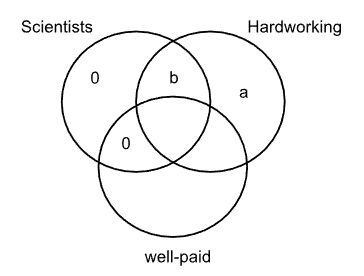
Following is a Venn diagram defining the three classes, "scientists", "hardworking", and "well-paid".

Based on the given info, we can draw the following conclusions:
Since all scientists are hardworking, the inputs in the scientist circle that are outside the hardworking circle are zero. Since there are some hardworking people who are not well paid, the inputs a and b will be such that a+b>0. No other information can be known.
Statement I says that some scientists are not well-paid. This requires the value of b to be greater than zero. The best we can say is that a+b>0. Therefore, statement I does not follow.
Statement II says that some well-paid people are scientists, this requires the central input of the venn diagram to be greater than zero, which we cannot say anything of.
The correct answer is option D; neither 1 nor 2 follows.
Statement: To improve the employment rate, the government should provide vocational training to the youth.
Which of the following, if true, would weaken the argument?
This statement directly weakens the argument because it challenges the assumption that providing vocational training will actually improve employment rates. If many individuals who already possess such training remain jobless, it suggests that vocational training alone does not necessarily lead to employment opportunities. The problem, therefore, may lie not in the lack of skills but in the availability of suitable jobs or market demand. The correct answer should therefore be option (a)
The other options may pose difficulties or practical challenges, but they do not directly undermine the effectiveness of vocational training in improving employment, which is the central claim of the statement. Option (b) only questions cost, not effectiveness; option (c) suggests preference for degrees but doesn’t prove training fails as some sectors still rely on skills; option (d) shows a lack of interest, not ineffectiveness, and the logic that training improves employability still stands.\
Statement: The company has decided to lay off 20% of its workforce due to economic recession.
Conclusion: The company will now be able to overcome its financial crisis.
The statement tells us that the company has decided to lay off 20% of its workforce because of an economic recession. This action suggests that the company is attempting to reduce expenses and improve its financial position. However, while this decision may help relieve financial strain, it does not guarantee that the company will completely overcome its crisis, as several other factors, such as market conditions, demand, and management decisions, also play a role. Therefore, the conclusion that the company will now be able to overcome its financial crisis cannot be said to definitely follow, but it probably follows based on the intent behind the layoffs.
The correct choice is therefore option B.
Statement: The quality of primary education in government schools has been a cause for concern, as many students are failing to achieve basic literacy and numeracy skills.
Assumptions:
I. Private schools provide better primary education.
II. The government has the resources and capability to improve the quality of education in its schools.
The statement highlights a problem: the quality of primary education in government schools is poor, and many students are failing to acquire basic literacy and numeracy skills. It does not, however, make any comparison with private schools, nor does it imply that private schools offer better education. Therefore, assumption I is not implicit.
Similarly, the statement does not assume that the government necessarily has the resources or ability to improve the situation; it merely identifies the issue. The possibility of government action is not mentioned or suggested. Hence, assumption II is also not implicit. The statement confines itself to expressing concern about the present state of affairs without implying either assumption.
So, the correct choice would be option D: Neither I nor II is implicit
Statement: Despite a significant increase in marketing expenditure, the sales of 'Alpha' brand smartphones have remained stagnant for the last quarter.
Which of the following, if true, would best explain this phenomenon?
The correct answer is (b) A major competitor launched a new model with superior features at a lower price during the same quarter. This option best explains why sales of the ‘Alpha’ brand remained stagnant despite increased marketing expenditure. A strong competitor offering a better product at a lower price would naturally attract potential customers, neutralising the impact of Alpha’s marketing push.
The other options are not correct because: Option (a) is irrelevant, as praise for creativity doesn’t guarantee sales impact. Option (c) could contribute to lower demand, but it doesn’t explain stagnation despite marketing as clearly as the competitor’s move does. Option (d) shows market growth but doesn’t explain why Alpha’s sales didn’t grow along with it.
Thus, (b) provides the most direct and logical explanation.
Large national budget deficits do not cause large trade deficits. If they did, countries with the largest budget deficits would also have the largest trade deficits. In fact, when deficit figures are adjusted so that different countries are reliably comparable to each other, there is no such correlation.
If the statements above are all true, which of the following can properly be inferred on the basis of them?
The passage argues that there is no consistent relationship between national budget deficits and trade deficits once data are adjusted for proper comparison. This means that changes in one (the budget deficit) do not predict changes in the other (the trade deficit). Therefore, it logically follows that lowering a country’s budget deficit does not necessarily lead to a reduction in its trade deficit. The correct answer is therefore option (c) Reducing a country’s national budget deficit will not necessarily result in a lowering of any trade deficit that country may have.
Option (a) is unsupported; the passage never mentions trade restrictions. Option (b) is the opposite of what’s stated; it says comparisons are possible when adjusted. Option (d) introduces population, which is irrelevant to the argument.
Hence, (c) is the only valid inference.
Statement: "Democracy cannot exist without secularism.” Which of the following statements, if true, would show that the above statement is false?
The correct answer is (b) Britain is democratic but not secular. This statement directly contradicts the claim that democracy cannot exist without secularism. If Britain, a well-known democracy, functions successfully despite not being secular, it serves as evidence that democracy can exist without secularism.
Option (a) shows a case where democracy failed despite secularism — it doesn’t prove the two can exist independently. Options (c) and (d) are irrelevant because both describe countries lacking democracy, which doesn’t test the link between democracy and secularism.
Hence, (b) clearly shows the original statement to be false.
The income of Q is 25% less than the income of R. The income of P is 20% higher than that of Q. What percent less is P’s income from R’s income?
Let the incomes of P, Q, and R be $$p,q$$ and $$r,$$ respectively.
We are given that the value of $$q$$ is $$25\%$$ less than $$r$$. So, the value of $$q$$ can be written as,
$$q\ =\left(1\ -\ \dfrac{25}{100}\right)r=\dfrac{3}{4}r$$.
We are also given that $$p$$ is $$20\%$$ higher than $$q$$. So, the value of $$p$$ can be written as,
$$p=\left(1\ +\ \dfrac{20}{100}\right)q=\dfrac{6}{5}q=\dfrac{6}{5}\times\ \dfrac{3}{4}r=\dfrac{9}{10}r$$
The percentage by which the salary of $$p$$ is less than $$r$$ can be calculated as,
Percentage $$=$$ $$\dfrac{r\ -\ p}{r}\times\ 100\ =\ \dfrac{\left(r\ -\ \dfrac{9}{10}r\right)}{r}\times\ 100\ =\ \dfrac{1}{10}\times\ 100\ =\ 10\%$$
Hence, the correct answer is option B.
In how much time (in years), will a sum of money become thrice of itself at the rate of 25% per annum simple interest?
For an amount to become three times itself, the interest gained on that amount must be twice its value.
Let the value of the amount be P, and the number of years it takes for the interest gained on that amount is 2P can be calculated as,
$$SI=\dfrac{P\times\ T\times\ R}{100}$$
$$2P=\dfrac{P\times\ T\times\ 25}{100}$$
$$T\ =\ 8$$ years.
Therefore, the time it takes for the amount to become three times its value is 8 years.
Hence, the correct answer is option B.
The half of the average value of three number is 20. The second number is thrice the third number and first number is twice the second number. What is the sum of smallest and largest number?
Let the three numbers be $$a,b$$ and $$c$$ in decreasing order.
Half of the average of these 3 numbers is,
$$\dfrac{1}{2}\times\ \dfrac{a\ +\ b\ +\ c}{3}\ =\ 20$$
$$\ a\ +\ b\ +\ c\ =\ 120$$ --(1)
We can see that the first number mentioned is the highest in the question, and its value is given to be,
$$a=2b$$ --(2)
The second number value is given to be,
$$b=3c$$ --(3)
So, the value $$a$$ can also be written as,
$$a=2b=2*3c=6c$$ --(4)
Substituting (3) and (4) in (1), we get,
$$6c+3c+c=120$$
$$10c=120$$
$$c=12$$
$$a=6c=72$$
Sum of smallest and largest numbers can be calculated as,
$$a+c=72+12=84$$.
Hence, the correct answer is option C.
If a train runs at 50 km/hr, it reaches 60 minutes earlier than its schedule time at its destination but if it runs at 8.33 m/s it reaches at its destination 300 minutes late, find the correct time for the train to complete its journey.
Let the scheduled time be T and the distance that needs to be travelled be D.
While travelling at 50kmph, the train covers D in (T - 1) hours. The value D can also be written as,
D = speed * time = 50kmph * (T - 1)
We are also given that when the train runs at 8.33 m/s = $$\dfrac{25}{3}$$m/s = $$\dfrac{25}{3}\times\ \dfrac{18}{5}\ =\ 30$$kmph, train covers the distance is (T + $$\dfrac{300}{60}$$) hours = (T + 5) hours. The value of D can also be written as,
D = speed * time = 30kmph * (T + 5)
Equating both the values of D, we get,
50T - 50 = 30T + 150
20T = 200
T = 10 hours.
So, the correct time for the train to complete the journey is 10 hours.
Hence, the correct answer is option A.
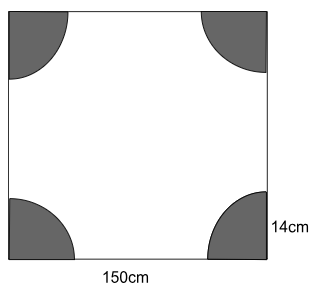
If from a square of side 150 cm. A quarter of radius 14 cm is cut from each of the four corners, then find the remaining area.

The total area of square $$=\ S^2\ =\ \left(150cm\right)^2\ =\ 22500cm^2$$
The area of the parts cut from the edges $$=\ 4\ \times\ \dfrac{1}{4}\ \times\ \dfrac{22}{7}\ \times\ \left(14cm\right)^2\ =\ 22\ \times\ 14\ \times\ 2\ =\ 616\ cm^2\ $$
Area remaining $$=22500-616=21884\ cm^2$$
Hence, the correct answer is option C.
A and B together can complete a task in 12 days. A alone can complete the task in 18 days. In how many days can B alone complete it?
Let the total amount of work that needs to be done be $$W$$, and the efficiencies of $$A$$ and $$B$$ be $$a$$ and $$b$$, respectively.
The amount of work done by $$A$$ and $$B$$ together in 12 days is,
$$12(a+b)=W$$ --(1)
The amount of work done by $$A$$ alone in 18 days is,
$$18(a)=W$$
$$a=\dfrac{W}{18}$$ --(2)
Substituting (2) in (1), we get,
$$12\left(\dfrac{W}{18}\ +\ b\right)\ =\ W$$
$$\dfrac{2W}{3}\ +\ 12b\ =\ W$$
$$12b\ =\ \dfrac{W}{3}$$
$$W\ =\ 36b$$
So, $$B$$ alone can complete the total work in 36 days.
Hence, the correct answer is option B.
If $$x^2−7x+12=0$$, what are the roots?
Roots of a quadratic equation $$ax^2\ +\ bx\ +\ c\ =\ 0$$ can be calculated using the formula,
Roots $$=\ \dfrac{-b\ \pm\ \sqrt{\ b^2\ -\ 4ac}}{2a}$$
Roots of $$x^2−7x+12=0$$ can be calculated as,
Roots $$=\ \dfrac{-\left(-7\right)\ \pm\ \sqrt{\ \left(-7\right)^2\ -\ 4\left(1\right)\left(12\right)}}{2\left(1\right)}\ =\ \dfrac{7\ \pm\ \sqrt{\ 49\ -\ 48}}{2}\ =\ \dfrac{7\ \pm\ 1}{2}\ =\ \dfrac{7\ +\ 1}{2}\ or\ \dfrac{7\ -\ 1}{2}\ =\ 4\ or\ 3$$
So, the roots of the equation are (3, 4)
Hence, the correct answer is option A.
The least number which when divided by 12, 18, and 27 leaves a remainder of 9 is:
To find this number, we must first find the Least Common Multiple (LCM) of the divisors (12, 18, 27) and then add the required remainder 9.
Step 1: To find the LCM of 12, 18, and 27
We use prime factorisation to find the LCM:
- $$12=2^2\times3^1$$
- $$18 = 2^1 \times 3^2$$
- $$27 = 3^3$$
The LCM is the product of the highest power of all prime factors:
$$\text{LCM}(12, 18, 27) = 2^2 \times 3^3$$
$$\text{LCM} = 4 \times 27$$
$$\text{LCM} = 108$$
Step 2: Add the Remainder
The required number is (LCM) + (Remainder).
$$\text{Required Number} = 108 + 9$$
$$\text{Required Number} = 117$$
Hence, the correct answer is option A.
The length of a rectangle is increased by 25% and the breadth is decreased by 20%. What is the percentage change in area?
Let the initial length and breadth of the rectangle be $$L$$ and $$B$$.
We are told that the length is increased by 25% and the breadth is decreased by 20%. So, the new length and breadth become
Length $$L\left(1\ +\dfrac{25}{100}\right)\ =\ \dfrac{5}{4}L$$
Breadth $$=\ B\left(1\ -\ \dfrac{20}{100}\right)\ =\ \dfrac{4}{5}B$$
Initial Area $$=\ L\times\ B$$
Final Area $$=\ \dfrac{5}{4}L\times\ \dfrac{4}{5}B\ =\ L\ \times\ B$$
We can see that there is no change in the Area. So the percentage change in area is 0%.
Hence, the correct answer is option A.
A sum of ₹12,000 is divided between A, B, and C in the ratio 2:3:5. How much does B get?
If the sum ₹12,000 is divided between A, B, and C in the ratio 2:3:5, then the share of B can be calculated as,
B's share $$=\ \dfrac{3}{2\ +\ 3\ +\ 5}\ \times\ 12000\ =\ \dfrac{3}{10}\times\ 12000\ =\ 3600$$
So, B's share is ₹3,600.
Hence, the correct answer is option B.
Two dice are thrown. What is the probability of getting a sum of 9?
We know that when there are two dice thrown, there are 36 possible outcomes.
(1,1), (1,2)......(1,6)
(2,1), (2,2),.....(2,6)
..
(6,1), (6,2), .....(6,6)
We need to get a sum of 9
(3,6),(4,5),(5,4),(6,3)
Thus, there are four possibilities.
Therefore, the probability of getting a sum of 9 = 4/36 = 1/9
Option B is the correct answer.
A man covers a distance of 120 km at 40 km/h and returns at 60 km/h. What is his average speed?
A man covers a distance of 120 km at 40 km/h
Time taken = 120/40 = 3 hours
A man covers a distance of 120 km on the return journey at 60 km/h.
Time taken = 120/60 = 2 hours.
Average speed = Total distance travelled / Total time taken
Average speed = 240/5 = 48 km/hr
If log10(2)=0.3010 , log10(3)=0.4771, log10(12) = ?
The sum of three numbers in AP is 27. If 1 is added to the first number, 2 to the second, and 3 to the third, the new numbers are in GP. Find the numbers.
The sum of three numbers in AP is 27.
Let us assume the numbers are a-d, a , a+d
Where d is the common difference.
Sum a-d+a+a+d = 27
3a = 27
a = 9
If 1 is added to the first number, 2 to the second, and 3 to the third, the new numbers are in GP.
So, the new numbers are
9-d+1, 9+2, 9+d+2
10-d , 11, 11+d
Checking options:
A) 6, 9, 12 when we add numbers it becomes 7, 11, 15 (Not in GP)
B) 5, 9, 13 when we add numbers it becomes 6, 11, 16 (Not in GP)
C) 10, 9, 8 when we add numbers it becomes 11, 11, 11 (In GP)
D) 4, 9, 14 when we add numbers it becomes 5, 11, 17 (Not in GP)
Hence, answer is option C.
A container has milk and water in the ratio 5:3. 16 liters of mixture is taken out and replaced with water. The ratio becomes 5:4. Find the total quantity of mixture in the container.
The HCF of two numbers is 15 and LCM is 360. If one number is 45, find the other.
We know that the product of two numbers = the product of HCF and LCM
The HCF of two numbers is 15, and the LCM is 360.
If one number is 45
Assuming the other number to be N
Therefore, 15*360 = 45*N
Thus, N = 120
An electric pump can fill a cistern in 6 hours. Because of a leak in the cistern it was taking 9 hrs to fill the cistern. Find the time in which the leak can drain all the water of the cistern when full.
An electric pump can fill a cistern in 6 hours.
Assuming the capacity of the cistern to be 90 litres.
Thus, the electric pump can fill the cistern 90 litres in 6 hours or 15 litres in one hour.
Because of a leak in the cistern, it was taking 9 hrs to fill the cistern.
Therefore, the total volume filled in 1 hour = 90/9 = 10 litres per hour.
We know the pump can fill 15 litres in one hour; therefore, because of the leak, 5 litres of water are removed every hour.
If the tank is filled, it contains 90 litres.
The time taken by the leak to empty = 90/5 = 18 hours.
A trader sells 2 articles at the same price. On one he gains 30% and on the other he loses 20%. Find the overall gain/loss percentage.
A train covers a certain distance at 60 km/h. If the speed had been 10 km/h more, it would have taken 30 minutes less. Find the distance.
A three-digit number is divisible by 3, 5, and 7. What is the largest such number less than 500?
495 is not divisible by 7, so we can eliminate it.
455 and 490 are not divisible by 3, since a number is divisible by 3 only if the sum of its digits is divisible by 3.
Hence, 420 is the correct answer.
Find the opposite: Apoplectic
The word apoplectic refers to someone who is extremely angry or furious, often to the point of being speechless or losing control. Therefore, its opposite would describe a state of composure or tranquillity, which is best captured by the word calm. While 'relaxed' is close in meaning, 'calm' more directly contrasts with the intense anger implied by 'apoplectic'. Hence, the correct choice will be option A.
In the question below, the sentence has been given in Direct/Indirect speech. From the given alternatives, choose the one that best expresses the given sentence in Indirect/Direct speech:
"He needs to get it fixed else he'll face a lot of trouble soon", I told him.
The tense of the sentence inside the inverted commas [reported speech] is Simple Present, and the tense of the reporting verb is past. This means that when converting to indirect, the reported speech will become past simple. Hence, the correct conversion will be: "I told him that he needed to get it fixed or he would face a lot of trouble soon ", which is option B.
[ 'he'll' means 'he will', which becomes 'he would' in the change ]
Choose the correct meaning of proverb/idiom:
Cut to the quick
The idiom "cut to the quick" refers to causing someone intense emotional pain or distress, often by saying or doing something that strikes at their most sensitive feelings. The correct choice will therefore be Option A: To hurt someone deeply in their emotions.
Find the correctly spelt word.
The correct spelling for the word is COMMITTEE, which matches option A. Hence, option A is the correct choice.
The following sentence may contain grammatical error(s). If so, spot the error(s).
Even when we run the risk of losing our lives, courage make us defend what is right and oppose what is wrong.
The error lies in the verb 'make', which should agree in number with its singular subject, 'courage'. Since courage is a singular noun, the correct verb form is makes. Therefore, the sentence should read:
“Even when we run the risk of losing our lives, courage makes us defend what is right and oppose what is wrong.”
The word oppose is already correct because it properly follows us defend… and oppose, both in base form after 'makes us'. [Parallel construction]
The following sentence may contain grammatical error(s). If so, spot the error(s).
He feels that the scissor that he has bought is not very sharp and cannot be used for his tailoring work.
When describing the object, the word "scissors" is used. It is used in any use-case as the scissors are a pair of blades. "Scissor" is an incorrect use and the correct answer is option A.
In each question, an incomplete statement followed by fillers. Pick out the best one which
can complete incomplete statement correctly and meaningfully.
No sooner had we passed the cave than…
The phrase “No sooner had we…” is used to indicate that one event happened immediately after another, emphasising quick succession. It is typically followed by “than” and then the second action. Of the options given, the sentence is best completed as: “No sooner had we passed the cave than a sudden roar emerged from within”. This is both grammatically correct and contextually meaningful. The other options either break the sequence of immediate events or do not logically follow the cause-and-effect or time pattern implied by “no sooner… than.”
In each question, an incomplete statement followed by fillers. Pick out the best one which
can complete incomplete statement correctly and meaningfully.
I was really determined to get the task done so.....
In the following question, choose the word which best expresses the meaning of the given word.
Foist
The word foist means to force something upon someone, often deceitfully or without their consent. It carries a negative connotation, implying that something unwanted or inferior is being imposed. Among the options, impose best captures this idea of forcing something on someone. The other options don’t quite fit the meaning. The correct choice is therefore option B.
In the following question, convert the type of voice from active to passive or vice versa.
Active: The teacher had been correcting the papers before the power went out.
Which is the correct passive form?
When converting a sentence from the active to the passive form, the subject becomes the object and vice versa. The tense structure of past perfect continuous (had-been-verbing) will change to (had-been-being-past participle-by-subject). Therefore, the correct form of the sentence in passive form will be: The papers had been being corrected by the teacher before the power went out.
In the sentence below, choose the option that correctly completes the blank with who, whom, whoever, or whomever.
The director asked for a report on the consultant, ____ he was told had already resigned.
In this sentence, the clause after the comma — “who he was told had already resigned” — contains the word functioning as the subject of the verb had resigned. Although it follows 'on the consultant,' which might suggest an object form like whom, the grammatical role within the clause determines the choice.
Since 'who' performs the action (had already resigned), the correct sentence is:
“The director asked for a report on the consultant, who he was told had already resigned.”
If 'whom' were used, it would incorrectly suggest that the word is receiving an action within the clause, ie, suggest it’s the object of a verb, which it isn’t.
In the sentence below, choose the option that correctly completes the blank with who, whom, whoever, or whomever.
Give the award to ____ you think will use it best.
In the clause “you think will use it best,” the word filling the blank functions as the subject of the verb “will use.” Even though the blank comes after the preposition 'to', which normally takes an object (whom or whomever), the grammatical role within the clause determines the choice. Since the pronoun acts as a subject inside the clause (“whoever will use it best”), “whoever” is correct. We use “whoever” instead of “who” because the word is part of a larger clause: “whoever will use it best”, which functions as the object of the preposition to, while inside that clause it also acts as the subject of will use. “Whoever” can play both roles at once (object of the outer clause and subject of the inner one), but “who” cannot.
So the full sentence reads: “Give the award to whoever you think will use it best.
In the question below, each passage consists of six sentences. The first (S1) and sixth (S6) sentences are fixed. The middle four sentences P, Q, R, S are jumbled. Find the proper order of the four sentences:
S1: For Mao, dialectical materialism was not a static doctrine but a living method of analysis.
He saw contradiction as the driving force of all development, both in nature and society.
P. Mao’s writings, particularly On Contradiction and On Practice, reveal how he applied dialectical materialism to questions of strategy, organization, and ideology.
Q. He believed that only by identifying and resolving these contradictions could China advance toward socialism.
R. This conviction shaped his insistence that the Chinese Revolution could not simply replicate the Russian path but had to grow out of China’s own realities: chiefly, the semi-colonial, semi-feudal structure of its economy and the centrality of the peasantry.
S. Through this lens, Mao emphasized the dynamic balance between opposites: theory and practice, leadership and mass line, reform and revolution, centralization and decentralization.
S2: Dialectical materialism thus became the cornerstone of Mao’s political philosophy, guiding both his revolutionary tactics and his vision of continuous struggle within socialism itself.
After S1 states Mao’s view of contradiction as the engine of development, R logically grounds that view in China’s specific conditions (semi-colonial, semi-feudal economy and peasant centrality), showing why Mao couldn’t copy the Russian path. P then points to his essays (On Contradiction, On Practice) as the vehicles through which he operationalised dialectical materialism for strategy and ideology. S elaborates the method’s content by listing the opposing pairs Mao sought to balance (theory/practice, leadership/mass line, etc.). Q finally generalises the political payoff that progress toward socialism depends on identifying and resolving contradictions, smoothly priming S2, which summarises dialectical materialism as the cornerstone guiding both tactics and the continuous struggle.
The most appropriate order should therefore be RPSQ, which is option D.
Identify the figure of speech involved in the following sentence:
“The pen is mightier than the sword”
In this sentence, “the pen” represents writing or peaceful expression, while “the sword” represents war or violence. The words are not meant literally but as symbols for the ideas they are closely associated with. This substitution of one word for another that is closely related in meaning is what defines a 'metonymy'. The correct choice will therefore be option B.
The following sentence use modifier incorrectly. Choose the alternative that uses the modifier correctly in the given context.
While reading the novel, the lights suddenly went out.
The sentence, in its current form, implies that the lights went out while they were reading the novel i.e, that the lights were reading the novel. We need to keep the form and tense intact and write the correct event description. Since the speaker should be the subject reading the novel, the main clause would be: "While I was reading the novel". The supporting modifier is correct. The sentence would be: "While I was reading the novel, the lights suddenly went out."