 91- 6303239042
Milk and water in two vessels A and B are in the ratio 4 : 3 and 2 : 3 respectively. In what ratio the liquids in both the plate vessels should be mixed to obtain a new mixture in vessel C, only maintaining half milk and half water?
Sign in
Please select an account to continue using cracku.in
↓ →
Milk and water in two vessels A and B are in the ratio 4 : 3 and 2 : 3 respectively. In what ratio the liquids in both the plate vessels should be mixed to obtain a new mixture in vessel C, only maintaining half milk and half water?
The fraction of milk in A = 4/(4+3) = 4/7
The fraction of milk in B = 2/(2+3) = 2/5
Let them be mixed in the ratio x:y such that their fraction is 1/2
It can be written as
$$\frac{4x}{7}$$ + $$\frac{2y}{5}$$ = $$\frac{x+y}{2}$$
Upon solving,
$$\frac{4x}{7}$$ - $$\frac{x}{2}$$ = $$\frac{y}{2}$$ - $$\frac{2y}{5}$$
$$\frac{x}{14}$$ = $$\frac{y}{10}$$
$$\frac{x}{y}$$ = $$\frac{7}{5}$$
Required ratio is 7:5
A picture was bought at a certain sum, which was the price paid for its frame. Had the frame cost Rs 100 less and the picture Rs 75 more the price for the frame would have been only half of that of the picture. What is the price of the frame?
Let the cost of Picture be Rs X. Then the cost of frame is also Rs X.
As per question $$\frac{X+75}{2}$$ = $$2\cdot\left(X-100\right)$$
X + 75 = 2X - 200
X = 275
What is the closest time between 7 and 8 when the hands of your watch are exactly
opposite each other?
At 7 the hour hand is $$\frac{7}{12}\cdot360$$ = 210 degrees ahead of the minute hand.
Let after x minutes they are at 180 degrees with each other (since they are exact opposite)
Total angle covered by hour hand = 210 + 0.5x ( as hour hand moves at 0.5 degrees/minute)
Total angle covered by minute hand = 6x ( speed of minute hand is 6 degrees/minute)
As per the question
Angle by hour hand - Angle by minute hand = 180
(210 + 0.5x) - 6x = 180
210 - 5.5x = 180
5.5x = 30
x = 5.45 minutes
The closest answer is 5.5 minutes

There are 6 tickets to the theater, four of which are for seats in the front row. 3 tickets are selected at random. What is the probability that two of them are for the front row?
Out of all the 6 tickets, 4 are front row tickets and the rest 2 are not.
Out of 4 front tickets 2 can be selected in $$^{4\ }C\ _2$$
The remaining 1 ticket has to be selected in $$^{2\ }C\ _1$$
Hence total ways of selecting 3 tickets such that 2 of them are front row are $$^{4\ }C\ _2$$ * $$^{2\ }C\ _1$$
3 out of 6 tickets can be selected in $$^{6\ }C\ _3$$ ways.
Required probability = $$^{4\ }C\ _2$$ * $$^{2\ }C\ _1$$ / $$^{6\ }C\ _3$$
Which is equal to 0.6
When 75% of a no. is added to 75, the result is the same number. The no. is
Let the number be x
As per question
$$\ \frac{\ 75x}{100}$$ + 75 = x
$$\ \frac{\ 3x}{4}$$ + 75 = x
$$\ \frac{\ x}{4}$$ = 75
x = 4*75 = 300
Any traveled $$\frac{4}{7^{th}}$$ as many miles on foot as by water and $$\frac{2}{5^{th}}$$ as many miles on horse back as by water. If she covered a total of 3036 miles, how many miles did she travel in each manner: water,foot and horseback?
Let x be the distance traveled by water
Distance by foot is $$\ \frac{\ 4x}{7}$$
Distance by horseback is $$\ \frac{\ 2x}{5}$$
Total distance = x + $$\ \frac{\ 4x}{7}$$ + $$\ \frac{\ 2x}{5}$$ = 3036
Hence x = 1540
$$\ \frac{\ 4x}{7}$$ = 880
$$\ \frac{\ 2x}{5}$$ = 616
Option A is correct

A family has several children. Each boy in the family has as many sisters as brothers but each girl has twice as many brothers as sisters. How many brothers and sisters are there?
Let there be x boys and y girls in the family.
For each of the boys, number of brother = x-1 and number of sister = y
For each of the girls, number of brother = x and number of sisters = y-1
As per question,
x-1 = y ( equation of brother and sister for boys)
x = 2(y-1) (equation of brother and sister for girls
On solving we get x = 4 and y= 3, Hence option C
You are given 50 white marbles, 50 black marbles and two jars. You need to put 100 marbles in any of these two jars. The jars will then be shaken and you will be asked to pick one marbles from either jar. How would you distribute the marbles in two are to maximize the possibility of picking a white marble blind folded?
The probability of picking the white is 0.5*(Probability of white in Jar1) + 0.5*(Probability of white in Jar2)
To maximize the probability we can put 1 white marble in jar 1. Hence the probability of white in jar 1 = 1
The remaining 49 white and 50 black can be put in Jar 2. Thus, the Probability of white in Jar 2 = 49/99.
All other options give less probability
The no. plate of a bus had peculiarity. The bus number was a perfect square. It was also a perfect square when the plate was turned upside down. The bus company had only five hundred buses numbered from 1 to 500. What can be the number?
Since the bus has numbers from 1 to 500 and is a perfect square it has to be one of the numbers among
1 , 4 , 9 , ..... 484($$22^2$$)
When the plate is put upside down then also a number is obtained which is a perfect square.
It is possible when the digit on the plate contains only digits 0,1,6,8 and 9
Among the options, 196 ($$13^2$$)is a perfect square which upon putting upside down gives 961($$31^2$$) which is also a perfect square

If 5 spiders can catch five flies in five minutes. How many flies can hundred spiders catch in 100 minutes?
The rate at which spiders catch the flies remains the same. Hence multiplying the time frame and the number of spiders relative to the information provided gives the solution.
Distributing 5 spiders as a group. There are 20 groups and each group catches 5 spiders in 5 minutes ad hence 100 spiders are caught in 5 minutes and in 100 minutes.
100*(100)/5 = 2000 flies.
$$\frac{\left(M1\cdot D1\cdot\right)}{W1}\ =\frac{\left(M2\cdot D2\right)}{W2}$$
$$\frac{\left(5\cdot5\right)}{5}\ =\frac{\left(100\cdot100\right)}{W2}$$
=> W= 2000
Recently my brother and I played chess form chocolates. Who ever lost the game gave the other a chocolate. After the last game we counted the chocolates. I had 20 more chocolates than I started with, although he won 7 games. There is no draw. How many games did we play?
I have won X number of chess games and my brother has won 7 games.
For every game I win I get 1 chocolate and and I give 1 chocolate if my brother wins. Let A be number of chocolates with me initially.
Then , A +X - 7 = A +20
X= 27
Total games played = Games won by me + Games won by my brother = 27+7 = 34
Study the series carefully 'B 8 4 C R M 9 P D K W F A 2 E J 7 X U Q H L T Y 6 G S'. If it is possible to make a meaningful word with the ninth, the sixteenth, the twenty-fourth and the twenty-seventh letters from the left in the above series, which of the following will be the first letter of the word? If no such word can be made, give 'X' as an answer. If more than one such word can be made, give 'M' as an answer.
$$9^{th}$$ term = D
$$16^{th}$$ term = J
$$24^{th}$$ term = Y
$$27^{th}$$ term = S
No meaningful word can be made from the terms hence X is the answer

The value is?
$$5^{\frac{1}{4}} \times (125)^{0.25}$$
$$5^{\frac{1}{4}}$$ * $$125^{0.25}$$
= $$5^{0.25}$$ * $$5^{3*0.25}$$
= $$5^{0.25+0.75}$$
=$$5^1$$
=5
Imagine you have two large pitchers, A and B. A contains 10 litres of wine and B contains 10 litres of water. One litre of water is removed from B and poured into A. The liquid is mixed very well. Then one litre of the mixture from A is poured into B. Which of the following statements is true?
Initially, A has 10 L wine and B has 10L water
Process 1 : When 1 L of water is poured from B to A
A now has 11L ( 10 L wine and 1L water) and B has 9L water
Process 2: 1L from A is put into B
1L of liquid from A will have the composition of 10/11L Wine and 1/11L Water
Composition of A(10L) = $$\frac{100}{11}$$ L wine and $$\frac{10}{11}$$ L water
Composition of B(10L) = $$\frac{10}{11}$$ L wine and $$\frac{100}{11}$$ L water
Anand, Binoy, Chetan and Dharma together have Rs 47 with them. Anand and Binoy together have Rs 27; Chetan and Anand have Rs 25 and Dharma and Anand have Rs 23. How much money does Binoy have?
Let a,b,c and d represent the money with Anand, Binoy, Chetna and Dharma respectively.
It is given that a+b+c+d = 47 ......(I)
a+b = 27 ........(II)
a+c = 25 ........(III)
a+d = 23 ........(IV)
Adding eqn (II),(III) and (IV) and subtracting (I)
(a+b)+(a+c)+(a+d) - (a+b+c+d) = (23+25+27-47)
2a = 28 or a = 14
from eqn (II) b = 13

David gets on the elevator at the 11th floor of a building and rides up at the rate of 57 floors per minute. At the same time Albert gets on an elevator at the 51st floor of the same building and rides down at the rate of 63 floors per minute. If they continue traveling at these rates, then at which floor will their elevators meet?
Let them meet at time "t"
Floor of David at time t = 11+57t
Floor of Albert at time t = 51- 63t
When they meet their floor will be same. 11+57t = 51 - 63t
t = $$\dfrac{1}{3}$$ minutes.
Floor at which they meet = 11 + 57 *$$\dfrac{1}{3}$$ = 11+19 = 30
The average of 5 consecutive numbers is n. If the next two numbers are also included the average will
Average of 5 consecutive number = $$\frac{\left(n\right)+\left(n+1\right)+\left(n+2\right)+\left(n+3\right)+\left(n+4\right)}{5}$$ = n+2
If 2 more consecutive number are added then its average = $$\frac{\left(n\right)+\left(n+1\right)+\left(n+2\right)+\left(n+3\right)+\left(n+4\right)\ +\left(n+5\right)+\left(n+6\right)}{7}$$ = n+3
Hence average is increased by 1
Which is the wrong term in the following sequence?
52, 51, 48, 43, 34, 27, 16
Here T(n) represent the $$n^{th}$$ term of series
T(1) - T(2) = 1
T(2) - T(3) = 3
T(3) -T(4) = 5
T(4)- T(5) = 9.. is incorrect since we notice that difference between consecutive terms are consecutive odd numbers.
T(5) = 34 is incorrect
P is six times as large as Q. By what per cent is Q less than P?
Given P =6Q
Required answer is
$$\ \frac{\ P-Q}{P}\times\ 100$$%
= $$\ \frac{\ 5Q}{6Q}\times\ 100$$% (since P=6Q)
= $$83\frac{\ 1}{3}$$ %
When a heap of pebbles is grouped in 32, 40 or 72 it is left with remainders of 10,
18 or 50 respectively. What is the minimum number of pebbles that the heap contains?
Family of numbers when divided by a,b,c and leaves remainders x,y,z respectively such that (a-x)=(b-y)=(c-z)=v are of the form N = k *LCM ( a,b,c) - v
Therefore N = k*LCM(32,40,72) - 22 => N=1440k-22
Smallest such number is obtained when k=1 which is 1418
Each of the series S1 = 2 + 4 + 6 + ......... and S2 = 3 + 6 + 9 + ......... is continued
to 100 terms. Find how many terms are identical.
The identical terms will be of the form k*LCM(d1,d2) +smallest common number .
Where d1 , d2 are common differences in two series and smallest common term in two series = 6
So N= k*LCM ( 2,3) + 6
N= 6k+6 (where k is a whole number)
Since the last number in 1st series is 200 and last number in 2nd series is 300, it is sufficient to check multiples of till 200
Therefore total number of multiples of 6 below 200 = 33
Alternate Explanation:
S1 = 2 + 4 + 6 + 8 + 10 + 12 + 14 + 16 + 18 + .......198 + 200 (100 terms)
S2 = 3 + 6 + 9 + 12 + 18 + 21 + 24 + 27 .......+ 297 + 300 (100 terms)
Common terms forms an AP, as both series are also in AP
Common terms are : 6, 12, 18, 24, .......... 198 (As S1 is upto 200)
Now, first term a= 6
Common difference = 6
Last term = 198
Number of terms = ?
Last term = first term + (n-1)*common difference
198 = 6 + (n-1)*6
n = 33
Ram Singh goes to Pushkar Mela with Rs 10000 to buy exactly 100 animals. He finds that cows are sold at Rs 1000, horses at Rs 300, and chickens at Rs 50. If Ram spends the whole Rs 10000, then what is the maximum number of chickens that he can buy?
Let x,y and z be the number of cows, horses and chickens, respectively.
Since he has Rs 10,000.
$$1000x+300y+50z$$ = 10,000 ....(I)
$$ x+y+z$$ = 100 ....(II)
300*eqn(II)- eqn(I) gives
$$250z - 700x = 20,000$$
$$z\ =\ \ \frac{\ 20,000+700x}{250}$$
since $$z$$ is an integer then $$Remainder\left(\frac{\ 20,000+700x}{250}\right)$$ = 0
$$Remainder\left(\frac{\ 20,000+700x}{250}\right)$$ = $$Remainder\left(\frac{200x}{250}\right)$$
$$Remainder\left(\frac{200x}{250}\right)$$ = 0 is possible when x takes values 5 ,10, 15 and so on
When x = 5, then z = 94 and y = 1
When x = 10, then z = 108 ( rejected as the total number of animals has to be 100)
For all the values of x greater than 10, the value of z exceeds 100 and does not satisfy the given conditions.
Thus, he has to buy 94 chickens.
Fill in '+' or '-' sign in between these numbers so that they give the correct answer.
$$1 2^3 3^3 1 4^3 = 31$$
Option A : $$1\ +\ 2^{3\ }+\ 3^{3\ }\ -1\ -4^3=-29$$
Option B: $$1\ +\ 2^{3\ }+\ 3^{3\ }\ +1\ -4^3=-27$$
Option C: $$1\ -\ 2^{3\ }-3^{3\ }\ +1\ +4^3=31$$
Option D: $$1\ -\ 2^{3\ }-3^{3\ }\ -1\ +4^3=29$$
Symbiosis runs a Corporate Training Programme. At the end of running the first programme its total takings were Rs 38950. There were more than 45 but less than 100 particulars. What was the participant fee the programme?
Total taking = number of participants * cost per participant
38950 = $$2\times\ 5^2\times\ 19\times\ 41$$
50, 82, and 95 are the only factor of 38950 which lies between 45 to 100.
If, we check for 50,
Cost per participant = 38950/50 = 779
If, we check for 82,
Cost per participant = 38950/82 = 475
Hence 95 is number of participants.
Cost per participant = 38950/95 = 410
Which is option A.
Complete the series 1, 6, 6, 36, 216, .....
T(n) be $$n^{th}$$ term
We see that T(n)= T(n-1) * T(n-2)
1, 6, 6, 36, 216, .....
T(1) = 1
T(2) = 6
T(3) = 6
T(4) = 36
T(5) = 216
T(6) = T(5)*T(4)
Hence next term is 36*216 = 7776
Three friends had a dinner at a restaurant. When the bill was received Amita paid $$\dfrac{2}{3}$$ as much as Veena paid and Veena paid $$\dfrac{1}{2}$$ as much as Tanya paid. What fraction of the bill did Veena pay?
Let the amount Tanya paid be 6x
Amount paid by Veena is 3x
Then Amita paid by 2x
Required fraction $$\frac{3x}{6x+3x+2x}$$ = $$\frac{3}{11}$$
128 players start in the men's single at a tennis tournament, where this number
reduces to half on every succeeding round. How many matches are played totally in the event?
In Round 1 : 64 matches are played among 128 members
In Round 2: 32 matches are played among 64 members
In Round 3 : 16 matches are played among 32 members
and so on till 1 match is played among final 2 Players.
Total matches = 1+2+4+8+16+32+64 = 127
A crew can row 10 miles in 5/6th of an hour down-stream and 12 miles upstream
in 90 minutes. Find the current's rate and crew's rate in still water.
Let speed of crew= 'a' mph
Speed of current = 'b' mph
Downstream, the speeds will be added
Upstream, the speeds will be subtracted
a+b = $$\frac{\left(10\right)}{\frac{5}{6}}$$ = 12 miles/hr
a-b = $$\frac{\left(12\right)}{\frac{3}{2}}$$ = 8 miles/hr
Solving the above two equations, we get a = 10 mph and b as 2 mph.
Therefore, Option B is the correct answer.
If Swamy has two children and he truthfully answers yes to the question "Is at least one of your children a girl?" what is the probability that both his children are girls?
Probability = $$\frac{\left(Number\ of\ favourable\ cases\right)}{Total\ number\ of\ cases}$$
Here the possible outcomes are GG or GB
So probability of two girls = 1/2
Starting from his house one day, a student walks at a speed of $$2\frac{1\ }{2}$$ kmph and reaches his school 6 minutes late. Next day he increases his speed by 1 kmph and reaches his school 6 minutes early. How far is the school from the house?
Assume the distance to be $$x$$ km.
When he travels at the speed of 2.5 km/hr he is 6 minutes late.
When he travels at the speed of 3.5 km/hr he is 6 minutes early
$$\frac{\ x}{2.5}$$ - $$\frac{\ x}{3.5}$$ = $$\frac{\ 12}{60}$$
$$\frac{\ 2x}{5}-\frac{\ 2x}{7}\ =\frac{\ 1}{5}$$
$$\frac{\ 4x}{35}=\frac{\ 1}{5}$$
$$\ x=\frac{\ 7}{4}=\ 1\frac{\ 3}{4}$$ km
What year comes next in the sequence 1973, 1979, 1987, 1993, 1997, 1999 ......... ?
The sequence is of prime numbers. 2003 is the next prime number
The numbers of students studying Physics, Chemistry and Zoology in a college were in the ratio 4 : 3 : 5 respectively. If the number in these three disciplines increased by 50%, 25% and 10% respectively in the next year, then what was the new respective ratio?
Let the number of student in Physics, Chemistry and Zoology be 4x, 3x and 5x respectively
New number of Physics student = 4x*(1+$$\frac{50}{100}$$) = 6x
New number of Chemistry student = 3x*(1+ $$\frac{25}{100}$$) = $$\frac{15x}{4}$$
New number of Zoology student = 5x * (1 + $$\frac{10}{100}$$) = $$\frac{11x}{2}$$
Required ratio is $$6$$ : $$\frac{15}{4}$$ : $$\frac{11}{2}$$
Multiplying overall by 4, answer is 24:15:22
A man earns Rs 20 on the first day and spends Rs 15 on the next day. He again
earns Rs 20 on the third day and spends Rs 15 on the fourth day. If he continues to save like
this, how soon will he have Rs 60 in hand?
For every cycle of 2 days his overall earnings will be 5 Rs ,
In 8 cycles i.e in 16 days he will earn 40 Rs, on 17th day he will earn 20 more rupees and his overall savings will reach to 60 Rs.
A game of football with 11 players lasts for exactly 90 minutes. There are four substitutes that alternate equally. If each player plays for the same length of time, what is the duration?
Let each alternate player plays for x minutes
Thus 4x = 90
x = 22.5 minutes
A, B and C start a business each investing Rs 20000. After 5 months A withdrew Rs 5000, B Rs 4000 and C invested Rs 6000 more. At the end of the year a total profit of Rs 69900 was recorded. What is the share of B?
The profit fraction will be divided based on the amount spent and the investment time
For A, the investment = (20,000*5) +(15,000*7) = 205,000
For B, the investment = (20,000*5) + ( 16,000*7) = 212,000
For C, the investment = (20,000*5) + ( 26,000*7) = 282,000
Profit share of B = $$\frac{212000}{205000+212000+282000}$$ = $$\frac{212}{699}$$
Share of B = $$69900\times\ \frac{212}{699}$$ = 21200
The current birth rate per thousand is 32, whereas corresponding death rate is 11 per thousand. The growth rate in terms of population increase in per cent is given by
For 1000 people, 32 person are born and 11 die.
Overall increase in population = 32-11 = 21
%increase in popoulation = $$\frac{21}{1000}\times\ 100$$% = 2.1%
A difference between two numbers is 1365, when larger number is divided by the
smaller one, the quotient is 6 and the remainder is 15. What is the smaller number?
Let the smaller number be denoted by $$x$$
The bigger number can be $$6x+15$$
Bigger number - smaller number = ($$6x+15$$) - ($$x$$)
$$5x+15$$ = 1365
$$5x$$ = 1350
$$x$$ = 270
Two vertical poles are 40 metres apart and the height of one is double that of the other. From the middle point of the line joining their feet, an observer finds the angular elevations of their tops to be complementary. Find their heights.
Let AB and CD be the vertical poles such that the height of one is double to that of the other
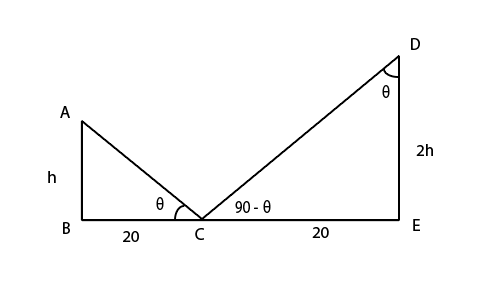
It is given that the angles of elevation are complimentary. Thus let us assume the angle made by smaller tower be $$\theta\ $$. Then angle made by DE is $$90-\theta\ $$
In $$\bigtriangleup\ $$ ABC, $$\tan\left(\theta\ \right) = \frac{\ h}{20}$$
In $$\bigtriangleup\ $$ CDE, $$\tan\left(\theta\ \right) = \frac{\ 20}{2h}$$
Equating the values of$$\tan\left(\theta\right)$$ we get, $$\ \frac{\ h}{20}=\ \frac{\ 20}{2h}$$
$$h^2\ =\ 200$$ $$\Rightarrow$$ $$h=14.14$$
Hence height of poles are $$14.14$$ and $$28.28$$
Meera and Sameera start moving from the same point. Meera goes 4 kms west followed by 3 kms north. Sammera goes 4 kms east and then a right turn and keeps going for 3 kms. What is the shortest distance between the two of them?
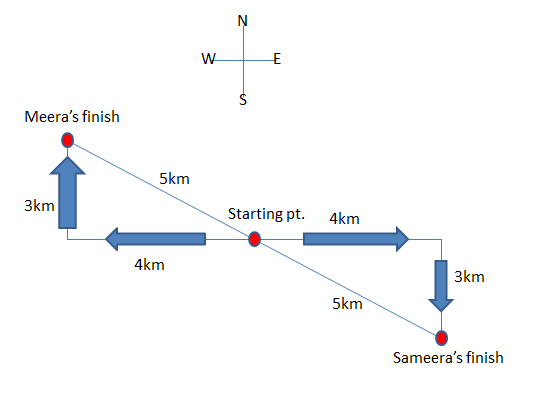
Using pythagoras theorem, we can clearly see from above that the shortest distance between Sameera and Meera is 10km.
A boy was asked to multiply a certain number by 53. He multiplied it by 35 and got his answer less than the correct one by 1206. Find number to be multiplied.
Let number to be multiplied be $$x$$
Number obtained by the boy = $$35x$$
Actual answer = $$53x$$
Difference obtained = $$53x$$ - $$35x$$ = 1206
$$18x$$ = 1206
$$x$$ = 67
Study the sector wise sales of a group of companies for the financial year 2004 - 2005 and answer the following questions.


This group of companies operates in multiple sectors. The holding company has decided to closely monitor minimum number of sectors (not exceeding 5) contributing together a major part (at least 80%) of sales of the group. Identify the correct set of sectors
Engineering, Material, Services and CIS contributes around 81% of market share.
The average profit against the sales across the sectors is 10% while the profit margin of engineering is 12% and CIS, 20%. What is the average profit across the remaining sectors?
Let us represent the sales revenue in terms of 'k'.
Total sales revenue = 100k
Sales revenue from Engineering = 31k
Sales revenue from CIS = 19k
Remaining revenue from other sectors = 50k
Profit margin = Profit/Revenue
Let the profit margin of remaining sectors be x%.
So the eqn is:
10*100k = x*50k + 12*31k + 20*19k
after cancelling 'k' from both sides, we get:
=> x = 4.94% (answer)
Each question given below is followed by three statements. Study the question and the statements. Identify which option is necessary to answer the question.
The mean temperature of Monday to Wednesday was 37 degree Celsius and of Tuesday to Thursday was 34 degree. What was the temperature on Thursday?
I. The temperature on Thursday was $$\frac{4}{5^{th}}$$ that of Monday.
II. The mean temperature of Monday and Thursday was 40.5 degree Celsius.
III. The difference between the temperature on Monday and that on Thursday was 9 degree Celsius.
Let the temperature on Monday, Tuesday, Wednesday and Thursday be a,b,c and d respectively
It is given that a+b+c = 3*37 = 111...(I)
and b+c+d = 3*34 = 102 ... (II)
Using statement (I) alone we get $$d\ =\ \ \frac{\ 4}{5}a$$. Which can be put in eqn (I), after which we can obtain the value of d
Using statement (II) alone we can add eqn(I) and eqn(II) to get value of b+c and it can be used to get value of d from eqn(II)
Using statement (III) alone we a-d = 9 which can be obtained by eqn(I) and (II) and n hence no new information is given. Statement (III) is no sufficient to get the required answer.
What will be the sum of two numbers?
I. Among the two numbers, the bigger number is greater than the smaller number by 6.
II. 40 % of the smaller number is equal to 30 % of the bigger number.
III. The ratio of half of the bigger number to one third of the smaller number is 2 : 1.
Statement 1: Let the smaller number be x, then the bigger number becomes x + 6.
Statement 2: Let the smaller number be a and the bigger number be b. Given that 40% of a is 30% of b,
$$\frac{40}{100}\ \times\ a\ =\ \frac{30}{100}\ \times\ b$$
$$\frac{a}{b}\ =\ \frac{3}{4}\ $$
Statement 3: Let the smaller number be a and the bigger number be b. The ratio of half of the bigger number to one-third of the smaller number is 2: 1, which means,
$$\dfrac{\frac{b}{2}}{\frac{a}{3}}\ =\ \frac{2}{1}$$
$$\frac{3b}{2a}\ =\ \frac{2}{1}$$
$$\frac{a}{b}\ =\ \frac{3}{4}$$
Case 1 : I and II
Let smaller number be x => bigger number = x+6
$$\frac{40}{100}\cdot x=\frac{30}{100}\left(x+6\right)$$
=> x=18 , Sum of bigger and smaller number = 42
Case 2 : I and III
Let smaller number be x => bigger number = x+6
$$\frac{\left(x+6\right)}{2}\cdot\frac{3}{x}=\frac{2}{1}$$
On solving, x=18. So sum = 42
Case 3 : II and III
The conclusion from both statements is the same, and the sum of the numbers cannot be obtained using both statements.
Hence, the correct answer is option C.
A tank is fitted with two taps A and b: In how much time will the tank be full if both the taps are opened together?
I. A is 50% more efficient than B
II. A alone takes 16 hours to fill the tank
III. B alone takes 24 hours to fill the tank
Let total work to be done is 48 units
Case 1 : I and II
A takes 16 hours => B=24 hours (since A is 50 percent more efficient than B)
A does 3 units/hour
B does 2 units/hour
Total per day work = 5 units
Total time taken = 48/5 hr
Case 2 : I and III
B takes 24 hours => A = 16 hours (since A is 50 percent more efficient than B)
Together they take = 48/5 hours
Case 3 : II and III
B takes 24 hours
A takes 16 hours
Together they take = 48/5 hours
What is the principal sum?
I. The interest amount after 30 months is half the interest amount after 5 years.
II. The sum amounts to Rs 750 in a five years at simple interest rate
III. The rate of interest is 8% p.a.
A=$$P\left(1+\frac{TR}{100}\right)$$
From 2 and 3 , A= 750 , T=5 and R=8
P can be found out by substituting these values in the above equation.
Study the weekly data table and daily data graph for Toya Motors share prices at the National Stock Exchange and answer the following questions. Toya Motors NSE Share prices for 3 months.

.png)
What is the average share price for 10/8/2005 to 12/9/2005?
Average of share price for 10/8 to 12/9 is $$\ \frac{\ 483+475+467+513}{4}$$ = 483
The drop in the sales price during October 2005 is approximately
Price at end of September (near to beginning of october)= 535
Price at the end October = 461
$$% decrease$$ = $$\frac{535-461\ }{535}\times\ 100\%$$
= $$13.83$$%
10% is the closest option
How many times during this 3-month period the share price dropped in the graph?
From the given graph, we can observe that the share price dropped 17 times in the given period.
Hence, the answer is option B.
If you purchased 100 shares on 31/8/2005 and sold them on 10/10/2005 what will be your gains?
Money spent to buy 100 shares on 31/08 is 100*461 = 46,100
Money Recieved after selling 100 shares on 10/10 = 538*100 = 53,800
Overall profit = 53,800-46,100 = 7,700
Each question consists of a statement and/or a question followed by two statements I and II. Identify an option which provides sufficient data to answer the given question. Mark your answer as
A. if the data in statement I is sufficient and II is not required;
B. if the data in statement II is sufficient and I is not required;
C. if the data in both statements is necessary;
D. if the data in both statements is not sufficient to answer the question.
The total of the present ages of A, B, C and D is 96 years. What is B's present age?
I. The average age of A, B and D is 20 years.
II. The average age of C and D is 25 years.
It is given that A+B+C+D = 96
Using statement I alone A+B+D = 20*3 = 60
Thus we can say that C = 96-60 = 36
Using Statement II alone
C+D = 2*25 = 50 and hence A+B = 46
Using both statements I and II
A+B = 46 hence D = 14
We still can't find the value of B even after using both the statements
Deepak's marks in Hindi are 15 more than the average marks obtained by him in Hindi, Economics, Sociology and Philosophy. What are his marks in Philosophy?
I. The total marks obtained by him in Hindi and Philosophy together is 12.
II. The difference between the marks obtained by him in Sociology and Economics is 120.
Let h,e,s and p represent the scores in Hindi, Economics, Sociology and Philosophy respectively.
$$h\ =\ 15+\ \frac{\ h+e+s+p}{4}$$
From statement I alone we can see that even though we know h+p = 12 we can't determine exact value of h
In statement II we see that s-e = 120. Even if we input this in the original equation, we won't be able to determine the exact value of h.
Using both statement together also does not give the definite value of h
What was the cost price of the suitcase purchased by Richard?
I. Richard got 20% concession on the labeled price.
II. Richard sold the suitcase for Rs 2000 with 25% profit on the labeled price.
Here we have to find the CP of a suitcase for Richard and M represent the labeled price
From Option I we see that he got discount of 20%on Marked Price. But since we do not know the MP it is not possible to determine CP for Richard
Using only Option II we see that we can we can obtain the profit in terms of marked price but not the cost price.
When we use the option I and II together we can determine CP and Profit in term of M and thus know the CP for Richard
B alone can complete a work in 12 days. How many days will A, B and C together takes to complete the work?
I. A and B together can complete the work in 3 days.
II. B and C together can complete the work in 6 days.
Assume total work to be done = 12 units. Then $$\eta_B$$ = 1 unit/day
Using only statement I, we get $$\eta_A$$+ $$\eta_B$$ = 12/3 = 4unit/day.
Thus only $$\eta_A$$ can be calculated.
Similarly using statement II, we can calculate $$\eta_C$$ only.
Using both the statement together will give $$\eta_A$$ as well as $$\eta_C$$ and thus we will get the required answer. Hence option C is correct
Study the following two tables of data on Agriculture Import and Export of India during 1998-2001 and answer the following questions.

Which was the single largest contributor to the total agri exports in 2000-01? If the total agri exports were valued at US $ 6 billion, what is its contribution in dollar terms?
We see that the maximum value of export in 2000-01 belongs to Marine Products which is 1,394. and is 23.2% of total export.
Value of total export is US $ 6 billion.
Value of Marine Product will be $$23.2\%\ of\ 6\ billion$$ = US $ 1.39 billion
Which product has shown strong growth in exports during the 3-year period?
For Meat and Meat Preparation $$\%\ increase$$ = $$\ \frac{\ 322-187}{187}\times\ 100\%$$ = 72%
For Fruits and Vegetables $$\%\ increase$$ = $$\ \frac{\ 248-184}{184}\times\ 100\%$$ = 34%
For Processed Fruits and Vegetables $$\%\ increase$$ = $$\ \frac{\ 122-69}{69}\times\ 100\%$$ = 76.8%
Hence Option C is correct
Which was the dominant import commodity in 2000 2001 after the vegetable oil?
The Veg Oil value for the import is 1334.
Next, highest value is of Cashew Nut i.e. 211
From the import data about Sugar and Cereals it can be said that
For both the commodities we see the decline in the imports. This is possible if the production of these commodities go up or the consumption goes down. But we cannot exactly say which of the following is true. However it is evident that the gap has decreased. Hence Option C
In some circles concerns were expressed that liberalization of imports, resulting from lifting of quantitative restrictions on agri products, would lead to surge of agri imports affecting the Indian farmers. What does the data depict?
Even though India was importing the commodities the overall import has been coming down. Hence option A is not suitable.
Vegetable and Pulses form the majority of the import but it does not justify the statement as their import is also decreasing. Hence C is invalid.
Option D is incorrect as total export is less than the import
Option B states the correct scenario as we can see that overall import are coming down
Over the period under study both percentages of the total agri-exports to the total exports and that of the total agri-imports to the total imports show a downward trend. This indicates that
A country should always be looking to export as much as possible and import as less as possible. As the import is decreasing, it is a positive sign. But the export is also decreasing, which is not a good sign.
Option A doesn't issue the address in hand and shifts focus.
Option B is totally the opposite.
Option C is partially right but limiting exports is not a good choice.
Option D is the solution to the problem.
Nalini, her brother, her daughter and her son are tennis players and are playing game of doubles. Their positions on the court are as follows: Nalini's brother is directly across the net from her daughter. Her son is diagonally across the net from the worst player's sibling. The best player and the worst players are on the same side of the net. Who is the best players?

Case 1:
If the worst player is Nalini, then her son is diagonally across the worst player's sibling i.e. her brother who is the best as the best and the worst are on the same side of the net.
Case 2:
If the worst player is Nalini's son, then he is diagonally across the worst player's sibling which is his sister and we get case 2. In this case also the best player is Nalini's brother.
In certain code language 'PROMOTION' is written as 'QSP89'. How will you write 'DEMOTION'?
We see that in word PROMOTION
P---> Q
R--->S
O--->P
MOTION --->89
Hence for DEMOTION the coding will be
D--->E
E--->F
MOTION--->89
EF89 is the correct answer
Study this matrix.
In this game there are two players. The first player can split the matrix vertically into two equal halves and choose one half for further play. The next move on this half is by the other player who will be split it only horizontally and choose one half for further play. The game will continue in this manner. At the end, the last number left is the first player's gain. If you start the game, retain the right half and, again right half after your opponent's move, then how should your opponent play to minimize your gain?


What is the next letter in the series?
U, F, Q, J, M, N
Let us write the order at which the letters come in the alphabetical series:
U - 21
F - 6
Q - 17
J - 10
M - 13
N - 14
Here, alternate numbers are in A.P. with a common difference of 4.
Like, 21-17-13 and 6-10-14
to continue 21-17-13-9 , next letter in the series will be 'I'.
Sonal, a mathematician defines a number as 'connected by 6' if it is divisible by 6, or if the sum of digits is 6, or if 6 is one of the digits of the number.Other numbers are 'not connected by 6'. As per the definition, the number of integers, from 1-60 (both inclusive) which are not connected with 6 is
For the number to be connected to 6 it has to be either
(i) Divisible by 6 which are : 6,12,18,24,30,36,42,48,54,60
(ii) Has 6 as their digits which are : 6,16,26,36,46,56,60
(iii) Sum of digit has to be 6 which are : 6,15,24,33,42,51,60
Here we see that 6,24,36,42,60 are repeated. Overall there are 17 numbers that are connected to 6. Thus 60-17 = 43 is the required answer
Leena, Nitin, Arun and Mohan crossed a lake in a canoe that could hold only two persons. The Canoe held two persons on each of three forward trips across the lake and one person on each of two return trips. Leena was unable to paddle when someone else was in the canoe with her. Nitin was unable to paddle when anyone else except Arun was in the canoe with him. Each person paddle continuously for at least one trip. Who paddled twice?
On the first trip, Nitin and Arun crossed the river with Nitin paddling the canoe.
Arun came back alone with the canoe.
On the second trip, Arun and Leena crossed the river, with Arun paddling.
Leena came back alone in the canoe.
On the last trip, Leena and Mohan crossed the river, with Mohan paddling.
Thus, Arun is the only one who paddled twice.
Hence, the answer is option D.
A, B, C, D, E, F and G are the members of a family consisting of 4 adults and 3 children, two of whom, F and G are girls, A and D are brothers and A is doctor. E is an engineer married to one of the brothers and has two children. B is married to D and G is their child. Who is C?
It is given that B is married to D and their child is G. Also, E is married to the one of the 2 brothers A and D. As D is married to B, E is obviously married to A. That leaves us with F and C. It is also said that E has two children. So, we can clearly infer that the 2 children are F and C.
Now, it is given that there are 3 children of whom only 2 are girls i.e. F and G. This means sex of C is male.
C is A and E's son.
If every alternative letter of English Alphabet from B onwards (including B) is written in lower case (small letters) and the remaining letters are capitalized, then: How will be the first month of the second half of the year be written?
B onwards all alternate alphabets are written in lower case. The alphabets will look like this
AbCdEfGhIjKlMnOpQrStUvWxYz
First month of second-half of year is July which will be written as jUlY
A rich merchant had collected many gold coins. He did not want anybody to know about them. One day, his wife asked, "How many gold coins do we have?" After pausing a moment he replied, "Well! If I divide the coins into two unequal numbers, then 48 times the difference between the two numbers equals the difference between the squares of the two numbers." The wife looked puzzled. Can you help the merchant's wife by finding out how many gold coins the merchant has?
Let $$x$$ and $$y$$ be the 2 unequal number in which he divides the gold such that x>y.
Total coins with him = $$x+y$$
As per the merchant
$$48\left(x-y\right)\ =\ x^2-y^2$$
$$48\left(x-y\right)\ =\left(x-y\right)\left(x+y\right)$$
Either $$x+y = 48$$ or $$ x=y$$(rejected as it is given that they are unequal
hence merchant has 48 coins.
An enterprising businessman earns an income of Rs 1 on the first day of his business. On every subsequent day, he earns an income which is just double of that made on the previous day. On the 10th day of business, his income is
For Day 1 his income was = Rs 1
For Day 2 his income was = Rs 1*2 = Rs. 2
For Day 3 his income was = Rs 2*2 = Rs 4 = Rs 1 * $$2^2$$
Similarly for nth day his income = Rs 1* $$2^{n-1}$$
Hence for 10th day his overall income is Rs 1*$$2^{10-1}$$ = $$2^9$$
One night three naughty boys stole a basket full of apples from the garden, hid the loot and went to sleep. Before retiring they did some quick counting and found that the fruits were less than a hundred in number. During the night one boy awoke, counted the apples and found that he could divide the apples into three equal parts if he first took one for himself. He then took one apple, ate it up and took $$\frac{1}{3}$$ of the rest, hid them separately and went back to sleep. Shortly thereafter another boy awoke, counted the apple and he again found that if he took one for himself the loot could be divided in to three equal parts. He ate up one apple, bagged $$\frac{1}{3}$$ of the remainder, hid them separately and went back to sleep. The third boy also awoke after some time, did the same and went back to sleep. In the morning when all woke up, and counted apples, they found that the remaining apples again totaled I more than could be divided into three equal parts. How many apples did the boys steal?
We'll approach this question by checking the options.
When the 1st boy woke up, he ate 1 and hid a third of the remaining, which leaves two-thirds.
So, if the initial no. of apples was N, after the actions of the 1st boy who woke up, now remaining apples are:

The 2nd boy repeats the process which makes the remaining no. of apples :

Now the 3rd guy repeats the process as well. No. of apples remaining after the 3rd operation:

Now this number has to be an integer and one less than this will be divisible by 3.
On putting the value of N as 67, 79 and 85 we can observe that only 79 satisfies the conditions.
Choose from these four diagrams the one that best illustrates the relationship among three given classes.

Chilli, Salt, Vegetables
Chili is also a vegetable. But salt is different from vegetables. Hence option C is correct
Student of Law, Students of Science, Men
Students of Law and Student of Science will belong to different sections. But both of them will be men. Hence option B
Study the following example and answer the questions.
An electronic device rearranges numbers step-by-step in a particular order according to a set of rules. The device stops when the final result is obtained. In this case the device stops at Step V.
Input: 85 16 36 04 19 97 63 09
Step I - 97 85 16 36 04 19 63 09
Step II - 97 85 63 16 36 04 19 09
Step III - 97 85 63 36 16 04 19 09
Step IV - 97 85 63 36 19 16 04 09
Step V - 97 85 63 36 19 16 09 04
Which of the following will be Step III for the input below?
Input: 09 25 16 30 32 18 17 06
We see that the device takes the biggest number which is not in descending order and places it at its place.
Input : 09 25 16 30 32 18 17 06
Step I : 32 09 25 16 30 18 17 06
Step II : 32 30 09 25 16 18 17 06
Step III : 32 30 25 09 16 18 17 06
Hence Option D is correct
What is last step for the input below?
Input: 16 09 25 27 06 05
Since the device is sorting the number in descending order with biggest number and one at a time.
For Input 16 09 25 27 06 05
Step I : 27 16 09 25 06 05
Step II : 27 25 16 09 06 05
After which all the numbers are sorted. Hence 2 steps are needed
What is the output of Step V for the input below?
Input: 25 08 35 11 88 67 23
We see that the device takes the biggest number which is not in descending order and places it at its place.
For Input : 25 08 35 11 88 67 23
Step I : 88 25 08 35 11 67 23
Step II : 88 67 25 08 35 11 23
Step III : 88 67 35 25 08 11 23
Step IV : 88 67 35 25 23 08 11
Step V : 88 67 35 25 23 11 08
Which one of the following would be last step for the input below?
Input: 03 31 43 22 11 09
We see that in this, the number is sorted in the descending order in which every step the biggest number which is not in the correct place picked and placed at its place.
Input: 03 31 43 22 11 09
Step I = 43 03 31 22 11 09
Step II = 43 31 03 22 11 09
Step III = 43 31 22 03 11 09
Step IV = 43 31 22 11 03 09
Step V = 43 31 22 11 09 03
Total 5 steps are needed.
If the output of Step IV is as given below, what was the input?
Step IV: 92 86 71 69 15 19 06 63 58
Since we know that in every step the series gets sorted in descending order. But it is not possible to know that from which position the number was picked.
Read the following information carefully and then answer the questions given below:
P # Q means P is the father of Q
P + Q means P is the mother of Q
P - Q means P is the brother of Q
P * Q means P is the sister of Q
If A + B # C - D, then A is D's
From the given relation, we can understand that A is the mother of B, who is the father of C, who is the brother of D.
This makes A the grandmother of D.
Which of the following shows that A is the Aunt of E?
Let's go option by option:
1) Option 1 says A is the brother of B and this makes A a male. So he cannot be E's aunt.
2) Option 2 says A is the sister of B, who is the father of C, who is the sister of D, who is the brother of E.
This makes A aunt of E.
3)Option 3 says A is the father of B which makes him a male. Thus he cannot be the aunt of E.
4) Option 4 says A is the mother of B, is the brother of C, who is the sister of D, who is the father of E.
This makes A the grandmother of E.
Read the following passage and answer (c) how climatic changes led to the founding of the earliest the 7 questions following the same.
As the climate in the Middle East changed beginning around 7000 B.C.E., conditions emerged that were conducive to a more complex and advanced form of civilization in both Egypt and Mesopotamia. The process began when the swampy valleys of the Nile in Egypt and of the Tigris and Euphrates Rivers in Mesopotamia became driver, producing reverine lands that were both habitable and fertile, and attracting settlers armed with the newly developed techniques of agriculture. This migration was further encouraged by the gradual transformation of the once-hospitable grasslands of these regions into deserts. Human population became increasingly concentrated into pockets of settlement scattered along the banks of the great rivers.
These rivers profoundly shaped the way of life along their banks. In Mesopotamia, the management of water in conditions of unpredictable drought, flood and storm became the central economic and social challenge. Villagers began early to build simple earthworks, dikes, canals, and ditches to control the waters and reduce the opposing dangers of drought during the dry season (usually the spring) and flooding at harvest time.
Such efforts required a degree of cooperation among large numbers of people that had not previously existed. The individual village, containing only a dozen or so houses and families, was economically vulnerable; but when several villages, probably under the direction of a council of elders, learned to share their human resources in the building of a coordinated network of water-control systems, the safety, stability, and prosperity of all improved. In this new cooperation, the seeds of the great Mesopotamian civilizations were being sown.
Technological and mathematical invention, too, were stimulated by life along rivers. Such devices as the noria (a primitive waterwheel) and the Archimedean screw (a device for raising water from the low riverbanks to the high ground where it was needed), two forerunners of many more varied and complex machines, were first developed here for use in irrigation systems. Similarly, the earliest methods of measurement and computation and the first developments in geometry were stimulated by the need to keep track of land holdings and boundaries in fields that were periodically inundated.
The rivers served as high roads of the earliest commerce. Traders used boats made of boundles of rushes to transport grains, fruits, nuts, fibers, and textiles from one village to another, transforming the rivers into the central spines of nascent commercial kingdoms. Trade expanded surprisingly widely; we have evidence suggesting that, even before the establishment of the first Egyptian dynasty, goods were being exchanged between villagers in Egypt and others as far away as Iran.
Similar developments were occuring at much the same time along the great river valleys in other parts of the world - for example, along the Indus in India and the Hwang Ho in China. The history of early civilization has been shaped to a remarkable degree by the relation of humans and rivers.
This passage basically explains
In the first paragraph, the author says, "Human population became increasingly concentrated into pockets of settlement scattered along the banks of the great rivers.", and the last line of the passage, "The history of early civilization has been shaped to a remarkable degree by the relation of humans and rivers.".
These lines clearly indicate that the main topic of discussion in the passage is how river settlements lead to the establishment of early civilizations.
Hence, the answer is option B.
According to the passage, the increasing aridity of formally fertile grasslands in
Egypt and Mesopotamia caused the settlement patterns in those regions to become.
"In Mesopotamia, the management of water in conditions of unpredictable drought, flood and storm became the central economic and social challenge."
"but when several villages, probably under the direction of a council of elders, learned to share their human resources in the building of a coordinated network of water-control systems, the safety, stability, and prosperity of all improved."
Thus, life became more stable after they learned to manage water resources. Thus, earlier their life was less stable.
Hence, the answer is option B.
The passage implies that the earliest geometry was practiced primarily by
The passage says, "the earliest methods of measurement and computation and the first developments in geometry were stimulated by the need to keep track of land holdings and boundaries in fields that were periodically inundated."
Thus, the earliest forms of geometry were practised by land owners.
Hence, the answer is option B.
The passage indicates that the social effects of the unpredictability of water
supplies in Mesopotamia was
In the third paragraph, the author says, "but when several villages, probably under the direction of a council of elders, learned to share their human resources in the building of a coordinated network of water-control systems, the safety, stability, and prosperity of all improved. In this new cooperation, the seeds of the great Mesopotamian civilizations were being sown."
Hence, the answer is option A.
Option B says "far from the rivers" and hence can be eliminated.
Option C says it promoted warfare, which is contrary to the passage's theme.
The passage refers to the earliest trade routes in the Middle East
The last line of the fifth paragraph says, "Trade expanded surprisingly widely; we have evidence suggesting that, even before the establishment of the first Egyptian dynasty, goods were being exchanged between villagers in Egypt and others as far away as Iran."
Hence, the answer is option B.
The passage implies that the emergence of complex civilizations in the Middle
East was dependent upon the previous development of
In the first paragraph, the author says, "The process began when the swampy valleys of the Nile in Egypt and of the Tigris and Euphrates Rivers in Mesopotamia became driver, producing riverine lands that were both habitable and fertile, and attracting settlers armed with the newly developed techniques of agriculture."
Hence, the answer is option D.
The others options are not present in the passage and would be beyond the scope of argument.
By referring to emerging civilizations in India and China the author wants to
emphasize the
The last paragraph says, "Similar developments were occuring at much the same time along the great river valleys in other parts of the world - for example, along the Indus in India and the Hwang Ho in China. The history of early civilization has been shaped to a remarkable degree by the relation of humans and rivers."
Hence, the answer is option C.
Askance means:
"Askance" means with an attitude or look of suspicion.
Hence, the answer is option D.
Virtuoso means
"Virtuoso" refers to a person highly skilled in music or another artistic pursuit.
Hence, the answer is option A.
Nuance: Subtle
'Nuance" refers to a subtle difference.
A. a pun is a humorous use of a word [in meaning or sound], while sarcasm is the use of irony for humour.
B. a fib is a lie, whereas honesty means to be truthful.
C. Inquiry can be discreet or indiscreet
D. A hint can be direct or indirect.
Only option A comes close to the relation given in the question.
Hence, the answer is option A.
Arena: Conflict
An "Arena" is a structure where conflicts are decided.
Similarly, a "Forum" is where discussions are decided/held.
Hence, the answer is option B.
Hierarchy: Ranked
"Hierarchy" is the order of ranking of entities.
In both cases, the second word describes the order or state that is related to the first word. A hierarchy is ranked, and chronology is sequential.
Hence, the answer is option C.
Come with me to Kiebera: the largest shantytown in sub-Saharan Africa. More than 500,000 people live in this vast illegal section of Nairobi, in mud huts on mud streets, with no fresh water or sanitation. Walk down Kiebera's sodden pathways and you will see a great deal of hunger, poverty and disease. But you'll also find health clinics, beauty salons, grocery stores, bars, restaurants, tailors, clothiers, churches, and schools. In the midst of squalor and open sewage, business is booming.
Indeed, Kiebera's underground economy is so vibrant that it has produced its own squatter millionaire, someone I have known for years. From his start a generation ago selling cigarettes and biscuits from the window of his hut, this Kenyan (he asked to remain unnamed) has assembled an empire that includes pharmacies, groceries, bars, beverage-distribution outlets, transportation and manufacturing firms, and even real estate.
Families flock to Kiebera for the same reason country folk have always migrated to the city in search of oppurtunity. In the city they find work but not a place to live. So they build illegally on land they don't own. There are a billion squatters in the world today, almost one in six people on the planet. And their numbers are on the rise. Current projections are that by 2030 there will be two billion squatters, and by 2050, three billion, better than one in three people on the planet. In itself, it is nothing to worry about, for squatting has long had a positive role in urban development. Many urban neighbourhoods in Europe and North America began as squatter outposts. London and Paris boasted huge swaths of mud and stick homes, even during the glory years of the British and French monarchies. Squatters were a significant force in most U.S. cities too. It would no doubt surprise residents paying millions for co-op apartments on Manhatten's Upper east and West Sides to know that squatters occupied much of the turf under their buildings until the start of the 20th century. ............. from an article by Robert Neuwirth.
The author argues that Kiebera becoming the shantytown is not unusual because
"Families flock to Kiebera for the same reason country folk have always migrated to the city in search of oppurtunity. In the city they find work but not a place to live. So they build illegally on land they don't own." This refers to options A.
"There are a billion squatters in the world today, almost one in six people on the planet. And their numbers are on the rise." This refers to option B.
"for squatting has long had a positive role in urban development". This refers to option C.
Thus, all three options are valid.
Hence, the answer is option D.
The prosperity of Keibera's underground economy is described by the author
through
In the second paragraph, the author says, "Indeed, Kiebera's underground economy is so vibrant that it has produced its own squatter millionaire, someone I have known for years." The author then describes how their friend started and how well he is doing now.
Hence, the answer is option B.
The author puts forward the thesis that
Option A: The author puts this forth through the study suggesting that according to him too, the number of squatters will increase.
Option B: The author although does not present squatting as something evil, he also does not argue for squatting being permissible. This opinion is not present in the passage.
Option C: The author says that they had a large number of mud and stick homes, not that they are still shantytowns.
Option D: This is not implied in the passage.
Therefore, Option A is the correct answer.
What is the most appropriate title for this passage?
In the passage, the author is mainly talking about the squatters in Kiebera. Thus, A is the most appropriate title.
The passage does not discuss the conditions in different locations, making options B and C unsuitable. The future of squatters is mentioned only briefly, and hence is also not suitable to be the title of the passage.
Therefore, Option A is the correct answer.
The _____ managed to deceive the entire village.
A. Renegade: a person who deserts and betrays an organization
B. Sycophant: a person who acts obsequiously towards someone important in order to gain advantage.
C. Charlatan: a person falsely claiming to have special knowledge or skill.
D. Actor: a person whose profession is acting on the stage, in films, or on television.
Since the sentence talks about "deceiving a village", "Charlatan" is the best choice for the answer.
Hence, the answer is option C.
She ordered the taxi driver, Driver faster, _____________?"
The sentence is in the past tense. Thus, options A and B can be ruled out.
Since it is a question tag, option C can also be ruled out.
Hence, the answer is option D.
Her written statements failed to be consistent ____ what she had said eariler
The preposition used with "consistent" is always "with".
Hence, the answer is option B.
Choose the antonym nearest in meaning to the word.
Facetious
"Facetious" means "treating serious issues with deliberately inappropriate humour"
Among the options, A is the opposite in the meaning of the given word.
Hence, the answer is option A.
Which one of the following alternatives is spelt correctly?
The correct spelling of the word is "ecstasy".
Hence, the answer is option B.
Choose the correct alternative that best explains the following idiom.
"Writing on the wall"
The idiom "writing on the wall" means "there are clear signs of something happening".
Thus, the answer is option B.
Although many of the members were _____ about the impending deal, others were _____ about the benefits it would bring.
The use of "Although" indicates that the blanks will have terms contradictory to each other.
Thus, among the options, only B is the choice for the answer.
Select the lettered pair that best expresses a relationship similar to that expressed by the original pair.
BROOK : RIVER
"Brook" refers to a small stream, i.e., a smaller version of a river.
Among the options, only "path : highway" represents a similar relationship.
Hence, the answer is option B.
'But for cancer i would not have given up smoking'. 'But' in the sentence is
In the given sentence, "but" is used as a preposition as it shows the relationship between cancer and smoking.
Adverbs and Adjectives are used to indicate the qualities of verbs and nouns. A verb is used to indicate action.
Hence, the answer is option B.
Here is my list oranges, potatoes, garbage bags and a tooth brush. After the word 'list' identify which one of the following is required.
A "colon" is used to list items.
Hence, the answer is option A.
Identify the grammatical error in the sentence below by choosing one of the alternatives.
My main reason for learning pharmacy was that my brother was one.
The sentence should have been "My main reason for becoming a pharmacist was that my brother was one."
Thus, the reference to the brother using the pronoun is a faulty one.
Hence, the answer is option C.
For the following pair a sentences choose the correct option
I. The team quickly took their positions on the field.
II. The team quickly took its position on the field.
A team is a singular entity. Thus, the plural usage "positions" is wrong in statement 1.
Statement 2 is grammatically correct.
Hence, the answer is option A.
Choose the erroneous underlined segment or option 'd' if no error.
He carried his clothes (a) in a black heavy (b) steel trunk (c)
Segment B should have been "heavy black". The phrase "a black heavy steel trunk" is incorrect because adjectives should follow a proper order. The correct order is: Opinion → Size → Age → Shape → Color → Origin → Material → Purpose.
Therefore Option B is the correct answer.
Choose the erroneous underlined segment or option 'd' if no error.
The corpse (a) had been dead (b) for five days (c)
A "corpse" refers to a dead body. Thus, saying that it "had been dead" indicates that it was alive at some point, which is incorrect. A corpse is always dead.
Thus, the erroneous section is (b)
Hence, the answer is option B.
Identify the odd one.
In options A, B and D, Ashoka is being compared to other kings and is called one of the greats.
Whereas, in option C, Ashoka is called the "greatest" king. Thus, there is no comparison.
Hence, the answer is option C.
Identify the incorrect one.
Since the king is singular, "was" should have been used instead of "were".
Hence, the answer is option C.
Identify the sentence that gives the same meaning as the following.
He said, "Yes, I'll come and see you."
The indirect speech of the given sentence is "He said that he would come and see me."
The auxiliary verb should be in the past tense in an indirect speech.
Hence, the answer is option D.
Choose one option to fill in the blanks in the following sentences.
(a) a
(b) an
(c) the
(d) none
I had met him ______ year ago
Option A: This would be grammatically correct and the most natural choice in standard English, indicating a singular, indefinite time period one year prior.
Option B: "An" is used before vowel sounds, and "year" starts with a consonant sound.
Option C: This could work if "the year" refers to a specific year (e.g., "the year 2023"), but "ago" makes it awkward unless clarified (e.g., "the year before"). It’s less natural here.
Therefore, Option A is the correct answer.
Can you see _____ moon?
Since there is only one moon, the correct article will be "the".
Hence, the answer is option C.
He is _____ honourable man.
Since "honourable" starts with a vowel sound, the article used will be "an".
Hence, the answer is option B.
_____ people with little patience rarely succeed.
Since "people" is a collective noun, articles cannot be used with it.
Hence, the answer is option D.
Choose the correct arrangement of the following jumbled sentence of a paragraph to make it coherent.
The first sentence is:
Barely a year had elapsed before the Pritzker clan began to squabble.
L. Under the plan he has until 2011 to distribute the assets among the heirs.
M. The family was no longer cohesive whole, they wrote and therefore the business needed the kind of transparency a public corporation might have.
N. A year later the family agreed on a giverning structure for the Pritzker Organisation, requiring Tom to open the books, hold annual meetings of family share holders and issue regular financial reports.
O. In summer 2000, Tom's two brother and a handful of his cousins sent a letter asking him to restructure the holdings.
Statement O will start the discussion as it begins with "In the summer of 2000" which continues from "Barely a year".
N will follow O as the "A year later" continues the idea in N.
M will follow N as it mentions how the family was no longer a whole as a result of the brothers writing the letter.
L will finish the discussion as it mentions what the new plan was going to do.
Thus, the required sequence is O-N-M-L.
The answer is option D.
"Time to bust some myths about the EPF Organisation, India's only social security fund manager for non-government workers, though what follows is not published on a regular basis. Active membership is just about 5 percent, and only 17 per cent of the members account for 84 percent of the balances. That's only Rs. 20000 each ! less than 7percent have a deposit amount more than 5 lacs!"
Choose the statement closest to the idea expressed in this paragraph
The paragraph begins by addressing myths about the EPFO. It then explains the imbalance concerning the percentage of members and funds.
Thus, the answer will not be a positive statement. Hence, A and C can be ruled out.
The passage does not discuss the EPFO's inability to manage the future. It just mentions the low number of active users and funds per user. Thus, D can be ruled out.
Option B is the best choice for the answer.
"Two recent World Bank studies on India's rapidly depleting water resources have caused quite a stir. More interesting is how water seems to have become the new focus area for Bank assistance: at $ 3.2 billion in 2005 08 from a mere $ 700 million in 1999 04. Within water again, more money is going to rural water, large hydropower projects, and water resource management in poor states."
Choose the statement that summarises the above paragraph best.
All four options are true, but we have to select the most appropriate one among the four.
Options A and B start the discussion but are not the main point of discussion in the passage.
The main topic of discussion is how the funds from the World bank are being distributed to meet the needs of rural areas of the country.
Hence, among the options, D is the most suitable choice.
The International Date Line is located
The Roman Magsaysay award is named after the former President of ?
What level of noise is considered permissible in human habitats?
The Indian city which has a natural harbour and is also one of the largest Indian
ports is
If saccharine, an artificial sweetener which is 70 times sweeter than sugar, is kept in the open, which one of these insects will it attract first
When a Pepsi bottle is opened, the gas fizzes out because it obeys
Television signals from transmission towers are restricted to a limited area because
Who is the Author of Food, Nutrition and Poverty in India ?
Internet is controlled by
Identify the incorrect statement.
The largest chunk of revenue for the Union government comes from
India test-fired three medium range surface-to-air missilies in Oct. 2005. Name the missile.
How many calories are there in one litre of water
The city closest to the epicenter of the devastating earthquake that hit Pakistan & India in October 2005 is
The CDMA mobile services from BSNL is
The highest ranking country for 2005-06 in "Global Competitiveness Report" of the World Economic forum is
Which two independent nations does the 17th Parallel separate
In the " One by Six" rule of Income Tax, it is mandatory to file Income Tax Returns if you posses
The Kyoto Protocol pertains to
The riots spreading across France in 2005 were caused by
One of the UK's leading telecom company and sponsor of the England cricket team is
The price of any currency in the international market is determined by
The "Whisle Blower Bill" was passed due to pressure created by the murder of
The alleged corruption scan of UN's $64 billion in Iraq disclosed in Nov, 2005 is related to
The Reserve Bank of India Governor is
Which one is listed in the first place among the largest global corporations in 2005 by the Fortune magazine?
Recently VAT was introduced in India. Choose the correct statement.
Parachute is brand of
Tamiflu is
Earlier this year, President Bush revoked a trade embargo against a country that had been declared a terrorist state earlier. This allows US companies to invest in this country for the first time since 1986. Which is the country ?
Start your IIM journey with the right preparation and crack CAT 2026.

Educational materials for CAT preparation
 Share
Share
