NTA JEE Main 9th January 2019 Shift 1 - Chemistry

Instructions

For the following questions answer them individually

NTA JEE Main 9th January 2019 Shift 1 - Chemistry - Question 31


For emission line of atomic hydrogen from $$n_i = 8$$ to $$n_f = n$$, the plot of wave number $$\bar{\nu}$$ against $$\frac{1}{n^2}$$ will be: (The Rydberg constant, $$R_H$$ is in wave number unit)

NTA JEE Main 9th January 2019 Shift 1 - Chemistry - Question 32


In general, the properties that decrease and increase down a group in the periodic table, respectively, are:

NTA JEE Main 9th January 2019 Shift 1 - Chemistry - Question 33


Aluminium is usually found in +3 oxidation state. In contrast, thallium exists in +1 and +3 oxidation states. This is due to:

NTA JEE Main 9th January 2019 Shift 1 - Chemistry - Question 34


According to molecular orbital theory, which of the following is true with respect to $$Li_2^+$$ and $$Li_2^-$$?

NTA JEE Main 9th January 2019 Shift 1 - Chemistry - Question 35


0.5 moles of gas A and x moles of gas B exert a pressure of 200 Pa in a container of volume 10 m$$^3$$ at 1000 K. Given, R is the gas constant in JK$$^{-1}$$mol$$^{-1}$$, x is:

NTA JEE Main 9th January 2019 Shift 1 - Chemistry - Question 36


Consider the reversible isothermal expansion of an ideal gas in a closed system at two different temperatures $$T_1$$ and $$T_2$$ ($$T_1 < T_2$$). The correct graphical depiction of the dependence of work done $$w$$ vs the final volume $$V$$ is:

NTA JEE Main 9th January 2019 Shift 1 - Chemistry - Question 37


20 ml of 0.1 M $$H_2SO_4$$ solution is added to 30 mL of 0.2 M $$NH_4OH$$ solution. The pH of the resultant mixture is: ($$pK_b$$ of $$NH_4OH = 4.7$$)

NTA JEE Main 9th January 2019 Shift 1 - Chemistry - Question 38


The isotopes of hydrogen are:

NTA JEE Main 9th January 2019 Shift 1 - Chemistry - Question 39


The alkaline earth metal nitrate that does not crystallise with molecules is:

NTA JEE Main 9th January 2019 Shift 1 - Chemistry - Question 40


Correct statements among regarding silicones are:
(a) They are polymers with hydrophobic character.
(b) They are biocompatible.
(c) In general, they have high thermal stability and low dielectric strength.
(d) Usually, they are resistant to oxidation and used as greases.

NTA JEE Main 9th January 2019 Shift 1 - Chemistry - Question 41


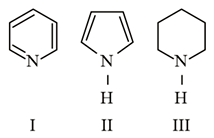
Arrange the following amines in the decreasing order of basicity.

NTA JEE Main 9th January 2019 Shift 1 - Chemistry - Question 42


Which amongst the following is the strongest acid?

NTA JEE Main 9th January 2019 Shift 1 - Chemistry - Question 43


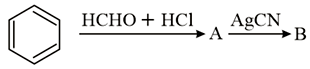
The compounds A and B in the following reaction are, respectively:

NTA JEE Main 9th January 2019 Shift 1 - Chemistry - Question 44


A water sample has ppm level concentration of the following metals: Fe = 0.2; Mn = 5.0; Cu = 3.0; Zn = 5.0. The metal that makes the water sample unsuitable for drinking is:

NTA JEE Main 9th January 2019 Shift 1 - Chemistry - Question 45


The one that is extensively used as a piezoelectric material is:

NTA JEE Main 9th January 2019 Shift 1 - Chemistry - Question 46


A solution of sodium sulphate contains 92 g of Na$$^+$$ ions per kilogram of water. The molality of Na$$^+$$ ions in that solution in mol kg$$^{-1}$$ is:

NTA JEE Main 9th January 2019 Shift 1 - Chemistry - Question 47


Which one of the following statements regarding Henry's law is not correct?

NTA JEE Main 9th January 2019 Shift 1 - Chemistry - Question 48


The anodic half-cell of lead-acid battery is recharged using electricity of 0.05 Faraday. The amount of $$PbSO_4$$ electrolyzed in g during the process is: (Molar mass of $$PbSO_4 = 303$$ g mol$$^{-1}$$)

NTA JEE Main 9th January 2019 Shift 1 - Chemistry - Question 49


The following results were obtained during kinetic studies of the reaction.
$$2A + B \rightarrow$$ product

Experiment I: A = 0.10 mol L$$^{-1}$$, B = 0.20 mol L$$^{-1}$$, Rate = $$6.93 \times 10^{-3}$$ mol L$$^{-1}$$ min$$^{-1}$$
Experiment II: A = 0.10 mol L$$^{-1}$$, B = 0.25 mol L$$^{-1}$$, Rate = $$6.93 \times 10^{-3}$$ mol L$$^{-1}$$ min$$^{-1}$$
Experiment III: A = 0.20 mol L$$^{-1}$$, B = 0.30 mol L$$^{-1}$$, Rate = $$1.386 \times 10^{-2}$$ mol L$$^{-1}$$ min$$^{-1}$$

The time (in minutes) required to consume half of A is:

NTA JEE Main 9th January 2019 Shift 1 - Chemistry - Question 50


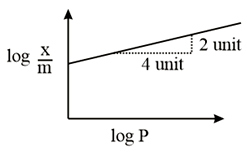
Adsorption of a gas follows Freundlich adsorption isotherm. In the given plot, $$x$$ is the mass of the gas adsorbed on mass $$m$$ of the adsorbent at pressure P. $$\frac{x}{m}$$ is proportional to:

NTA JEE Main 9th January 2019 Shift 1 - Chemistry - Question 51


The ore that contains both iron and copper is:

NTA JEE Main 9th January 2019 Shift 1 - Chemistry - Question 52


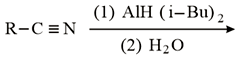
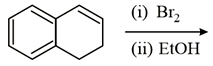
The major product of the following reaction is:

NTA JEE Main 9th January 2019 Shift 1 - Chemistry - Question 53


Two complexes $$[CrH_2O)_6]Cl_3$$ (A) and $$[Cr(NH_3)_6]Cl_3$$ (B) are violet and yellow coloured, respectively. The incorrect statement regarding them is:

NTA JEE Main 9th January 2019 Shift 1 - Chemistry - Question 54


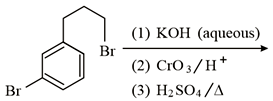
In the reaction given below what will be the major product at the end:


Options:

NTA JEE Main 9th January 2019 Shift 1 - Chemistry - Question 55


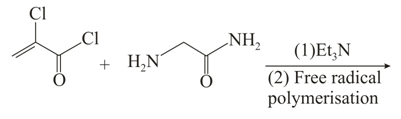
Major product of the given reaction is:


Options:

NTA JEE Main 9th January 2019 Shift 1 - Chemistry - Question 56


The highest value of the calculated spin only magnetic moment (in BM) among all the transition metal complexes is:

NTA JEE Main 9th January 2019 Shift 1 - Chemistry - Question 57


Acid strength given below the correct decreasing order will be:

NTA JEE Main 9th January 2019 Shift 1 - Chemistry - Question 58


Major product of the given below reaction:


Options:

NTA JEE Main 9th January 2019 Shift 1 - Chemistry - Question 59


The correct match between column-I and column-II is:
Column-I (drug)              Column-II (test)
(A) Chloroxylenol           (P) Carbylamine test
(B) Norethindrone         (Q) Sodium hydrogen carbonate test
(C) Sulphapyridine        (R) Ferric chloride test
(D) Penicillin                  (S) Baeyer's test

NTA JEE Main 9th January 2019 Shift 1 - Chemistry - Question 60


The increasing order of pKa of the following amino acids in aqueous solution is: Glycine, Aspartate, Lysine, Arginine.

banner

banner
cracku

Boost your Prep!

Download App