
Join Our JEE Preparation Group
Prep with like-minded aspirants; Get access to free daily tests and study material.
Sign in
Please select an account to continue using cracku.in
↓ →
Join Our JEE Preparation Group
Prep with like-minded aspirants; Get access to free daily tests and study material.
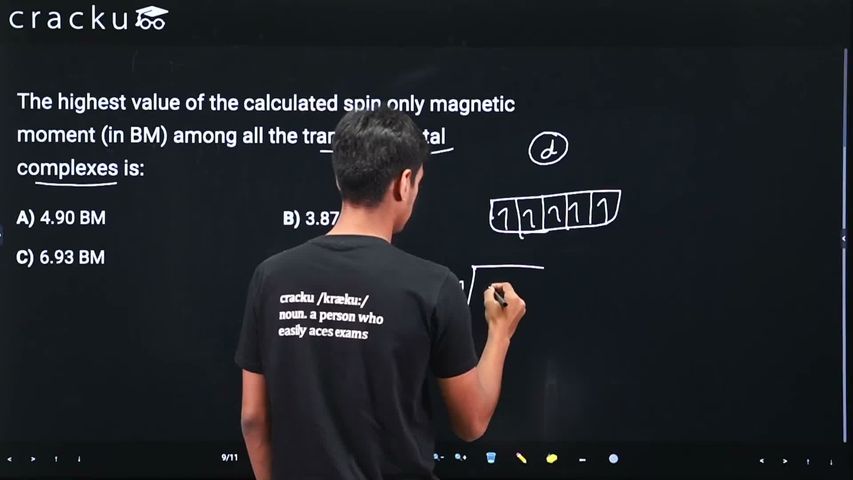
The highest value of the calculated spin only magnetic moment (in BM) among all the transition metal complexes is:
For transition-metal complexes we normally assume that the orbital contribution to the magnetic moment is quenched, so we use the spin-only formula first:
$$\mu_{\text{spin-only}}=\sqrt{n\,(n+2)}\;\text{BM}$$
Here $$n$$ denotes the number of unpaired electrons present in the metal ion. We must now decide what is the largest possible value that $$n$$ can take for any transition-metal ion.
The transition elements fill the $$d$$-orbitals. A single $$d$$ subshell can accommodate a maximum of five unpaired electrons (one in each of the five $$d$$ orbitals with parallel spins) before pairing begins. In other words
$$0\;\le\;n\;\le\;5$$
Hence the greatest attainable value is $$n=5$$, which is realised for high-spin $$d^{5}$$ configurations such as $$Mn^{2+\;(3d^5)}$$, $$Fe^{3+\;(3d^5)}$$, etc.
Now we substitute $$n=5$$ into the spin-only formula:
$$\mu_{\max}=\sqrt{5\,(5+2)}=\sqrt{5\times7}=\sqrt{35}$$
Calculating the square root, we have
$$\sqrt{35}=5.916\ldots\;\text{BM}\approx5.92\;\text{BM}$$
This value of $$5.92\;\text{BM}$$ is larger than the other listed possibilities $$4.90\;\text{BM}$$, $$3.87\;\text{BM}$$ and $$6.93\;\text{BM}$$ (note that $$6.93\;\text{BM}$$ would correspond to $$n=6$$, which cannot occur in a single $$d$$ subshell). Therefore the highest allowed spin-only magnetic moment for transition-metal complexes is $$5.92\;\text{BM}$$.
Hence, the correct answer is Option D.
Was this solution helpful?
Click on the Email ☝️ to Watch the Video Solution
Create a FREE account and get:
_1.webp)

Educational materials for JEE preparation

Ask our AI anything

AI can make mistakes. Please verify important information.
AI can make mistakes. Please verify important information.
