
Join Our JEE Preparation Group
Prep with like-minded aspirants; Get access to free daily tests and study material.
Sign in
Please select an account to continue using cracku.in
↓ →
Join Our JEE Preparation Group
Prep with like-minded aspirants; Get access to free daily tests and study material.
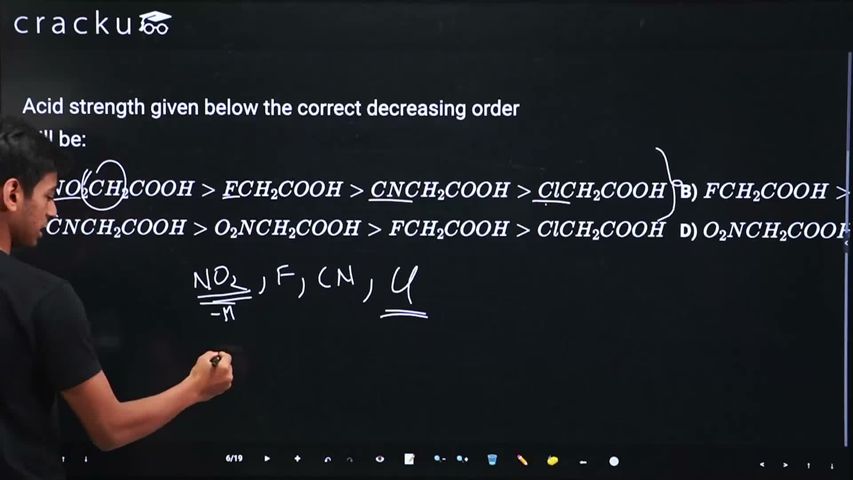
Acid strength given below the correct decreasing order will be:
We want to compare the acidic strength of the four substituted acetic acids
$$\text{XCH}_2\text{COOH}\;(X = NO_2,\;F,\;NC,\;Cl).$$
An acid is stronger when its conjugate base is more stable. When one of the hydrogens of the -COOH group is lost, the following equilibrium is set up
$$\text{XCH}_2\text{COOH}\;\rightleftharpoons\;\text{XCH}_2\text{COO}^- + H^+$$
The acid-dissociation constant is written as
$$K_a=\dfrac{[\text{XCH}_2\text{COO}^-][H^+]}{[\text{XCH}_2\text{COOH}]},$$
and a larger $$K_a$$ (or a smaller $$pK_a=-\log K_a$$) indicates a stronger acid. As soon as the proton is removed the negative charge resides on the carboxylate ion; any factor that withdraws electron density from the -COO- group will spread out (delocalise) that negative charge and lower the energy of the conjugate base, thereby raising $$K_a$$.
The factor that dominates here is the inductive effect (symbolised as -I). A group with a strong -I effect pulls σ-electrons toward itself through the σ-bond framework, reducing the electron density on the -COO- unit and stabilising it. The groups in question are compared below.
1. The -F group
Fluorine is the most electronegative element (χ = 4.0 on Pauling’s scale). Just one σ-bond away from the carboxylate, it exerts the strongest -I effect of all the substituents in the list. Consequently $$\mathrm{FCH_2COO^-}$$ is stabilised the most, and $$\mathrm{FCH_2COOH}$$ is expected to have the largest $$K_a$$ (the smallest $$pK_a$$) and therefore be the strongest acid among the four.
2. The -NC (cyano) group
In the nitrile group the carbon is sp-hybridised and therefore very electronegative. This makes the -NC group a powerful electron withdrawer through the σ-framework. Its -I effect is slightly weaker than that of -F but still very large, so $$\mathrm{NCCH_2COOH}$$ is expected to be the next strongest acid after $$\mathrm{FCH_2COOH}$$.
3. The -NO2 group
-NO2 is well known for an intense -M (-R) effect on π-conjugated systems, but that resonance effect cannot operate through the saturated -CH2- bridge present here. Only its -I effect remains operative, and that -I effect, while strong, is a little weaker than that of the -NC group because two heavy atoms (N and O) lie one bond farther from the acidic centre, lessening the field-inductive pull. Hence $$\mathrm{NO_2CH_2COOH}$$ comes third.
4. The -Cl group
Chlorine is electronegative, but its -I effect is appreciably less than that of -F and just smaller than that of -NO2 and -NC. Moreover, because Cl has available 3d orbitals, a small +R effect can partly offset its -I pull, making its overall withdrawing ability the weakest of the four. Thus $$\mathrm{ClCH_2COOH}$$ is the least acidic in the set.
As a result we have the decreasing order of acid strength
$$\mathrm{FCH_2COOH} \; > \; \mathrm{NCCH_2COOH} \; > \; \mathrm{NO_2CH_2COOH} \; > \; \mathrm{ClCH_2COOH}.$$
This sequence is exactly the one written in Option B.
Hence, the correct answer is Option B.
Was this solution helpful?
Click on the Email ☝️ to Watch the Video Solution
Create a FREE account and get:
_1.webp)

Educational materials for JEE preparation

Ask our AI anything

AI can make mistakes. Please verify important information.
AI can make mistakes. Please verify important information.
